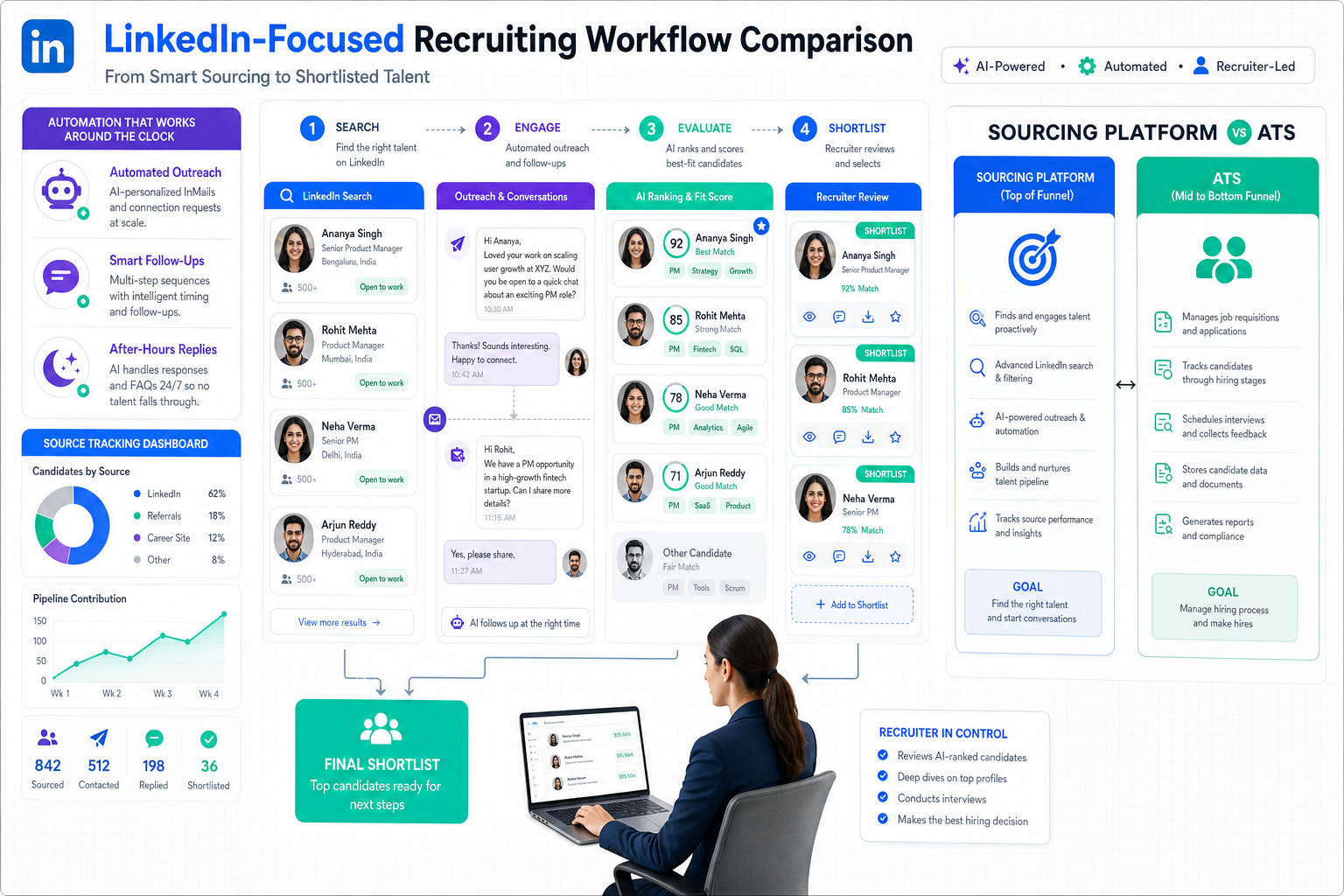
When LinkedIn-heavy headhunters compare sourcing platforms through this article’s market-testing lens, they avoid busy outreach and choose better shortlist workflows.
That sounds simple, but it is exactly where many teams lose momentum. Agency recruiters keep pushing through another hiring sprint even when the search is no longer teaching them anything new, when candidate replies pile up after hours, or when the market is clearly signaling that their current approach is too slow. For small and mid-sized search firms, the damage is practical: more manual LinkedIn work, slower response times, weaker candidate experience, and more pressure to prove why a shortlist is actually worth a hiring manager’s attention.
In my own LinkedIn sourcing work, tools like StrategyBrain AI Recruiter can help at exactly that breaking point. The most useful part is not handing over judgment. It is reducing repetitive outreach, keeping candidate conversations moving across time zones, and collecting resumes or contact details once a prospect shows real interest. The recruiter still reviews the resume, decides whether the profile truly fits, and owns the next step with the client or hiring team.
The underlying dilemma is not new. In the reference discussion about whether an auditor should stay long enough to become manager, the real decision was not title alone. It was whether the person was still learning, whether the culture fit was repairable, and whether the market should be tested before committing to another intense season. That same decision logic shows up in sourcing: a recruiter can stay with the same manual search habits for one more stretch, or test the market, challenge assumptions, and decide whether the current workflow is actually improving candidate quality.
Once you look at AI candidate sourcing through that lens, the buying question gets sharper. Good sourcing platforms are not just search tools. They should help recruiters test the marketplace faster, understand whether they are still learning from the talent pool, and decide when a separate sourcing system is needed instead of forcing an ATS or procurement-style strategic sourcing software label onto a recruiting problem.
- AI candidate sourcing works best when recruiters use it to test the market, not just send more outreach.
- Sourcing platforms should be evaluated on search quality, candidate engagement support, and rediscovery of internal talent.
- A sourcing system is different from an ATS because it focuses on discovery before candidates enter the formal process.
- The phrase strategic sourcing software often belongs to procurement, so recruiting teams need cleaner language and requirements.
- LinkedIn-heavy teams benefit most when automation handles repetitive messaging while recruiters keep final qualification and client judgment.
Table of Contents
- The Decision Before Automation
- What AI Candidate Sourcing Means in Practice
- Why LinkedIn Workflows Push Teams Toward Sourcing Platforms
- What to Look for in a Sourcing System
- Test the Market Before You Commit to a Workflow
- Sourcing Platforms vs. an ATS
- Why Strategic Sourcing Software Confuses Recruiting Buyers
- A Practical LinkedIn AI Sourcing Process
- How Recruiters Measure Sourcing Performance
- How to Choose Among Sourcing Platforms
- Common Mistakes in AI Candidate Sourcing
- FAQ
The Decision Before Automation
Experienced recruiters know that workflow problems rarely start as technology problems. They start as judgment problems. Are you still learning from your current searches, or are you repeating the same title filters and getting the same tired pool? Is the market telling you there are better adjacent profiles available? Are you staying with a manual routine out of habit, or because it still gives you an edge?
That is why the old career question from the reference piece translates surprisingly well into modern sourcing. In that piece, the key issue was not simply whether a person should remain until a promotion. The real test was whether the role still offered challenge, whether the environment fit, and whether testing outside options would produce a clearer view of value. For recruiters, AI candidate sourcing creates a parallel moment. Before buying another tool, you need to know what problem you are trying to outgrow.
If your team is stuck in endless manual LinkedIn outreach, buried in inconsistent follow-up, or unable to tell whether passive-candidate sourcing is producing stronger talent than old applicant databases, then the problem is not effort. It is lack of a disciplined front-end sourcing model.
What AI Candidate Sourcing Means in Practice
AI candidate sourcing is the use of search, ranking, enrichment, outreach assistance, and talent rediscovery to help recruiters identify people before they apply. In real recruiting work, that usually means searching public professional profiles, revisiting silver medalists, reopening older candidate records, and segmenting who is worth contacting now.
The reason many recruiters care most about LinkedIn is obvious: it remains one of the easiest places to find current career signals, likely role scope, and network context. But anyone who has sourced there heavily knows the friction. Messaging volume rises quickly, after-hours replies are common, and a promising prospect can go cold if the recruiter does not respond in time.
That is where AI support becomes practical. For example, I have found value in using AI Recruiter to keep first-touch conversations moving when candidates reply outside business hours, especially for cross-border searches. It can introduce the role, ask whether someone is open to a move, answer basic role questions, and collect a resume or contact details from interested candidates. What it does not replace is the recruiter’s final screening judgment, calibration against the brief, or decision on who actually reaches the shortlist.
Why LinkedIn Workflows Push Teams Toward Sourcing Platforms
LinkedIn sourcing often looks efficient from a distance because the first step is easy: run a search, save a few filters, send outreach. The trouble starts afterward. A recruiter may be juggling outreach across multiple roles, switching between candidate replies, checking whether a resume arrived by email or file upload, and trying to remember whether a passive prospect was already contacted by a colleague two months earlier.
That operational mess resembles the reference article’s manager dilemma more than it first appears. In that piece, staying made sense only if continued effort still created growth. In sourcing, another week of manual work only makes sense if it improves market understanding, candidate quality, or client credibility. If not, you are just surviving another busy season in recruiting form.
Modern sourcing platforms matter because they bring order to those front-end tasks. They help recruiters search more broadly, engage consistently, rediscover people they already know, and distinguish between activity and actual market progress.
What to Look for in a Sourcing System
The best sourcing platforms combine several functions well enough that recruiters can move from guesswork to repeatable practice. A strong sourcing system should support at least the following:
Natural-language and semantic search
Boolean still has its place, especially for niche searches, but natural-language search is far more useful when a hiring manager briefs the role in business terms instead of exact resume keywords. Semantic search should also identify adjacent backgrounds and skill equivalents, not just title matches.
AI ranking with visible logic
Ranking matters only when recruiters can understand and challenge it. If the system pushes profiles to the top without making the likely match signals understandable, recruiters will stop trusting it.
Profile enrichment
Enrichment helps answer practical questions: has this person moved recently, has their scope likely expanded, is the profile current enough for outreach, and is contact information handled in a compliant way?
Messaging support for LinkedIn-heavy teams
For LinkedIn sourcing, this is a major category. A useful platform should help with first contact, follow-up continuity, and candidate intent capture without turning every conversation into robotic spam. When I tested this workflow with StrategyBrain AI Recruiter, the practical gain was simple: repetitive introductions and initial interest checks no longer consumed the entire evening. Candidates could respond in their own time, and I could review the genuinely interested profiles later with a clearer head.
Talent rediscovery and source tracking
Many recruiting teams underuse people already in their database. A sourcing system should make it easy to separate new external prospects from prior applicants, silver medalists, referrals, and talent-community members.
| Feature | Why it matters | Recruiter check |
|---|---|---|
| Natural-language search | Handles real hiring-manager language | Test messy briefs, not polished keywords |
| AI ranking | Shortens review time | Ask why profiles are ranked where they are |
| Enrichment | Adds screening context | Verify provenance and refresh practices |
| LinkedIn messaging support | Keeps outreach moving | Confirm recruiter remains final decision maker |
| Rediscovery | Unlocks existing talent pools | Audit old applicants before buying more reach |
| Source tracking | Clarifies pipeline origin | Align labels with recruiting reports |
Test the Market Before You Commit to a Workflow
One of the most useful ideas from the reference piece is the advice to test the marketplace before deciding whether to stay. Recruiters should do the same with their sourcing habits. Before committing to a new tool or keeping an old method, test what the market gives you now.
That means comparing at least three things:
- Your current manual search results. Are you still finding fresh talent, or the same visible profiles every time?
- Your internal talent pool. Do past applicants and silver medalists convert better than cold prospects?
- Your AI-assisted results. Does a sourcing platform surface adjacent talent you would not have found as quickly on your own?
This approach matters because software should improve judgment, not replace it. A recruiter who never tests the market ends up mistaking familiarity for effectiveness.
Practical takeaway: If a week of sourcing produces more outreach volume but no better insight into candidate quality, your workflow is busy, not strategic.
Sourcing Platforms vs. an ATS
Many buyers still expect an ATS to solve front-end discovery. It will not. An applicant tracking system manages candidates already in process: applications, stages, interview scheduling, feedback, and offers. Sourcing platforms work before that moment. They help find, rank, enrich, and engage people who are not yet in your funnel.
The distinction matters because it shapes software expectations. If your team complains that the ATS is not generating enough quality candidates, the real issue may be missing discovery capability. If candidate flow is strong but the process is chaotic, the ATS may be the right place to optimize.
| Category | Sourcing platforms | ATS |
|---|---|---|
| Main job | Find and engage talent | Manage active hiring workflow |
| Best users | Sourcers, recruiters, search teams | Recruiters, coordinators, HR operations |
| Best stage | Top of funnel | In-process candidates |
| Key outputs | Longlists, outreach, source insight | Stage control, feedback, offers |
| Core question | Who should we approach? | What happens next? |
Why Strategic Sourcing Software Confuses Recruiting Buyers
The term strategic sourcing software often belongs to procurement, where teams compare suppliers, spending, contracts, and purchasing decisions. In recruiting, sourcing means something else entirely: identifying and attracting talent.
This confusion is not just semantic. It can distort buying research, internal requirements, and even stakeholder alignment. Procurement-style strategic sourcing software is not designed for passive-candidate search, LinkedIn outreach, or talent rediscovery. Recruiting teams should write requirements in recruiting language: search quality, source visibility, workflow fit, data provenance, outreach support, and integration with the hiring stack.
If the software cannot help recruiters understand the talent market, improve timing, or create stronger shortlists, then it is not solving the same problem described in this article, even if the word sourcing appears in the product category.
A Practical LinkedIn AI Sourcing Process
For LinkedIn-centered recruiting teams, the most reliable workflow follows a sequence that balances automation with human control.
- Clarify the role beyond title. Ask what the hiring manager really values: scale, context, industry transferability, team size, or stakeholder complexity.
- Test the market broadly. Run natural-language and semantic searches before narrowing too fast.
- Review ranked profiles critically. Look for adjacent talent, not just exact-title comfort picks.
- Start controlled outreach. Use AI support to handle repetitive introductions and interest checks, especially when candidates reply at night or from another region.
- Capture signals cleanly. Separate uninterested prospects, warm prospects, resumes received, and true shortlist contenders.
- Keep the recruiter in the loop. Final qualification, resume review, and client calibration stay human.
- Track outcomes by source. Measure who becomes a real screen, not just who replied.
In my own use, the best scenario for StrategyBrain AI Recruiter on LinkedIn was high-message-volume search work where I needed candidate conversations to keep moving after hours without sacrificing control. It handled repetitive opening exchanges and resume collection better than I could manually at scale, while I still made the judgment call on fit. That is the right boundary for AI candidate sourcing in most serious search work.
How Recruiters Measure Sourcing Performance
Strong sourcing measurement separates top-of-funnel discovery from later pipeline operations. Useful sourcing metrics include:
- Qualified profiles surfaced
- Positive reply rate
- Resume or contact capture rate
- Recruiter screen conversion
- Hiring manager acceptance rate
- Interview conversion by source
- Rediscovery performance vs. new external outreach
This matters because a busy recruiter can generate plenty of outbound activity without proving that the market is being read well. The reference article’s deeper lesson applies here too: effort alone is not a reason to stay with a path. Evidence of growth is.
How to Choose Among Sourcing Platforms
When evaluating sourcing platforms, I recommend using a practical scorecard instead of broad AI claims.
Questions worth asking
- Does search quality improve when the brief is ambiguous or nonstandard?
- Can the system support LinkedIn-first outreach without removing recruiter control?
- How well does it manage candidate responses outside working hours?
- Can it capture resumes or contact details cleanly when prospects express interest?
- Does it rediscover prior applicants and silver medalists effectively?
- How clearly does it explain data origin, privacy controls, and consent handling?
- Where does it fit relative to the ATS?
Who should care about what
Agency recruiters should prioritize speed-to-conversation, search flexibility, and candidate follow-up continuity. In-house recruiters should pay close attention to rediscovery, reporting, and process governance. Leaders in small and mid-sized firms should care most about whether the platform improves productive recruiter time without degrading candidate experience.
The best choice is usually the one that helps your team test the market better, not the one that promises the loudest automation story.
Common Mistakes in AI Candidate Sourcing
- Confusing effort with insight. More messages do not automatically mean better sourcing.
- Using an ATS as a discovery tool. It is usually the wrong system for that job.
- Ignoring internal talent. Older applicants can outperform fresh cold outreach.
- Letting AI overrun judgment. Recruiters still need to screen fit and calibrate with stakeholders.
- Using procurement terms loosely. Strategic sourcing software often solves a different problem.
- Failing to test the market. If you never compare manual, internal, and AI-assisted results, you will not know what is actually working.
FAQ
What is AI candidate sourcing?
AI candidate sourcing is the use of search, ranking, enrichment, rediscovery, and outreach assistance to help recruiters find potential hires before they apply.
How are sourcing platforms different from an ATS?
Sourcing platforms focus on discovery and first engagement. An ATS focuses on managing candidates after they enter the hiring process.
What should a sourcing system do for LinkedIn recruiting?
It should help recruiters search effectively, manage initial outreach, keep conversations moving, capture interest signals, and hand qualified candidates into the formal process.
Why is strategic sourcing software a confusing term here?
Because it often refers to procurement software, not recruiting technology. In recruiting, sourcing is about talent discovery, not supplier management.
Can AI replace recruiter judgment in candidate sourcing?
No. It can reduce repetitive work and improve workflow consistency, but recruiters still need to assess resumes, determine fit, and make final shortlist decisions.
When do sourcing platforms add the most value?
They add the most value when teams are doing proactive search, especially on LinkedIn, managing high message volume, or trying to rediscover overlooked talent while keeping recruiter judgment intact.
Conclusion
AI candidate sourcing becomes genuinely useful when recruiters treat it the way good professionals treat career decisions: test the market, check whether you are still learning, and do not stay with a workflow just because it is familiar. The best sourcing platforms help recruiters read the talent market faster, support stronger outreach, and create better shortlist judgment.
If you are evaluating a new sourcing system, focus on how it improves LinkedIn-heavy recruiting work, how it separates discovery from ATS process management, and whether it solves a real recruiting problem rather than a procurement-style strategic sourcing software problem. That is the difference between adding another tool and building a sourcing practice that actually gets sharper over time.