This article helps recruiting leaders judge ai hiring software by whether it removes workaround-driven delays before booking.
That conclusion matters because most interview bottlenecks are not caused by a lack of candidates. They come from small fixes piled on top of each other: copied calendar links, manual reminder messages, late interviewer replies, one more spreadsheet to track reschedules, and no shared rule for when a candidate should move to the next stage. For a solo recruiter, that means lost response windows. For a small agency owner, it means consultants spending billable time on coordination. For an in-house talent lead, it means slower hiring manager alignment and a candidate experience that feels improvised.
In my own workflow, tools such as StrategyBrain AI Recruiter have been most useful when they reduce the repetitive communication that creates those workarounds in the first place. The strongest fit is not “AI makes the hire for you.” It is AI helping with after-hours candidate follow-up, multilingual communication, and early interest confirmation so the recruiter can spend more time reviewing resumes, deciding who should interview, and controlling the next step.
The clearest way to understand this is through the same logic behind a finance transformation keynote published in February 2020: growing companies get stuck when they become addicted to quick fixes, fall into blame cycles, and ignore the pain points that are trying to show them where the process is broken. Recruiting teams do the same thing. A sourcer sends a role, waits for a reply, checks one calendar, chases a hiring manager, then rebuilds the interview plan in email because no single workflow holds the conversation, the availability, and the next action together.
Once you look at automated interview scheduling through that lens, the real buying question changes. You are not only choosing between calendar tools or free video interview platforms. You are deciding whether your process still depends on workarounds, whether your ai interview software can absorb repetitive communication before scheduling starts, and whether the recruiting stack gives the recruiter a clean path from candidate interest to interview without losing human control.
- How workaround-heavy interview scheduling slows hiring
- What AI interview software should fix before and during scheduling
- A practical five-step framework for closing the scheduling gap
- When live, asynchronous, and AI-supported interviews make sense
- How to compare free video interview platforms with fuller workflows
Table of Contents
- Close the Scheduling Gap First
- What AI Interview Software Really Means
- How Automated Interview Scheduling Works
- A 5-Step Framework to Remove Workarounds
- Live, Asynchronous, and AI-Supported Interviews
- Features That Matter Most
- ATS and Workflow Fit
- Free vs Paid Video Interview Platforms
- Rollout Best Practices
- Common Mistakes
- FAQ
Close the Scheduling Gap First
Recruiting leaders often talk about interview speed as if it begins at the moment a scheduling link is sent. In practice, the delay starts earlier. It starts when candidate outreach, interest confirmation, resume collection, internal handoff, and stage movement all sit in different places. By the time the recruiter is “ready to schedule,” the process has already accumulated friction.
That is why the workaround-gap idea is useful here. In hiring, a workaround gap appears when the team keeps patching over recurring operational pain instead of fixing the workflow that creates it. A recruiter manually follows up because the messaging step is weak. A coordinator sends separate reminders because the interview tool is disconnected. A hiring manager blames candidate drop-off when the real issue is a three-day gap between response and booking.
Automated interview scheduling is valuable because it can close that gap, but only if it is connected to the actual upstream work. That is where ai hiring software earns its place. It should not just present available slots. It should reduce the messy handoffs that make scheduling feel harder than it needs to be.
Key insight: Most interview scheduling pain is not a calendar problem alone. It is a workflow problem disguised as admin work.
What AI Interview Software Really Means
AI interview software is best understood as an operational layer across screening, coordination, reminders, documentation, and evaluation. Depending on the stack, it may include self-scheduling links, asynchronous interview tools, panel coordination, scorecards, summaries, candidate messaging support, and shortlist organization.
The most useful systems do not remove the recruiter from hiring decisions. They reduce repetitive actions while keeping the final judgment with the recruiter or hiring manager. That distinction matters for compliance, candidate trust, and practical adoption.
In real recruiting environments, buyers usually want three things from this category:
- Less manual coordination before the interview
- Fewer delays between stage movement and booking
- Cleaner records across the hiring workflow
That is why ai hiring software often sits beside, not outside, the rest of the recruiting process. It works best when candidate communication, interview scheduling, feedback, and next-stage decisions remain connected.
How Automated Interview Scheduling Works
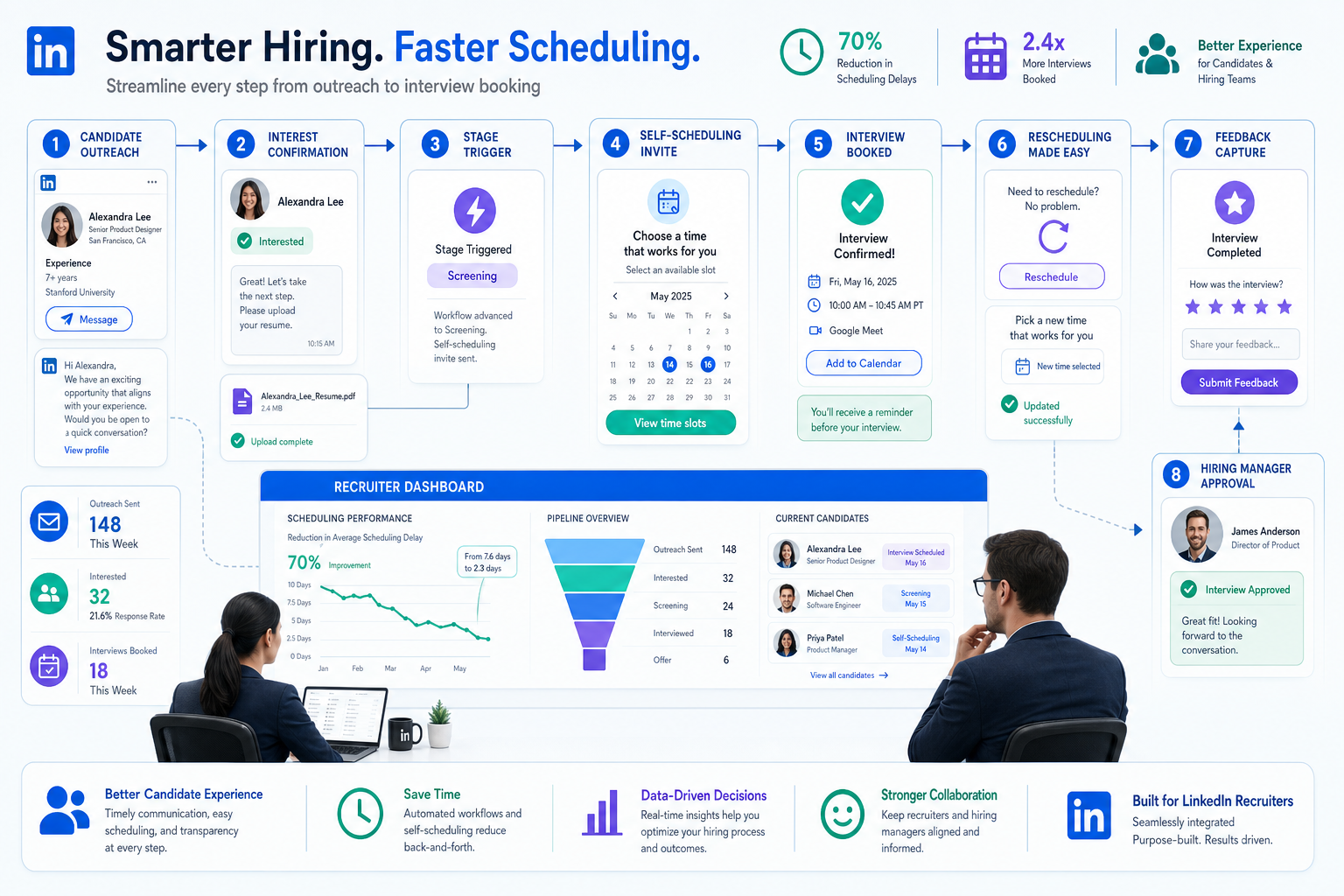
Automated interview scheduling usually begins when a candidate reaches a defined trigger point such as recruiter-qualified, first-round invite, hiring manager review, or panel interview stage. Instead of manually trading availability by email, the system uses connected calendars and workflow rules to offer bookable times.
A common sequence looks like this:
- Stage trigger: the candidate is moved to an interview-ready stage.
- Availability check: interviewer calendars are checked for suitable open slots.
- Candidate selection: the candidate chooses a time through a self-scheduling page.
- Reminder automation: confirmation and reminders go to both sides.
- Reschedule handling: changes update calendars and notifications.
- Feedback capture: notes, scorecards, or summaries are attached after the interview.
That sounds straightforward, but it only works well when earlier communication is already under control. In my experience, this is where pairing scheduling with StrategyBrain AI Recruiter can help upstream. If a recruiter is sourcing through LinkedIn, the tool can keep candidate communication moving after hours, answer routine role questions, collect resume and contact details from interested candidates, and surface warmer leads before scheduling starts. The recruiter still reviews the resume and decides who should progress, but the handoff into interview setup becomes cleaner.
A 5-Step Framework to Remove Workarounds
The finance-transformation reference offered a useful pattern: stop relying on quick fixes, stop the blame cycle, and use pain points to solve the real problem. For recruiting teams, I would translate that into five practical steps.
1. Identify the workaround, not just the symptom
If interview booking is slow, ask what the recruiter is doing manually before the link is ever sent. Are they confirming interest one message at a time? Are resumes arriving through inconsistent channels? Are hiring managers adding availability too late? Workarounds hide in those repeated actions.
2. Trace the cost of delay across the hiring chain
When teams do not measure the operational consequence, they default to blame. Recruiters say managers are unavailable. Managers say recruiters send incomplete slates. Candidates feel ignored. The real cost shows up as slower shortlists, lower response momentum, and more avoidable drop-off.
3. Use pain points as selection criteria
Do not buy software based on broad AI claims. Turn the pain into a checklist. If your issue is candidate follow-up before scheduling, look for communication support. If it is panel coordination, test calendar depth. If it is poor documentation, evaluate scorecards and record sync.
4. Standardize one stage before automating the whole funnel
Start with a repeatable step such as first-round screens or hiring manager intros. This helps the team agree on triggers, reminders, ownership, and reschedule logic before adding more complex stages.
5. Keep accountability human and visible
The system can support speed, but a recruiter or hiring manager should still own progression decisions, interview quality, and candidate communication standards. Good automation clarifies responsibility rather than obscuring it.
This five-step lens is often more useful than feature-heavy demos because it keeps the conversation tied to actual recruiting pain. It also reflects how growing teams mature: they stop patching process gaps and start designing for repeatability.
Live, Asynchronous, and AI-Supported Interviews
Not every interview format solves the same problem, so scheduling should be matched to the workflow rather than treated as one generic step.
Live video interviews
These are best when the role needs discussion, stakeholder calibration, or final-stage assessment. Automated scheduling matters most when multiple interviewers are involved and time-zone complexity is high.
Asynchronous video interviews
These help when teams want to remove early-stage booking entirely and review responses later. This is also the area where many teams start by exploring free video interview platforms before they invest in broader workflow tooling.
AI-supported conversational interviews
These can organize responses, create summaries, or guide a structured sequence of questions. They should be positioned as support for consistency and speed, not as autonomous decision-makers.
The right choice depends on hiring volume, role type, stakeholder load, and candidate geography. If the team is fighting workaround-driven delays, a mixed model is often the most practical: communication support before scheduling, automated booking for live stages, and asynchronous review where volume justifies it.
Features That Matter Most
When evaluating ai hiring software for automated interview scheduling, practical depth matters more than ambitious branding.
| Feature | Why It Matters | What to Test |
|---|---|---|
| Self-scheduling links | Reduce email back-and-forth | Can links be tied to stages, jobs, or interviewer pools? |
| Calendar sync | Avoid stale availability and conflicts | Does it support two-way sync and panel coordination? |
| Automated reminders | Lower confusion and no-shows | Can reminders go to both candidates and interviewers? |
| Rescheduling workflows | Preserve momentum when plans change | Does the workflow update all parties automatically? |
| Structured scorecards | Keep speed from creating inconsistency | Are scorecards role-specific and easy to complete? |
| Candidate messaging support | Reduces pre-booking friction | Can the system handle routine outreach and follow-up cleanly? |
| Resume/contact capture | Simplifies handoff into scheduling | How are interested candidates documented? |
| Workflow integration | Prevents fragmented records | Do status changes, notes, and interview history stay connected? |
One lesson I have learned is that scheduling tools look similar in a demo but behave very differently at the edges. The edge cases matter: the candidate who responds at night, the hiring manager who opens only two slots, the resume that arrives through LinkedIn instead of email, the reschedule that happens after reminders were already sent. That is where a broader workflow helper such as AI Recruiter can support the recruiter before the formal interview stage by keeping candidate conversations active and organized until the recruiter is ready to schedule.
ATS and Workflow Fit
Automated scheduling creates the most value when it fits naturally into the rest of the recruiting stack. A disconnected tool may still send invites, but it often forces recruiters back into the same workaround pattern they were trying to escape.
Before you buy, check these points:
- Can interview invites be triggered by stage movement?
- Will notes, scorecards, and reminders stay attached to the candidate record?
- Can hiring managers review interview context without leaving the workflow?
- Does the tool support both live and asynchronous steps?
- Can pre-scheduling candidate communication be handled without extra manual effort?
If the answer to most of those questions is no, then the software may solve the meeting itself but not the process around the meeting. That is how workaround gaps survive new tooling.
Free vs Paid Video Interview Platforms
Free video interview platforms can be perfectly reasonable for some teams, especially when the need is simply to host a call. But they should be measured against operating complexity, not only budget.
When free tools are often enough
- Hiring volume is low
- You only need basic live video interviews
- The recruiter can manage scheduling manually without much strain
- You are testing candidate comfort with remote interviews
When paid tools usually justify themselves
- You want candidate self-scheduling at scale
- You need asynchronous review options
- You coordinate multiple interviewers across time zones
- You need workflow records and structured feedback
- You want stronger communication support before scheduling starts
The practical difference is this: free tools help you hold an interview, while better ai interview software helps you run an interview process. If your current pain resembles the workaround-gap pattern, basic video alone will not fix it.
Rollout Best Practices
Teams get more value from automated interview scheduling when they treat it as a process change rather than a plug-in.
Start with a known pain point
If hiring managers complain about delayed first rounds, begin there. Do not automate every stage at once.
Define ownership clearly
Decide who confirms readiness for interview, who reviews resumes, who owns panel setup, and who approves candidate progression.
Map candidate communications before scheduling
This is where many rollouts fail. If outreach, interest checks, and document collection are still ad hoc, interview automation starts too late.
Use structure before analytics
Scorecards and standard prompts should come before any deeper AI summary or ranking logic.
Review privacy and retention
Any system handling candidate responses, resumes, contact details, or interview records should be reviewed for data handling, retention, and access controls.
On this point, one reason some recruiters value StrategyBrain AI Recruiter in the sourcing-to-screening handoff is its emphasis on customer-specific data handling, encrypted credentials, and keeping recruiter decision-making intact. That does not remove the need for internal review, but it is the kind of operational detail serious teams should ask about.
Common Mistakes
Buying for AI language instead of workflow fit
If the software sounds advanced but cannot support the handoff from candidate interest to confirmed interview, it will not solve the real problem.
Automating scheduling too late in the process
If pre-booking communication remains manual, the biggest source of delay may still sit upstream.
Confusing interview hosting with interview operations
A meeting link is not the same thing as a reliable hiring workflow.
Using unstructured interviews after speeding up access
Faster interviews without agreed evaluation criteria simply accelerate inconsistency.
Letting responsibility disappear into the tool
Recruiters and hiring managers should still own review, selection, and candidate treatment.
FAQ
How does automated interview scheduling work in recruiting?
It connects interview-stage triggers, calendar availability, candidate booking, reminders, rescheduling, and interview records into one workflow so recruiters do less manual coordination.
What is the difference between ai hiring software and ai interview software?
AI hiring software is the broader category covering sourcing, screening, coordination, and workflow support. AI interview software usually focuses more specifically on interview planning, delivery, documentation, and evaluation.
Can free video interview platforms work for hiring?
Yes, if you only need simple live interviews and your hiring volume is low. They become less suitable when you need structured workflows, self-scheduling, reminders, integrations, or asynchronous review.
Should recruiters let AI decide who gets interviewed?
No. Responsible use keeps AI in a support role for communication, coordination, summaries, and organization, while recruiters and hiring managers retain final judgment.
Where does StrategyBrain AI Recruiter fit if the topic is scheduling?
It fits best before scheduling begins, especially for LinkedIn-heavy workflows where recruiters need help with repetitive outreach, after-hours replies, multilingual communication, interest confirmation, and collecting resumes and contact details before deciding who should move to interview.
Conclusion
Automated interview scheduling works best when you treat it as a way to close the workaround gap, not just a way to send calendar links. That framing matters because most recruiting delays begin before the booking page appears.
If you are evaluating ai hiring software, focus on the pain points your team keeps patching over: candidate follow-up, role clarification, resume collection, stage handoff, reminders, and rescheduling. Then assess whether the tool stack actually removes those workarounds while preserving recruiter judgment.
For many teams, that means combining strong interview operations with better upstream communication support. Done well, ai interview software and carefully chosen workflow tools can help recruiters move faster, keep candidate momentum, and maintain human control where it matters most.