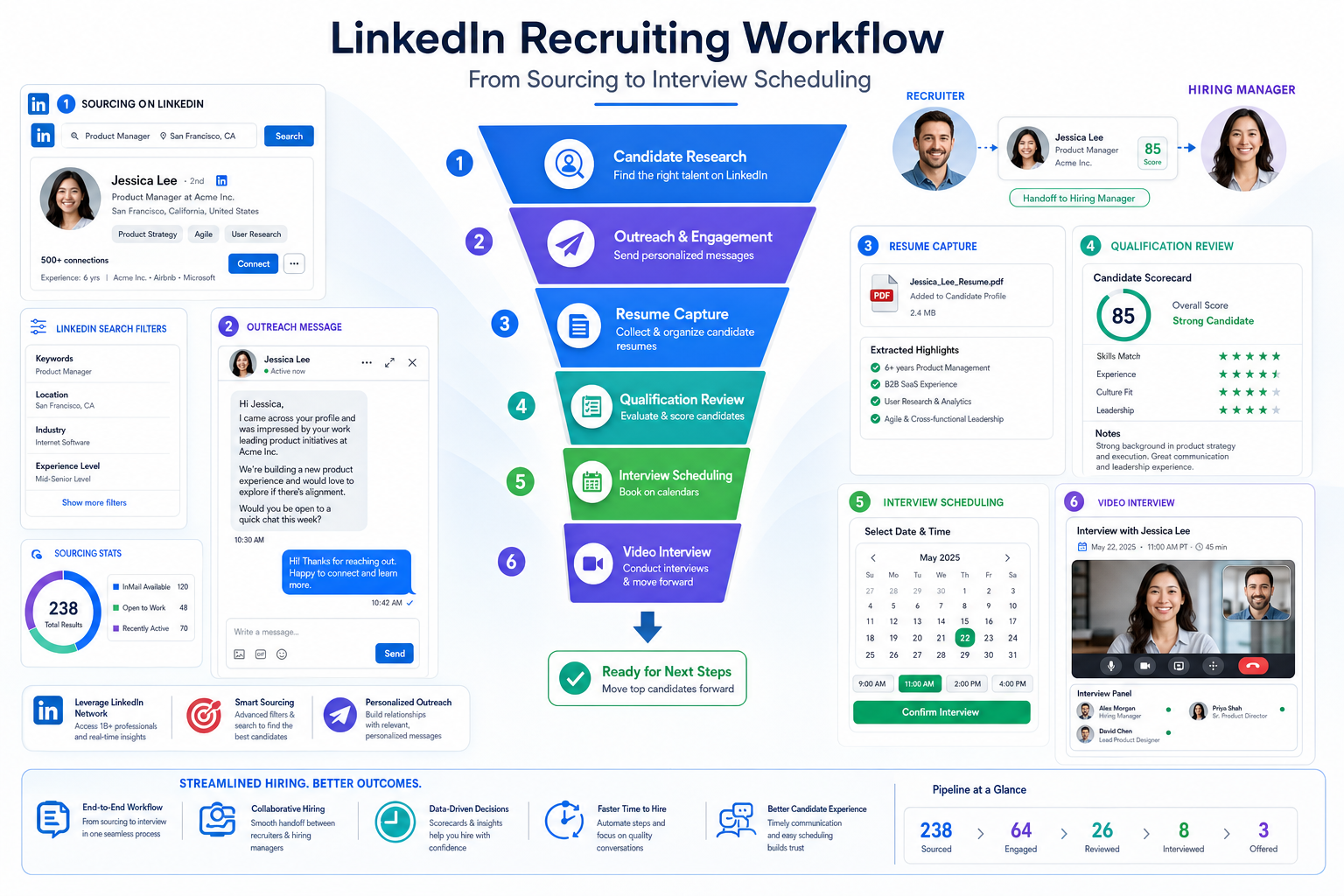
When ai hiring software is under review, recruiting leaders can spot workflow gaps that slow interviews and weaken handoffs.
In real search work, scheduling rarely breaks down because recruiters do not know how to send a calendar invite. It breaks down because the pipeline before the invite is fragmented. A recruiter identifies strong prospects, builds an outreach list, gets late replies across time zones, chases resumes, confirms interest, and only then discovers that interviewer availability, candidate timing, and stage ownership are all scattered across separate tools. That slows placement speed, frustrates hiring managers, and can quietly damage candidate trust.
I have found that StrategyBrain AI Recruiter is most useful when it is treated as support for that pre-interview bottleneck rather than as a replacement for recruiter judgment. Its LinkedIn outreach automation, after-hours multilingual follow-up, and resume/contact capture help keep the top of funnel moving so interview scheduling starts with warmer, better-documented candidates. The recruiter still reviews resumes, decides who is qualified, and owns the next step into screening or interview.
That matters because sourcing comes before scheduling, and good recruiters know the handoff is where process quality is won or lost. First you define the ideal candidate profile. Then you research likely matches across networks, directories, or prior talent pools. Then you build an outreach list and start conversations with people who may not have applied yet. Only after that groundwork do you know who is genuinely worth moving into an interview process.
In other words, automated interview scheduling works best when it is built on the same discipline as talent sourcing: clear role criteria, organized candidate research, documented handoffs, and visible next steps. That is why teams evaluating video interview software or broader video interview platforms should not look at scheduling in isolation. The real question is whether the system connects outreach, qualification, scheduling, and review in a way that fits how recruiters actually work.
- Why sourcing logic matters before interview scheduling
- What automated interview scheduling means in practice
- How scheduling connects with live and asynchronous video interviews
- What to evaluate in ai hiring software
- How experienced recruiting teams implement it well
- My experience using StrategyBrain AI Recruiter in the workflow
- Common mistakes to avoid
- Trust, human review, and compliance considerations
- FAQ
Why sourcing logic matters before interview scheduling
One of the best lessons from senior search work is that interview coordination is downstream from candidate identification. Before anyone compares time slots, the recruiting team has to define the ideal profile, research where matching talent is likely to be found, build a list based on fit, and pass the right prospects into assessment. If that early work is sloppy, scheduling automation only makes a messy process move faster.
That is especially true for hard-to-fill, niche, or senior roles. In those searches, recruiters are not waiting for applicants to appear. They are actively mapping talent, revisiting prior contacts, and opening conversations with passive candidates. By the time scheduling starts, the quality of notes, resume collection, interest tracking, and handoff discipline already affects whether a candidate actually reaches interview.
So when buyers review ai hiring software, they should ask a more useful operational question: does this tool improve the transition from sourcing to interview, or does it only automate the final booking step? The strongest systems support the full chain from candidate research through communication and into a structured interview workflow.
What automated interview scheduling means in practice
Automated interview scheduling is the use of software to coordinate interview timing without relying on long back-and-forth email threads. In practice, it usually includes self-scheduling links, interviewer assignment based on role or availability, calendar syncing, automated invitations, reminders, rescheduling flows, and interview stage coordination inside a wider recruiting system.
That is why it should not be treated as a narrow utility. In current buying conversations, ai hiring software is expected to do more than book time slots. Recruiting teams increasingly want one connected process for outreach, resume capture, interview setup, scorecards, transcripts, and shortlist review. Scheduling sits at the center because it affects speed, consistency, and funnel visibility.
It helps to separate a few adjacent categories:
- Interview scheduling software: mainly focused on booking and calendar coordination.
- Automated interview scheduling: emphasizes workflow automation such as self-service booking, reminders, and stage routing.
- Video interview software: supports the interview experience itself, especially live or recorded video interactions.
- Video interview platforms: broader systems that may include scheduling, interview delivery, evaluation, and collaboration.
- Asynchronous interview or one-way video interview: candidates respond on their own time within a set window.
- Live video interview: recruiter, candidate, and hiring team meet in real time.
For recruiting leaders, the practical distinction is simple. If all you need is a booking link, a point solution may be enough. If you need recruiters to move from sourced candidate to structured interview with fewer handoff failures, you need ai hiring software that connects the surrounding workflow.
How scheduling connects with live and asynchronous video interviews
A common buying mistake is to confuse scheduling automation with the interview format itself. Scheduling manages coordination. Video interview software manages how the interview happens. Some tools do both, but many are stronger in one area than the other.
Live video interviews
Live video interviews create the heaviest scheduling burden because candidate and interviewer calendars must align in real time. This is where automation matters most. Calendar sync, automated invitations, rescheduling rules, and meeting-link generation remove a surprising amount of recruiter admin.
Live interviews are usually best when:
- the role requires deeper discussion
- the hiring manager needs to test judgment or communication style
- multiple interviewers need a shared view of the candidate
- the process depends on structured scorecards across a panel
Asynchronous or one-way video interviews
Asynchronous interviews change the scheduling problem. Instead of finding a common slot, the team sets a completion window and tracks whether the candidate records responses on time. Here, automation is less about calendar matching and more about invitations, deadlines, reminders, and status visibility.
Asynchronous formats are usually best when:
- application volume is high
- early-stage screening needs consistency
- candidates are spread across time zones
- recruiters want structured first-pass responses before committing manager time
When to use each format
| Interview format | Best use case | Scheduling need | Advice for recruiting teams |
|---|---|---|---|
| Live video interview | Manager screens, panel interviews, final rounds | High | Prioritize calendar sync, interviewer assignment, and reminder reliability |
| Asynchronous or one-way video interview | Early screening, high-volume recruiting, distributed candidate pools | Moderate | Prioritize candidate instructions, completion windows, and human review steps |
When evaluating video interview platforms, ask whether the system supports both formats well or whether one is clearly stronger. The right answer depends on your recruiting model, not on the category label in the demo.
What to evaluate in ai hiring software
If the opening case taught us anything, it is that speed alone is not the standard. Recruiters need software that preserves context from sourcing through interview. These are the features worth checking first.
1. Candidate handoff from outreach to interview
A sourced candidate is not the same as an applicant. Good systems should carry forward notes, contact history, interest level, resume status, and ownership so the person entering scheduling is not treated like a blank record.
2. ATS integration
This is foundational. Without ATS connectivity, interview scheduling becomes another disconnected layer. The workflow should update stage status, communication history, and interviewer tasks without manual copying.
3. Calendar syncing
Real-time calendar sync prevents double booking and helps teams reserve interview blocks, control interviewer availability, and manage reschedules without chaos.
4. Self-scheduling and rescheduling
Candidates increasingly expect simple booking options. A strong system lets them choose from approved slots and reschedule when necessary without restarting the whole process.
5. Interviewer assignment by role or availability
For structured hiring, assigning interviewers based on competency coverage or stage rules is far more useful than a generic calendar link.
6. Video meeting or interview delivery support
If your process depends on remote interviews, the scheduling flow should connect smoothly with your live meeting setup or your chosen video interview software.
7. Structured scorecards and transcripts
This is where scheduling stops being a convenience feature and starts supporting better hiring discipline. Once interviews are booked, teams need a consistent way to capture what happened and compare candidates fairly.
8. Auditability and human review controls
If the platform includes AI-assisted summaries or scoring, buyers should understand what is automated, what is recruiter-led, and what can be reviewed later.
How experienced recruiting teams implement it well
Software alone does not fix scheduling problems. The best teams redesign the workflow around clarity, ownership, and structured handoffs.
- Define the target profile before the workflow starts
This mirrors disciplined sourcing. Agree on must-have experience, likely talent sources, and who qualifies for first outreach before anyone starts booking screens.
- Separate candidate research from candidate contact
Strong recruiting operations keep sourcing and outreach cleanly documented. Once a candidate responds, the recruiter should know what was attractive about the profile and why that person was prioritized.
- Map live and asynchronous stages deliberately
Not every step deserves a live interview. Use manager time where discussion matters and use structured asynchronous steps where consistency matters more.
- Set interviewer rules by stage
Document who joins each interview, what they assess, and how alternates are assigned. This reduces reschedule risk and keeps evaluation more consistent.
- Standardize candidate instructions
For live interviews, share timing, expectations, and access details. For asynchronous interviews, state the deadline, technical requirements, and whether a human will review the submission.
- Watch the breakdown points
If one stage is repeatedly delayed, the problem may not be scheduling software at all. It may be weak sourcing notes, unclear ownership, overloaded interviewers, or poor hiring-manager response habits.
My experience using StrategyBrain AI Recruiter in the workflow
In searches where LinkedIn outreach is the real bottleneck, I have used AI Recruiter as a front-end support layer before interview scheduling begins. The value was not that it somehow made final hiring decisions easier on its own. The value was that it kept candidate conversations moving when I would otherwise lose momentum between sourcing and screening.
What stood out in practice was the combination of always-on follow-up, multilingual messaging, and automatic collection of resumes or contact details from interested candidates. That was especially useful when candidates replied after hours or from different regions, because the conversation did not stall waiting for me to get back online. By the time I reviewed the profile, I had a clearer record of interest and next-step readiness. From there, I still made the qualification call and decided who should move into interview.
If your team is curious about how it handles recruiter conversations on LinkedIn, the product overview and examples are worth reviewing directly: how the workflow is set up and how conversations are presented. My practical takeaway is that it is most effective when paired with a clear interview design afterward. It helps the recruiter reach the scheduling step with less manual chasing, but the recruiter still owns evaluation quality.
Common mistakes to avoid
- Treating scheduling as an isolated feature
If scheduling does not connect to sourcing notes, stage definitions, and interviewer roles, you may move faster without learning better.
- Assuming every sourced lead should become an interview
Sourcing is about identifying and researching likely fits. Headhunting or outreach starts the conversation. Scheduling should happen only after the recruiter has enough evidence to justify the next step.
- Using live interviews for every stage
Some early screens are better handled asynchronously, especially in high-volume or distributed hiring.
- Ignoring candidate-side friction
If instructions are unclear or technical requirements appear too late, candidate experience suffers even when the process is highly automated.
- Over-automating evaluation language
Automation can support structure, but teams should be cautious with any scoring logic that is hard to explain or weakly tied to job requirements.
- Skipping recruiter and hiring-manager training
Even good systems underperform when hiring teams bypass the workflow and book outside the process.
Trust, human review, and compliance considerations
Automated interview scheduling is relatively low risk compared with automated candidate scoring, but many tools now connect scheduling with transcripts, summaries, and recommendation layers. That means transparency still matters.
Recruiting teams should ask:
- What parts of the process are automated, and what parts remain human-led?
- Can recruiters review candidate history before scheduling decisions are made?
- Are interview records and workflow steps auditable later?
- Are evaluation criteria job-related and explainable?
- How are candidate data, resumes, and communication records protected?
From an adoption standpoint, trust matters as much as compliance. Hiring managers are more likely to support ai hiring software when they understand that automation is handling coordination and documentation, not replacing recruiter judgment.
Practical takeaway: The most effective setup is to automate sourcing follow-up and interview coordination, while keeping qualification and final hiring decisions with human reviewers.
FAQ
What is automated interview scheduling?
It is the use of software to coordinate interview timing, reminders, rescheduling, and interviewer availability without relying on manual back-and-forth emails.
Why does sourcing matter before interview scheduling?
Because scheduling only works well when recruiters already know who fits the role, who has responded, who shared a resume, and who is genuinely ready for the next step. Good scheduling depends on good handoff discipline.
Is automated interview scheduling the same as video interview software?
No. Scheduling manages timing and coordination. Video interview software manages the interview experience itself. Some tools include both functions, but not all do.
How do video interview platforms fit into this workflow?
Video interview platforms may combine scheduling, live interviews, asynchronous interviews, evaluation, and collaboration. Buyers should confirm which parts of the workflow are truly integrated.
When should recruiters use live interviews instead of one-way video interviews?
Use live interviews when discussion, follow-up questions, or panel interaction matter. Use asynchronous interviews when the goal is consistent early-stage screening or flexible participation across time zones.
Does AI replace the recruiter in interview scheduling?
No. Good systems reduce admin work, organize communication, and support candidate movement through the funnel. Recruiters should still review resumes, assess fit, and decide who advances.
Conclusion
Automated interview scheduling is one of the clearest operational benefits inside ai hiring software, but it delivers the most value when it follows the same logic as strong talent sourcing. First define the profile, then research and contact the right people, then hand qualified interest into a structured interview process.
If your team is comparing video interview software or broader video interview platforms, do not evaluate the booking link alone. Look at how the system connects sourcing, outreach, resume collection, candidate communication, scheduling, and human review. That is where automation stops being a convenience feature and becomes real recruiting infrastructure.