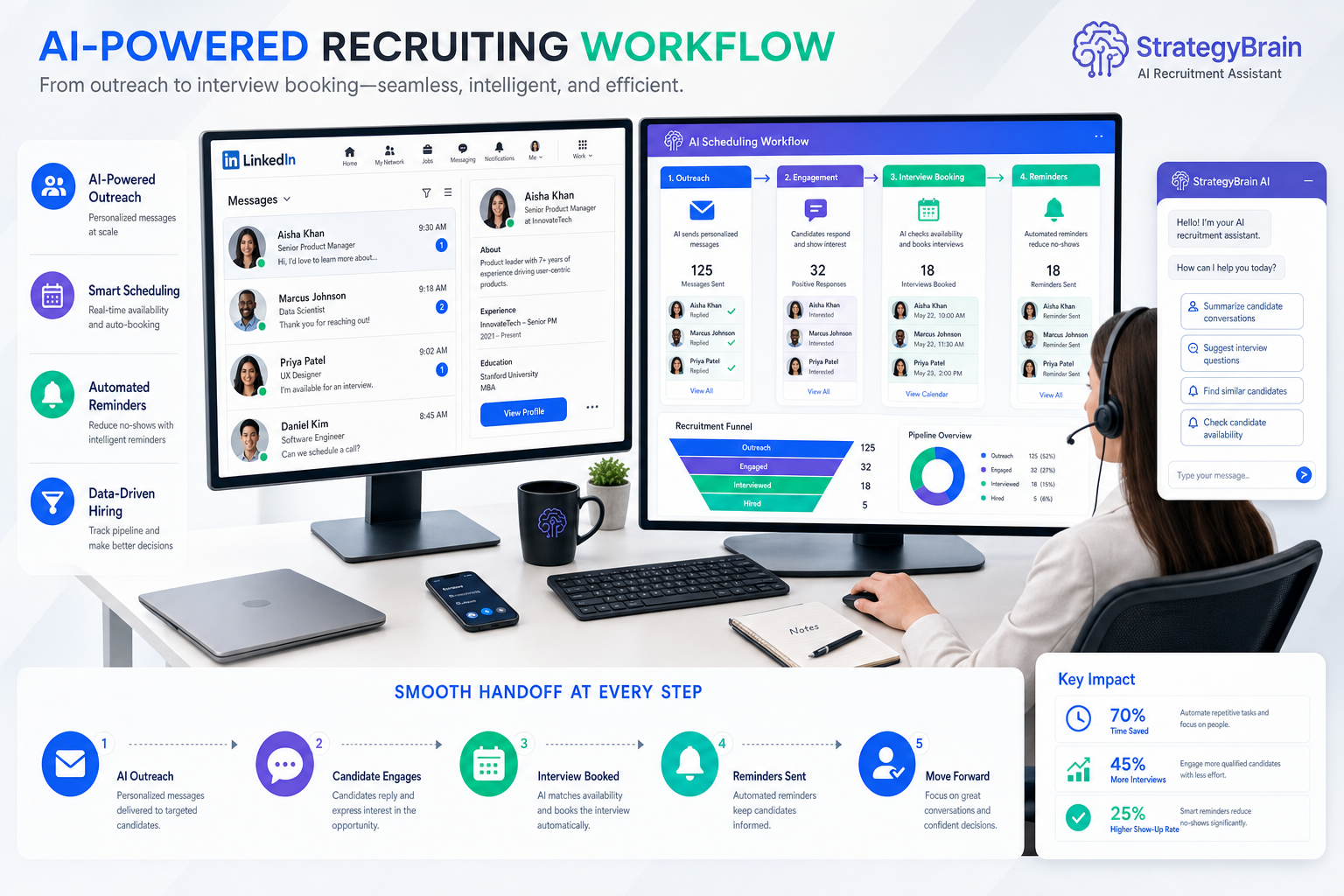
This article shows headhunters how to assess ai hiring software so scheduling delays do not turn into candidate drop-off.
That distinction matters more than most teams admit. A scheduling delay is rarely just an admin problem. In a small search firm, it can mean losing a candidate who wanted quick confirmation. For an in-house recruiter, it can damage trust with a hiring manager who already thinks recruiting moves too slowly. For a talent leader, it can turn age-diverse hiring into a messy candidate experience because different applicants respond to different signals: some want speed, some want flexibility, some want status, and some want a process that respects work-life balance.
In my own workflow, I have found that StrategyBrain AI Recruiter is most useful before the interview is even booked. Its always-on messaging, multilingual follow-up, and automated collection of candidate intent and contact details help reduce the silence that usually builds between outreach and scheduling. The recruiter still owns résumé review, fit assessment, and the decision to move someone into interviews, but the tool helps keep candidate momentum alive when time zones, after-hours replies, or repetitive LinkedIn conversations would otherwise slow everything down.
The management challenge behind this is not new. In a multi-generational workplace, leaders have long had to recognize that people do not evaluate work in the same way. One candidate may care most about title, recognition, and compensation. Another may value balance and flexibility more than prestige. A younger applicant may weigh friendship, culture, or ethical alignment alongside money rather than after it. When those motives are missed during recruiting, the problem shows up in practical moments: the recruiter sends availability, waits too long, adjusts the panel, answers late-night questions, then tries to rebuild interest after momentum has already slipped.
That is exactly why automated interview scheduling should be evaluated as part of a wider recruiting workflow rather than as a standalone calendar tool. The real question is not only whether a platform can book time slots. It is whether ai hiring software, online interview platforms, and remote interview software can help recruiters respond to different candidate expectations without losing control of process, communication, or final hiring judgment.
If you recruit across functions, generations, or geographies, scheduling is often where candidate motivation becomes visible. People show you what matters to them by how they respond to timing, flexibility, reminders, and interview setup. That is why strong interview operations depend on more than availability syncing. They depend on understanding what the scheduling moment means to the person on the other side.
Table of Contents
- Why interview scheduling breaks down in real hiring
- How candidate motivation changes scheduling expectations
- How ai hiring software supports scheduling workflows
- What to look for in online interview platforms and remote interview software
- Managing complex interview loops without losing candidate interest
- How to evaluate the right platform
- How I use StrategyBrain AI Recruiter around scheduling
- Common mistakes to avoid
- FAQ
Why Interview Scheduling Breaks Down in Real Hiring
Automated interview scheduling is supposed to remove friction, but in practice many teams automate only the final booking step while leaving the rest of the coordination mess intact. A recruiter may still need to chase candidate replies, confirm interest, clarify compensation expectations, explain the interview sequence, and gather the right contact details before any self-scheduling link is useful.
That is why scheduling failures often begin earlier than people think. The workflow breaks when there is weak handoff between sourcing, qualification, and interview coordination. If the candidate is interested but under-informed, if the recruiter has not confirmed timing preferences, or if communication goes quiet after business hours, even good software cannot fully protect the process.
| Where the workflow breaks | What happens manually | Why it hurts hiring |
|---|---|---|
| Early candidate communication | Recruiter answers repetitive questions one by one | Momentum slows before scheduling starts |
| Interest confirmation | Availability is requested before intent is clear | Low response rates and wasted slots |
| Time-zone coordination | Messages wait until the next workday | Candidates disengage or choose another process |
| Remote setup | Interview links and reminders are handled separately | More errors, more confusion, weaker experience |
Key insight: Scheduling friction is usually a symptom of a larger communication problem, not just a calendar problem.
How Candidate Motivation Changes Scheduling Expectations
The reference point that many recruiters miss is simple: candidates do not all interpret the same interview process in the same way. In age-diverse hiring, motivations differ enough that one scheduling style can feel efficient to one person and dismissive to another.
Some candidates are strongly motivated by advancement, title, recognition, and visible seriousness from the employer. For them, a vague or delayed interview setup can look like lack of commitment. Others care more about work-life balance and will respond better to flexible windows, clear expectations, and a process that does not consume their personal time unnecessarily. Still others place more weight on team culture, social fit, or values, which means the tone and ease of scheduling can influence whether they stay engaged.
That does not mean recruiters need a different process for every person. It means the scheduling system should be flexible enough to support different expectations while keeping a consistent structure. This is one reason online interview platforms and remote interview software are now part of candidate experience, not just operations.
Motivation signals recruiters should notice
- Status-focused candidates often respond best to quick confirmation, clear sequencing, and visible respect for their time.
- Balance-focused candidates usually value self-scheduling, rescheduling ease, and transparent time commitments.
- Culture-focused candidates tend to notice communication tone, coordination quality, and whether the process feels human.
When scheduling ignores these signals, teams tend to misdiagnose the outcome. They call it a response-rate problem, but often it is really a process-fit problem.
How AI Hiring Software Supports Scheduling Workflows
The best ai hiring software does not replace recruiter judgment. It supports the sequence that leads to a successful interview booking: outreach, candidate response, intent confirmation, information capture, follow-up, and then scheduling. That distinction matters when buyers compare workflow automation with actual recruiting value.
Used responsibly, AI can help in three practical areas. First, it can keep candidate communication active outside recruiter working hours. Second, it can organize inbound information such as résumés and contact details so the recruiter is not rebuilding context before every scheduling step. Third, it can reduce lag between candidate interest and next action, which is where many interview processes lose momentum.
Those gains are especially useful in remote and cross-border recruiting. When candidates reply in different languages or outside local business hours, automation helps maintain continuity. The recruiter still decides who moves forward, who is qualified, and how the interview panel should be structured.
Where AI helps most before and around scheduling
- Candidate messaging: timely replies that keep conversation moving
- Interest capture: identifying who is open to interviews before calendars are involved
- Information collection: gathering résumés and contact details for recruiter review
- Follow-up continuity: reducing drop-off when the recruiter is offline
For hiring teams, this is the operational bridge between sourcing activity and a cleaner scheduling stage.
What to Look for in Online Interview Platforms and Remote Interview Software
When interview scheduling is part of a larger platform decision, feature quality matters more than broad claims. The platform has to work for real recruiting conditions, especially when teams are hiring remotely or coordinating across multiple stakeholders.
1. Candidate self-scheduling with recruiter control
Good self-scheduling reduces back-and-forth, but only if recruiters can define windows, interviewer pools, and stage rules in advance. Candidates should get flexibility without gaining access to the wrong interview type or unsuitable time slots.
2. Reliable calendar coordination
Support for Google Calendar, Microsoft 365, and Outlook is baseline. More important is how well the system handles interviewer conflicts, buffer times, and changes. If calendar orchestration is weak, manual repair work comes back quickly.
3. Virtual interview execution in the same flow
This is where online interview platforms and remote interview software become central. Booking, confirmation, reminder messages, and video link creation should feel like one process. In fragmented setups, candidates receive duplicate invites, interviewers join the wrong links, and recruiters spend time cleaning up avoidable errors.
4. Workflow visibility after booking
The interview is not finished when the slot is booked. Recruiters still need stage updates, interviewer notifications, and feedback collection. Strong ai hiring software connects these steps so scheduling becomes part of a managed workflow rather than an isolated event.
5. Support for different candidate expectations
This is the lesson many teams learn too late. A platform that only optimizes internal efficiency may not serve candidates equally well. Flexibility, communication clarity, and rescheduling logic matter because candidate motivation differs.
Managing Complex Interview Loops Without Losing Candidate Interest
Simple one-on-one bookings are easy. Complex hiring loops expose the real strength of a scheduling system. Senior roles, technical roles, and cross-functional positions often require panels, split sessions, and carefully staged handoffs.
These loops create more than calendar complexity. They also heighten candidate interpretation. A senior candidate may see repeated rescheduling as a sign of weak decision-making. A balance-focused candidate may view a fragmented all-day interview as poor respect for time. A relationship-oriented candidate may start questioning the team culture if communication becomes disjointed.
Common complex scheduling needs
- Panel interviews with multiple interviewers
- Segmented interviews across different days
- Break blocks between sessions
- Different meeting links for different interview stages
- Reschedule logic when one interviewer drops out
Recruiters should test these scenarios before rollout. In my experience, that is where the difference between a basic booking tool and genuine process support becomes obvious.
How to Evaluate the Right Platform
Choosing software for automated interview scheduling should start with recruiting reality, not a feature grid. The right question is: what kind of candidate communication and interview complexity does your team actually manage?
- Map the pre-scheduling stage. Identify how candidates are sourced, how interest is confirmed, and where communication gaps occur.
- Review candidate expectations. Consider whether your typical talent pool values speed, flexibility, structure, or high-touch coordination.
- Test self-scheduling rules. Check whether candidates can book easily without bypassing recruiter guardrails.
- Validate remote interview flow. Confirm that booking, reminders, and virtual link creation work together.
- Stress-test complex loops. Run a panel or multi-stage sequence through the platform.
- Separate AI claims from workflow value. Ask what is truly automated and what still needs recruiter action.
- Check exception handling. Make sure reschedules, panel changes, and late replies can be managed cleanly.
| Evaluation area | What to verify | Why it matters |
|---|---|---|
| Candidate communication | Follow-up speed, after-hours continuity, language support | Protects momentum before scheduling |
| Scheduling controls | Templates, windows, buffers, interviewer logic | Keeps the process consistent |
| Remote execution | Integrated meeting links and reminders | Reduces friction in virtual interviews |
| Workflow updates | Stage progression and feedback triggers | Improves recruiter visibility |
| AI assistance | Messaging, information capture, follow-up support | Helps without replacing recruiter judgment |
How I Use StrategyBrain AI Recruiter Around Scheduling
I would not describe StrategyBrain AI Recruiter as an interview scheduler first. I see it as a workflow support layer that improves what happens before scheduling and right around the handoff into interviews. In LinkedIn-heavy recruiting, that matters a lot.
My main use case has been straightforward: when candidate replies come in after hours, across time zones, or in bursts during active sourcing, the tool helps continue the conversation, introduce the role, answer common questions, and confirm whether someone is open to moving ahead. Interested candidates can then share résumés and contact details, which makes the next recruiter step cleaner. By the time I am ready to schedule, I am not starting from a cold thread or an incomplete record.
I also like that the recruiter still stays responsible for the actual hiring decision. The system can help with communication and information flow, but I still review the résumé, decide whether the profile fits the search, and choose when to move to interview. That separation is important if you want efficiency without losing professional judgment.
For teams dealing with global outreach, the multilingual and 24/7 communication layer is particularly useful. Candidates often respond when recruiters are offline. Letting those replies sit until the next day creates exactly the delay that later shows up as a scheduling problem. More details are available on the AI Recruiter page, and if your team works primarily through LinkedIn outreach, its workflow is worth reviewing before you blame interview scheduling alone for candidate drop-off.
Common Mistakes to Avoid
Treating scheduling as a calendar-only task
Most interview delays start in communication, not booking. If the candidate is unclear, unresponsive, or under-informed, scheduling software arrives too late to fix the problem fully.
Using one communication style for every candidate
The generational lesson still holds: people value different things at work. A rigid process can unintentionally push away candidates who need more flexibility, more structure, or more visible seriousness.
Buying on AI language alone
Claims are easy. Reliable workflow support is harder. Prioritize tools that clearly explain what they automate and how recruiter judgment remains in control.
Separating remote interview setup from scheduling
If remote interview software is disconnected from the scheduling step, errors multiply. One workflow is usually better than several loosely connected tools.
Ignoring exception handling
Panels change, candidates reschedule, and interviewers cancel. If the system works only for the ideal case, recruiters will return to manual coordination very quickly.
FAQ
What is automated interview scheduling in recruiting?
It is the use of software to coordinate interview availability, candidate booking, reminders, and meeting setup with less manual back-and-forth. In stronger systems, this also connects to workflow updates and interview feedback steps.
How does ai hiring software help with interview scheduling?
It usually helps before and around the scheduling event by supporting candidate communication, confirming interest, organizing information, and reducing delays between recruiter actions.
Why do online interview platforms matter for scheduling?
Because the interview does not end with a calendar invite. Online interview platforms help connect the booking step with reminders, meeting links, and the live interview experience.
What should remote interview software include?
At minimum, it should support virtual meeting setup, reminder communication, rescheduling, and reliable coordination for distributed interview teams.
Can automated scheduling improve candidate experience?
Yes, especially when it respects different candidate priorities. Faster booking, clearer communication, and easier rescheduling make the process feel more professional and responsive.
Does AI replace recruiter judgment in this process?
No. The recruiter should still decide who is qualified, who moves forward, how interviews are structured, and what hiring decision is made.
Conclusion
Automated interview scheduling works best when recruiters understand that booking speed and candidate motivation are connected. The strongest ai hiring software supports communication before scheduling, keeps remote interview workflows organized, and helps teams use online interview platforms and remote interview software without losing process control.
For recruiting teams, the practical goal is not just to automate calendars. It is to create an interview flow that respects candidate differences, protects recruiter judgment, and keeps hiring momentum intact from first reply to completed interview.