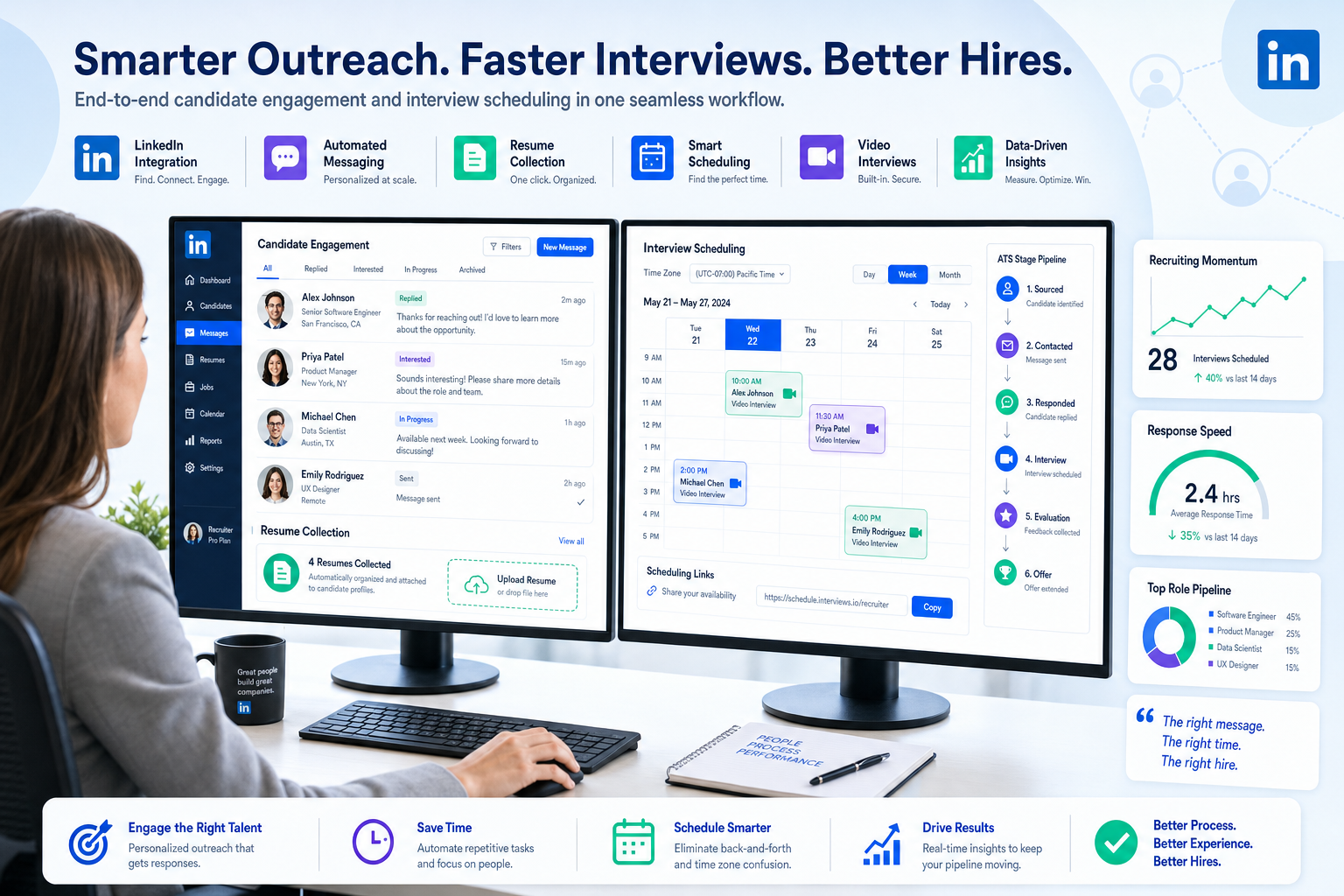
When candidate interest fades in inbox delays, this article helps recruiters evaluate ai hiring software by whether it preserves interview momentum.
That sounds obvious until you are handling several live searches at once and the bottleneck is no longer sourcing but coordination. A candidate replies after hours, a hiring manager delays availability, a panel needs reshuffling across time zones, and what looked like a strong process starts leaking momentum. For agency recruiters, that means harder placements and avoidable candidate drop-off. For internal teams, it means slower hiring, weaker employer perception, and more manual cleanup inside the ATS.
In my own workflow, I have found that tools only help when they remove the repetitive communication layer without pretending to replace recruiter judgment. Used that way, StrategyBrain AI Recruiter is useful before scheduling even begins: it can keep candidate conversations moving after hours, collect resumes and contact details from interested prospects, and communicate in the candidate's language when cross-border searches are involved. The recruiter still reviews the resume, decides who advances, and owns the final interview decision, but the early handoff into scheduling becomes much cleaner.
The reference point that keeps coming back to me is not a calendar at all, but career intent. In a widely discussed search pattern, many Americans were looking up how to become a real estate agent or a notary, while smaller groups searched how to become a pilot or an electrician. That matters in recruiting because people do not enter interview funnels as blank records in a system. They arrive with very different motivations, trade-offs, and levels of commitment. Someone considering flight may be thinking about time away from family. Someone leaning toward electrical work may be weighing long-term opportunity, physical demands, and business potential.
Once that candidate raises a hand, the recruiter has to turn aspiration into motion through concrete actions: reply while interest is fresh, confirm whether the person is truly open to a move, collect the resume, update the stage, and get the right interview option in front of them before doubt or delay takes over. That is where automated interview scheduling stops being a convenience feature and becomes a control point inside the hiring process, especially when online video interview steps and even tests of free video interview platforms are part of the funnel.
Table of Contents
- Why candidate intent should shape scheduling design
- What automated interview scheduling means in ai hiring software
- Why recruiters and hiring managers care about it
- How it works in day-to-day hiring workflows
- Where online video interview workflows change the rules
- How to assess free video interview platforms carefully
- What features are worth comparing
- Implementation checklist before rollout
- Common mistakes that slow teams down
- FAQ
Why Candidate Intent Should Shape Scheduling Design
One useful lesson from career-search behavior is that interest alone is not commitment. A person searching how to become a pilot is not evaluating the same future as someone exploring notary work or real estate. The same is true in recruiting funnels. Different candidates respond to interview scheduling differently because the opportunity sits differently in their lives.
Experienced recruiters know this already in practice. The candidate exploring a major career shift often needs a smoother path, faster replies, and fewer coordination gaps than someone actively applying to ten similar roles. If your process takes too long to move from initial interest to booked interview, you are not just losing calendar efficiency. You are losing people at the exact moment they are still deciding whether this opportunity is worth pursuing.
That is why I treat scheduling as part of candidate conversion, not just administration. Good ai hiring software should help teams capture that moment by aligning outreach, qualification, booking, reminders, and feedback in one flow. The best systems support recruiter judgment while reducing the lag that turns interest into silence.
Key insight: Recruiting teams often blame weak candidate commitment when the real issue is that the process failed to turn early curiosity into a scheduled next step.
What Automated Interview Scheduling Means in AI Hiring Software
Automated interview scheduling uses workflow rules, calendar availability, candidate-facing booking tools, and reminders to coordinate interviews without manual back-and-forth for every step. In modern ai hiring software, it usually sits inside a larger process that also includes screening, communication, stage movement, and interview feedback.
That broader connection matters. Scheduling creates the most value when it works with the rest of the hiring stack rather than as a disconnected plug-in. For most teams, that means ATS synchronization, stage-based triggers, interviewer permissions, time-zone handling, and communication templates that keep everyone aligned.
From an operations standpoint, integrated scheduling usually improves hiring in a few practical ways:
- Candidate records update automatically when interviews are booked or changed
- Recruiters avoid re-entering data across separate systems
- Hiring managers can see progress without chasing status updates
- Interview steps stay more consistent across roles and departments
If you are comparing software, do not evaluate scheduling as a side feature. Evaluate it as part of the system that either preserves candidate momentum or breaks it.
Why Recruiters and Hiring Managers Care About It
The strongest case for scheduling automation is reliability under real hiring pressure. Manual coordination usually holds up for a few openings. It starts failing when recruiters are balancing multiple searches, distributed interviewers, and candidates who reply outside standard business hours.
That is one reason many teams now see scheduling as a real buying factor in ai hiring software. It shortens the dead space between screening and interview, gives candidates clearer next steps, and reduces the small administrative misses that quietly damage hiring outcomes.
| Role | Where the friction appears | What automation improves |
|---|---|---|
| Recruiters | Inbox follow-up, reschedules, chasing availability | Self-scheduling, reminders, cleaner handoffs |
| HR teams | Inconsistent process and weak visibility | Standard rules and easier oversight |
| Hiring managers | Conflicts, delays, unclear timelines | Faster coordination and better context |
| Candidates | Slow replies, time-zone confusion, vague next steps | Clear booking options and confirmations |
In agency settings, the benefit is especially visible when you are dealing with passive or semi-passive candidates. They may be curious about a role, but they are not always patient. A delayed scheduling step can kill a search faster than a weak outreach message.
How It Works in Day-to-Day Hiring Workflows
In a typical workflow, a candidate reaches a qualified stage and the system triggers the next interview action automatically. That action may be a self-scheduling link for a recruiter screen, a request for panel availability, or a route into an online video interview.
Well-designed ai hiring software usually combines several moving parts:
- A candidate shows real interest. This may happen through direct application, sourcing response, or recruiter outreach.
- The recruiter confirms fit at a first-pass level. Final judgment still stays with the human recruiter.
- The system opens the correct interview path. Different roles may trigger different interview types.
- Availability logic is applied. Interviewer calendars, buffers, and time zones are checked.
- The candidate receives booking options. Self-scheduling removes unnecessary email loops.
- Reminders and updates run automatically. This helps reduce no-shows and confusion.
- Status writes back to the ATS. Everyone works from the same record.
This flow becomes more valuable when the top of the funnel is also moving quickly. In searches where I have used AI Recruiter to continue candidate conversations while I am offline, the gain is not that the tool makes hiring decisions for me. The gain is that interested people are less likely to disappear before I can review their resume and move them to the right interview stage. That is a meaningful difference in searches where intent is fragile and speed matters.
For higher-volume hiring, ask whether the system supports bulk actions, reusable templates, and role-based permissions. Those are often the dividing line between a basic scheduler and software built for live recruiting operations.
Where Online Video Interview Workflows Change the Rules
The phrase online video interview covers two different operating models, and the scheduling logic is not the same for both.
Live online video interview
This is the scheduled real-time interview most teams know well. Here, automation should manage booking links, calendar matching, meeting access, confirmations, reminders, and rescheduling. The main goal is to remove friction without losing control.
One-way or asynchronous video interview
In this format, the candidate records responses within a time window. Scheduling still matters, but the system is coordinating deadlines rather than live availability. Reminders, access windows, and reviewer workflows become more important than panel calendars.
The difference matters because career-interest signals vary by candidate type. Someone casually exploring a new path may tolerate a one-way step if it is easy and fast. Someone weighing a high-commitment move may expect quicker access to a live conversation. Strong ai hiring software should let you support both without forcing recruiters into awkward workarounds.
- If most early interviews are live, prioritize self-scheduling and panel coordination.
- If asynchronous screening is common, prioritize deadline management and reviewer flow.
- If your process uses both, make sure ATS status updates happen automatically.
How to Assess Free Video Interview Platforms Carefully
Interest in free video interview platforms is understandable. Many teams want to test candidate experience before making a broader software decision. That can be a sensible starting point, but free access often hides the operational limits that matter most once hiring volume grows.
When reviewing free tools, look beyond whether a candidate can technically complete an interview. The real question is whether the workflow supports the same speed and clarity your team needs in active hiring.
| Evaluation area | What to verify | Why it matters |
|---|---|---|
| Usage limits | Interview caps or candidate limits | Free plans may not support real recruiting volume |
| Branding | Provider branding on candidate-facing pages | Affects professionalism and candidate trust |
| Integrations | ATS, calendar, and workflow connections | Without integration, admin work returns quickly |
| Interview format | Live only, one-way only, or both | Determines fit for your funnel |
| Automation depth | Scheduling links, reminders, rescheduling | Basic video access is not the same as coordination support |
| Advanced features | Transcripts, summaries, review tools | These may disappear outside paid plans |
In practice, free video interview platforms are useful for testing narrow use cases. They are less useful if you need an end-to-end process that protects candidate momentum from first signal through scheduled next step.
What Features Are Worth Comparing
When buyers compare hiring systems, they often focus on sourcing or screening first. But if the opening case of this article proves anything, it is that candidate intent is lost in handoff moments. That makes scheduling quality a serious evaluation category, not an afterthought.
| Capability | Basic tool | Stronger ai hiring software approach |
|---|---|---|
| Self-scheduling | Simple booking link | Stage-based logic, interviewer matching, buffers |
| Calendar sync | Limited availability checking | Real-time coordination across interviewers |
| Time-zone handling | Manual confirmation often needed | Automatic localization for candidate and team |
| ATS connection | Manual updates or partial sync | Status written into candidate records |
| Online video interview support | Separate setup | Embedded in stage workflow |
| Reminders | Basic notification | Multi-step reminders and reschedule prompts |
| Feedback flow | Separate notes or documents | Structured scorecards inside process |
| Candidate communication | Manual follow-up | Connected outreach and progression logic |
| Bulk scheduling | Limited | Designed for high-volume hiring |
Questions to ask during evaluation
- Does the software support the kinds of candidates you actually recruit, including passive and exploratory ones?
- Can candidates reschedule without breaking interviewer coordination?
- How well does it support both live and asynchronous online video interview steps?
- Does candidate status stay accurate inside the core workflow?
- Can it support after-hours communication before interview booking?
- Will it still work when hiring volume or geography becomes more complex?
If your team also does LinkedIn-heavy sourcing, a separate but related question is whether early-stage outreach and qualification can feed the scheduling workflow cleanly. That is where StrategyBrain AI Recruiter can complement the process: not as a replacement for your ATS or interview scheduler, but as a way to maintain candidate conversation, capture resume and contact details, and keep warm prospects moving until a recruiter decides to schedule the next step.
Implementation Checklist Before Rollout
Even the right software underperforms when the process is vague. Before implementing automated scheduling, define the points where candidate intent is most likely to fade and build around those moments.
- Map your interview types. Separate recruiter screens, manager interviews, panels, and asynchronous video steps.
- Identify fragile handoff points. Note where candidates most often wait too long.
- Set stage triggers. Decide which interview stages should open scheduling automatically.
- Confirm ownership. Make clear when the recruiter reviews fit and when automation takes over logistics.
- Configure reminders and reschedules. Do not leave no-show reduction to chance.
- Test time-zone behavior. This matters quickly in distributed hiring.
- Run the candidate experience yourself. Check mobile and desktop flows.
- Review reporting needs. Track delays, no-shows, and stage bottlenecks.
That last point matters more than many teams expect. If your software cannot show where delay happens, you will keep guessing whether the problem is sourcing, fit, or scheduling, when the real issue is process latency.
Common Mistakes That Slow Teams Down
Treating scheduling as an admin tool instead of a conversion tool
If candidates are still deciding whether a role is worth serious attention, delays cost more than time. They cost intent.
Assuming all online video interview workflows are operationally the same
Live and one-way interviews create different scheduling demands. Many teams buy for one and discover later that the other is awkward.
Using free tools as if they reflect full production reality
Free video interview platforms can be helpful for testing, but they often hide limits around scale, integrations, and automation depth.
Letting outreach and scheduling live in separate worlds
When the sourcing conversation is disconnected from interview booking, recruiters spend more time rebuilding context. In my experience, that is why using AI Recruiter for LinkedIn-heavy searches works best when I treat it as the front end of a human-reviewed process. It keeps conversations moving and captures the basics, then I step in for resume judgment and scheduling decisions.
Expecting automation to repair a weak hiring process
Automation improves execution. It does not fix unclear interview design, slow stakeholder response, or weak recruiter ownership.
FAQ
Can automated interview scheduling reduce no-shows?
Yes. Clear confirmations, reminder logic, rescheduling options, and accurate time-zone handling can all help lower avoidable no-shows.
Why does candidate intent matter in scheduling?
Because many candidates are still evaluating the opportunity when they first engage. Delays between initial interest and booked interview can cause them to disengage before the process really begins.
How is scheduling different for live and one-way online video interview workflows?
Live interviews depend on matching calendars and sending meeting access. One-way interviews depend more on deadlines, reminders, and access windows.
Are free video interview platforms good enough for recruiting teams?
They can be useful for testing, but many teams outgrow them quickly because of limits around integrations, branding, automation, and scale.
Where does AI Recruiter fit if I already have scheduling software?
It fits earlier in the funnel. It can help maintain candidate communication, collect resumes and contact details, and reduce lag before the recruiter decides who should move into the interview process.
Does ai hiring software replace recruiter judgment?
No. Strong systems remove repetitive coordination work, but recruiters still need to review resumes, evaluate fit, and make progression decisions.
Conclusion
The most useful lesson from career-interest behavior is simple: people do not move through hiring funnels with equal urgency, equal certainty, or equal patience. That is why automated interview scheduling matters so much inside ai hiring software. It helps teams act while candidate intent is still alive.
If you are evaluating tools, focus less on feature volume and more on flow quality. The right system should support your online video interview model, handle real coordination pressure, and tell you whether free video interview platforms are enough for testing or too limited for production hiring. In real recruiting work, the difference between a curious candidate and a booked interview is often just one well-managed step.