This article helps headhunters evaluate ai recruiting companies by response speed, trust, and handoffs to avoid false efficiency.
That matters because most recruiting teams do not lose time in one dramatic place. They lose it in small but expensive gaps: slow first outreach, missed after-hours replies, inconsistent follow-up, weak rediscovery of interested talent, and vague handoffs between sourcing and review. For a solo recruiter, that means late nights and dropped momentum. For a small agency owner, it means lower consultant capacity and uneven delivery across clients. For an in-house team, it means a damaged employer impression when serious candidates ask basic questions and wait too long for a useful answer.
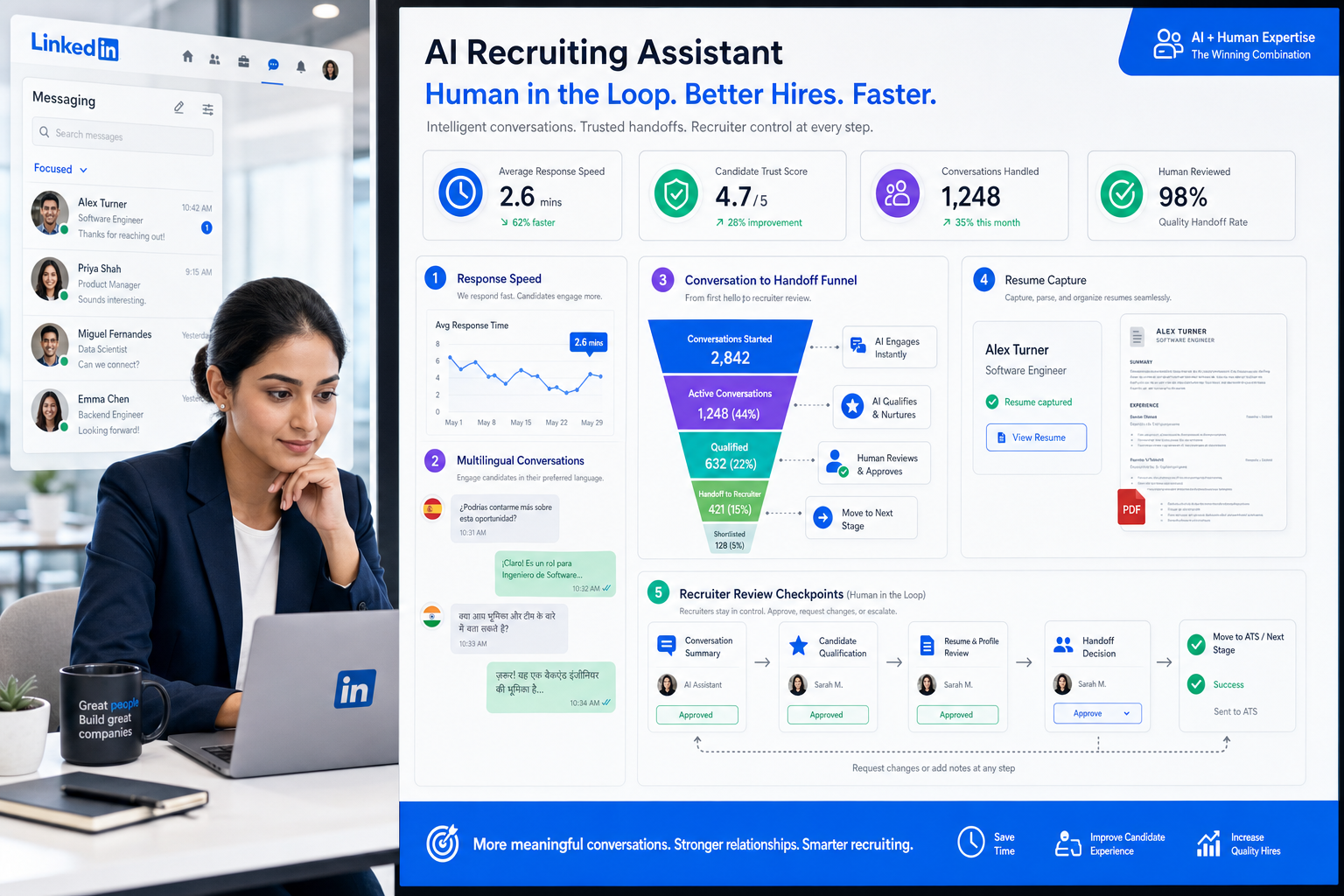
In my own LinkedIn-heavy searches, I have found that StrategyBrain AI Recruiter is most useful when the bottleneck is repetitive front-end communication rather than final assessment. Its always-on messaging, multilingual candidate communication, and automated collection of resumes and contact details can keep conversations moving when recruiters are offline or covering too many reqs at once. The important boundary is that the recruiter still reviews the resume, decides whether the profile truly fits, and owns the next step.
The underlying issue is not new. Younger candidates entering the workforce often arrive with a different decision model than many recruiters assume. They have grown up seeing constant examples of fast career movement, but many also came of age around economic uncertainty, which makes them practical about risk. They do not just want a role explained; they want to understand whether there is a real path forward, whether the employer supports ongoing learning, and whether the work arrangement feels purposeful instead of performative. In recruiting terms, that means the first messages, follow-ups, and early screening conversations carry more weight than teams sometimes realize.
That is where a lot of AI recruiting software succeeds or fails. If your workflow only automates outreach volume, you may generate activity without building confidence. But if the system helps recruiters respond quickly, answer routine questions clearly, surface interested candidates, and preserve context for human review, it addresses the exact pressure exposed by this Gen Z decision pattern. That is why buyers looking into ai recruiting companies, a machine learning recruiter workflow, or machine learning staffing support should evaluate not just matching engines, but how software handles the first layer of candidate trust and momentum.
- What AI Recruiting Companies Really Means
- Why Candidate Expectations Now Shape Software Value
- What AI Recruiting Software Actually Does
- AI Recruiting Software vs. a Traditional ATS
- Key Features to Look For
- Where LinkedIn Workflows Benefit Most From AI
- How a Machine Learning Recruiter Workflow Improves Matching
- How Machine Learning Staffing Changes Agency Work
- How to Evaluate the Right Platform
- Questions to Ask Vendors
- Common Mistakes Teams Make
- FAQ
What AI Recruiting Companies Really Means
When people search for ai recruiting companies, they are usually mixing together three different categories. The first is software vendors that sell AI-enabled recruiting tools. The second is staffing and search firms that use AI inside their delivery model. The third is hybrid service providers that combine recruiter labor with workflow automation.
That distinction matters because each option solves a different business problem. If you already have recruiters and want more process control, you are probably evaluating software. If your hiring volume is unstable or you need niche talent quickly, you may be looking for outside recruiting capacity. If your team has both execution problems and platform gaps, you may need to compare technology modernization with outsourced support.
From an operator's perspective, the mistake is treating all of them as interchangeable. Software helps you build repeatability, reporting discipline, and internal speed. A recruiting partner helps you add bandwidth or specialized market reach. The right choice depends on whether your problem is workflow design, recruiter capacity, candidate engagement, or all three at once.
Why Candidate Expectations Now Shape Software Value
One useful lesson from early-career hiring is that younger candidates often evaluate work as a pathway, not just a transaction. They want to know whether they will keep learning, whether advancement is visible, and whether the organization uses their time well. That outlook is partly shaped by constant exposure to public career stories online and partly by economic caution. They may be ambitious, but they are rarely naive.
Recruiters feel this in practical ways. A candidate who is open to hearing about a role may still disengage if the first exchange feels generic, if questions about growth go unanswered, or if the process creates friction without showing value. High-volume messaging alone does not solve that. What helps is a workflow that captures intent quickly, responds consistently, and preserves enough context for a recruiter to step in with judgment.
This is one reason AI recruiting software should be evaluated against real candidate behavior, not just feature lists. If the tool helps your team explain opportunity, follow up in the candidate's language, and keep momentum between first contact and resume review, it is addressing a modern recruiting problem. If it only creates more messages, it may increase noise rather than improve hiring.
What AI Recruiting Software Actually Does
AI recruiting software helps teams reduce manual work across sourcing, screening, ranking, outreach, scheduling, and reporting. In the strongest setups, it supports recruiters at the exact points where process drag usually appears: repetitive search refinement, inconsistent first-pass review, slow message handling, and fragmented funnel visibility.
In practice, the software is most helpful when it augments human work instead of pretending to replace it. Recruiters still calibrate with hiring managers, evaluate trade-offs, judge candidate quality, and decide who moves forward. AI is best used to organize information, accelerate routine communication, and improve prioritization.
For buyers comparing ai recruiting companies, the core question is not whether the platform sounds intelligent. The real test is whether it makes a recruiter faster and more consistent at tasks that still need human oversight.
Core jobs AI can support
- Sourcing: surfacing profiles through semantic or contextual search
- Screening: organizing resumes, questions, and profile signals for faster review
- Matching: identifying adjacent skills and related experience across non-identical titles
- Outreach: drafting or automating first-touch communication
- Scheduling: reducing coordination work and interview admin
- Analytics: showing funnel movement, delays, and recruiter activity patterns
AI Recruiting Software vs. a Traditional ATS
A traditional ATS is primarily a system of record. It stores candidate data, stage history, notes, and workflow steps. Those functions are still essential because they create process consistency and compliance visibility.
AI recruiting software goes beyond storage. It helps interpret the data and act on it. That can include candidate ranking, semantic search, response automation, transcript analysis, or pattern detection in the funnel. In other words, the ATS records the process, while AI tools try to improve how the process runs.
For many teams, the practical answer is not AI versus ATS. It is ATS plus AI, provided the extra layer does not create duplicate work or black-box decisions.
| Function | Traditional ATS | AI Recruiting Software |
|---|---|---|
| Candidate record management | Core strength | Usually included or connected |
| Workflow tracking | Core strength | Often enhanced with automation |
| Search | Keyword-based | Semantic or contextual options |
| Matching | Rules-based or limited | Machine learning-assisted ranking |
| Candidate communication | Templates or manual | Drafting and conversational automation |
| Insights | Static reports | Pattern detection and prioritization support |
Key Features to Look For
Feature comparisons can get noisy fast, so I prefer to evaluate AI recruiting software by workflow impact. If the tool cannot improve recruiter throughput, candidate communication quality, or decision clarity, the feature list does not matter much.
1. Contextual sourcing and matching
The platform should find equivalent or adjacent experience, not just exact resume wording. This is especially valuable in technical recruiting and cross-industry searches where titles are inconsistent.
2. Structured screening support
Resume parsing and profile structuring should help recruiters compare candidates faster. It should also be reviewable, so screened-out candidates can be audited for fairness and logic.
3. Human-readable ranking
Scores are useful when they help prioritize review, but risky when they cannot be explained. Recruiters should be able to see why a candidate surfaced and where the logic may be too narrow.
4. Communication automation with guardrails
This is where many teams see quick operational gains. Automated messaging can handle introductions, candidate questions, interest checks, and resume requests. But it should still preserve the recruiter's role in final qualification and next-step decisions.
5. Actionable reporting
Leaders need reports that show where roles stall, which channels convert, and where recruiter time disappears. A dashboard that cannot drive action is mostly decoration.
Where LinkedIn Workflows Benefit Most From AI
LinkedIn recruiting creates a very specific kind of workload. The challenge is not only finding people; it is maintaining a fast, credible conversation rhythm once people respond. Recruiters often need to introduce the role, answer questions about compensation or scope, confirm whether the candidate is open to moving, collect a resume, and capture contact details before the thread goes cold.
That is the use case where I have seen AI Recruiter fit best. It can automate initial LinkedIn conversations, respond around the clock, and communicate across languages without forcing the recruiter to stay glued to every inbox. On searches involving international talent or after-hours reply patterns, that alone can stabilize pipeline flow.
My own takeaway is straightforward: using AI Recruiter for repetitive LinkedIn steps works best when you define the handoff clearly. I let the system handle early engagement, routine job explanation, and resume collection, but I do not outsource fit judgment. Once a candidate shows genuine interest, I want the recruiter reviewing the CV, calibrating against the brief, and deciding whether to move to interview outreach.
Practical takeaway: In LinkedIn-heavy recruiting, speed of response often matters more than message volume, and AI is strongest when it protects that speed without taking over candidate qualification.
How a Machine Learning Recruiter Workflow Improves Matching
The term machine learning recruiter usually describes a recruiting workflow supported by models that score relevance, infer skill similarity, and improve prioritization based on patterns in structured data. It does not mean the recruiter disappears. It means the recruiter starts with a better-ordered set of possibilities.
That can be useful when titles are unreliable or skills are transferable across adjacent domains. A backend engineer may not use the same tool labels as your job description. A strong sales candidate may come from a related sector with different naming conventions. A machine learning recruiter workflow can help surface those overlaps faster than strict keyword logic can.
The caution is familiar to experienced recruiters: historical data can help, but it can also freeze old assumptions into the ranking process. That is why explainability, bias review, and recruiter override matter just as much as the matching itself.
Where machine learning is most useful
- Finding related skills across inconsistent resume language
- Rediscovering past applicants or archived prospects
- Prioritizing review lists for high-volume roles
- Highlighting adjacent candidates who may be trainable
- Supporting agencies that place across varied client definitions
How Machine Learning Staffing Changes Agency Work
Machine learning staffing becomes especially relevant when agencies or search firms juggle multiple clients, overlapping roles, and uneven job definitions. In those environments, speed matters, but so does defending why a candidate belongs on a shortlist.
The best machine learning staffing tools help firms reuse institutional memory more intelligently. They can resurface older candidates, recognize patterns from successful submissions, and spot equivalent backgrounds even when different clients describe the same need in different language.
For agency leaders, the right test is not whether the model produces a long list. It is whether the shortlist becomes more placeable. Can recruiters explain why the candidates surfaced? Can the logic adapt across clients without becoming so account-specific that it misses new profiles? Those are the desk-level questions that matter.
How to Evaluate the Right Platform
The phrase "best AI recruiting software" means very different things depending on your environment. A corporate TA team may care most about process consistency and candidate communication. A headhunter may care most about LinkedIn throughput and response capture. A staffing firm may care most about cross-client matching and rediscovery.
That is why evaluation should begin with workflow diagnosis. Map where time is lost, where candidate trust breaks down, where recruiters repeat manual tasks, and where the ATS fails to support action. Only then should you compare platforms.
Evaluation criteria that matter
- Search quality: Does the system find transferable experience or just approximate keyword matches?
- Communication fit: Can it support real candidate conversations without making every message feel robotic?
- Explainability: Can recruiters see why profiles were recommended or ranked?
- Workflow fit: Does it reduce recruiter effort or simply move work to another stage?
- ATS alignment: Will it strengthen your current process or create duplicate admin?
- Oversight controls: Can recruiters review, override, and audit decisions?
- Adoption likelihood: Will the team actually trust it enough to use it daily?
If your hiring depends heavily on LinkedIn outreach, also evaluate the practical details many demos skip: after-hours response handling, multilingual communication, resume capture, and handoff clarity from AI conversation to recruiter review.
Questions to Ask Vendors
- How does your system explain why a candidate was surfaced or ranked?
- Can recruiters override automation at every critical decision point?
- How does the tool handle candidate questions before a recruiter joins the conversation?
- What happens when a candidate replies after business hours or in another language?
- How are resumes and contact details captured and passed back to the recruiter?
- What bias review or audit controls are available?
- How does the software work with our ATS and existing communication workflow?
- What kind of implementation effort is required from recruiting operations and IT?
Common Mistakes Teams Make
1. Buying volume instead of workflow relief
More automation is not always better. If the software increases activity but creates weak handoffs or generic communication, the recruiter still pays for it later.
2. Treating candidate engagement like a minor step
For many roles, especially early-career and globally sourced roles, first-response quality strongly affects conversion. Software that ignores this can undermine the whole funnel.
3. Over-trusting rankings
Scores should support review order, not replace recruiter judgment. This matters in both machine learning recruiter and machine learning staffing workflows.
4. Ignoring multilingual and off-hours reality
A lot of recruiting now happens across time zones and outside office hours. If your process cannot keep pace, interested candidates cool off before a recruiter gets back to them.
5. Forgetting the handoff
Every AI-supported step should end with a clear human decision point. In my experience, that is where good systems stand apart from flashy ones.
FAQ
What are ai recruiting companies?
The term usually refers to software vendors, staffing firms that use AI in delivery, or hybrid recruiting services that combine human recruiting with automation.
What is AI recruiting software?
AI recruiting software is technology that helps with sourcing, screening, matching, outreach, scheduling, and reporting. Its best use is to support recruiter judgment, not replace it.
How is a machine learning recruiter workflow different from normal sourcing?
A machine learning recruiter workflow uses pattern recognition and similarity logic to surface relevant candidates beyond exact keyword matches. It helps recruiters prioritize better, especially when titles and skills vary by industry.
What is machine learning staffing?
Machine learning staffing refers to agency or staffing workflows that use machine learning to improve candidate rediscovery, fit scoring, shortlist prioritization, and cross-client matching.
Is AI useful for LinkedIn recruiting?
Yes, especially for repetitive early-stage tasks such as outreach, interest checks, answering common role questions, collecting resumes, and handling after-hours replies. Recruiters should still own final qualification.
Can AI recruiting software replace recruiters?
No. It can reduce repetitive work and improve prioritization, but recruiters still handle assessment, stakeholder alignment, candidate management, and final hiring recommendations.
What should buyers compare first?
Start with your actual bottleneck: sourcing, messaging, screening, scheduling, or reporting. Then compare tools against that workflow rather than buying based on broad AI claims.
Conclusion
The most useful ai recruiting companies are not the ones with the loudest AI language. They are the ones that fit the real mechanics of hiring: how candidates evaluate opportunity, how recruiters maintain momentum, and how teams preserve judgment while cutting manual work.
If your process depends on LinkedIn outreach, global response coverage, or better early-stage handoffs, AI can help materially. If your process needs stronger prioritization, a machine learning recruiter workflow or machine learning staffing model may add real value. In both cases, the standard is the same: faster work, clearer context, better trust, and no loss of recruiter accountability.