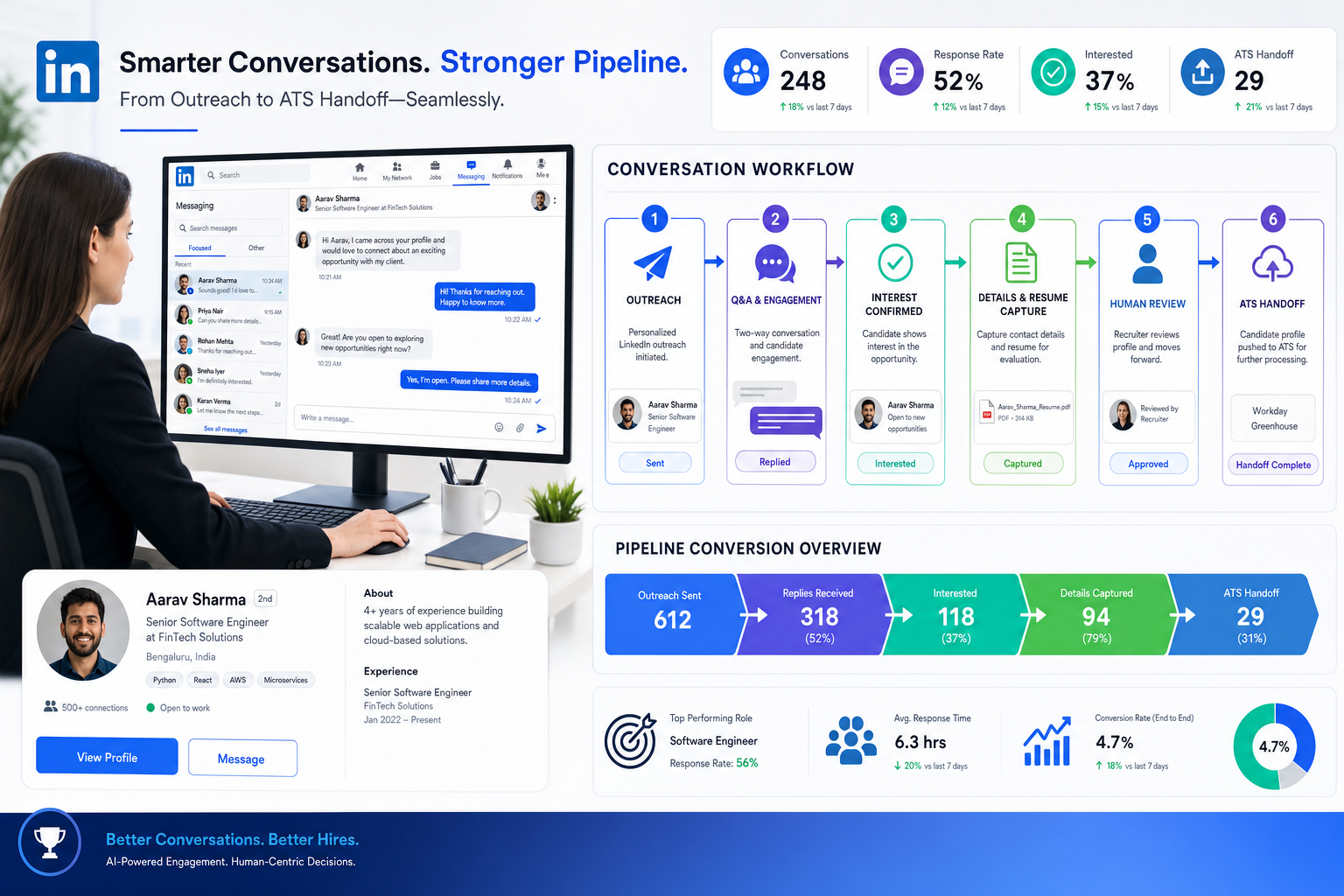
What stalls most ai recruiting companies evaluations is not outreach volume but weak handoffs—this article helps headhunters judge flow, control, and resume conversion before buying.
That sounds simple, but it is where many recruiting workflows break down. Internal talent teams, solo recruiters, and small search firms often lose time not in sourcing itself, but in the awkward middle: too many candidate threads open at once, slow follow-up after business hours, inconsistent handoffs, and unclear signals about who is genuinely interested. The result is familiar—good prospects cool off, recruiters spend hours managing messages instead of evaluating resumes, and hiring managers see a slower, noisier funnel.
In my own LinkedIn-heavy search work, I have found that AI Recruiter by StrategyBrain can reduce that friction when used for the right part of the workflow. It is most useful where recruiters need persistent outreach, timely follow-up, and multilingual candidate communication without turning every interaction into a manual task. The tool can introduce roles, answer routine questions, and collect resumes or contact details from interested prospects, but the recruiter still owns final judgment, resume review, and the decision about who moves forward.
The logic reminds me of a networking lesson many recruiters learn the hard way. At an event, the difficult part is often not starting a conversation but exiting it well. You need a natural moment to shift, acknowledge what you learned, wrap up respectfully, and move on without leaving the other person feeling dismissed. If you are distracted, scanning the room, or planning your escape instead of listening, the exit usually feels awkward because the relationship was weak from the start.
Recruiting conversations on LinkedIn follow a similar pattern. A recruiter reaches out, explains the opportunity, answers a few questions, gauges interest, and then has to move the exchange toward a useful next step—resume, contact details, interview interest, or a polite close. When that transition is clumsy, the pipeline stalls. That is one reason buyers searching for ai recruiting companies, an ai recruitment agency, or tools that support a machine learning recruiter workflow should evaluate how software manages not just outreach, but conversation flow, handoff quality, and recruiter control.
Key insight: In AI recruiting, the win is rarely “more messages.” The real win is moving candidates cleanly from first contact to a recruiter-owned next step.
Table of Contents
- What Buyers Usually Mean by AI Recruiting Software
- Why Conversation Flow Matters More Than Raw Automation
- AI Recruiting Companies vs AI Recruitment Agency Models
- Where AI Recruiting Software Adds Value in Practice
- LinkedIn Recruiting Experience: What Helped in My Workflow
- Why the ATS Still Decides Whether AI Works
- How to Compare AI Recruiting Companies
- Bias, Privacy, and Governance Questions to Ask
- Implementation Advice for Recruiters and HR Teams
- FAQ
What Buyers Usually Mean by AI Recruiting Software
When people search for ai recruiting companies, they are often looking at several categories at once: sourcing tools, candidate messaging systems, screening workflows, AI-assisted scheduling, recruiting CRM features, matching engines, and applicant tracking integrations. The market language is broad, but the buying decision should be specific.
In practice, AI recruiting software is most valuable when it supports repeatable tasks across the hiring funnel. That includes candidate discovery, first-touch outreach, back-and-forth qualification, resume capture, rediscovery of past applicants, interview coordination, and status communication. The point is not to replace recruiter judgment. The point is to reduce low-value repetition so recruiters can spend more time on calibration, relationship quality, and shortlist decisions.
For experienced recruiting teams, the better question is not “Which platform has the most AI?” It is “Which workflow bottleneck costs us the most time or trust?” That shift leads to better vendor comparisons and better implementation outcomes.
Why Conversation Flow Matters More Than Raw Automation
The networking reference above matters because recruiting is full of transition moments. A message thread has to move somewhere useful. A candidate asks about the role, compensation, location, or timing. The recruiter needs to answer clearly, assess interest, and either progress the candidate or close the loop professionally.
That is why one of the strongest evaluation angles for ai recruiting companies is conversation-to-conversion design. Does the tool simply send messages, or does it help the recruiter move from outreach to a meaningful next step?
Strong systems usually support at least three parts of that transition:
- Respectful progression: The candidate gets enough information to decide whether to continue.
- Clear next actions: Resume submission, contact capture, interview interest, or a qualified stop.
- Clean handoff: The recruiter can step in with context, not start over from scratch.
This is also where a true machine learning recruiter mindset becomes useful. Good recruiters already know that not every conversation should be pushed the same way. Automation should help prioritize and progress, not flatten every human exchange into a generic script.
AI Recruiting Companies vs AI Recruitment Agency Models
One reason this topic gets confusing is that buyers use the same words for very different operating models. Separating them early makes the market much easier to read.
AI recruiting software companies
These vendors provide technology that your internal team, recruiters, or coordinators use directly. The value usually shows up in sourcing support, outreach automation, candidate communication, resume intake, CRM activity, scheduling, analytics, and ATS-connected workflow management. This model fits teams that want process ownership and internal visibility.
AI recruitment agency services
An ai recruitment agency combines delivery capacity with technology. You are buying execution, not just software access. This can be the better fit if your team lacks recruiter bandwidth, needs specialty search help, or is entering new markets where language and time-zone coverage matter.
Recruiters using machine learning tools
A machine learning recruiter is usually not a separate profession. It is a practical operating style: using AI signals, search expansion, message automation, candidate rediscovery, and workflow analytics while keeping final accountability human. That distinction matters because the best results in hiring still depend on recruiter judgment, stakeholder alignment, and candidate trust.
Practical takeaway: If your team already knows how to recruit but loses time in message handling and early-stage coordination, software may be the cleaner answer. If you need outside delivery, an ai recruitment agency may be more suitable. If your recruiters are strong but overloaded, look for tools that make them more effective rather than invisible.
Where AI Recruiting Software Adds Value in Practice
Most teams should evaluate AI recruiting software by workflow stage, because that is where operational value becomes visible.
Sourcing and search expansion
AI can help recruiters widen search criteria, identify adjacent profiles, and uncover talent faster. This matters for both in-house teams and headhunters because speed to first relevant contact still shapes market outcomes.
Candidate outreach and first-response management
This is where many LinkedIn-centered workflows either scale well or collapse into admin work. A tool that can introduce the role, answer routine questions, and keep communication moving after working hours can be valuable, especially when recruiters handle multiple open searches at once.
Resume and contact capture
One overlooked bottleneck in outreach-heavy recruiting is not getting enough useful information back from interested candidates. AI-enabled conversation flows can make it easier to move from “sounds interesting” to an actual resume, email address, or phone number. That is a meaningful step because it turns loose interest into a recruiter-manageable pipeline record.
Screening and prioritization
Once resumes arrive, software can help organize, rank, or flag profiles for review. But this is also where buyers should slow down and ask harder questions about explainability, override controls, and fairness. Interest detection is not the same as qualification.
Scheduling and follow-through
Interview coordination remains one of the easiest places for automation to create visible time savings. Small delays create real candidate drop-off, especially with employed professionals who respond late in the day.
Candidate rediscovery
Teams with years of ATS history often underuse their own data. AI-supported rediscovery can surface relevant past applicants before recruiters restart sourcing from zero.
LinkedIn Recruiting Experience: What Helped in My Workflow
Because this topic often becomes too abstract, it helps to ground it in a LinkedIn workflow. In one search cycle, I was spending too much time on the same pattern: connect, explain the role, answer basic questions, wait, follow up again, ask for a resume, then manually sort who was serious and who had gone quiet. The real drag was not the initial sourcing. It was the conversation management between first interest and recruiter review.
That is where I found StrategyBrain AI Recruiter useful as a support layer rather than a replacement. I used it primarily for initial outreach continuity, after-hours replies, and gathering resumes or contact details once a candidate showed genuine interest. In multilingual searches, that support was especially helpful because candidates could respond in their own language rather than waiting for a recruiter to catch up across time zones.
What I appreciated most was not a promise of automatic hiring. It was the ability to keep conversations moving without losing the recruiter handoff. Once a candidate sent a resume or shared contact details, I still reviewed the background myself, checked role fit, and decided whether to move to interview. That division of labor is important. It keeps speed where automation helps and judgment where recruiters add the most value.
For readers evaluating tools, the relevant experience question is simple: does the platform help you progress candidate conversations cleanly, or does it just create more surface activity? If your workflow depends heavily on LinkedIn outreach, that distinction matters more than flashy AI language.
Why the ATS Still Decides Whether AI Works
Even the best conversation automation loses value if your applicant tracking system is disorganized. AI recruiting software works best when it connects to a stable applicant tracking system for recruiters, not when it tries to operate as a disconnected layer.
A strong ATS still provides the foundation for:
- Structured candidate records
- Consistent workflow stages
- Searchable talent history
- Permission controls and audit trails
- Reporting across funnel steps
These applicant tracking system benefits become even more important when AI is introduced. If outreach, resume capture, and early qualification activity are happening at scale, recruiters need reliable records of who said what, when interest was confirmed, and where a candidate sits in the process.
That is why the real question is not whether AI replaces the ATS. It is whether the AI strengthens the advantages of applicant tracking system use by making candidate movement cleaner and more visible.
How to Compare AI Recruiting Companies
Buyers do not need the longest feature list. They need the right operating fit. The table below reflects the criteria that matter most in serious evaluations of ai recruiting companies.
| Evaluation Area | What to Look For | Why It Matters |
|---|---|---|
| Conversation workflow | Role intro, candidate Q&A, interest confirmation, clean next-step prompts | Determines whether automation creates pipeline movement or just activity |
| Resume and contact capture | Reliable collection of resumes, email addresses, and phone details | Turns soft interest into usable recruiter records |
| ATS integration | Field mapping, sync logic, and stage continuity | Protects applicant tracking system benefits and reporting quality |
| Recruiter handoff | Clear point where human review takes over | Prevents hidden decision-making and supports accountability |
| Multilingual support | Candidate communication across languages and time zones | Useful for international hiring and after-hours response coverage |
| Screening transparency | Reviewable logic and override capability | Critical for trust, fairness, and compliance |
| CRM and rediscovery | Talent pools, nurture workflows, historical search value | Improves long-term sourcing efficiency |
| User fit | Useful for recruiters, headhunters, coordinators, and TA leaders | Adoption fails when only one user type benefits |
For service-based comparisons, use a different lens. An ai recruitment agency should be evaluated on delivery model, communication discipline, market specialization, and accountability. A recruiter using machine learning tools should be evaluated on how well automation improves throughput without weakening candidate quality or stakeholder trust.
Bias, Privacy, and Governance Questions to Ask
Any article about AI recruiting software that focuses only on speed is incomplete. Buyers should ask what the system automates, what it recommends, what it stores, and where human review remains mandatory.
Key governance questions include:
- How does the system explain candidate recommendations or workflow decisions?
- Can recruiters override outputs and document why?
- What audit trail exists for messaging, resume capture, and status movement?
- How is candidate data protected?
- Is customer data used to train shared models, or is it isolated?
- Which workflow steps still require recruiter or hiring-manager sign-off?
These questions matter even more in outreach-heavy environments. Messaging systems can create scale quickly, but they also create compliance, privacy, and quality risks if data handling and review responsibilities are vague.
Implementation Advice for Recruiters and HR Teams
The opening case about exiting conversations gracefully points to a useful implementation principle: define the transition points first. In recruiting, those transitions are where software either supports the process or disrupts it.
Start with one broken handoff
Do not begin with a vague goal like “use AI in recruiting.” Start with a narrow problem such as slow follow-up, inconsistent response handling, low resume conversion from LinkedIn outreach, or poor after-hours candidate engagement.
Decide where automation stops
For many teams, the right line is clear: let software handle repetitive outreach, candidate Q&A, and information gathering, but keep final qualification, shortlist review, and hiring decisions with recruiters.
Clean the ATS before scaling
If your stages, notes, or historical records are unreliable, AI will only accelerate confusion. This is one of the most practical advantages of applicant tracking system maturity: clean workflow data makes every automation layer more useful.
Measure movement, not hype
Track metrics such as response speed, interview-interest rate, resume capture rate, scheduling turnaround, and recruiter admin time. These reveal whether the tool actually improved the workflow that mattered.
Preserve candidate tone
The networking lesson still applies. Automation should not make interactions feel abrupt, inattentive, or transactional. Good recruiting software helps a recruiter move the conversation forward professionally, whether the outcome is a resume, an interview, or a courteous close.
FAQ
What do ai recruiting companies usually offer?
Most offer some combination of sourcing support, candidate outreach, messaging automation, screening assistance, scheduling, ATS integration, recruiting CRM features, analytics, and candidate rediscovery.
How is an ai recruitment agency different from AI recruiting software?
An ai recruitment agency provides hiring delivery as a service, often using technology behind the scenes. AI recruiting software gives your own team the tools to run the workflow internally.
What does a machine learning recruiter actually do?
A machine learning recruiter uses AI-assisted search, prioritization, outreach, and analytics to work more efficiently, while still owning relationship management, qualification, and hiring judgment.
Is AI recruiting software most useful for LinkedIn hiring?
It can be especially useful there because LinkedIn workflows often involve repetitive outreach, delayed replies, and many parallel conversations. Tools that support follow-up and candidate progression can reduce manual load significantly.
Can AI recruiting software replace recruiters?
No. In real recruiting operations, AI is most effective as workflow support. Recruiters still need to evaluate resumes, manage stakeholders, assess fit, and make final decisions.
What should I ask before buying AI recruiting software?
Ask how the tool handles conversation flow, resume capture, recruiter handoff, ATS integration, multilingual communication, transparency, and data governance. Those answers matter more than broad claims about automation.
Conclusion
The best way to evaluate ai recruiting companies is to stop treating AI as a single category. Some teams need better conversation management. Some need sourcing leverage. Some need agency capacity. Others need to help good recruiters operate more like high-output, well-supported machine learning recruiters.
If you remember the networking lesson, the market becomes easier to read. Starting a candidate conversation matters, but moving it forward gracefully matters more. The strongest tools help recruiters do exactly that: provide enough information, confirm interest, collect what is needed, and hand the next step back to a human who can judge fit properly. That is the standard worth using whether you are comparing software, reviewing an ai recruitment agency, or redesigning your LinkedIn recruiting workflow.