When ai recruiting companies create communication risk, this article helps agency leaders compare models and avoid pipeline leakage.
The real hiring drag is rarely one dramatic failure. It is the accumulation of small misses: late follow-up, weak recruiter notes, inconsistent candidate screening, hiring managers who do not see the full context, and talented people who disengage because no one handled communication with enough speed or clarity. For a solo recruiter, that means lost placements and evening admin. For a small agency owner, it means lower consultant productivity and uneven delivery. For an internal talent team, it means slower approvals, weaker employer impression, and avoidable pipeline leakage.
That is where AI-supported workflow can help, especially in communication-heavy channels like LinkedIn. In my own testing, AI Recruiter was most useful not as a replacement for recruiter judgment, but as a way to keep outreach moving, answer routine candidate questions across time zones, and collect resumes and contact details without the usual back-and-forth. The recruiter still has to review the profile, assess fit, and decide whether the next step is worth taking, but tools like AI Recruiter can remove a surprising amount of repetitive messaging work.
A useful way to understand this is to start outside recruiting for a moment. In a March 2024 interview about communication and leadership, a speech coach described a familiar business truth: people often have more to contribute than they manage to say, because pressure, nerves, and unclear delivery get in the way. In her world, better communication makes better leaders. In ours, better communication often makes better hiring outcomes too, because recruiting is full of moments where confidence, clarity, timing, and trust shape what happens next.
Her case also exposed something recruiters know well. When leaders step away, when responsibilities are handed off, or when growth depends on trusted recommendations, communication quality becomes operational risk. She spoke about delegation, culture fit, and the importance of resonance when assessing who should join a team. That is exactly why choosing among ai recruiting companies, an ai recruitment agency, or a machine learning staffing model is not just a software decision. It is a decision about how your team communicates, evaluates fit, preserves trust, and keeps judgment where it belongs.
- Why communication is the real starting point
- What AI recruiting software actually means
- Where AI helps most across the hiring workflow
- What to evaluate before you buy
- AI recruiting companies vs AI recruitment agency vs machine learning staffing
- How LinkedIn-heavy recruiting workflows benefit
- ATS fit, governance, and human oversight
- Common mistakes teams make
- A practical selection framework
- FAQ
Why communication is the real starting point
Most articles on AI recruiting software begin with automation features. In practice, experienced recruiters should start somewhere else: communication quality. Hiring breaks down when candidate outreach feels generic, when recruiters cannot maintain momentum, when handoffs between sourcer, recruiter, and hiring manager lose context, or when nobody can explain why a person was shortlisted in the first place.
That is why the leadership lesson from the communication coaching reference is so relevant. Strong communicators influence decisions, bring values into the room, and create trust. Recruiters do a version of that every day. They motivate passive candidates to reply, persuade hiring managers to consider non-obvious talent, and keep clients aligned when searches become difficult. If AI is going to be useful, it has to strengthen that communication system rather than flatten it.
In other words, the best recruiting software is not the one with the longest feature list. It is the one that helps your team speak more clearly through the workflow: better outreach, better follow-up, cleaner notes, more transparent matching, and less confusion at handoff points.
Key insight: AI helps recruiting most when it reduces communication friction without removing recruiter accountability.
What AI recruiting software actually means
AI recruiting software is no longer a separate box sitting next to the hiring stack. Most teams experience it as an intelligence and automation layer inside sourcing, screening, candidate matching, outreach, scheduling, rediscovery, and reporting.
For buyers researching ai recruiting companies, that matters because the market includes very different operating models. Some vendors provide software that supports your internal team. An ai recruitment agency combines tools with recruiter execution. A machine learning staffing approach usually sits closer to delivered hiring support, using matching systems and data-driven prioritization while human recruiters still manage relationships and final decisions.
The distinction sounds obvious, but it causes confusion all the time. Many leaders think they are comparing software products when they are really comparing service models. Others assume AI should replace recruiter judgment when the more realistic value is workflow support.
If you remember the communication case above, the lesson becomes clearer. Tools can support delivery, but they cannot remove the need for authenticity, alignment, and trustworthy judgment. That applies as much to recruiting as it does to public speaking or leadership.
Where AI helps most across the hiring workflow
The most useful way to evaluate AI is by hiring stage, not by broad vendor claims.
Sourcing and talent rediscovery
AI can search existing databases, rank likely-fit profiles, and surface strong past applicants who were previously overlooked or poorly timed. This is one of the highest-value use cases because many teams already have years of candidate data sitting in an ATS or CRM.
In communication terms, rediscovery matters because it prevents recruiters from restarting every search with zero context. A good system should help you re-enter prior relationships with better timing and cleaner records.
Screening and shortlist support
AI can organize resumes, infer likely skill alignment, cluster similar profiles, and support shortlist building. The important phrase is support. It should help recruiters get to a stronger first pass, while the final judgment stays with a human reviewer.
This is where buyers should ask hard questions. Can the system explain why someone was surfaced? Can recruiters override ranking logic easily? Does it help hiring managers understand the shortlist, or does it just generate one more opaque score?
Outreach and candidate engagement
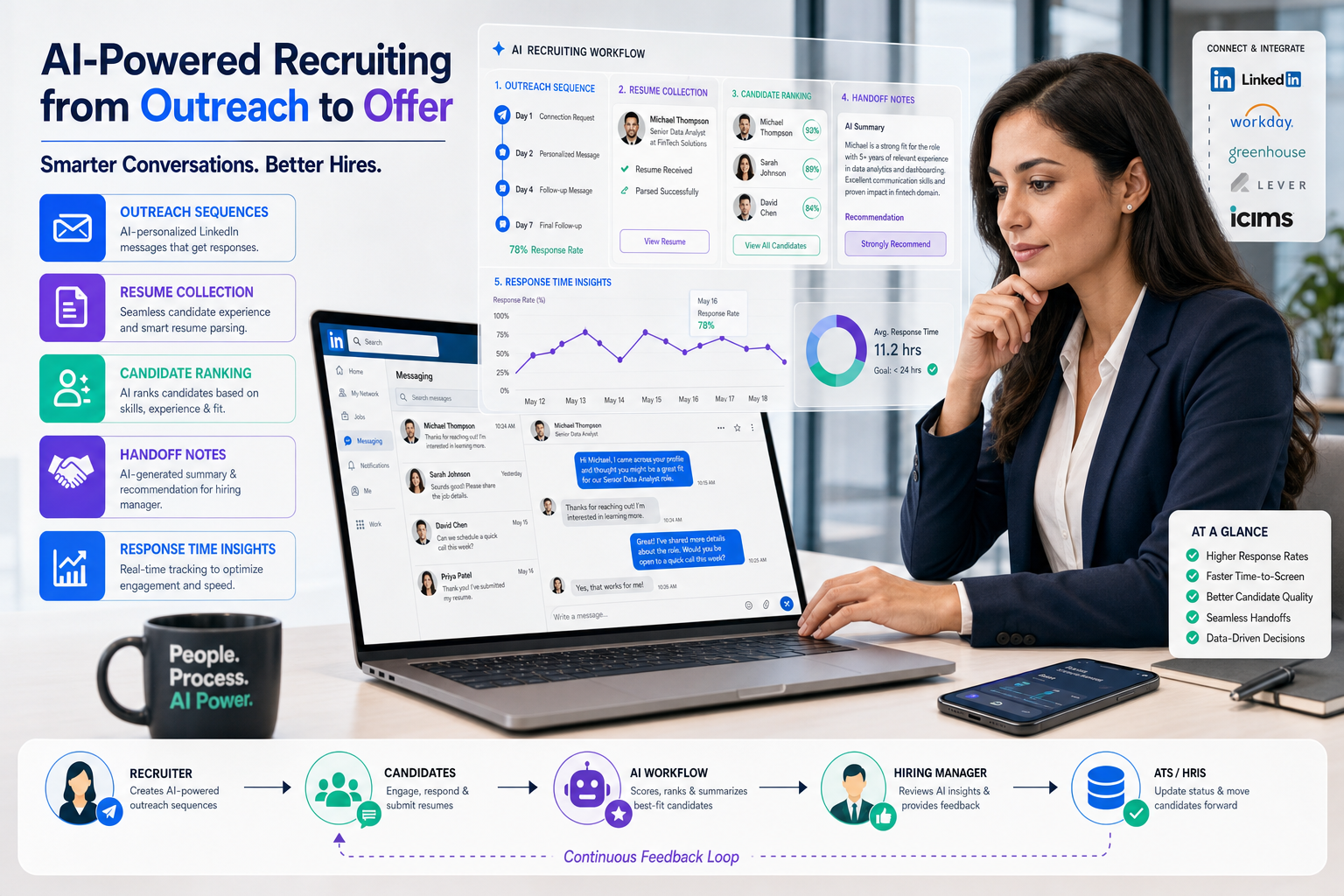
Outreach is one of the clearest areas where AI can add real value, especially for headhunters and agency teams who spend huge amounts of time on repetitive follow-up. In LinkedIn-heavy workflows, I have found that the strongest gain comes from maintaining conversational momentum. Candidates reply after hours, across regions, and often with simple qualification questions that do not need a recruiter to stop everything immediately.
That is where StrategyBrain AI Recruiter fits naturally. It can automate first-touch communication, handle round-the-clock multilingual responses, and gather resumes or contact details from interested candidates. What I liked in practice was not the idea of replacing a recruiter. It was being able to keep candidate engagement active while still holding back final qualification for an experienced human.
Interview coordination
Scheduling remains one of the least glamorous and most useful automation layers. Candidate experience suffers quickly when interview planning becomes slow or fragmented. AI-supported coordination can remove delays, reminders, and status-chasing from the process.
Reporting and workflow visibility
Good AI-supported reporting highlights stage bottlenecks, response patterns, and process drift. Weak reporting just produces dashboards. The difference matters because recruiting leaders need decision support, not decorative analytics.
What to evaluate before you buy
The reference article was ultimately about effective leadership, and one of its strongest underlying lessons was that preparation matters more than surface confidence. The same is true when evaluating AI recruiting tools. You need a decision framework that goes deeper than a demo script.
1. Can it improve communication quality, not just task speed?
Ask whether the system helps recruiters maintain clear, timely, candidate-friendly communication. Generic automation is easy to sell and hard to trust.
2. Does it preserve human judgment?
Any serious evaluation should confirm which steps are recommended, which are automated, and which still require recruiter review. If that line is blurry, adoption problems usually follow.
3. Will it fit your actual workflow?
Look for natural ATS, CRM, and outreach integration. Recruiters rarely want another dashboard that forces duplicate work.
4. Can it support delegation without losing context?
This point maps directly to the leadership handoff lesson in the source material. When work shifts between team members, systems need to preserve notes, communication history, and rationale. Otherwise, every handoff becomes fragile.
5. Does it help you assess resonance, not just resume match?
The source interview emphasized evaluating enthusiasm, commitment, conscientiousness, and fit. Recruiting tools cannot fully score those human signals, but they should make it easier for recruiters to capture and compare them.
| Evaluation area | Why it matters | What to ask |
|---|---|---|
| Candidate communication | Protects response rates and brand trust | Can it manage timely, context-aware follow-up? |
| Human oversight | Reduces compliance and quality risk | Which steps stay with the recruiter? |
| Workflow fit | Improves adoption | Does it connect cleanly with ATS, CRM, and messaging channels? |
| Handoff quality | Preserves context across the team | How are notes, resumes, and decision reasons tracked? |
| Explainability | Builds trust in matching | Can recruiters understand and challenge rankings? |
AI recruiting companies vs AI recruitment agency vs machine learning staffing
Search intent around ai recruiting companies is mixed, so buyers need clear categories.
When AI recruiting software is the better fit
Choose software when you already have a recruiting team and your main problem is workflow efficiency. This is common in internal talent acquisition functions and established agencies that need better outreach, matching, or scheduling support.
When an AI recruitment agency is the better fit
An ai recruitment agency makes more sense when the issue is not tooling but execution capacity. If your team lacks bandwidth, market reach, or specialist search ability, service delivery matters more than software access.
When machine learning staffing makes sense
Machine learning staffing tends to fit repeatable, higher-volume hiring environments where rapid candidate prioritization creates operational value. Staffing teams can use machine learning to narrow attention, but recruiters still need to validate availability, motivation, and client fit.
The practical rule is simple: buy for the bottleneck. If the core problem is communication load and repetitive outreach, AI-enabled software can help quickly. If the problem is execution ownership, software alone will not fix it.
| Model | Best for | Buyer still owns |
|---|---|---|
| AI recruiting software | Teams improving in-house workflow | Shortlisting, stakeholder alignment, final hiring decisions |
| AI recruitment agency | Teams needing delivered search support | Role briefing, internal decisions, final selection |
| Machine learning staffing | Repeatable or volume hiring | Workforce planning, approval, final fit judgment |
How LinkedIn-heavy recruiting workflows benefit
Because so much sourcing now starts in LinkedIn conversations, it is worth addressing that workflow directly. Recruiters often lose time in the same places: connection requests, role introductions, after-hours replies, qualification questions, resume collection, and the constant need to switch from messaging to record-keeping.
In that environment, AI Recruiter is useful for a very specific reason. It can keep the first layer of LinkedIn recruiting moving continuously, communicate in the candidate's language, and bring interested candidates to the point where a recruiter can review their resume and decide whether to advance them. That is especially helpful for independent recruiters, small agencies, and global hiring teams that cannot monitor every reply in real time.
My own view after reviewing this kind of workflow is that the benefit is less about novelty and more about stamina. Recruiters get tired; inboxes do not. A well-managed AI layer can absorb repetitive messaging volume, while the recruiter focuses on candidate quality, client calibration, and final interview decisions.
That said, LinkedIn automation should be evaluated carefully. You still need thoughtful targeting, role-specific messaging inputs, and human review before any candidate is presented. AI can start and sustain the conversation, but it should not be treated as the final voice of professional judgment.
ATS fit, governance, and human oversight
Many teams still evaluate AI and ATS as separate categories. Operationally, that is outdated. AI creates the most value when it strengthens the applicant tracking system rather than fragmenting it.
A strong setup should improve these basics:
- Better reuse of historical candidate records
- Cleaner movement from outreach to shortlist review
- More complete communication history
- Less manual status chasing
- Better visibility for hiring managers
Governance matters just as much. Responsible AI in recruiting should include explainable recommendations, audit trails, data protection, and clear human review checkpoints. If a provider cannot explain how recommendations are produced or what candidate data is retained, that is a serious concern.
This is another place where the communication-leadership angle matters. In hiring, trust is operational. Candidates, recruiters, and hiring managers all need confidence that the system is helping decisions, not hiding them.
Common mistakes teams make
Buying for hype instead of workflow need
If the tool sounds impressive but does not fix a real sourcing, communication, or handoff problem, it probably will not stick.
Confusing service delivery with software capability
Many buyers searching for ai recruiting companies are actually deciding whether they need execution help. Clarify that before comparing demos.
Underestimating communication as a hiring variable
Recruiters often focus on sourcing volume or matching accuracy while ignoring candidate communication quality. But speed, tone, and consistency directly affect conversion.
Expecting AI to replace recruiter judgment
Strong recruiters still own calibration, relationship assessment, and final recommendation. AI should remove repetitive work, not remove accountability.
Ignoring data quality and handoff quality
Poor CRM hygiene, incomplete notes, and weak delegation processes will limit the value of any AI layer.
A practical selection framework
If you are comparing options, use this sequence:
- Define whether you need software, an ai recruitment agency, or a machine learning staffing partner.
- Identify the main breakdown in your process: sourcing, outreach, screening, handoff, scheduling, or reporting.
- Review how the tool supports communication, not just automation.
- Check where human review stays mandatory.
- Test ATS and CRM fit before getting impressed by standalone features.
- Pressure-test governance, data handling, and explainability.
The market for AI recruiting software is broad, but the winning decision is usually narrower than buyers expect. Focus on the part of the workflow where communication, coordination, or repetitive admin is slowing your recruiters down. That is where practical value tends to appear first.
Used well, AI can help recruiters operate more like strong business communicators: clearer, faster, more consistent, and better prepared at the moments that matter.
FAQ
What do ai recruiting companies usually offer?
They may offer software, recruiting services, or a hybrid model. Some focus on workflow automation and matching, while others combine AI tools with human search delivery.
How is an ai recruitment agency different from AI software?
An ai recruitment agency provides delivered recruiting support. Software helps your team execute the work internally. The difference is operational ownership.
What does machine learning staffing mean?
Machine learning staffing usually refers to staffing workflows supported by data-driven candidate matching and prioritization. Human recruiters still handle relationship management and final recommendations.
Where does AI recruiting software help most?
It helps most in repetitive, communication-heavy stages such as sourcing support, candidate rediscovery, outreach sequencing, interview coordination, and reporting.
Can AI replace recruiter judgment?
No. It can support early workflow steps and reduce admin, but recruiter judgment remains essential for fit assessment, shortlist decisions, and stakeholder alignment.
Is LinkedIn a good use case for AI recruiting software?
Yes, especially for recruiters who handle high outbound volume. Messaging, follow-up, and resume collection are areas where AI can reduce manual work while keeping the recruiter in control of final qualification.
What should teams ask about compliance?
Ask how candidate data is stored, whether it is used for model training, how recommendations are explained, and what audit controls or oversight mechanisms exist.