When trust starts slipping, this article helps recruiting leaders judge artificial intelligence for recruiting without scaling cold outreach or candidate drop-off.
That tension is where many recruiting teams get stuck. A search can be well scoped, the outreach list can be strong, and the workflow can still break down because the human experience around it feels cold, controlling, inconsistent, or simply absent. For a solo recruiter, that means more after-hours admin and more dropped conversations. For a small agency owner, it means consultants spend too much time chasing replies instead of qualifying real interest. For an in-house TA leader, it can turn into slower hiring manager alignment, weaker employer brand signals, and candidates who disengage before the interview stage.
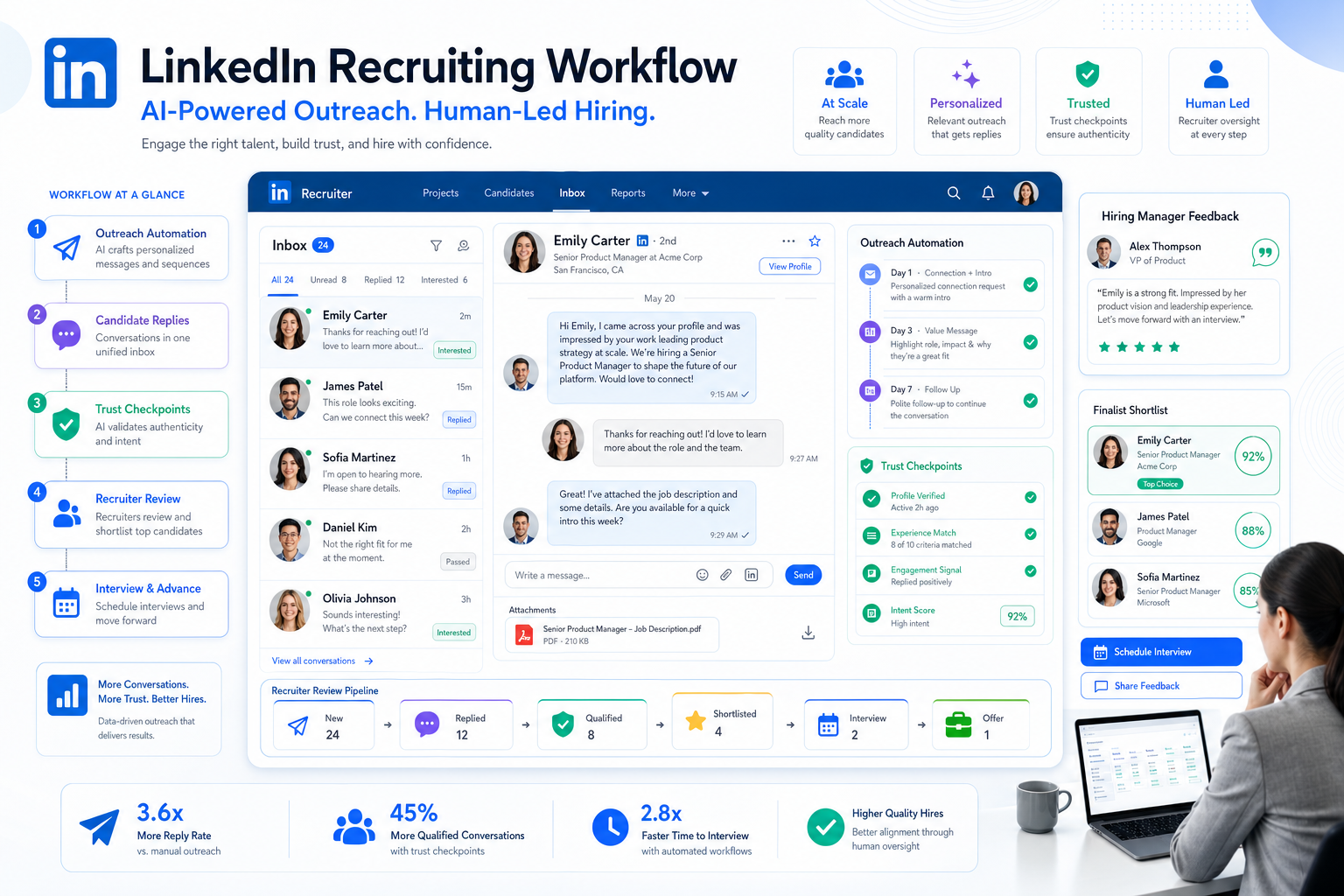
In my own workflow, tools like StrategyBrain AI Recruiter are most useful when they take over the repetitive communication layer without pretending to own the hiring decision. I have found its always-on candidate messaging, multilingual outreach support, and automated collection of resumes and contact details especially helpful for LinkedIn-heavy sourcing campaigns where response timing matters. The recruiter still has to review the resume, judge fit, and decide whether the candidate should move forward, but the system can remove a large amount of back-and-forth that usually drains the day.
A useful way to understand this is to step outside recruiting for a moment. In one workplace article, a small but telling detail stood out: employees reportedly felt less bitter when given a symbolic way to express frustration with a boss, because the deeper problem was not the object itself but a relationship shaped by distance, control, and unresolved tension. The better workplace, the article argued, is one where that pressure never builds because leaders listen, stay consistent, admit mistakes, and create an environment where people do not feel managed like machines.
That same logic shows up in hiring. A recruiter opens a requisition, checks the latest LinkedIn replies, updates candidate stages, and tries to nudge a hiring manager for feedback. If every interaction feels automated in the wrong way, candidates stop trusting the process and recruiters start operating like traffic controllers instead of relationship builders. That is why AI recruiting software should be evaluated less as a replacement tool and more as an operating layer for artificial intelligence for recruiting, especially across the AI in recruitment process and the real benefits of AI in recruitment.
Table of Contents
- Why Trust Is the Real Starting Point
- How AI Works Across the Recruitment Process
- Benefits of AI in Recruitment That Actually Hold Up
- What Good Management Teaches Us About Hiring Automation
- How AI Fits with an ATS and the Broader Hiring Stack
- What to Look For in AI Recruiting Software
- Where I Have Seen AI Help Most in Daily Recruiting Work
- Bias, Privacy, and Human Oversight
- How to Choose the Right System
- FAQ
Why Trust Is the Real Starting Point
Most conversations about AI recruiting software begin with efficiency. In practice, experienced recruiters usually care about something more specific: whether efficiency gains damage trust. That is the real filter.
The reference case above was not about recruitment technology, but it captured a familiar workplace dynamic. When people feel handled rather than heard, frustration rises. In hiring, that shows up when candidates receive vague status updates, get repetitive outreach from different team members, or feel that nobody owns the conversation. Recruiters feel the same pressure from the other side when hiring managers give inconsistent feedback, change priorities without notice, or use the process as a control mechanism instead of a shared decision-making workflow.
So before defining software features, it helps to define what good hiring behavior looks like. Borrowing from the leadership principles in that workplace article, strong recruiting operations usually have five traits:
- Open communication: candidates and hiring managers know what is happening and what is expected next.
- Respect for people: the process does not treat candidates like records moving down a conveyor belt.
- Humility in decisions: recruiters and managers can revisit assumptions when the shortlist is weak or the role definition is flawed.
- Visible ownership: someone is clearly responsible for keeping the process moving.
- Consistency: the experience should feel coherent across sourcing, screening, scheduling, and follow-up.
That framework matters because artificial intelligence for recruiting works best when it reinforces those behaviors. It works poorly when it scales confusion faster.
How AI Works Across the Recruitment Process
To evaluate artificial intelligence for recruiting properly, map it to each stage of hiring rather than treating it as one giant capability. That makes it easier to judge where AI is removing friction and where it still needs firm human oversight.
Sourcing and talent discovery
At the top of funnel, AI can help recruiters search broader talent pools through semantic search, related-skills logic, and contextual matching. This is especially useful on LinkedIn and in internal talent databases where the right profile may not use the exact words from the job description.
In the AI in recruitment process, sourcing support is most credible when it widens the search without lowering standards. A recruiter still has to pressure-test whether the surfaced profiles actually reflect the role's required capabilities, level, market conditions, and compensation reality.
Outreach and first response handling
This is one of the most practical AI use cases for recruiters who depend on active sourcing. AI can initiate outreach, answer common candidate questions, follow up after hours, and determine whether someone is open to a conversation. That matters because sourcing quality is often wasted by response lag.
In my experience, this is where AI Recruiter style automation can be helpful. When a system handles initial candidate messaging, confirms interest, and gathers resume or contact details, the recruiter can focus on evaluating the response instead of babysitting every inbox thread. The key boundary is simple: interest detection is not the same as qualification.
Resume screening and qualification
Screening remains one of the most debated parts of AI recruiting software. A system can parse resumes, extract work history, summarize relevant experience, and flag gaps or likely fit. That can speed up review, especially in high-volume workflows.
But resume screening is also where overconfidence causes trouble. If the role profile is weak or overly narrow, AI can scale that weakness. Recruiters need to check whether scoring logic is rewarding real capability or just title familiarity, employer pedigree, or resume style.
Scheduling and stage coordination
Interview scheduling is less glamorous than sourcing, but often more painful in day-to-day execution. AI-assisted scheduling can suggest times, manage reminders, handle reschedules, and reduce candidate drop-off caused by unnecessary delay. For lean teams, that is a meaningful operational improvement.
Done well, it also supports the open-door style of process communication that candidates appreciate. Done badly, it creates the digital equivalent of a silent office where nobody knows who is accountable.
Interview support and summaries
Some systems now help with interview note structuring, rubric prompts, recap generation, and interviewer follow-up. These functions can improve process discipline, especially when multiple stakeholders are involved and feedback quality varies.
The caution is the same as with leadership: consistency is useful, but false certainty is dangerous. Summaries should support interviewer judgment, not replace it.
Reporting and pattern recognition
AI can also highlight funnel bottlenecks, message response trends, source conversion patterns, and stage delays. That helps TA leaders identify where the process is underperforming, whether the problem is search quality, candidate communication, hiring manager responsiveness, or interview discipline.
Benefits of AI in Recruitment That Actually Hold Up
The real benefits of AI in recruitment are easier to defend when they are tied to ordinary recruiting work instead of inflated promises. In practical terms, I see the strongest value in five areas.
- Faster response handling: outreach and follow-up do not stall when recruiters are offline.
- Less administrative drag: teams spend less time repeating the same messaging and coordination tasks.
- Better use of recruiter judgment: recruiters review warmer conversations and more structured candidate information.
- More consistent workflow execution: stages are easier to manage when communication and data capture are standardized.
- Improved candidate coverage across geographies: multilingual and time-zone-friendly communication can keep conversations moving.
These are meaningful gains, but they only matter if the process still feels human where it should. Candidates generally accept automation for logistics and first-touch coordination. They are less forgiving when automation replaces transparency, empathy, or decision ownership.
Key insight: The best AI recruiting software does not make hiring feel more robotic. It removes enough repetitive work that recruiters can act more like trusted advisors.
What Good Management Teaches Us About Hiring Automation
The workplace article behind this opening offers a surprisingly useful editorial frame for recruiting technology. It argued that a healthy environment does not rely on pressure-release gimmicks. It relies on leadership behaviors that prevent frustration from hardening in the first place.
That maps cleanly to hiring. If your recruiting operation needs endless apology emails, frantic manual follow-ups, and ad hoc explanations for why candidates are confused, the issue is not just workload. It is workflow design.
Open-door policy becomes transparent hiring communication
Good bosses do not rule through distance and control. In recruiting terms, that means candidates should not feel locked out of the process. AI can help by keeping communication active, but the messages still need clarity, escalation paths, and a visible human owner.
Fun at work becomes respectful candidate experience
The original piece warned against treating employees like machines. Recruiters should use that as a direct warning about automation. If every message sounds generic, repetitive, or evasive, the process may be efficient on paper but poor in lived experience.
Humility becomes audit and override discipline
Strong managers admit mistakes. Strong recruiting systems do the operational equivalent by allowing overrides, surfacing weak assumptions, and making it easy to revisit criteria when the market signal does not match the initial brief.
Passion becomes visible recruiter ownership
Candidates can tell when no one is really steering the process. AI should make recruiter ownership more visible, not less. The recruiter should have more time to advise, challenge, and close, not disappear behind software.
Consistency becomes trust at scale
The original article praised leaders who are the same person across settings. Hiring teams need the same consistency across channels and stages. If sourcing outreach sounds polished but interview coordination is chaotic, trust breaks. This is one reason AI in recruitment process design should be evaluated end to end, not as isolated features.
How AI Fits with an ATS and the Broader Hiring Stack
For most organizations, AI recruiting software does not replace the applicant tracking system. The ATS remains the system of record for jobs, stages, notes, approvals, and compliance documentation. AI adds intelligence and automation on top of that foundation.
| Function | ATS Role | AI-Enhanced Role |
|---|---|---|
| Candidate records | Stores applicant history and status | Summarizes profiles and surfaces patterns |
| Search | Keyword and filter search | Semantic and skills-based discovery |
| Outreach | Basic templates or manual messaging | Follow-up automation and response handling |
| Screening | Manual review workflows | Structured summaries and fit prompts |
| Scheduling | Stage movement and calendar handoff | Automated time suggestions and reminders |
| Reporting | Pipeline visibility | Bottleneck insight and pattern recognition |
If your team relies heavily on outbound sourcing, especially on LinkedIn, then the software question becomes more specific: does the AI layer help you communicate at scale without undermining candidate trust or creating more cleanup work later?
What to Look For in AI Recruiting Software
When I evaluate tools in this category, I separate technical language from operational value. A feature only matters if it solves a real recruiting bottleneck.
Useful capabilities to prioritize
- Semantic search: useful when exact-title matching misses strong talent.
- Automated outreach handling: valuable for active sourcing teams with heavy inbox volume.
- Multilingual candidate communication: important for cross-border hiring and distributed searches.
- Resume and contact capture: reduces manual transfer work after interest is confirmed.
- Screening support: helps recruiters review faster without hiding logic.
- Governance controls: necessary for auditability, privacy, and permissions.
- Clear role boundaries: the system should support, not obscure, recruiter and manager accountability.
Buyers should test these functions using real roles, not demo-friendly examples. If the output looks polished but does not improve an actual requisition workflow, it is not ready for production.
Where I Have Seen AI Help Most in Daily Recruiting Work
My own strongest use case for this category is still outbound recruiting support, especially when LinkedIn sourcing creates more live conversations than one recruiter can handle well in real time. In those situations, the gap is rarely search alone. The gap is what happens after a prospect replies.
Using StrategyBrain AI Recruiter, I found the practical value was not in replacing recruiting judgment but in protecting momentum. The system could keep candidate conversations active after hours, handle early role questions, and capture resumes and contact information from interested prospects. For searches involving international candidates, multilingual communication support also reduced the awkward delays that usually appear when messages arrive outside the team's working day.
What I would not outsource is the final qualification step. The resume still needs a recruiter review. The market context still needs human interpretation. A candidate can sound engaged and still be wrong for the role. That distinction matters, and any mature AI workflow should preserve it.
For recruiters who want to see how those conversation flows are structured, the conversation examples and broader LinkedIn recruiting notes are useful reference points. They show why the biggest gains often come from continuity of communication rather than from aggressive automated scoring.
Bias, Privacy, and Human Oversight
No balanced article on artificial intelligence for recruiting should ignore the risks. The same automation that speeds up sourcing and communication can also scale poor assumptions, unclear criteria, and weak oversight.
The most common risk areas are familiar:
- Bias amplification: if past hiring patterns were narrow, AI can repeat them.
- Weak explainability: black-box recommendations are hard to defend.
- Candidate privacy concerns: especially where messaging, resumes, and contact data are captured.
- Over-automation: teams mistake response automation for true qualification.
- Process drift: no one notices that the workflow has become impersonal or inconsistent.
Any system used in production should offer clear controls around data handling, review trails, permissions, and human override. If a vendor cannot explain how customer data is isolated, retained, and protected, that should slow the buying process immediately.
How to Choose the Right System
Choosing AI recruiting software should start with diagnosis. Ask where your current process loses trust, time, or candidate momentum.
- Identify the actual bottleneck. Is the problem search quality, reply handling, scheduling, screening speed, or manager alignment?
- Define acceptable automation boundaries. Decide what the system can automate and what must stay human-led.
- Test on real requisitions. Use recent or live searches, not idealized sample data.
- Review communication quality. Especially if your team does outbound sourcing, evaluate message tone and candidate clarity.
- Check ATS fit. The tool should strengthen your existing workflow, not fracture it.
- Audit governance and privacy. Look for explainability, data controls, and override discipline.
- Include recruiters in the evaluation. Software fails when bought only by leadership or operations.
If your work is heavily LinkedIn-based, give extra weight to response handling, multilingual communication, and the handoff from initial interest to recruiter review. Those are often the make-or-break points for real adoption.
FAQ
What does artificial intelligence for recruiting mean in practice?
It means using software to support or automate parts of hiring such as sourcing, outreach, screening, scheduling, and reporting. In well-run teams, AI supports recruiters instead of replacing hiring judgment.
Where does AI in recruitment process help most?
For many teams, the strongest early wins are in outbound messaging, response handling, scheduling, profile summarization, and search. These are repetitive tasks that consume time but do not require final hiring judgment.
What are the most credible benefits of AI in recruitment?
The most defensible benefits are faster communication, lower admin workload, more consistent workflows, better use of recruiter time, and stronger support for high-volume or cross-border hiring.
Can AI recruiting software replace recruiters?
No. It can reduce repetitive work and improve workflow speed, but recruiters still need to assess resume quality, advise hiring managers, manage candidate relationships, and make defensible decisions.
Is AI recruiting software mainly useful for LinkedIn recruiting?
No, but LinkedIn-heavy sourcing is one of the clearest use cases because response timing, follow-up volume, and manual messaging burden are so high. That makes automation especially valuable when used carefully.
How should teams avoid damaging candidate trust?
Use automation for logistics and early coordination, keep a visible human owner in the process, review message quality carefully, and never let automated engagement stand in for transparent decision-making.
Conclusion
AI recruiting software is easiest to justify when it solves a problem recruiters already feel: too much manual coordination, too many unanswered candidate messages, and too little time for real evaluation and relationship-building. But the opening lesson still matters. When a process is built around control, distance, or machine-like treatment, technology only makes the tension more obvious.
The better path is to use artificial intelligence for recruiting as support for a hiring process that is already trying to be transparent, consistent, and accountable. That is where the best results from AI in recruitment process design appear, and it is where the long-term benefits of AI in recruitment are most likely to hold up under real recruiting pressure.