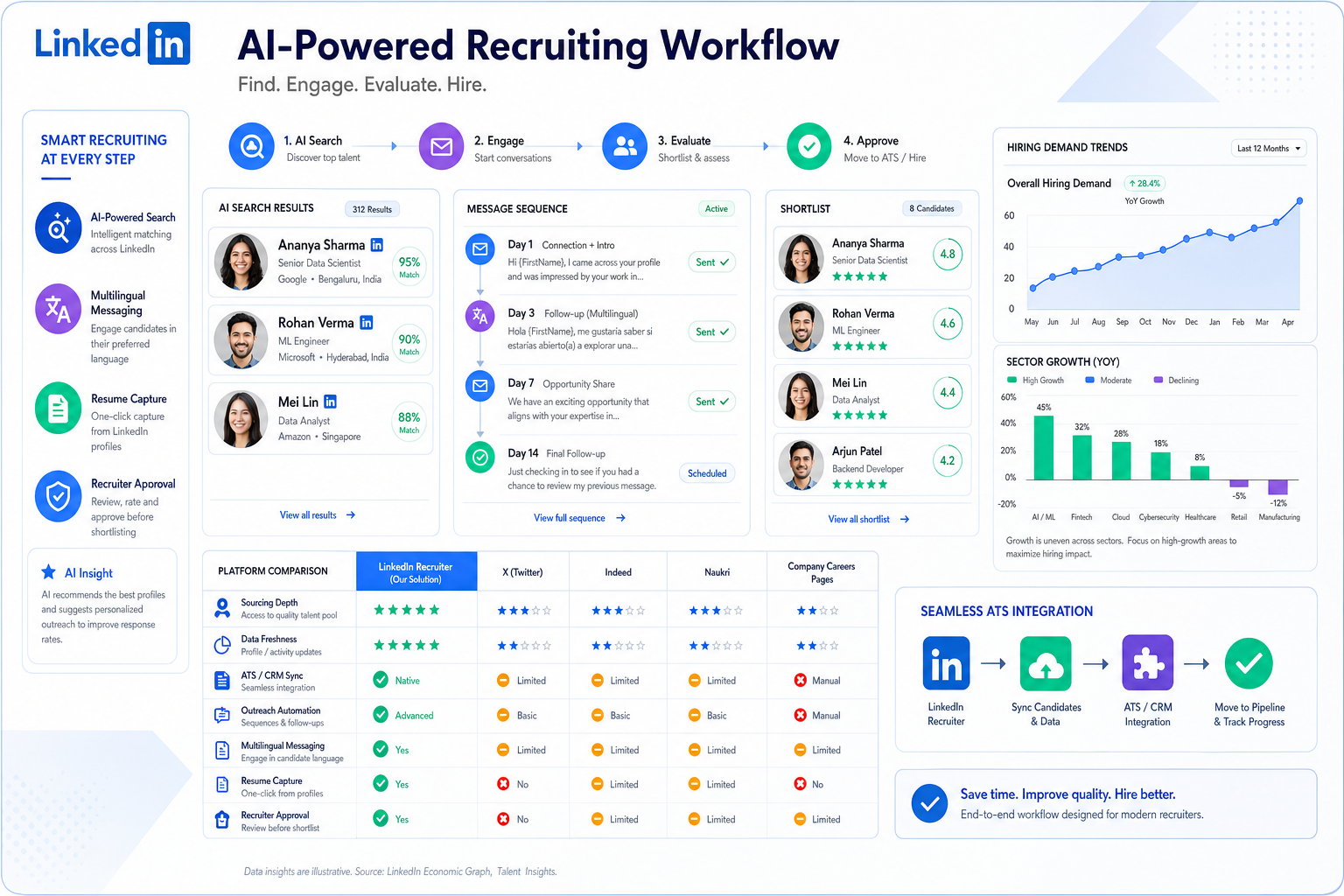
When hiring demand shifts unevenly, recruiters can use this ai recruiting tool guide to judge workflow fit, compare sourcing depth, and avoid shortlist delays from stale data and follow-up bottlenecks.
That matters most when the market starts sending mixed signals. Recruiters may see wages rising, hours worked edging up, and hiring demand returning in selected functions, yet the desk reality still feels harder: more outbound messages, thinner response rates, and not enough qualified people for the roles clients suddenly want filled first. For a solo recruiter, that means evenings lost to follow-up and profile cleanup. For a boutique search firm, it can mean slower shortlist delivery, inconsistent candidate records, and strained client confidence. For an in-house talent lead, it often shows up as hiring managers asking why demand is improving while pipeline quality is not.
In my own LinkedIn-heavy sourcing work, I found that AI Recruiter helped most when the problem was not strategy but execution drag. Its always-on candidate messaging, multilingual follow-up, and automated résumé/contact capture reduced the repetitive back-and-forth that usually piles up after outreach starts. Just as important, the recruiter still owns the final judgment: reviewing résumés, checking real fit, and deciding who moves forward.
A useful way to frame this comes from an older Canada employment update that did not talk about software at all, but did capture a pattern recruiters still recognize. Wages were up 2.6 percent year over year, weekly hours had been improving for months, and the expectation was that August and September hiring could strengthen if employer demand followed through. At the same time, some functions looked active while others lagged, and employers were already struggling to find enough industrial management talent, electricians, and millwrights. That is a familiar recruiting moment: demand signals turn positive, requisition priorities shift, and a recruiter has to review open roles, re-rank search priorities, reopen older candidate lists, and respond to late LinkedIn replies before the market gets tighter.
That kind of market turn is exactly where ai sourcing becomes more than a feature label. When hiring demand rises unevenly across sectors, recruiters need an ai recruiting tool that can surface adjacent talent quickly, keep communication moving, and preserve decision quality under time pressure. The rest of this guide uses that hiring-season logic to evaluate what the best ai recruiting tools should actually do, how AI candidate sourcing works in practice, and where recruiter control still matters most.
- Why market timing changes sourcing requirements
- What is AI candidate sourcing?
- What the best AI recruiting tools should offer
- How AI sourcing works in real recruiting workflows
- Features to compare before you buy
- LinkedIn sourcing experience and workflow lessons
- How sourcing connects to applicant tracking systems
- Pricing considerations and team fit
- Common mistakes when buying AI sourcing software
- FAQ
Why Market Timing Changes Sourcing Requirements
Most recruiting software evaluations start with features. Experienced recruiters often start somewhere else: what happens to our workflow when the market speeds up?
The employment snapshot from Canada in mid-2014 is still useful because it shows the operational side of hiring cycles. Earnings had climbed, hours worked had inched up over several months, and there was cautious optimism that hiring could improve in late summer and early fall. Construction had added 31,800 jobs in June, while manufacturing and business support functions were being watched more closely. Meanwhile, candidate scarcity was already a problem in industrial management, electrical trades, and millwright hiring.
Those conditions create a practical sourcing test. Recruiters do not just need more names in a database. They need to decide which sectors are actually moving, which roles will tighten first, and whether they can re-engage passive candidates fast enough before the market catches up. If the tool cannot support that sequence, it will not help much when demand changes quickly.
| Market Signal | Recruiting Impact | What an AI recruiting tool should help with |
|---|---|---|
| Wages rising | Candidates become more selective | Better targeting and more relevant outreach |
| Hours worked rising | Employers may be getting busier before adding headcount | Faster pipeline building before roles fully open up |
| Sector-specific job growth | Some talent pools tighten sooner than others | Adjacent-skill discovery and search expansion |
| Skilled trade shortages | Manual sourcing becomes slower and less reliable | Rediscovery, follow-up automation, and recruiter prioritization |
Key insight: The best AI candidate sourcing setups do not replace recruiter judgment; they help recruiters respond faster when labor-market pressure changes before the pipeline does.
What Is AI Candidate Sourcing?
AI candidate sourcing uses automation, machine learning, natural language search, and relevance ranking to identify potential candidates across multiple sources. In practical recruiting terms, it helps you move from role brief to shortlist with fewer manual searches, fewer tabs, and less dependence on memory.
This is narrower than general recruiting software. A broad platform may include career sites, scheduling, approvals, onboarding, or analytics. An ai recruiting tool built for sourcing is designed for candidate discovery, search expansion, ranking, rediscovery, and outreach support.
It is also different from traditional sourcing. Manual Boolean work still has value, especially for niche roles, but it is slower when the market changes quickly and candidate supply is uneven. AI sourcing adds semantic search, title normalization, skill adjacency, multi-source profiles, and ranking logic so recruiters can review likely matches more efficiently.
Quick glossary
- AI sourcing: AI-assisted search and matching for candidate discovery.
- AI recruiting: A broader category that can include sourcing, outreach, screening, and workflow support.
- Candidate rediscovery: Finding previously known candidates who fit a new role or changed market.
- Talent intelligence: Market and talent-pool insight related to skills, geography, and supply.
- Recruiter control: The human review layer that validates fit, fairness, and next-step decisions.
What the Best AI Recruiting Tools Should Offer
When recruiters search for the best ai recruiting tools, they are rarely asking for the longest software list. They want to know what separates a usable sourcing platform from a rebranded resume search product.
A strong ai recruiting tool for sourcing should perform well in six areas: data reach, data freshness, search quality, workflow support, outreach support, and system connectivity. Those categories matter even more when demand rises unevenly by function or region, because recruiters need to move quickly without losing control.
| Evaluation Area | What to Look For | Why It Matters |
|---|---|---|
| Data coverage | Broad role, geography, and source coverage | Improves reach for hard-to-fill and passive searches |
| Data freshness | Recent updates and clear refresh logic | Reduces wasted outreach to stale profiles |
| Search quality | Semantic search and strong relevance ranking | Surfaces people beyond exact keyword overlap |
| Workflow fit | Shortlists, notes, handoffs, approvals | Helps teams operationalize sourcing |
| Outreach support | Sequencing, reminders, response handling | Connects discovery to engagement |
| Integrations | ATS, CRM, email, reporting | Prevents duplicate work and fragmented records |
If you are comparing the best ai recruiting tools with broader recruiting platforms, start with the bottleneck. If the problem is not enough qualified pipeline, sourcing depth matters first. If the problem is process control after application, end-to-end recruiting software may deserve more weight.
Who benefits most?
- Agency recruiters: Need speed-to-shortlist across multiple briefs.
- In-house talent teams: Need repeatable pipeline building when volume rises.
- Specialist sourcers: Need better search precision for niche skill sets.
- HR teams: Need sourcing support without adding heavy admin overhead.
- Hiring managers: Benefit indirectly from faster, more relevant shortlists.
How AI Sourcing Works in Real Recruiting Workflows
In practice, ai sourcing usually starts with a role brief, intake notes, or a job description. The tool interprets required skills, likely adjacent titles, seniority, geography, and trade-offs. Better systems do more than keyword matching. They recognize alternative career paths and related skill patterns.
Next comes ranking and profile assembly. The platform builds a usable view of the candidate from its source environment, then prioritizes likely matches. That stage only works when freshness and source quality are strong enough to trust the output.
Then the workflow shifts from search to action. Recruiters review the list, reject weak matches, prepare outreach, and sync approved prospects into the wider hiring process.
A practical workflow sequence
- Read the market signal: Identify whether hiring demand is broad or concentrated in specific functions.
- Define the role precisely: Separate must-haves from trainable skills.
- Expand the search: Include adjacent titles and alternative backgrounds.
- Review ranking critically: Accept that AI can accelerate review but not replace judgment.
- Start outreach fast: Engage candidates before the market tightens further.
- Sync to systems of record: Move serious prospects into ATS or CRM workflows.
This is where weak tools tend to fail. They may generate a decent first search but create friction in the follow-up work, especially when response handling, notes, and handoffs still sit outside the main workflow.
Features to Compare Before You Buy
If you are evaluating an ai recruiting tool, do not stop at a generic AI feature checklist. Test the platform against the sourcing problems that actually slow recruiters down.
1. Data sources and source transparency
Ask where profiles come from, how broad the source mix is, and how often records are refreshed. In tight labor markets, stale profiles waste more time than no profiles.
2. Search methodology
Look for natural language search, semantic matching, and the ability to distinguish core requirements from preferred ones. Test non-standard titles and edge cases. Shortage roles rarely fit perfect taxonomy.
3. Relevance ranking and candidate rediscovery
Ranking quality saves time only if recruiters can understand and tune it. Candidate rediscovery also matters, especially when older applicants or past outreach records become relevant again as demand shifts.
4. Outreach workflow
Good sourcing software should reduce repetitive communication work without turning outreach into spam. Recruiters still need control over message quality and next steps.
5. Integrations with ATS and CRM workflows
If sourced prospects cannot move cleanly into your systems of record, reporting and collaboration will break down. Integration quality matters as much as search quality over time.
6. Governance and auditability
Ask how the platform supports human review, approval controls, and visibility into recommendation logic. Responsible AI recruiting depends on this layer.
LinkedIn Sourcing Experience and Workflow Lessons
Because a large share of AI candidate sourcing today is tied to outbound prospecting, LinkedIn workflow is where many recruiters feel the limits of manual effort first. The pattern is familiar: a search starts well, responses arrive at uneven hours, candidate questions stack up, resumes come back in different formats, and the recruiter still needs to decide who is actually worth interviewing.
That is the part of the workflow where I found StrategyBrain AI Recruiter most useful. I did not use it as a replacement for sourcing judgment. I used it to keep momentum after search. For roles where response speed mattered, the system handled candidate communication around the clock, replied in the candidate's language when needed, and helped collect resumes and contact details from interested people. That removed a lot of the repetitive LinkedIn messaging lag that normally builds up after the first outreach wave.
What I liked in practice was the division of labor. The AI managed repetitive communication, but I still reviewed every résumé, checked whether the candidate's background actually matched the brief, and decided who should move to a real interview conversation. For recruiters who want to see how that setup works, the product overview and the broader company site give a better sense of the workflow than generic AI claims do.
This kind of support is especially useful when hiring demand picks up in specific functions faster than your team can respond manually. In those moments, an ai recruiting tool earns its value less by sounding intelligent in a demo and more by keeping sourcing, follow-up, and record capture moving without losing recruiter oversight.
How Sourcing Connects to Applicant Tracking Systems
Many teams shopping for an ai recruiting tool are also reassessing their broader recruiting stack. This is where the divide between sourcing tools and applicant tracking systems becomes practical.
An ATS manages applicants, stages, interviews, approvals, and compliance records. AI sourcing software focuses on finding and engaging talent before those people are in the formal pipeline. The two work best together.
That connection becomes more important in the kind of demand pattern described earlier. If wages are rising, hours are increasing, and certain functions are getting tighter, recruiters need to re-engage old candidates, preserve contact history, and keep hiring managers aligned on pipeline status. That is much easier when sourcing activity flows cleanly into the ATS.
Benefits of stronger ATS integration
- Cleaner visibility: Teams can see sourced, contacted, interested, and active candidates in one system.
- Better rediscovery: Previous applicants and silver medalists become easier to revisit.
- Stronger collaboration: Recruiters and hiring managers work from the same record.
- Improved reporting: Teams can track sourcing contribution more accurately.
- Less admin: Fewer manual updates between systems.
Pricing Considerations and Team Fit
Pricing models vary, but recruiting teams should evaluate total workflow value rather than headline cost alone. The right comparison includes search depth, outreach support, seat model, implementation effort, and integration requirements.
| Team Type | What to Prioritize | Common Trade-Off |
|---|---|---|
| Solo recruiter or small agency | Speed, ease of use, communication automation | May accept narrower enterprise controls |
| Mid-market in-house team | Search quality, ATS sync, collaboration | Needs balance between cost and process fit |
| Enterprise talent team | Governance, scale, auditability | Longer evaluation and rollout cycle |
| Specialist search firm | Precision, source transparency, niche targeting | May value depth over broad automation |
During evaluation, ask:
- Is pricing based on users, searches, outreach volume, or database access?
- Are messaging and follow-up features included?
- Do ATS or CRM integrations require a higher tier?
- How much setup is needed for recruiter adoption?
- Who actually needs access: sourcers only, or hiring stakeholders too?
Common Mistakes When Buying AI Sourcing Software
Most bad purchases happen because teams buy the demo, not the workflow.
Mistake 1: Ignoring market context
A sourcing tool may look fine in a stable environment but fail when hiring demand changes quickly by sector or skill type.
Mistake 2: Confusing polished UX with search quality
If the platform cannot explain data sources, freshness, and ranking logic, be cautious.
Mistake 3: Underestimating follow-up workload
Discovery is only half the job. If response handling and record capture remain manual, recruiters still lose time.
Mistake 4: Treating sourcing as separate from recruiting operations
Weak handoffs into ATS or CRM systems create duplicate work and lost context.
Mistake 5: Letting automation replace recruiter review
AI can prioritize and communicate, but final fit assessment still belongs to the recruiter.
FAQ
What is AI sourcing?
AI sourcing is the use of AI-assisted search, matching, and automation to identify likely candidates across multiple sources and help recruiters build pipeline faster.
How is an AI recruiting tool different from general recruiting software?
An ai recruiting tool for sourcing focuses on candidate discovery, ranking, and outreach support. General recruiting software often covers the wider workflow, including applications, interviews, approvals, and onboarding.
Why does market timing matter in AI candidate sourcing?
Because sourcing pressure changes when wages rise, hours worked increase, or hiring demand picks up in selected sectors. Recruiters need tools that help them react quickly without sacrificing candidate quality.
What should I test when comparing the best AI recruiting tools?
Test data freshness, search quality, candidate rediscovery, outreach workflow, integrations, and human-review controls. Those are the areas that usually determine real recruiter value.
Can AI help with LinkedIn recruiting workflows?
Yes, especially with repetitive outreach, message follow-up, and capturing candidate details. But recruiters should still review resumes and decide who moves forward.
Do I still need an ATS if I use AI sourcing software?
Yes. AI sourcing helps find and engage people, while an ATS manages formal pipeline stages, team collaboration, and records.
Conclusion
The right ai recruiting tool should help recruiters do more than search faster. It should help them respond well when hiring conditions change, candidate supply tightens, and follow-up volume grows faster than manual workflows can handle.
If you are comparing ai sourcing platforms or building a shortlist of the best ai recruiting tools, focus on the fundamentals that matter in real recruiting cycles: data quality, search logic, outreach execution, ATS fit, and recruiter-visible control. Those are the factors that turn AI candidate sourcing from a software promise into a working recruiting advantage.