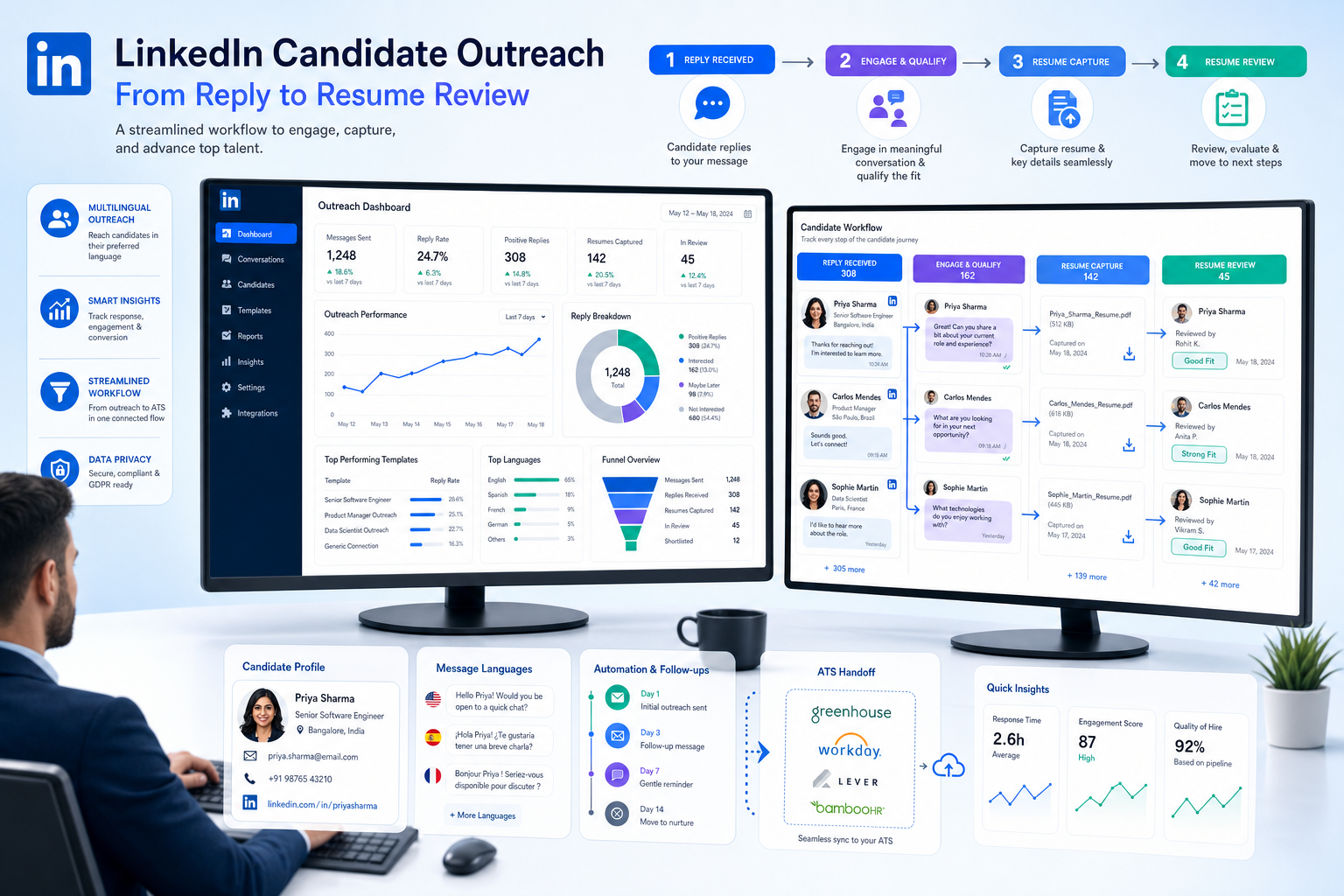
When LinkedIn outreach stalls after late replies and scattered resumes, this article helps recruiters evaluate an ai recruiting tool to keep follow-up relevant, capture resumes faster, and avoid losing strong candidates before screening.
That sounds obvious until a desk gets busy. Recruiters are still expected to personalize outreach, remember who replied after hours, keep candidate records clean, tailor follow-up to each opening, and move people forward before interest fades. Small agencies feel it as wasted consultant time. Solo recruiters feel it as evening admin and missed replies. In-house teams feel it as slower pipelines, weaker candidate experience, and hiring managers wondering why promising conversations never became live interviews.
In my own workflow, one practical way to reduce that pressure has been using StrategyBrain AI Recruiter to handle repetitive LinkedIn communication steps that usually eat recruiter time: first-touch outreach, follow-up conversations, and collecting resumes or contact details from interested candidates. What matters is not replacing recruiter judgment. The recruiter still reviews the resume, decides whether the profile really fits, and owns the next step. But for outreach-heavy roles, always-on messaging and multilingual follow-up can stop the early funnel from stalling.
A useful reminder comes from an older recruiting media segment built around job-seeker advice rather than software buying. The message was simple: employers often scan a resume in roughly 15 to 20 seconds, and candidates stand out when they are specific, honest, relevant to the opening, and not just sending the same generic document everywhere. That candidate-side reality matters to recruiters too. If a recruiter is handling coffee chats, network follow-ups, and inbound interest manually, there is very little room to keep every conversation tailored to the role while still moving quickly.
Think about the actual sequence. A recruiter reaches out to a passive candidate, gets a late reply, explains the role, answers a compensation or company question, asks whether the person is open to a conversation, then tries to collect a resume that is current, targeted, and useful enough to move into the yes pile. If those actions happen across scattered messages and delayed handoffs, the process breaks before screening even starts. That is exactly why recruitment teams now evaluate not just an ai recruiting tool, but broader recruitment automation software and recruitment management system options that can support sourcing, communication, resume capture, and pipeline control together.
- Why Tailored Outreach Still Matters in Automated Recruiting
- What Is an AI Recruiting Tool?
- How Recruitment Automation Tools Support LinkedIn Recruiting
- ATS vs CRM vs Recruitment Management System
- Features That Matter in Recruitment Automation Software
- A Practical Recruiter Experience Using StrategyBrain AI Recruiter
- How to Evaluate Matching, Oversight, and Workflow Fit
- Buyer Checklist for Recruitment Automation Tools
- Common Buying Mistakes
- FAQ
Why Tailored Outreach Still Matters in Automated Recruiting
One of the most useful ideas from traditional recruiting advice is that candidates do not win attention by being broad. They win it by being relevant. Recruiters operate under the same pressure from the opposite side. The more generic the outreach, the lower the reply quality. The less specific the follow-up, the less likely a candidate is to send a useful resume or commit to a call.
That is why automation should not be framed only as speed. In recruiting, speed without relevance usually creates more noise. A better framing is consistency at scale. Can your process help every candidate receive timely, role-aware communication while the recruiter keeps final control over fit, nuance, and next steps?
For teams sourcing heavily on LinkedIn, this is often the first real test of workflow quality. The challenge is not just finding names. It is sustaining a conversation long enough to confirm interest, answer reasonable questions, and gather the information needed for proper review.
What Is an AI Recruiting Tool?
An ai recruiting tool is software that helps automate parts of the hiring workflow using machine-assisted search, outreach, screening support, scheduling, record capture, and reporting. In the market, the label can refer to very different things. Some tools are narrow assistants for one step, such as scheduling or resume parsing. Others act more like connected recruiting operations layers across sourcing, communication, and pipeline movement.
That distinction matters because buyer expectations are different. If you only need help with one repetitive task, a point solution may be enough. If your team loses momentum between sourcing, follow-up, resume collection, and stage updates, you are really evaluating recruitment automation software or a fuller recruitment management system.
In practice, the best systems do not replace recruiter judgment. They remove repetitive work, preserve communication continuity, and make it easier for a recruiter to review the right information at the right time.
How Recruitment Automation Tools Support LinkedIn Recruiting
LinkedIn recruiting is where many teams first feel the operational gap between manual effort and scalable process. The workflow looks simple on paper, but it creates a surprising amount of hidden labor.
1. Initial outreach
Recruiters need to identify the right candidates, connect with them, and introduce the opportunity clearly. A useful tool supports that step without turning outreach into obvious template spam.
2. Candidate conversation
After the first response, momentum depends on follow-up. Candidates ask about role scope, employer context, compensation, timing, and location. If replies lag, interest drops. This is one reason many teams want automation that can keep communication moving beyond business hours.
3. Interest confirmation
Not every positive reply means a candidate is ready to interview. Good workflow asks the next practical question: are they open to hearing more, and are they willing to share a resume or contact details?
4. Resume and data capture
This is where process quality often breaks. If resumes arrive in mixed channels, details are stored inconsistently, or recruiters must manually copy information into another system, sourcing gains disappear into admin.
5. Recruiter review and next-step decision
Even when communication is automated, the recruiter still has to decide whether the profile actually matches the brief. That is a crucial line. Automation can confirm engagement and gather documents, but fit assessment should remain with the recruiter.
6. Pipeline tracking
Once a candidate becomes active, the handoff into your ATS or wider recruitment management system has to be clean. Otherwise the team ends up with duplicate records, missing context, and hiring-manager confusion.
Practical takeaway: In outreach-heavy recruiting, the biggest win is often not better search alone. It is reducing the gap between candidate reply, recruiter response, and usable resume review.
ATS vs CRM vs Recruitment Management System
Most buyers are not comparing categories as neatly as vendor pages suggest. They are trying to fix a real bottleneck. That bottleneck may sit in application management, relationship nurturing, or recruiter coordination between sourcing and screening.
| Category | Primary Focus | Typical Strength | Common Limitation |
|---|---|---|---|
| Applicant tracking system | Applications, requisitions, stage control | Process visibility and record keeping | Often weaker for proactive outreach |
| Recruiting CRM | Talent pools and candidate engagement | Nurturing passive candidates | May not manage end-to-end hiring operations well |
| Recruitment automation software | Workflow automation across sourcing, follow-up, scheduling, and reporting | Removes repetitive recruiter admin | Can create risk if oversight is weak |
| Recruitment management system | Broader coordination of the hiring lifecycle | Connects teams, stages, and decisions | Value depends on integration depth and adoption |
If your pain sits at the top of funnel, especially on LinkedIn, you may not need to replace your ATS first. You may need a workflow layer that handles first contact, follow-up continuity, and information capture better. If your whole process is fragmented, then a broader recruitment management system may be the better answer.
Features That Matter in Recruitment Automation Software
Feature checklists are easy to inflate, so I prefer evaluating software against the problems surfaced in the opening case: tailored communication, fast follow-up, resume capture, and clean recruiter control.
Role-aware outreach support
If candidates need a tailored resume to be taken seriously, recruiter outreach should show the same level of relevance. Look for systems that support role-specific messaging rather than one generic sequence for every job.
Always-on candidate communication
Many replies arrive after work hours. Software that can continue the conversation, answer common role questions, and keep momentum alive can help prevent warm candidates from going cold overnight.
Multilingual messaging
For global search, language matters. Recruiters lose opportunities when initial communication creates friction or confusion. Multilingual support is especially useful when an agency or internal team is expanding sourcing across regions.
Resume and contact-detail collection
A strong system should make it easy to gather resumes and contact information once a candidate shows real interest. This sounds basic, but it removes a lot of hidden manual effort in sourcing-led recruiting.
Clear handoff to recruiter judgment
One of the most important boundaries is who decides fit. Candidate engagement can be automated. Final review should not be. Look for tools that support handoff rather than pretending qualification is fully solved.
Governance and privacy controls
Any platform touching candidate messages, resumes, or contact details needs strong data handling and permission controls. Compliance is not a nice-to-have once communication becomes automated.
A Practical Recruiter Experience Using StrategyBrain AI Recruiter
Used carefully, StrategyBrain AI Recruiter fits a very specific part of the funnel well: LinkedIn-heavy sourcing where recruiters lose time in repetitive first-touch and follow-up work. In my experience, the value is not that it magically selects the best candidate. It is that it keeps the early conversation moving while I stay responsible for whether the resume actually fits the assignment.
What stood out first was the ability to keep candidate communication going when I was not online. Candidates often reply outside standard office hours, especially passive ones who are more comfortable responding at night. An automated workflow that can introduce the role, answer common questions, and ask whether the candidate is open to a conversation helps preserve timing that would otherwise be lost.
The second practical gain was document collection. When an interested candidate agrees to proceed, the system can request a resume and capture contact details. That matters because recruiters frequently spend more time chasing the resume than doing the actual evaluation. If you want to see the product context, the official StrategyBrain site and its conversation examples make that workflow easier to understand.
I would still draw the line clearly: this kind of tool supports communication and recruiter productivity; it does not remove the need for resume review, market judgment, or candidate calibration. In fact, one of the better use cases is exactly the one implied by that resume advice segment: get a tailored, current, honest resume into the recruiter’s hands faster, then let the recruiter decide whether it belongs in the yes pile.
For agencies, individual headhunters, and lean internal talent teams, that can be a meaningful operational improvement. If your bottleneck is proactive LinkedIn recruiting, multilingual candidate messaging, or after-hours response handling, AI Recruiter can help without forcing you to surrender final assessment.
How to Evaluate Matching, Oversight, and Workflow Fit
When buyers evaluate an ai recruiting tool, demos often overemphasize AI language and underemphasize workflow discipline. I suggest using three practical tests.
Test 1: Can it preserve relevance?
The opening lesson from the reference case still applies. Generic communication fails. Review whether outreach can stay specific to the role and whether candidate responses remain useful rather than shallow.
Test 2: Can it reduce hidden admin?
Measure what happens after a candidate replies. Can the system continue the conversation, collect the resume, capture contact details, and keep records organized? If not, automation may simply move work around.
Test 3: Does recruiter oversight remain intact?
Ask exactly where automation stops and recruiter judgment starts. If the answer is vague, trust will be low and adoption will suffer.
Questions worth asking vendors
- How does the tool handle candidate replies outside office hours?
- Can it support multilingual communication in a way that still feels role-specific?
- How are resumes and contact details captured and stored?
- What does the recruiter review before deciding next steps?
- What permissions, privacy controls, and audit mechanisms are built in?
Buyer Checklist for Recruitment Automation Tools
- Map the real bottleneck: Is the problem sourcing volume, follow-up lag, resume collection, or pipeline control?
- Separate engagement from qualification: Do not assume a communication tool solves fit assessment.
- Test real LinkedIn workflows: Run the system through outreach, candidate Q&A, interest confirmation, and resume request.
- Review handoff quality: Make sure candidate context can move cleanly into your ATS or broader recruitment management system.
- Check multilingual and after-hours support: These matter more than many teams expect.
- Confirm governance: Review data handling, privacy safeguards, and user controls before rollout.
- Assess recruiter adoption: If recruiters do not trust the workflow boundary, they will work around it.
Common Buying Mistakes
- Confusing conversation automation with candidate qualification: They are not the same task.
- Buying for AI branding instead of workflow need: The category label matters less than where your process stalls.
- Ignoring candidate relevance: Fast but generic outreach produces weak recruiting outcomes.
- Underestimating data capture friction: Resume and contact collection are still real operational choke points.
- Skipping privacy review: Messaging automation without clear controls creates unnecessary risk.
- Expecting one tool to fix broken hiring decisions: Automation helps process; it does not solve unclear briefs or slow hiring managers.
FAQ
What does an AI recruiting tool do?
An ai recruiting tool helps automate parts of recruiting such as sourcing, candidate communication, screening support, scheduling, and reporting. The best fit depends on which workflow problem you are trying to solve.
How is recruitment automation software different from an ATS?
Recruitment automation software focuses on reducing repetitive recruiting work across the funnel, while an ATS traditionally manages applications, requisitions, stage movement, and records. Many teams use both together.
When do I need a recruitment management system?
You typically need a recruitment management system when sourcing, communication, screening, approvals, and reporting are fragmented across tools and teams. It becomes more valuable as hiring operations become more complex.
Can automation help with LinkedIn recruiting?
Yes, especially in outreach-heavy workflows. It can help maintain candidate conversations, support after-hours replies, collect resumes, and reduce manual admin before formal screening begins.
Should automation make final candidate decisions?
No. Automation can support engagement, prioritization, and data capture, but recruiters and hiring teams should retain responsibility for fit assessment and final decisions.
What should recruiters look for first?
Start with the exact place your process loses momentum. In many LinkedIn-driven workflows, the first problem is not search. It is the gap between candidate reply, recruiter follow-up, and resume review.
Conclusion
The most useful lesson from old-school resume advice is still relevant in a modern stack: relevance wins attention. Candidates need tailored resumes, and recruiters need tailored communication. An ai recruiting tool becomes valuable when it helps preserve that relevance while removing repetitive work that slows the funnel down.
That is why buyers should evaluate automation through practical workflow questions rather than AI claims alone. If your team needs better sourcing continuity, cleaner resume capture, and stronger recruiter control, the answer may sit somewhere between targeted recruitment automation software and a broader recruitment management system. The best choice is the one that helps recruiters move faster without becoming less thoughtful.