When hiring teams evaluate ai resume screening tools through source, rules, and review control, they avoid weak shortlists and lost trust.
That distinction matters more than most teams realize. When hiring slows down, the problem is rarely just candidate volume. It is usually a mix of unclear role requirements, confusion between internal and external talent sources, inconsistent screening questions, and too much manual follow-up across recruiters, coordinators, and hiring managers. The cost shows up quickly: delayed shortlists, missed candidates, weaker candidate experience, and hiring managers who stop trusting the funnel.
In my own workflow, tools such as StrategyBrain AI Recruiter have been most useful when they support the messy front end of recruiting rather than pretend to replace judgment. The parts I have found most practical are automated candidate outreach, around-the-clock follow-up, and résumé collection in one flow, especially when searches involve external talent or multilingual communication. The recruiter still has to decide who actually fits the brief, review the résumé, and make the next move.
A useful way to understand this is through a familiar hiring choice: do you fill a role from inside the company or go to the outside market, and do you run that search through your in-house team or add outside recruiting support? Those are two different decisions, but they often collide in the same search. A team may prefer an internal candidate for speed and lower onboarding risk, then realize the role needs skills the current organization does not have. At that point, external applicants start coming in through job ads, referrals, sourcing messages, and recruiter outreach, and the screening workload changes immediately.
Once that shift happens, the real bottleneck is not abstract "AI." It is whether the process can intake applications cleanly, compare internal and external candidates against the same baseline, and surface the right people fast enough for human review. That is where ai candidate screening becomes a practical operations topic, and why questions like do employers check resumes for ai and how to get your resume noticed by ai matter for both employers and candidates.
Table of Contents
- Why screening starts before AI
- What AI candidate screening really means
- Internal vs. external hiring and why it changes screening
- How AI resume screening tools work in real workflows
- Do employers check resumes for AI?
- How to get your resume noticed by AI
- Formatting mistakes that hurt more than AI myths
- What hiring teams should evaluate in screening systems
- Myths vs. facts
- FAQ
Why Screening Starts Before AI
One of the biggest misunderstandings in recruiting is treating screening as a software feature instead of a decision framework. In practice, screening starts much earlier. A team first decides what kind of candidate it wants, whether internal mobility is realistic, whether outside recruiting support is needed, and which requirements are truly mandatory. If those decisions are fuzzy, even strong ai resume screening tools produce weak outputs because the process itself is weak.
That is one reason the internal-versus-external distinction is so helpful. It reminds hiring teams that candidate source and recruiting method are not the same thing. You can pursue internal candidates first and still use external support later. You can rely on an in-house team for recurring roles and add outside search help for confidential or hard-to-fill hiring. Each choice changes application volume, candidate mix, and the type of screening discipline required.
From a recruiter's perspective, this is where software earns its keep. I have used AI Recruiter most effectively on searches where the upstream problem was not evaluating talent depth but managing outreach and responsiveness without losing control of final review. When external hiring expands suddenly, especially across time zones, having AI handle repetitive candidate communication and résumé capture can keep the top of funnel moving while the recruiter focuses on qualification and shortlist quality.
What AI Candidate Screening Really Means
In recruiting operations, it helps to separate three layers that candidates often lump together:
- Application management: storing applicants, tracking stages, and organizing hiring workflow
- Resume parsing and search: extracting titles, dates, education, certifications, and skills into searchable fields
- AI-supported screening: matching, ranking, summarization, or conversational screening that helps prioritize review
Most employers are not relying on one magical system that makes all decisions alone. More often, the process includes an applicant tracking system, employer-defined knockout questions, search logic, and some form of ranking support. Recruiters and hiring managers still decide who advances.
Key insight: In most hiring funnels, requirement design and clean application intake influence outcomes earlier than advanced AI scoring does.
That is why good screening is less about mystery technology and more about operational clarity. If the job requires a license, work authorization, location availability, or direct domain experience, those factors usually matter before any sophisticated ranking model does.
Internal vs. External Hiring and Why It Changes Screening
The most useful lesson from the internal-versus-external recruitment framework is that screening standards shift with the hiring route.
When the likely hire is internal
Internal candidates typically come with known performance history, faster onboarding potential, and stronger cultural familiarity. Screening may focus less on broad discovery and more on role readiness, team fit, and whether moving one employee creates a second vacancy elsewhere.
When the likely hire is external
External recruitment opens the pool to new skills, new perspectives, and broader market reach, but it also introduces more uncertainty. Résumés vary more, application volume rises, and employers have fewer built-in trust signals. That is when ai resume screening tools become more valuable, because the team needs faster triage and more consistent comparison across unfamiliar profiles.
When in-house recruiting is enough
For repeat hiring, internal recruiting teams often handle the process well because they know the business, the managers, and the systems. Screening works best when job requirements are stable and applicant volume is predictable.
When outside support changes the process
Specialized, confidential, urgent, or executive hiring often stretches internal bandwidth. Outside recruiters may bring deeper networks and better access to passive candidates, but that also means screening data arrives from more channels. In those searches, intake discipline matters even more. Notes, résumé versions, outreach history, and qualification details need to be standardized or the process gets noisy fast.
This is the real connection to AI candidate screening: the broader and less standardized your funnel becomes, the more you need systems that can structure information without hiding the recruiter's judgment.
How AI Resume Screening Tools Work in Real Hiring Workflows
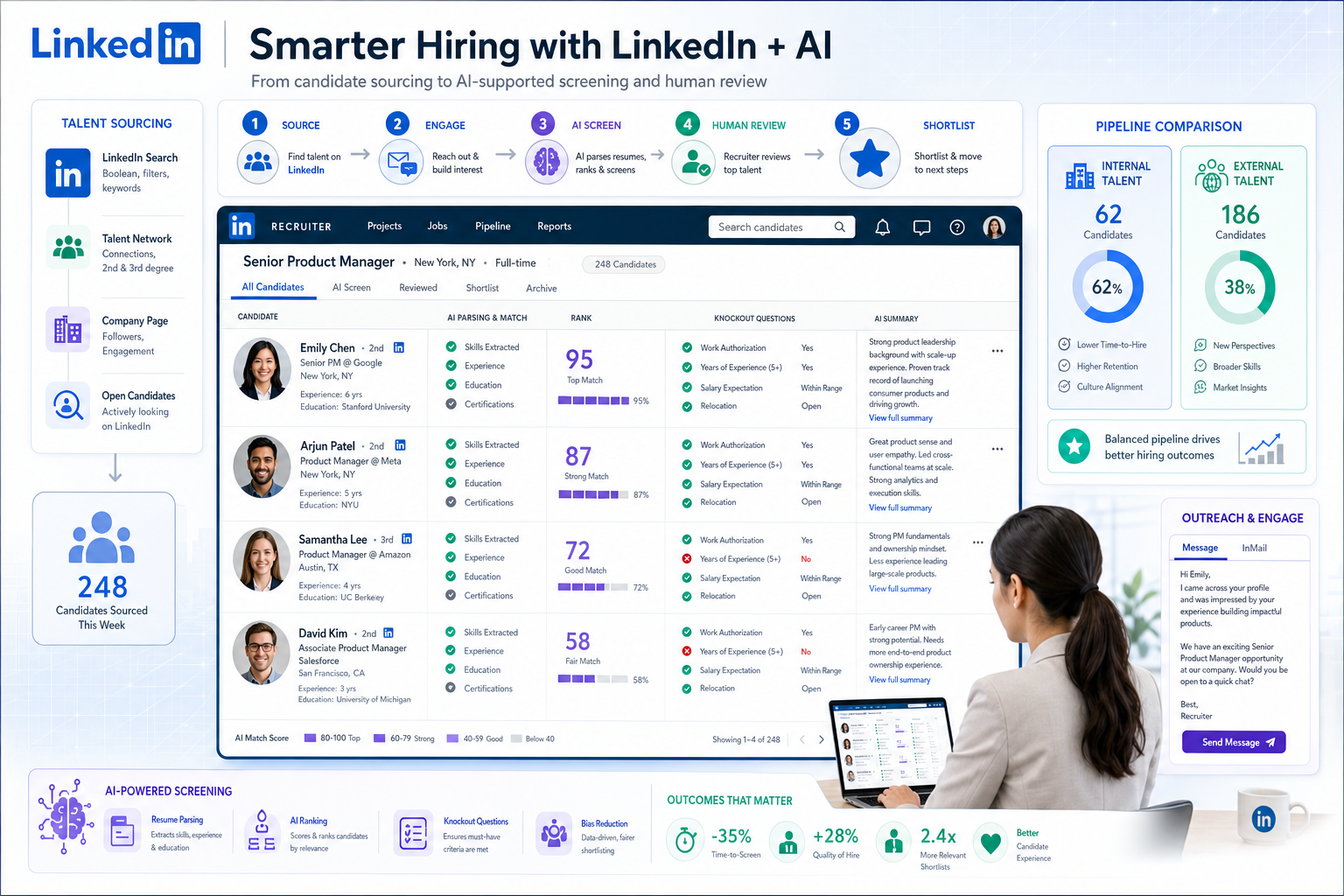
Most real workflows are more straightforward than candidates expect. Whether applicants come from internal mobility, external postings, referrals, sourcing, or AI-supported outreach, the sequence usually looks like this:
- Intake: The employer receives the résumé, application fields, and screener answers.
- Parsing: The system identifies employers, job titles, dates, education, certifications, and skills.
- Eligibility checks: Work authorization, location, schedule, license, or experience minimums may be checked first.
- Screening logic: Employer-defined knockout questions or must-have criteria filter or deprioritize applicants.
- Matching and ranking: AI may compare résumé content and structured fields against the job requirements.
- Human review: A recruiter or hiring manager reviews the shortlist and decides who advances.
When teams use outreach automation before the application stage, the flow simply starts earlier. That is where I have seen StrategyBrain AI Recruiter help most on LinkedIn-heavy searches. It can initiate contact, introduce the role, answer basic questions, and collect résumé and contact details from interested candidates. That does not replace qualification. It clears repetitive communication work so the recruiter can spend more time on résumé assessment and shortlist decisions.
What recruiters usually prioritize first
- Does the candidate meet non-negotiable requirements?
- Do titles and experience align with the level of the role?
- Are certifications, licenses, or tool skills stated clearly?
- Do application answers conflict with the résumé?
- Is the candidate realistically available in the required location or work setup?
- Does the résumé show evidence, not just polished language?
Notice how little of that requires mythical AI detection. It is mostly about evidence, relevance, and consistency.
Do Employers Check Resumes for AI?
If you are asking do employers check resumes for ai, the practical answer is usually no in the way job seekers fear. Most employers are not trying to prove whether a candidate used AI to help draft a résumé. They are trying to determine whether the résumé is credible, specific, and suitable for the role.
What they do evaluate includes:
- whether the file parses correctly
- whether the experience maps to the job
- whether mandatory questions were answered accurately
- whether dates, titles, and claims look consistent
- whether the content sounds specific enough to trust
Problems arise when AI-written content becomes generic, inflated, or strangely polished without evidence. A résumé full of broad claims such as "visionary leader" or "results-driven strategist" but light on scope, systems, and outcomes tends to raise concerns regardless of how it was written.
| Concern | What employers usually care about |
|---|---|
| Was AI used for drafting? | Usually a secondary issue |
| Can the résumé be parsed? | High priority |
| Does it show required qualifications? | High priority |
| Did the candidate pass screening questions? | High priority |
| Does the content feel accurate and specific? | High priority |
So the better candidate question is not "Will they detect AI?" It is "Will my résumé survive structured review and hold up when a recruiter reads it closely?"
How to Get Your Resume Noticed by AI
The best answer to how to get your resume noticed by ai is to make your relevance easy to identify, not to game the system. AI resume screening tools still rely heavily on explicit signals.
1. Match the language of the role truthfully
If a posting asks for contract lifecycle management, physician credentialing, revenue operations, or warehouse supervision, use those exact concepts when they genuinely reflect your background. Related phrasing helps, but direct alignment is easier for both search and ranking.
2. Use recognizable job titles
Internal or creative titles often hide fit. If your formal title was unusual, add the market-standard equivalent where accurate. That improves searchability and helps humans understand your experience faster.
3. Make must-have qualifications visible
Required certifications, licenses, language skills, tools, clearance, or location details should not be buried in dense text. Put them in obvious sections.
4. Show proof, not polish
Specific responsibilities, systems, industries, stakeholder groups, and scope outperform vague adjectives. Recruiters trust evidence much more than tone.
5. Keep practical eligibility clear
If the role depends on work authorization, regional availability, travel, hybrid attendance, or shift coverage, unclear details can stop progress before anyone studies your achievements.
6. Treat screener questions as part of screening, not admin
A strong résumé may not recover from a failed knockout answer. Review these carefully.
7. Format for parsing
Use standard headings such as Experience, Education, Skills, and Certifications. Keep dates, employers, and titles in plain text.
For most candidates, that is the real formula for how to get your resume noticed by ai: make fit explicit, honest, and structured.
Formatting Mistakes That Hurt More Than AI Myths
Across hiring teams, formatting errors still create more trouble than AI detection myths.
- Avoid overdesigned layouts: text boxes, graphics, tables used for layout, and multiple columns can break parsing.
- Use common section names: unusual labels can make information harder to extract.
- Keep employment history linear: fragmented timelines create confusion.
- Follow requested file types: use the format the employer asks for.
- Do not hide keywords: white text or stuffing tactics can damage trust.
This matters even more in externally sourced hiring, where the team is comparing people from many backgrounds at speed. The easier your résumé is to process, the easier it is to review fairly.
What Hiring Teams Should Evaluate in Screening Systems
For employers, good screening technology is not just about automation claims. It should help the team manage the exact tensions exposed earlier in the internal-versus-external decision.
Look for these capabilities
- Accurate parsing: reliable extraction of titles, dates, education, and skills
- Transparent screening logic: clear knockout settings and requirement checks
- Relevant matching: ranking based on real role criteria, not vague scoring alone
- Human override: recruiters can review, audit, and change outcomes
- Candidate communication support: especially useful when external sourcing expands volume
- Bias monitoring: checks for unfair impact across different candidate groups
I would also separate front-end communication tools from final screening tools. In practice, I have had better results when outreach automation handles repetitive contact and résumé collection while recruiters own shortlist quality. That division of labor is one reason AI Recruiter can fit into recruiting operations without pretending to be the final assessor of talent.
Responsible AI in recruiting
Responsible use means role-related criteria, explainable workflows, and documented human accountability. It also means recognizing when ranking models may underserve career changers, nontraditional candidates, or applicants whose experience is strong but described differently.
The right question is not whether AI exists in the process. It is whether the process remains reviewable, consistent, and fair.
Myths vs. Facts About AI Resume Screening
| Myth | Fact |
|---|---|
| ATS software automatically rejects every résumé. | Most systems organize, parse, search, and rank. Humans still review many applications. |
| Employers mainly use AI detectors on résumés. | Most care more about relevance, clean formatting, and requirement match. |
| Fancy design improves screening performance. | Simple structure usually works better for parsing and recruiter review. |
| Keyword stuffing beats ai resume screening tools. | Stuffing is risky and often less effective than clear, truthful alignment. |
| AI screening replaces recruiters. | In most organizations, it supports triage while people make hiring decisions. |
FAQ
Do employers check resumes for AI writing?
Usually not as a primary step. Employers are more focused on credibility, role fit, consistency, and whether the application clears screening requirements.
How do ai resume screening tools rank candidates?
They typically use structured résumé data, skill extraction, title relevance, experience patterns, and employer-defined requirements. Some also incorporate screener answers.
How can I get my resume noticed by AI without sounding robotic?
Use the job description's language where accurate, keep formatting simple, and show concrete evidence of fit. Clear specificity works better than buzzwords.
Can external recruiting increase the need for AI screening?
Yes. External hiring usually brings broader applicant volume and more variation in résumé style, which makes consistent intake, parsing, and prioritization more important.
Do employers compare internal and external candidates differently?
Often yes. Internal candidates may come with stronger performance context, while external candidates depend more heavily on résumé evidence, structured interviews, and reference checks.
Where does outreach automation fit in?
It fits before final screening. Tools that automate contact, follow-up, and résumé collection can help recruiters manage external pipelines, but recruiters should still own qualification and selection decisions.
Conclusion
AI candidate screening is easiest to understand when you stop treating it as a black box and start treating it as part of a broader hiring decision. First you decide where talent will come from, whether internal capacity is enough, and what the role truly requires. Then software helps structure intake, parse résumés, apply rules, and prioritize review.
If you have been wondering do employers check resumes for ai, the answer is usually far less dramatic than people think. Employers care much more about clarity, truthfulness, and requirement match. And if you want to know how to get your resume noticed by ai, the winning approach is still the simplest one: use standard formatting, make your qualifications obvious, and show evidence that a recruiter can trust.
For hiring teams, the same lesson applies in reverse. The best ai resume screening tools support a disciplined process. They do not rescue a vague one.