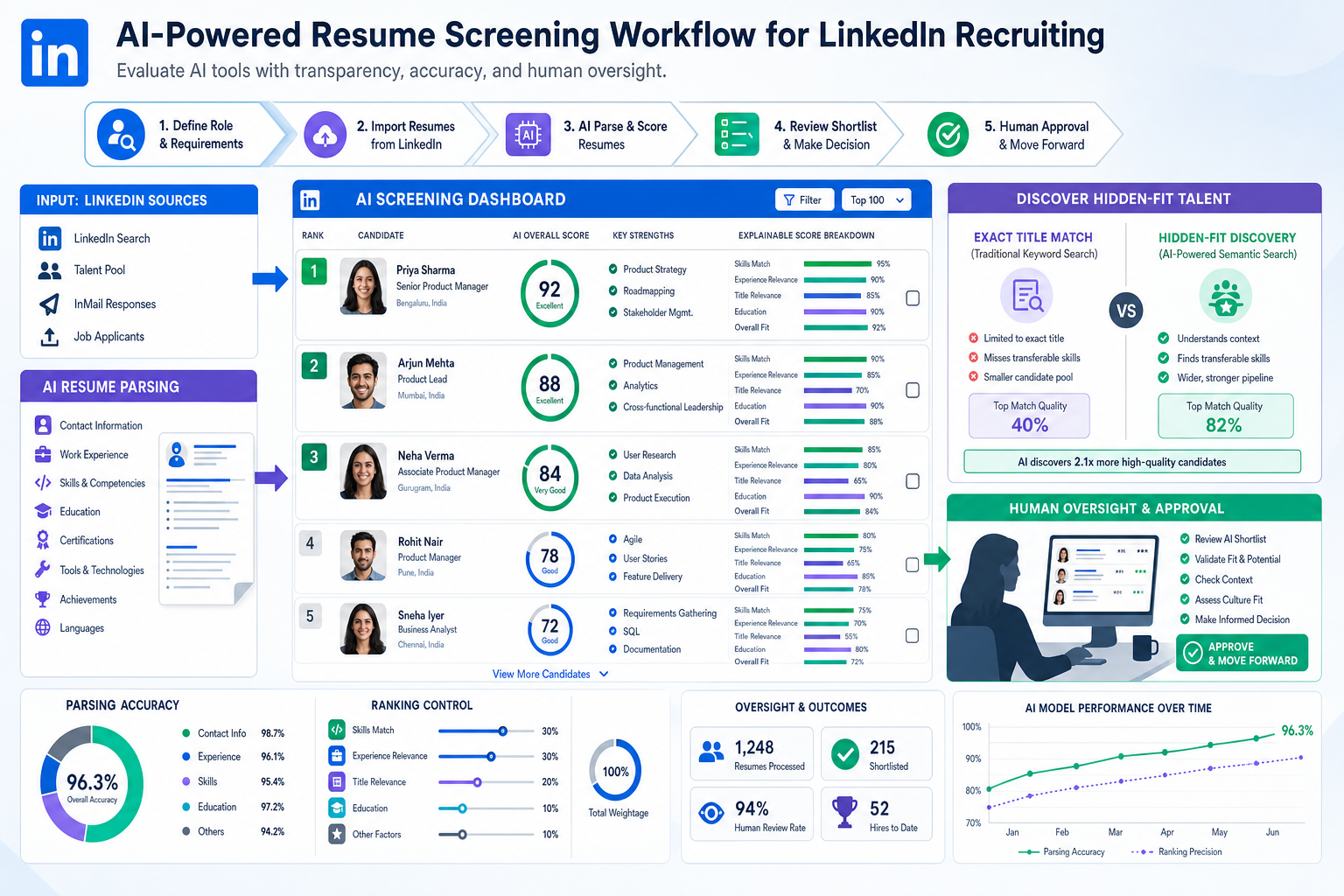
This article helps recruiters evaluate ai resume screening tools to spot hidden fit and avoid costly title-match misses.
That matters because screening pressure rarely shows up as a neat productivity problem. It shows up when a recruiter misses a high-potential career changer, when a hiring manager loses faith in the shortlist, or when an in-house team burns hours reviewing resumes that looked relevant only because the job brief was written too broadly. For smaller agencies and lean internal teams, those mistakes cost placements, candidate goodwill, and credibility with clients or stakeholders.
In my own workflow, tools that reduce repetitive sourcing and early qualification pressure have been most useful when they support—not replace—judgment. That is why I pay attention to platforms such as StrategyBrain AI Recruiter in the outreach and intake stage: always-on candidate messaging, multilingual communication, and automatic resume collection can keep LinkedIn conversations moving while the recruiter still makes the final call on fit, resume quality, and next steps.
The candidate side of this story is easy to underestimate. When compensation is broadly comparable, many professionals do not choose an employer because the firm says it has better technology. They look for signs of progression, useful feedback, flexibility, meaning, and development. In one widely cited employer-branding discussion about millennial accounting talent, that logic was explicit: work-life balance outranked most employer talking points, and the opportunity to progress mattered more than glossy positioning.
A recruiter trying to fill that kind of role sees the consequences quickly. First the resume pile grows. Then the team starts scanning for familiar employers, exact job titles, and tidy career paths because it feels faster. After that, applicants who invested in education, want mentoring, or value advancement over prestige are easier to overlook, even though they may be the people most likely to engage and stay. That is exactly where AI candidate screening, automated resume screening, and practical ai resume screening workflows become worth evaluating: not as a tech badge, but as a way to rank, review, and revisit candidates against what actually drives acceptance and retention.
If you are comparing screening software, the real question is not whether the system can read resumes. It is whether it helps your team recognize candidates whose decision criteria go beyond job-title matching, while still keeping the process explainable and manageable.
In this article, you will learn:
- How AI resume screening fits into a real recruiting workflow
- Why candidate motivation and job-choice criteria still matter during screening
- How AI screening differs from classic ATS filtering
- What to check when evaluating ranking, parsing, and oversight
- How to use automation without turning screening into a black box
- Why resume screening fails before interviews begin
- What is AI resume screening?
- How do ai resume screening tools work in practice?
- Which candidate signals get missed in manual screening?
- How is AI resume screening different from ATS screening?
- How should recruiters evaluate ai resume screening tools?
- How do you reduce bias and keep human control?
- What mistakes should teams avoid?
- FAQ
Why Resume Screening Fails Before Interviews Begin
One of the biggest screening mistakes is assuming the shortlist should be driven only by surface alignment. In practice, recruiters are often filling roles where candidate choice depends on more than salary and title. A professional may accept or reject an opportunity based on promotion visibility, manager quality, flexibility, ongoing feedback, or development support. If your screening process only rewards exact title matches, it can miss the people most likely to respond positively once the opportunity is explained well.
That is the useful lesson from the accounting-hiring example in the reference material. The issue was not just attraction marketing. It was decision logic. When two employers looked similar on pay and benefits, the deciding factors shifted toward progression, mentoring, work-life balance, flexibility, meaning, and professional development. Recruiters screening resumes for comparable roles should treat that as a workflow signal: fit is partly resume-based, but it is also tied to what kind of opportunity the candidate is likely to value.
Key Insight: Better screening does not start with smarter ranking alone. It starts with clearer criteria about what success in the role—and acceptance of the role—actually depends on.
That is why experienced recruiters separate three questions early:
- Is this person basically qualified?
- Does their background suggest transferable strength, even if the resume wording is imperfect?
- Is this the kind of opportunity they are structurally likely to engage with?
Manual review can answer those questions, but not always consistently at volume. That is where ai resume screening tools become useful, especially if they support candidate ranking, searchable records, and easier review of non-obvious profiles.
What Is AI Resume Screening?
AI resume screening is the use of software to parse resumes, extract candidate data, compare applicants with job criteria, and help recruiters decide who to review first. In strong hiring operations, it supports judgment rather than replacing it.
Most ai resume screening tools combine several functions: resume parsing, structured profile creation, criteria matching, skills identification, and candidate ranking. Some systems mainly automate filtering. Others try to identify broader relevance through semantic matching or skill relationships rather than exact term overlap.
That distinction matters because many teams say they want AI when what they really need is a better review sequence. A useful system should improve how recruiters move from application intake to shortlist review, especially in workflows where candidate motivation and opportunity fit are not fully visible through titles alone.
How Do AI Resume Screening Tools Work in Practice?
The easiest way to understand automated resume screening is to look at the workflow step by step.
1. Resume parsing turns documents into usable candidate records
The first stage is technical. The system extracts information such as work history, titles, employers, education, certifications, locations, and skills. If the parsing layer is weak, every later stage becomes less reliable.
Recruiters should test whether the system reads messy resumes well, handles career moves sensibly, and avoids creating distorted profiles from formatting issues.
2. The job brief becomes screening logic
Next, the platform maps role requirements into screening criteria. That may include must-have qualifications, preferred experience, licenses, location limits, seniority, or likely skill clusters.
This is where teams often make preventable mistakes. If the brief treats every preference as mandatory, the software simply scales bad discipline. A role that truly needs progression-minded candidates, strong coachability, or adjacent technical skills should not be screened as though only one exact prior title counts.
3. Candidate matching creates a review order
Some systems use hard rules. Others use broader matching logic that attempts to connect related experience and inferred skills. The output is usually a ranked list or a shortlist queue.
| Workflow Stage | What the System Does | What Recruiters Should Check |
|---|---|---|
| Resume parsing | Extracts structured data from resumes | Accuracy of titles, dates, skills, and education |
| Criteria mapping | Converts job requirements into screening logic | Clear separation of must-have and preferred criteria |
| Candidate matching | Compares applicants against role requirements | Whether adjacent experience can still surface |
| Ranking | Prioritizes who gets reviewed first | Whether ranking is explainable and challengeable |
| Human review | Validates recommendations before progression | Whether recruiters can override weak outcomes |
4. Recruiters review the shortlist in context
This is where the process either becomes useful or misleading. Human review should confirm fit, spot transferable background, and question weak rankings. It should also account for signals that matter in acceptance and retention, especially when a role depends on development, mentoring, flexibility, or a clear path forward.
5. Some teams automate outreach around the screening workflow
Resume screening is not always the first contact point anymore. In LinkedIn-heavy recruitment, I have seen more value when sourcing, candidate replies, and resume collection are organized before manual shortlist review. In that context, AI Recruiter can be practical because it keeps candidate conversations moving, answers common questions, and captures resumes and contact details while the recruiter focuses on actual qualification.
My own takeaway from using this kind of workflow is straightforward: automation helps most when it removes the repetitive waiting and chasing around resumes, not when it pretends to know who should be hired. If a candidate responds after hours or in another language, an AI-supported communication layer can preserve momentum. The recruiter should still review the CV, test the match against the brief, and decide whether the person belongs on the shortlist.
Which Candidate Signals Get Missed in Manual Screening?
The opening case matters because it highlights a real screening blind spot. Recruiters often screen as if resumes exist in isolation from candidate decision-making, but that is rarely true.
When professionals compare similar opportunities, they often care about:
- Promotion visibility: Is there a credible path to grow?
- Manager quality and feedback: Will someone support development rather than just assign tasks?
- Work-life balance and flexibility: Is the role sustainable?
- Meaning and development: Will the move build something long term?
Those factors came through clearly in the reference material, including the cited hierarchy where work-life balance led the list, followed by progression opportunities, flexibility, meaning, and professional development once compensation was roughly equal. Recruiters do not need to turn resume screening into amateur psychology, but they do need to recognize when the role itself is likely to attract people whose resumes may not look identical on paper.
That is one reason ai resume screening can outperform narrow keyword sorting. If the system can support skills-based screening and broader candidate matching, recruiters have a better chance of spotting applicants whose backgrounds align with the role even if the resume language does not mirror the job post exactly.
How Is AI Resume Screening Different From ATS Screening?
Many employers already have some form of filtering inside their applicant tracking system. That does not automatically mean they have useful AI screening.
Traditional ATS filtering usually handles application storage, stage movement, knockout questions, and rules-based sorting. That is important operationally. But it is often rigid.
AI resume screening adds another layer that may include semantic matching, inferred skill relationships, candidate ranking, or broader prioritization logic.
| Area | Classic ATS Screening | AI Resume Screening |
|---|---|---|
| Main method | Rules-based filters and workflow routing | Rules plus broader matching or ranking logic |
| Best for | Eligibility checks and process control | Prioritization and deeper shortlist support |
| Strength | Consistency and auditability | Potentially better discovery of relevant profiles |
| Risk | Over-filtering on exact requirements | Opacity if logic is poorly explained |
| Human role | Usually explicit | Must be protected intentionally |
The lesson from the opening candidate-choice example applies here too. A rigid system may screen for what is easy to count. A better system helps recruiters review what actually matters in the market they are hiring into.
How Should Recruiters Evaluate AI Resume Screening Tools?
If you are comparing ai resume screening tools, evaluate them against your recruiting reality rather than broad vendor claims.
Start with the role pattern, not the feature list
Some roles are high volume and transactional. Others depend on nuance, adjacent skills, or candidate motivation. If your jobs compete on development, flexibility, manager quality, or progression, your screening workflow needs to make room for non-obvious but relevant profiles.
Use practical evaluation criteria
| Evaluation Area | Why It Matters | What to Ask |
|---|---|---|
| Parsing quality | Poor extraction weakens every later step | Does it read varied resume formats accurately? |
| Matching depth | Exact-match logic can miss strong candidates | Can it surface adjacent or transferable experience? |
| Ranking control | Who gets seen first shapes outcomes | Can recruiters inspect and challenge rankings? |
| Workflow fit | Adoption fails if the process adds admin work | Does it fit existing ATS and recruiter habits? |
| Human oversight | Supports fairness and better decisions | Where must a recruiter review before rejection or progression? |
| Candidate communication | Slow follow-up damages response rates | Can outreach and resume collection stay organized? |
Test on edge cases
Use real or sample roles and manually inspect the output. Include career changers, strong applicants with unusual titles, and candidates whose backgrounds make sense only when skills are interpreted contextually.
Consider how sourcing and screening connect
For many recruiters, especially on LinkedIn, screening quality depends partly on what happens before the resume arrives. If candidate replies, after-hours messaging, and resume collection break down, the shortlist suffers no matter how good the ranking engine claims to be. That is one area where a communication-first tool like StrategyBrain AI Recruiter can complement screening operations. It does not replace evaluation, but it can reduce the admin drag between first response and recruiter review.
How Do You Reduce Bias and Keep Human Control?
Any use of automated resume screening needs guardrails. The first rule is simple: software should support prioritization, not make unchecked final hiring decisions.
Audit the criteria before you automate them
If your job requirements are inflated, vague, or inconsistent, AI will simply scale the problem. Review must-have versus preferred qualifications carefully.
Keep recruiters in the loop
Humans should be able to inspect excluded profiles, override questionable rankings, and revisit candidates who may have been screened down because of nonstandard wording or titles.
Ask for explainability
If a candidate is ranked highly or filtered out, your team should be able to explain the broad reason. Explainability improves trust with hiring managers and makes internal audits possible.
Watch for structural blind spots
The opening case reminds us that candidate value is not always captured by prestige signals. Teams should periodically check whether the system is pushing down applicants with strong development trajectories, continuing education, adjacent experience, or other nontraditional strengths.
- Document the criteria used in screening
- Run periodic excluded-candidate audits
- Compare shortlist patterns across role types
- Train recruiters on what ranking outputs do and do not mean
- Require human review before any final rejection decision
What Mistakes Should Teams Avoid?
Treating AI as a substitute for recruiter judgment
The most common mistake is assuming the tool should decide who matters. It should not.
Over-trusting title matches
When recruiters are under pressure, exact title overlap feels efficient. It is also how good candidates disappear.
Ignoring what makes the opportunity attractive
If the market for a role is shaped by progression, flexibility, mentoring, or work-life balance, screening should not be designed as though salary and keyword density tell the whole story.
Separating communication from qualification
In modern recruiting, sourcing, candidate replies, and resume collection influence screening quality. A fragmented process creates lag and candidate drop-off before real review even starts.
Failing to review outcomes over time
Recruiters should compare ranked lists with actual interview selections and eventual hiring decisions. That is how you tell whether the workflow improves judgment or only creates an illusion of order.
FAQ
What is AI resume screening?
AI resume screening is software-assisted review that parses resumes, extracts candidate data, compares applicants against role criteria, and helps recruiters prioritize who to review first.
How is AI resume screening different from automated ATS filters?
ATS filters usually apply rules such as knockout questions or exact eligibility checks. AI screening may add broader matching, skills-based interpretation, and candidate ranking.
Do ai resume screening tools replace recruiters?
No. In responsible hiring workflows, recruiters still review resumes, challenge rankings, and make final progression decisions.
Why can manual screening miss strong candidates?
Manual review under time pressure often defaults to familiar titles, employers, or exact wording. That can hide candidates with transferable skills or stronger long-term fit.
How do candidate preferences affect screening?
In many roles, acceptance depends on more than compensation. Candidates may care about progression, flexibility, mentoring, meaning, and development, which is why screening should not rely only on surface resume matches.
Where does StrategyBrain AI Recruiter fit?
It fits best on the outreach and response-management side of the workflow, helping recruiters keep LinkedIn conversations active, collect resumes, and reduce repetitive follow-up while recruiters retain final screening control.
Conclusion
The practical value of ai resume screening tools is not that they make hiring automatic. It is that they can help recruiters review resumes more consistently, surface relevant candidates sooner, and avoid narrowing the shortlist to the most obvious title matches.
The opening lesson from candidate job-choice behavior is worth keeping in view. Professionals often choose roles based on progression, feedback, flexibility, meaning, and development once compensation is close enough. Good screening workflows should leave room for that reality. When AI candidate screening, automated resume screening, and recruiter judgment are aligned, the result is not just faster review. It is a better chance of seeing the candidates who actually belong in the conversation.