When shortlist quality slips, recruiters can use this article to judge which ai resume screening tools surface real fit, avoid credential-first misses, and keep human judgment in control.
That distinction matters because early screening errors are expensive in ways recruiters feel immediately. Agency teams lose hours reviewing applicants who look polished on paper but cannot support the real work. In-house recruiters damage hiring-manager trust when strong candidates are buried under rigid filters. Smaller firms feel the cost twice: once in wasted sourcing time and again when a slow shortlist weakens client confidence or candidate experience.
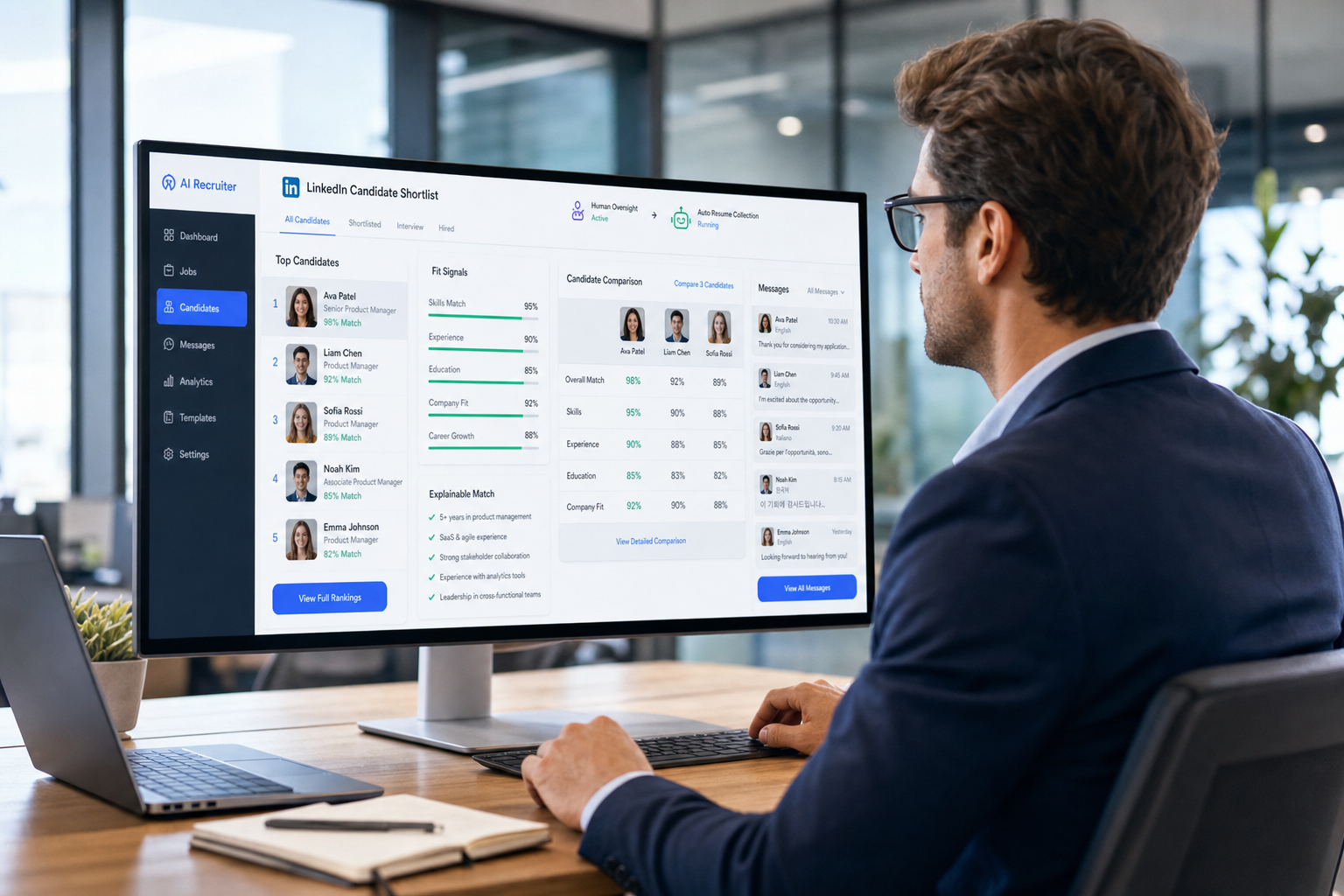
In my own workflow, I have found that StrategyBrain AI Recruiter is most useful before final resume review, not instead of it. When response volume rises on LinkedIn, its multilingual messaging, always-on follow-up, and automatic resume collection help keep conversations moving so recruiters are not stuck chasing files and basic intent signals. The recruiter still owns the real screening decision, the resume evaluation, and the call on who moves forward.
A useful parallel comes from how employers have historically screened FP&A talent. In one market snapshot, roughly 80% of sampled FP&A job descriptions asked for a CPA, yet actual team makeup varied sharply by employer: one company’s FP&A group was about 22% CPA/accounting, another sat above 80%, and a cross-border organization showed a dramatic split between its Canadian and U.S. teams. Recruiters looking at those requisitions, comparing backgrounds, and organizing slates could easily mistake a familiar credential for the best predictor of performance.
But the work itself told a more complicated story. Finance leaders interviewed in that discussion described evolved FP&A as business partnering, analytical storytelling, operational judgment, and comfort with the drivers behind EBITDA, not just budgeting cycles and variance commentary. Once that gap appears between what the role demands and what the first filter rewards, the screening problem becomes obvious. That is exactly why ai candidate screening deserves a more disciplined conversation: teams need automated resume screening that can surface relevant capability beyond narrow labels, while staying realistic about what an ai resume detector can and cannot do.
Table of Contents
- Why Early Screening Breaks Good Hiring
- What AI Resume Screening Actually Means
- Why Credentials Alone Miss Strong Candidates
- How AI Candidate Screening Works in Practice
- What Recruiters Should Look for in AI Resume Screening Tools
- How I Use AI Support Without Handing Over Judgment
- Operational Benefits for Recruiting Teams
- Bias, Explainability, and Compliance Risks
- Tool Categories and Buying Considerations
- What Candidates Should Know About Automated Review
- Implementation Best Practices
- FAQ
Why Early Screening Breaks Good Hiring
The opening FP&A example matters because it exposes a recruiting habit that shows up far beyond finance. Hiring teams often write requirements around what has historically been hired, then expect screening technology to enforce those preferences at scale. The result is consistency, but not always accuracy.
In recruiting terms, the failure usually starts upstream. A hiring manager asks for a familiar background. The recruiter translates that into hard filters. The system ranks candidates who mirror prior hires. Then everyone wonders why the shortlist feels safe but underwhelming. This is not a software problem alone; it is a criteria problem amplified by software.
That is why the best screening discussions begin with role truth, not tool demos. What actually predicts success in the job? Which requirements are essential, and which are legacy preferences? What business outcomes should a new hire influence? Without those answers, even sophisticated ai resume screening tools will simply automate old habits.
What AI Resume Screening Actually Means
In practice, ai resume screening tools review application content, structure candidate information, and compare it with job-related requirements using more than exact keyword matching. Depending on the system, that can include semantic matching, skill clustering, chronology review, title normalization, and ranking based on likely relevance.
That is different from a basic filter. Traditional automation might screen for exact credentials, years of experience, location, or must-have terms. Newer AI-supported screening attempts to infer related experience and identify patterns that a manual reviewer would recognize after reading more carefully.
Recruiters should still think of this as prioritization, not autonomous hiring. Good systems help you decide who to review first. They do not remove the need for recruiter judgment, hiring-manager calibration, or documented reasons for advancing and rejecting people.
Why Credentials Alone Miss Strong Candidates
The FP&A hiring pattern is a strong reminder that recruiting criteria can drift away from role reality. A company may say it wants strategic finance talent, but screen too narrowly for accounting designations. Another may value business acumen, data fluency, and cross-functional influence, yet write job ads that exclude profiles with those exact strengths.
Finance leaders quoted in that discussion made the issue plain. They argued that modern FP&A creates value when professionals understand business drivers, tell the story behind the numbers, and partner with leaders on decisions. Precision and verification still matter, but they are only part of the picture.
The recruiting lesson applies directly to AI screening. If a role depends on problem-solving, stakeholder judgment, or operational understanding, then the screening model should reflect those realities. Otherwise, automated resume screening may over-reward pedigree and under-reward fit.
| Screening approach | What it prioritizes | Main risk | Better recruiter question |
|---|---|---|---|
| Credential-first filtering | Licenses, degrees, familiar backgrounds | Misses adjacent but capable talent | Is this requirement truly job-critical? |
| Keyword-heavy matching | Exact wording from the job description | Rewards resume optimization over substance | Would a strong recruiter infer this skill from context? |
| AI-supported semantic screening | Related experience, skills context, role patterns | Can still mirror flawed criteria | Are we ranking for real performance signals? |
| Human review with clear scorecards | Evidence tied to the job | Slower without workflow support | What proof do we need before interview? |
Seen this way, the value of ai candidate screening is not that it replaces recruiter thinking. It helps recruiters scale better thinking.
How AI Candidate Screening Works in Practice
A typical workflow starts with the job description and the application itself. The system parses the resume, extracts structured fields, and compares the candidate profile with the role requirements. Depending on the product, it may also analyze adjacent skills, normalize titles, and rank applicants by relevance.
Most real-world workflows include five steps:
- Resume parsing: converting files into usable candidate records.
- Requirement matching: checking must-haves and preferred criteria.
- Skills interpretation: recognizing relevant experience even when wording differs.
- Ranking: surfacing applicants for recruiter review in priority order.
- Feedback adjustment: using recruiter decisions to refine future prioritization.
That fifth step is where many teams underestimate the work. Screening quality improves when recruiters and hiring managers revisit what the model is rewarding. If everyone keeps saying they want strategic talent but consistently shortlist only one traditional profile, the system will learn the mismatch instead of correcting it.
What Recruiters Should Look for in AI Resume Screening Tools
When I evaluate ai resume screening tools, I care less about broad marketing claims and more about whether the system helps me challenge weak assumptions without losing speed.
1. Explainable ranking
A useful shortlist needs visible reasons. Recruiters should be able to see which skills, experiences, or requirements pushed a candidate upward. If the tool cannot explain itself, it is hard to defend decisions to hiring managers or audit outcomes later.
2. Flexible criteria, not rigid cloning
The system should distinguish between non-negotiables and preferences. This matters in roles like FP&A, RevOps, customer success, technical sales, and many others where adjacent backgrounds may perform very well.
3. Feedback controls recruiters will actually use
If you cannot override, adjust, and learn from misses, the technology becomes a black box. Good screening support lets teams review false positives and false negatives, then refine what fit means.
4. Workflow integration
Recruiters need screening outputs where they already work. If data sits in a disconnected interface, adoption usually falls and manual work comes back quickly.
5. Fairness and audit readiness
Any tool shaping top-of-funnel decisions should support human oversight, documented logic, and outcome review. Speed without governance is a weak trade.
How I Use AI Support Without Handing Over Judgment
My own experience is that AI works best when it removes repetitive communication friction around screening rather than pretending to replace recruiter assessment. When I have used AI Recruiter in LinkedIn-heavy searches, the immediate gain has been continuity: candidates get quick replies after hours, interested people can send resumes without delay, and multilingual outreach keeps conversations from stalling across regions.
That matters most in searches where response management is the bottleneck before evaluation. If I am working a role with heavy passive outreach, I do not want to spend the best part of the day chasing basic intent, re-explaining the role, or manually collecting files from scattered message threads. StrategyBrain AI Recruiter helps absorb that front-end load so I can spend more time on resume review, calibration, and live qualification.
The important boundary is simple: I still decide whether the profile matches the assignment. The system can gather resumes, capture contact details, and keep candidate communication warm, but final fit judgment remains with the recruiter. For me, that is the right split between efficiency and accountability.
Operational Benefits for Recruiting Teams
The strongest case for ai resume screening tools is operational, not theatrical. Used well, they help teams review faster, create more consistent triage, and focus recruiter time where it matters.
- Faster first-pass review: less manual scanning of obvious mismatches.
- Better prioritization: stronger visibility into who deserves immediate attention.
- More consistent screening: clearer top-of-funnel discipline across recruiters.
- Greater scalability: better handling of application spikes and multi-role hiring.
- Cleaner collaboration: easier shortlist discussions with hiring managers.
These gains are especially valuable when teams are hiring for roles that do not fit a single standard background. In those cases, the goal is not just to move faster. It is to move faster without collapsing into narrow screening logic.
Key insight: The best use of AI in screening is to widen access to relevant talent while tightening recruiter discipline around what the role truly needs.
Bias, Explainability, and Compliance Risks
AI screening can improve consistency, but it can also scale weak assumptions. If the criteria are biased, stale, or disconnected from actual performance, the automation will preserve those patterns with impressive efficiency.
Recruiters should pay attention to several risks:
- Overweighting prestige markers that do not predict success.
- Using historical hiring patterns as a proxy for job fit.
- Creating scores that recruiters cannot explain to stakeholders.
- Failing to review who is systematically being missed.
- Assuming an ai resume detector can reliably identify AI-written resumes or candidate intent.
That last point deserves emphasis. Many searchers use the phrase ai resume detector, but most employer-side systems are designed for matching and prioritization, not for conclusively deciding whether a resume was written with AI assistance. Recruiters should stay focused on substance, evidence, and validation.
Tool Categories and Buying Considerations
Most buyers will encounter three broad categories when comparing screening technology.
ATS with built-in screening
These platforms combine applicant tracking with parsing, filtering, and ranking. They are often the simplest option for teams that want one system of record.
ATS plus AI screening layer
Here, the ATS remains the workflow backbone while a separate layer adds deeper matching or ranking logic. This can work well when the core process is stable but top-of-funnel review needs improvement.
Specialized screening or sourcing support tools
These tools focus more narrowly on sourcing conversations, applicant prioritization, or top-of-funnel automation. They can be helpful when the real problem is not just evaluation, but also keeping candidate communication active enough to generate resumes worth screening.
That is one reason recruiters should think about stack fit instead of shopping only by feature list. In some searches, the best answer is stronger resume ranking. In others, the bigger win comes from pairing screening with conversation automation so qualified people actually enter the review process in a timely way.
What Candidates Should Know About Automated Review
Candidates do not need to write for machines, but they do need to write clearly. Structured, honest, readable resumes perform better because both software and recruiters can understand them faster.
Useful candidate practices include:
- Use simple formatting that parses cleanly.
- State titles, dates, and responsibilities clearly.
- Show relevant skills in context, not as a keyword block.
- Match role language where it truthfully reflects experience.
- Highlight certifications, tools, or domain expertise directly.
For candidates worried about an ai resume detector, the practical concern is often overstated. Most systems are not judging authorship with certainty. They are trying to evaluate relevance. A clear, accurate, evidence-based resume remains the best strategy.
Implementation Best Practices
If your team is introducing or refining automated resume screening, implementation should start with process clarity.
Recommended rollout checklist
- Start with one job family: choose a repeatable role where success criteria can be defined clearly.
- Separate must-haves from preferences: avoid converting legacy habits into hard gates.
- Review misses regularly: inspect false positives and false negatives together.
- Keep override authority with recruiters: automation should support, not replace, judgment.
- Audit outcomes for fairness: review patterns by role and candidate segment.
- Train hiring managers: explain what the ranking means and what it does not.
The FP&A lesson belongs here too. If the organization says it wants analytical business partners but screens like it only trusts one legacy background, no technology will fix the contradiction. Better hiring starts when screening logic reflects actual role value.
FAQ
How do AI resume screening tools work?
They usually parse resumes, structure candidate data, compare it against role requirements, and rank applicants by relevance for recruiter review. Some systems also infer related skills from context rather than relying only on exact keywords.
Is automated resume screening the same as an ATS?
No. An ATS manages applications and workflow stages. Automated resume screening may be part of an ATS or a separate technology layer that evaluates and prioritizes applicants.
Can an AI resume detector tell whether a resume was written by AI?
Usually not with high certainty. Most employer-side tools focus on matching and ranking candidates, not definitively identifying AI authorship.
What is the biggest mistake teams make with AI candidate screening?
The biggest mistake is automating unclear or outdated criteria. If the role definition is weak, the screening output will be weak too.
How can recruiters reduce bias in AI screening?
Use job-related criteria, require explainable rankings, audit outcomes regularly, review missed candidates, and keep humans responsible for advancement decisions.
Who benefits most from AI-supported screening workflows?
High-volume recruiting teams, agencies managing many parallel searches, and in-house teams where recruiter time is being consumed by repetitive first-pass review or fragmented candidate communication.
Conclusion
The most useful way to think about ai resume screening tools is not as a shortcut to replace recruiter judgment, but as a method for applying better judgment at scale. The FP&A hiring example shows what happens when screening locks onto familiar credentials while the job itself has evolved toward broader business value.
That same risk appears across hiring. Strong ai candidate screening should help recruiters identify real fit, question weak assumptions, and review candidates more consistently. When paired with disciplined criteria, human oversight, and practical workflow support such as StrategyBrain AI Recruiter for front-end candidate communication and resume collection, the result is not just faster hiring. It is better hiring with fewer avoidable misses.