When shortlist quality keeps getting challenged, this article helps recruiting leaders evaluate ai talent management software to protect credibility and avoid noisy workflows.
That sounds straightforward, but most recruiting teams do not struggle because they lack more candidate data. They struggle because hiring pressure turns every search into a credibility test. Agency owners need consultants producing faster without damaging client trust. Solo recruiters need to keep outreach moving while still judging fit well. In-house talent teams need to show hiring managers why a shortlist makes sense, not just that a system produced it. When the workflow breaks, the costs show up in missed replies, weak handoffs, duplicated screening, inconsistent notes, and shortlists that look efficient but do not hold up in stakeholder review.
That is the practical gap I have seen AI-supported workflow tools help close, including StrategyBrain AI Recruiter. Used properly, it can take repetitive LinkedIn outreach, after-hours candidate messaging, and initial interest collection off the recruiter’s plate, while the recruiter still owns résumé review, final qualification, and the decision on who moves forward. In my experience, that matters most when a search has too many moving parts for one person to manage consistently.
The management lesson behind that is not new. A well-known finance leadership survival guide for new managers framed the real challenge bluntly: once you step into a bigger role, everyone is watching. You are expected to avoid basic mistakes, contribute beyond your own lane, establish credibility quickly with your team, and earn long-term confidence from senior stakeholders. That same pressure now defines many recruiting desks, especially when a recruiter is handed a strategic search, expected to organize the process fast, and judged not only on speed but on whether the shortlist improves the work of the wider business.
In recruiting, that pressure shows up in very specific actions. A recruiter opens the req list, reviews fresh LinkedIn replies, checks whether interested prospects actually sent résumés, updates candidate records, and prepares a hiring manager check-in before the search narrative is even settled. If the workflow is still split across inboxes, spreadsheets, ATS fields, and memory, credibility drops early. That is why choosing ai talent management software, the best talent intelligence software, or a better talent matching platform is not just a tech decision. It is a decision about how recruiters stay organized, prove judgment, and support the wider hiring team under scrutiny.
Table of Contents
- What AI-powered talent acquisition means in real recruiting work
- Why hiring teams need software that holds up when everyone is watching
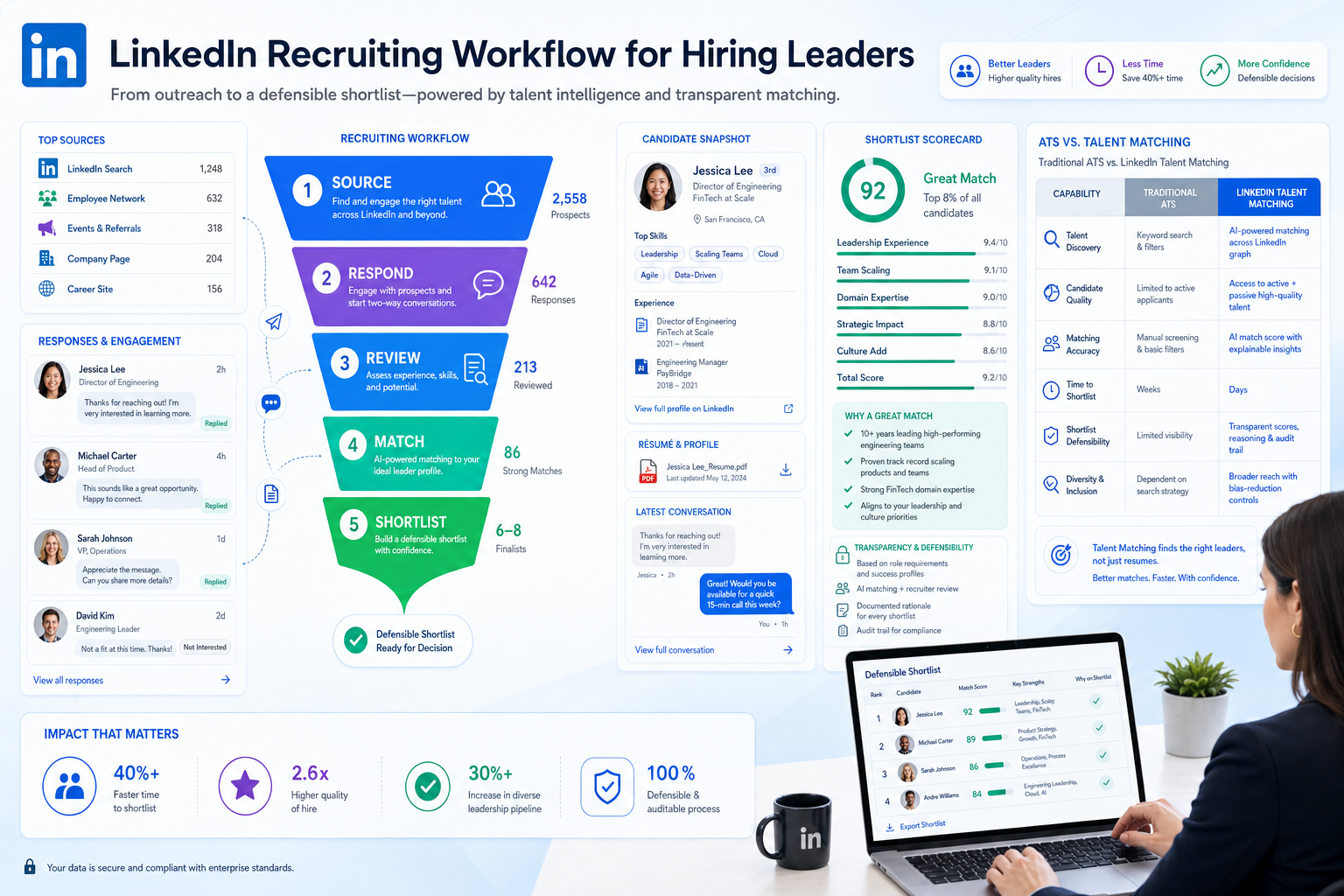
- The workflow that matters: source, respond, review, match, and shortlist
- Why matching has moved beyond titles and keywords
- Talent matching platform vs ATS: where each actually helps
- What to look for in the best talent intelligence software
- LinkedIn workflow support and recruiter experience
- How to implement ai talent management software without losing control
- Common buying mistakes
- FAQ
What AI-powered talent acquisition means in real recruiting work
In day-to-day recruiting terms, AI-powered talent acquisition is not mainly about replacing recruiters. It is about reducing avoidable manual work, widening talent discovery, improving consistency in screening and matching, and keeping candidate conversations moving when recruiters cannot be online every hour.
That is why the market now overlaps across categories like ai talent management software, talent intelligence, sourcing automation, and talent matching platform tools. Buyers need to look past the labels. Some systems are strongest at workflow control and documentation. Others are better at discovery, search expansion, semantic matching, or message handling. The right choice depends on where your team actually loses time and trust.
For most recruiting teams, the best setup still keeps humans in charge. AI can help source, respond, organize, and rank. Recruiters and hiring managers still need to decide whether a candidate is truly viable, whether a profile gap is acceptable, and whether the business context has shifted enough to change the search criteria.
Why hiring teams need software that holds up when everyone is watching
The most useful lesson from the management survival framing is accountability under observation. New managers are watched by their team, peers, and leadership at the same time. Recruiters in modern hiring face something similar. Candidates judge responsiveness. Hiring managers judge relevance. Recruiting leaders judge process discipline. Clients judge speed and market insight. A tool that only automates one surface-level task will not fix that broader pressure.
That is where software selection needs a more practical lens. If a system creates activity without making recruiter judgment easier to explain, it may increase noise rather than improve hiring. If it speeds outreach but leaves recruiters manually stitching together follow-up, résumé collection, and shortlist logic, it has only solved one fragment of the workflow.
The stronger buying question is this: does the software help a recruiter establish credibility faster? In other words, can it support organized execution, visible logic, cleaner communication, and more defensible shortlists?
Practical takeaway: Recruiting software earns trust when it helps the recruiter look more prepared, more responsive, and more consistent in front of candidates and stakeholders.
The workflow that matters: source, respond, review, match, and shortlist
Many articles describe AI hiring tools in abstract terms. In practice, recruiters should evaluate them against the workflow where pressure accumulates: finding people, keeping conversations active, reviewing who is genuinely interested, matching against role criteria, and presenting a shortlist that can survive stakeholder scrutiny.
1. Source
Sourcing still matters because weak top-of-funnel input creates downstream noise. Good ai talent management software should expand search beyond exact-title matching and help recruiters revisit existing databases, past applicants, and adjacent-fit profiles.
This is also where LinkedIn-heavy teams often feel the biggest operational drag. Outreach volume, connection management, and follow-up timing can consume hours that should be spent on calibration and qualification.
2. Respond
One underdiscussed part of AI-powered talent acquisition is message continuity. Prospects often reply outside recruiter working hours, in different time zones, or in languages the recruiter does not handle fluently. If those replies sit untouched, momentum drops.
That is one reason I see a role for AI Recruiter in LinkedIn workflows. It can continue candidate conversations, answer basic role questions, collect signals of interest, and capture contact details or résumé submissions, which is especially useful when a recruiter is managing multiple searches at once. The key boundary remains important: it should not replace the recruiter’s final assessment of fit.
3. Review
Once replies come in, review discipline matters. Recruiters need to know who responded, who looks interested, who sent a résumé, and which conversations need a human follow-up. This is where many teams still lose continuity through scattered records and partial notes.
Software should make those transitions visible rather than forcing recruiters to reconstruct candidate history from different tools.
4. Match
This is where a real talent matching platform should add value. Matching should not depend only on obvious title overlap. It should consider skills, related experience, seniority, function, and the actual hiring criteria defined at intake.
Recruiters know that many good candidates do not describe themselves in the same language used in the job description. That is why semantic and criteria-driven matching have become more valuable than rigid keyword logic.
5. Shortlist
The shortlist is still the real test. It needs to be fast enough for the business and defensible enough for stakeholder review. A strong system helps recruiters explain not just who was surfaced, but why each person belongs in the conversation.
That is the point where AI either becomes useful infrastructure or just another layer of noise.
Why matching has moved beyond titles and keywords
Keyword search is still part of recruiting, but it is no longer enough for most professional hiring. Titles vary by company, candidates describe impact differently, and some of the strongest people are adjacent rather than exact matches.
The best talent intelligence software usually performs better when it can interpret transferable skills, functionally similar experience, and signals that indicate likely success even when the résumé language is imperfect. A recruiter looking for a finance transformation leader, for example, may need someone from controllership, FP&A, systems implementation, or post-merger integration backgrounds. A title-only search can miss that nuance.
This matters because hiring managers rarely stay fixed on one profile definition. Once they see market realities, they often widen or refine what “fit” means. Good matching software should make that adjustment easier, not force the recruiter to restart from scratch every time criteria shift.
- Can the system explain why someone matched?
- Can recruiters change weighting as role priorities evolve?
- Does it reveal adjacent-fit candidates instead of only direct title clones?
- Can hiring managers understand the logic without needing a technical walkthrough?
If the answer is no, the software may still produce rankings, but those rankings will be harder to trust.
Talent matching platform vs ATS: where each actually helps
Recruiting teams often ask whether they need a new matching layer or whether their ATS is enough. The honest answer is that the tools solve different problems.
| Capability | ATS | Talent Matching Platform |
|---|---|---|
| Primary purpose | Track requisitions, applications, stages, approvals, and records | Find, rank, rediscover, and prioritize relevant talent |
| Typical posture | Reactive after candidates enter the funnel | Proactive before and during funnel creation |
| Search logic | Often keyword or field dependent | Semantic, skills-based, criteria-led |
| Best use | Process control, compliance, documentation | Discovery, fit analysis, shortlist quality |
| Human role | Stage management and process governance | Validation, adjustment, and final selection |
The problem is not that ATS platforms are obsolete. They remain important systems of record. The problem is that many recruiting teams expect them to do proactive search and nuanced matching work they were not designed to handle well.
For that reason, many organizations end up with a hybrid model: ATS for workflow recordkeeping, AI layers for sourcing support, candidate response handling, talent rediscovery, and shortlist improvement.
What to look for in the best talent intelligence software
If you are evaluating the best talent intelligence software, use criteria that reflect recruiter reality rather than demo polish.
Transparent logic
Recruiters need to understand how recommendations were produced. Hiring managers need reasons they can review. Opaque scores create dependence without trust.
Human control
The system should support recruiter judgment, not lock the team into a black box. Override options, visible criteria, and workflow checkpoints matter.
Strong search and rediscovery
Useful tools widen the search and also uncover people already known to the business: silver medalists, prior applicants, alumni, and internal talent.
Workflow support, not just analytics
Many teams do not fail because they lack dashboards. They fail because sourcing, outreach, follow-up, and shortlist preparation happen in disconnected places. The software should reduce fragmentation.
Candidate communication support
For LinkedIn-led recruiting especially, timely communication matters. Systems that help maintain message continuity can improve recruiter responsiveness without forcing 24/7 manual monitoring.
Compliance and auditability
As AI plays a larger role, buyers should confirm how decisions, criteria changes, and user actions are documented. If a shortlist is challenged, your team should be able to reconstruct how it was built.
LinkedIn workflow support and recruiter experience
Because so much proactive recruiting still starts on LinkedIn, it is worth separating general AI hiring claims from actual LinkedIn workflow support. In my own testing mindset, the useful question is not whether AI can “do recruiting.” It is whether it can take the repetitive parts of LinkedIn outreach off the desk without weakening screening discipline.
That is where StrategyBrain AI Recruiter stands out as a practical assistant for recruiters who spend large parts of the week on sourcing and follow-up. Its most relevant strengths for this workflow are automated candidate outreach within defined criteria, always-on multilingual messaging, and collection of résumé and contact details from interested prospects. I would still treat it as a front-end workflow assistant rather than a substitute for recruiter evaluation, because the final qualification decision still depends on résumé review and business context.
For recruiters handling cross-border searches or after-hours reply volume, that support can reduce one of the most common bottlenecks: the lag between candidate interest and recruiter response. I also like the fact that candidate data handling and compliance claims are addressed directly in its materials, which is essential for teams concerned about privacy and account security. Recruiters who want to review more workflow examples can see additional use cases here: AI Recruiter conversation cases.
The bigger lesson is broader than one tool. If your recruiting team depends heavily on LinkedIn for pipeline creation, then your ai talent management software evaluation should include outreach continuity, response capture, and recruiter handoff quality, not just search features.
How to implement ai talent management software without losing control
Implementation is where many promising purchases stall. The teams that get value usually begin with process clarity.
- Identify the exact pressure point. Is the team losing time in sourcing, late replies, rediscovery, screening consistency, or shortlist explanation?
- Standardize intake criteria. Matching quality improves when must-haves, nice-to-haves, and exclusion factors are agreed at the start.
- Define role boundaries. Decide what the AI can do, what the recruiter must review, and what the hiring manager needs to see before interviews begin.
- Start with repeatable searches. Pilot on a role family where you can compare process quality before and after adoption.
- Measure credibility as well as speed. Faster response time matters, but so do shortlist relevance, manager trust, and cleaner process records.
This is also where the “everyone is watching” lesson still applies. New systems succeed when they make recruiters look more organized and more credible in front of stakeholders. They fail when they create hidden complexity the recruiter has to explain away later.
Common buying mistakes
- Buying category language instead of workflow help. A modern label does not guarantee practical value.
- Ignoring recruiter handoffs. If AI can start a conversation but not support a clean human takeover, process quality suffers.
- Overvaluing speed alone. Faster outreach is useful, but not if shortlist quality or candidate experience drops.
- Testing only ideal data. Evaluate with messy job briefs, shifting criteria, and uneven résumés.
- Forgetting internal visibility. A good system should help teams rediscover talent they already know.
FAQ
What does ai talent management software actually do in recruiting?
It typically helps with search, sourcing support, candidate organization, matching, rediscovery, communication workflow, and shortlist preparation. The best systems improve recruiter judgment rather than trying to replace it.
How is a talent matching platform different from an ATS?
An ATS manages process and records. A talent matching platform focuses on discovering and ranking relevant talent. Many teams use both because they solve different problems.
What should recruiters look for in the best talent intelligence software?
Focus on transparent matching logic, criteria control, rediscovery ability, workflow fit, communication support, and auditability. Those factors affect adoption more than automation claims alone.
Can AI handle LinkedIn outreach without removing recruiter control?
Yes, if used correctly. Tools like AI Recruiter can automate repetitive outreach and response handling, but recruiters should still review résumés, assess fit, and decide who advances.
Does AI reduce bias in hiring?
Not automatically. It can improve consistency if criteria are clear and reviewable, but teams still need human oversight, documented logic, and careful evaluation of how recommendations are produced.
Is multilingual candidate communication a meaningful feature?
For global recruiting teams, yes. It can improve responsiveness and reduce friction in early conversations, especially across time zones. It is most useful when combined with strong recruiter review before final decisions.
Conclusion
The real value of ai talent management software is not that it makes recruiting feel futuristic. It is that it helps recruiters stay credible when the work is visible, time-sensitive, and judged from multiple directions. That is why the strongest tools do more than generate matches. They support organized execution, clearer reasoning, better communication, and cleaner handoffs.
If your team is comparing the best talent intelligence software or evaluating a new talent matching platform, start where the pressure is highest: sourcing quality, response continuity, review discipline, and shortlist trust. That is the practical path to AI-powered talent acquisition that actually improves hiring work.