When shortlist quality keeps slipping, this article helps recruiters judge ai talent management software against role clarity to avoid costly mismatches.
When that discipline is missing, the damage shows up fast. Agency recruiters waste time chasing the wrong profiles, in-house teams reopen searches because stakeholder expectations were never aligned, and hiring managers lose confidence when compensation, scope, and candidate caliber do not line up. For smaller search firms and lean TA teams, that is not just an efficiency problem; it affects fees, client trust, recruiter credibility, and whether strong candidates stay engaged.
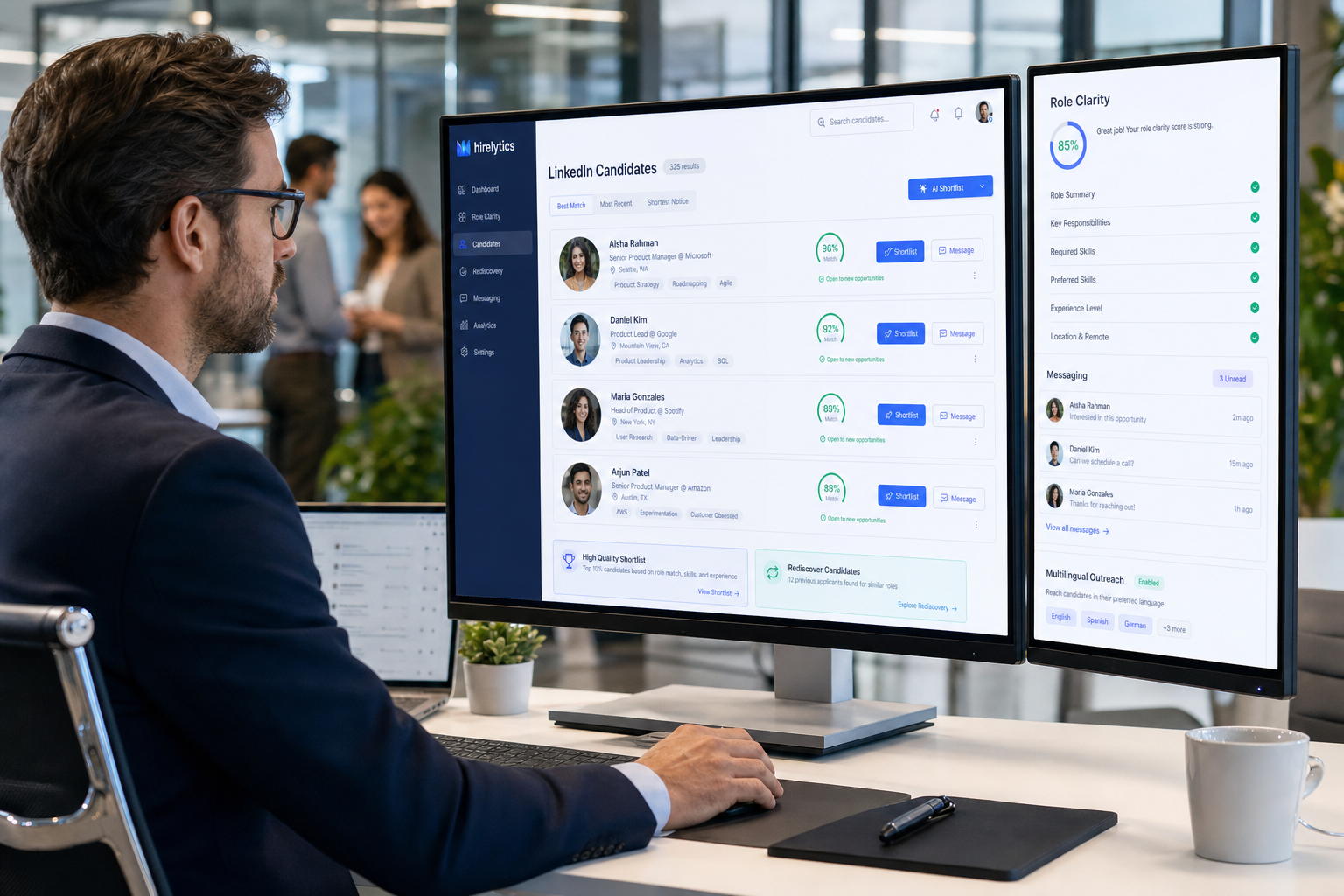
In my own workflow, tools only started helping once they supported the real bottleneck: clarifying the role, keeping candidate conversations moving, and preserving recruiter judgment at the end. That is where StrategyBrain AI Recruiter fits best in an AI-supported process. Its always-on candidate messaging, multilingual communication, and automated collection of resumes and contact details reduce the manual back-and-forth that usually clogs early outreach, while the recruiter still decides who actually matches the brief and what happens next.
A useful way to understand this is to look at executive recruitment, where the stakes are obvious. Before a search even accelerates, the real question is not only who looks impressive on paper. It is whether the company has properly evaluated the job itself: how the role compares to other leadership positions, what level of responsibility it truly carries, what success should look like in six months, and whether compensation matches that reality. In practice, recruiters end up gathering role details, benchmarking scope, revisiting reporting lines, and pressure-testing expectations before they can credibly approach the market.
That same scene exposes a broader hiring truth. If the role is unclear, even a strong pipeline becomes misleading; if the evaluation criteria are weak, matching logic becomes noisy; and if candidate communication is slow, qualified people drift away before a recruiter can recheck fit. That is why AI-powered talent acquisition is not just about automation. It is about using ai talent management software, a talent intelligence platform, and a talent matching platform to connect role clarity, search quality, rediscovery, and recruiter-led decision making.
- Why role clarity comes first in AI-powered talent acquisition
- What is AI talent management software?
- What is a talent intelligence platform?
- From job evaluation to better matching
- Talent intelligence vs ATS vs matching tools
- How AI-powered talent acquisition works in practice
- Why a talent matching platform beats keyword search alone
- Core use cases for recruiting teams
- Governance, fairness, and compliance
- What to look for when buying
- Best practices for implementation
- FAQ
Why Role Clarity Comes First in AI-Powered Talent Acquisition
Experienced recruiters know that better search does not fix a poorly defined role. In executive search, that lesson is obvious because compensation, authority, and performance expectations are all under scrutiny. But the same principle applies across commercial hiring, tech hiring, operations hiring, and internal mobility: if the team has not agreed on the job's real scope, the technology layer will only scale confusion.
That is why the logic behind job evaluation matters here. A recruiter needs more than a job description. They need a structured view of how the role compares to others, what level of complexity it carries, which outcomes matter most, where the reporting line sits, and how success will be assessed after the hire starts. Those factors shape outreach, calibration, screening, and final presentation of candidates.
In practical terms, strong ai talent management software works best when role intake includes:
- Business context behind the opening
- Clear success measures for the first six to twelve months
- Realistic scope and seniority expectations
- Compensation alignment with market and internal structure
- Required skills versus transferable skills
- Reporting relationships and stakeholder visibility
Without that foundation, a matching engine may return polished but irrelevant profiles, and a recruiter may still spend hours untangling what the client or hiring manager actually wants.
What Is AI Talent Management Software?
AI talent management software is a decision-support layer that helps recruiting and HR teams organize talent data, search with more context, rank people more intelligently, and manage candidate or employee fit across hiring and mobility workflows. In talent acquisition, it usually combines resumes, job requirements, skills data, candidate history, engagement signals, and workflow records to support sourcing, screening, rediscovery, and shortlist building.
From a recruiter's point of view, the label matters less than the operating result. Can the system help answer practical questions faster? Which candidates fit this role beyond title similarity? Which prior finalists are worth revisiting? Which applicants are close fits but described their experience differently? Which current employees may be viable internal options if the role evolves?
The most useful systems do not act like black-box judges. They help recruiters see patterns, challenge assumptions, and surface overlooked talent while keeping the final evaluation in human hands.
What Is a Talent Intelligence Platform?
A talent intelligence platform is the part of the recruiting stack designed to turn fragmented people data into something searchable and usable. It often creates normalized profiles, maps related skills, identifies adjacent experience, and connects past candidate activity with current demand.
That matters because most recruiting databases are full of partial records. Good people are buried under inconsistent notes, stale titles, duplicate entries, or narrow keyword tags. A talent intelligence platform helps recruiters move from storage to interpretation. Instead of asking only whether a resume contains exact language, it asks whether the candidate has the capabilities, context, and trajectory that make them relevant now.
In other words, if an ATS tells you where a candidate is in process, the intelligence layer helps explain why the candidate may still matter.
From Job Evaluation to Better Matching
The strongest connection between executive job evaluation and AI-powered hiring is this: better matching begins before sourcing starts. A role should be assessed not only by title and responsibilities, but by relative organizational value, expected outcomes, level of accountability, and internal alignment.
That job-evaluation logic improves matching in several ways:
- It sharpens search criteria. When the team understands the role's real level, recruiters can separate must-have experience from nice-to-have pedigree.
- It improves compensation realism. Searches go off track when employers want top-tier responsibility at mid-tier pay.
- It reduces overhiring and underhiring. Inflated expectations can make good candidates look weak later; under-scoped briefs can miss the business need entirely.
- It creates better six-month evaluation checkpoints. The hiring team can define what success actually looks like after the start date.
This is one reason modern ai talent management software should support more than search. It should help recruiters structure intake, compare role criteria, and preserve the reasoning behind candidate prioritization.
Practical takeaway: If a team cannot explain how a role will be judged six months after hire, no matching score should be trusted as complete.
Talent Intelligence vs ATS vs Matching Tools
These categories overlap, but they solve different bottlenecks.
| Category | Primary Role | Strengths | Common Limitation |
|---|---|---|---|
| Applicant tracking system | Manage requisitions, stages, approvals, and records | Process control, audit trail, workflow consistency | Usually weak at contextual search and rediscovery |
| Talent intelligence platform | Unify talent data and surface contextual insight | Skills mapping, semantic search, analytics, rediscovery | Needs workflow integration to activate daily usage |
| Talent matching platform | Prioritize people against roles using contextual fit signals | Better ranking, broader discovery, transferable-skill visibility | Can produce noisy results if role definition is weak |
| AI talent management software | Support end-to-end talent decisions across search, matching, engagement, and mobility | Combines decision support with live recruiting workflows | Requires governance, recruiter controls, and trust |
For most teams, the question is not which category sounds most advanced. It is which layer solves the current hiring problem. If process discipline is weak, fix workflow first. If approved roles still generate poor shortlists, repetitive searching, and low database reuse, a talent intelligence platform or talent matching platform may be the more urgent addition.
How AI-Powered Talent Acquisition Works in Practice
In real recruiting operations, AI-powered talent acquisition usually starts with messy inputs: resumes, job descriptions, interviewer notes, CRM history, compensation ranges, employee profiles, and historical placements. The system then applies semantic search, skills inference, and relationship mapping to make that data more useful.
A recruiter might search for "operations leaders who scaled distributed service teams after a merger" or "customer success managers with enterprise onboarding and renewal exposure in regulated industries." A stronger system can interpret the work context and likely fit rather than relying only on exact title strings.
That becomes even more useful after solid intake. When the role has been properly evaluated for scope, hierarchy, and expected outcomes, the AI has a clearer frame for ranking talent. When the role is vague, the same tooling may still return volume, but not clarity.
Core building blocks in modern systems
- Skills graph: links related capabilities, role families, and adjacent experience.
- Semantic search: interprets meaning instead of matching only keywords.
- Contextual ranking: prioritizes candidates using multiple fit signals.
- Candidate rediscovery: finds strong past candidates for current openings.
- CRM enrichment: uses past engagement to guide outreach priorities.
- Internal mobility matching: identifies current employees with adjacent fit.
- Explainability features: show why a candidate surfaced or ranked highly.
Where conversational automation helps
One practical lesson from using AI Recruiter in early-stage outreach is that speed matters most when the search criteria are already clear. I have found it most helpful when a role is defined, the likely target pool is known, and the team needs candidate conversations to continue outside business hours without losing continuity. In that setup, automated outreach and follow-up can keep interested talent engaged, collect resumes and contact details, and reduce the lag between first contact and recruiter review. It does not replace qualification. It protects momentum until the recruiter evaluates the resume and decides whether the person truly belongs in the shortlist.
Why a Talent Matching Platform Beats Keyword Search Alone
A capable talent matching platform should understand that recruiting language is inconsistent. One candidate writes "commercial growth," another writes "account expansion," and another writes "strategic revenue development." A basic keyword search may split them apart; contextual matching should recognize the overlap.
This matters even more when the role itself has been carefully scoped. If a search requires leadership in a turnaround, post-merger integration, or first-year function building, the system should understand those patterns through project history and operating context, not just title repetition.
In practice, better matching should recognize:
- Synonyms and equivalent terminology
- Transferable skills from adjacent industries
- Leadership scope and reporting complexity
- Company stage, size, and operating environment
- Projects and outcomes, not only job titles
- Past engagement or silver-medalist status
The result is not automated hiring. The result is fewer missed candidates and better-informed recruiter review.
Core Use Cases for Recruiting Teams
Sourcing with better role calibration
When intake is strong, ai talent management software helps recruiters search beyond surface titles and find candidates whose experience matches the real work of the role.
Screening with decision support
AI-supported screening should help prioritize review by surfacing relevant patterns, not reject people invisibly. Human review remains essential.
Candidate rediscovery
Many firms already have viable talent in past searches. A talent intelligence platform makes those records searchable by current context, not just old tags.
Executive and leadership hiring
This is where the job-evaluation connection is strongest. Better mapping of scope, compensation, and first-year expectations leads to better matching and stronger stakeholder alignment.
Internal mobility
Organizations can use the same logic to identify employees whose adjacent skills make them viable for evolving roles, especially after restructures or team redesign.
Outreach continuity
For recruiters handling high message volume, AI-assisted communication can keep conversations active across time zones and after hours. In my experience, that is one of the most practical use cases for StrategyBrain AI Recruiter: it helps move the repetitive first-contact workflow forward, especially on LinkedIn-heavy searches, while I retain control over shortlisting, qualification, and interview decisions.
Governance, Fairness, and Compliance
Any serious discussion of AI-powered hiring has to include governance. If the system influences ranking, outreach, rediscovery, or internal mobility decisions, teams need clear answers on transparency, data handling, and human oversight.
At minimum, buyers should ask whether the system supports:
- Explainable matching or recommendation logic
- Human review before any hiring decision
- Documented retention and privacy practices
- Bias mitigation and monitoring processes
- Role-based permissions and auditability
- Candidate communication controls and secure data handling
Recruiters should also separate two questions: can the platform keep communication moving, and can it justify why a person was surfaced? Both matter. A useful workflow may automate parts of outreach, but trust still depends on transparent reasoning and recruiter accountability.
What to Look for When Buying AI Talent Management Software
Buyers should evaluate these tools against actual hiring friction, not demo polish.
Priority evaluation criteria
- Role intake support: Does the system help capture scope, outcomes, and realistic criteria?
- Search quality: Can recruiters use plain-language search and get relevant results?
- Matching depth: Does it recognize context, synonyms, and transferable experience?
- Candidate rediscovery: Can it revive strong past candidates?
- Recruiter control: Can users adjust criteria and override ranking?
- Communication workflow: Can outreach and follow-up continue without losing human ownership?
- Governance: Are explainability, privacy, and audit controls clear?
- Integration readiness: Does it fit the existing recruiting stack?
If your biggest issue is unclear roles and mismatched expectations, start there. If the role definition is solid but recruiters are still losing time on repetitive outreach, resume collection, and after-hours follow-up, then conversational support tools can add immediate operational value.
Best Practices for Implementation
1. Start with intake discipline
Before turning on matching, define business goals, success measures, reporting relationships, and realistic compensation.
2. Pick one high-friction workflow
Examples include leadership candidate rediscovery, LinkedIn-heavy sourcing, multilingual outreach, or internal mobility matching.
3. Keep recruiter ownership explicit
Document that AI supports search, outreach, and prioritization, while recruiters and hiring teams make the final judgment.
4. Train teams on contextual search
Recruiters should search by outcomes, project exposure, and environment, not title alone.
5. Review fairness and privacy early
Governance works best when built into rollout rather than added after adoption.
6. Measure quality signals
Look for better shortlist relevance, stronger rediscovery, improved candidate responsiveness, and clearer hiring-manager calibration.
One useful implementation pattern is to pair better matching with better messaging. On searches where candidate response speed matters, I have used AI Recruiter to handle repetitive LinkedIn communication and resume capture while I focus on evaluating actual fit against the role's agreed criteria. The advantage is not blind automation. It is preserving recruiter energy for the judgment calls that matter.
FAQ
How does AI talent management software improve hiring decisions?
It helps recruiters search more intelligently, compare candidates with more context, rediscover relevant talent, and keep role criteria visible throughout the process. Its value is highest when the role has been clearly defined first.
What does a talent intelligence platform actually analyze?
A talent intelligence platform may analyze resumes, job descriptions, skills data, candidate history, CRM activity, internal employee profiles, and recruiter workflow signals to create a searchable and more contextual talent view.
What is the difference between a talent matching platform and keyword search?
A talent matching platform looks for contextual fit across synonyms, adjacent skills, role scope, and project history, while basic keyword search depends heavily on exact wording.
Why does job evaluation matter in AI-powered talent acquisition?
Because role clarity shapes matching quality. If the organization has not defined the role's value, scope, compensation logic, and first-year expectations, the search process becomes less reliable no matter how advanced the software is.
Can AI handle candidate outreach while recruiters keep control?
Yes, in many workflows AI can support first contact, message continuity, multilingual communication, and resume collection. Recruiters should still review resumes, assess fit, and make the next-step decision.
Does AI talent management software replace an ATS?
No. An ATS manages process and records. AI talent management software adds intelligence for search, matching, rediscovery, and in some cases communication support.
What should recruiters ask before buying?
Ask how the system supports role definition, explains matches, handles data, integrates with current workflows, and preserves human review.
Conclusion
The most useful lesson from executive job evaluation is simple: smarter hiring starts with a clearer role. Once teams understand what the job is really worth, how it will be judged, and what success looks like, AI becomes much more practical. That is when ai talent management software, a talent intelligence platform, and a talent matching platform can genuinely improve search quality, rediscovery, outreach continuity, and hiring decisions.
For recruiters, the best systems do not replace judgment. They protect it. They reduce manual drift, keep candidate communication moving, and help the team see fit more clearly. That is the real promise of AI-powered talent acquisition: not less recruiter involvement, but better recruiter leverage.