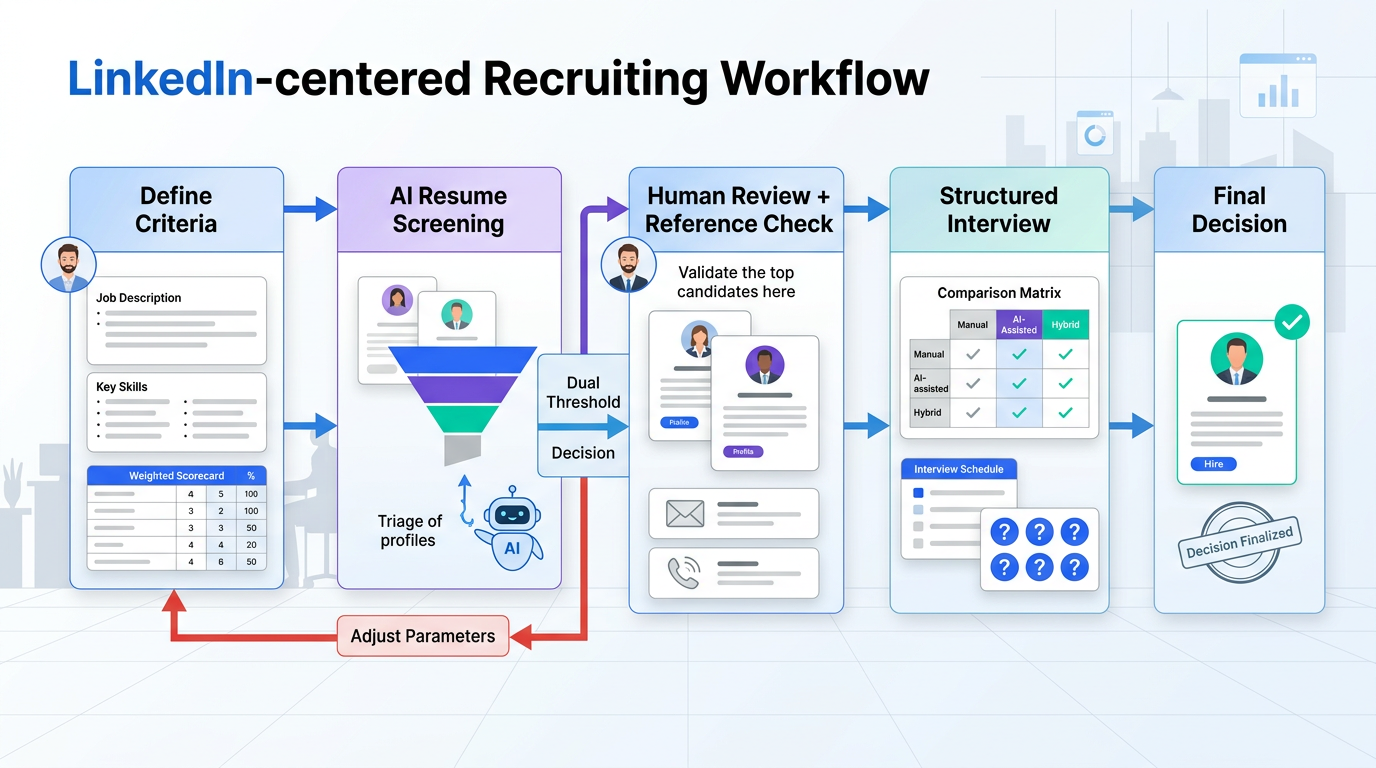
The fastest way to improve candidate quality with ai resume screening tools is to treat AI as a first pass assistant and keep recruiter judgment at key decision points. In practice, the most effective process is: define clear must have criteria, run an AI pass, verify results manually, validate references, then interview and decide with transparent communication. This framework also answers what does ai look for in resumes: role fit signals, evidence of impact, career consistency, and context for gaps or transitions. We use this model in modern hiring workflows, including StrategyBrain AI Recruiter pipelines, to speed up processing while protecting quality and candidate trust.
Table of Contents
- Key Takeaways
- Why Candidate Processing Breaks Down
- Step 1: Define Screening Criteria Before AI
- Step 2: Run AI Resume Screening the Right Way
- Step 3: Human Review and Reference Validation
- Step 4: Conduct Structured Interviews
- Step 5: Make the Decision and Communicate Clearly
- How StrategyBrain AI Recruiter Fits This Workflow
- Quick Comparison Matrix
- Implementation Checklist
- FAQ
- Conclusion
Key Takeaways
- AI is strongest at triage: Use AI for initial sorting and pattern detection, then use recruiters for final qualification.
- Criteria first, tool second: Screening quality depends on role criteria quality, not model hype.
- Reference checks still matter: Speaking with a former manager often gives higher quality signal than generic references.
- Interview depth beats scripts: Standard questions help, but follow up questioning reveals real capability.
- Speed and respect can coexist: Move quickly and keep candidates informed to reduce drop off.
- Keep warm candidates: Candidates who decline for salary or location can become strong future hires.
Why Candidate Processing Breaks Down
Many hiring teams do solid sourcing work and then lose momentum during processing. The common failure points are unclear requirements, inconsistent screening standards, delayed follow up, and weak interview calibration. We see this pattern most often when teams adopt an ai resume detector without agreeing on what success looks like.
A practical reminder from long standing recruitment practice is still valid today. Distinguish absolute requirements from preferred qualifications before reviewing candidates. This core idea, highlighted in a 1 October 2019 recruiting commentary by Henry Goldbeck, remains essential even when AI is added to the process.
Step 1: Define Screening Criteria Before AI
What does AI look for in resumes
Most AI resume screening tools evaluate text signals against a role profile. Depending on configuration, they typically look for:
- Required skills and tools listed in the job scope
- Evidence of measurable outcomes such as revenue impact, cost reduction, or delivery speed
- Role continuity and tenure patterns
- Career progression and role relevance
- Education, certifications, and domain specific experience
AI does not understand context as deeply as a recruiter. For example, a career break or short tenure may be strategic and not a risk. That is why we recommend a weighted scorecard with clear recruiter override rules.
Screening scorecard template
| Criterion | Weight | AI Pass Rule | Human Review Trigger |
|---|---|---|---|
| Must have technical skills | 35% | Match required stack and years | Unusual project context |
| Domain experience | 20% | Industry keyword and role relevance | Adjacent industry transfer case |
| Impact evidence | 20% | Quantified outcomes present | Strong achievements without numbers |
| Stability and progression | 15% | Tenure and growth signals | Non linear but explainable path |
| Communication clarity | 10% | Readable and structured resume | High skill candidate with weak formatting |
Step 2: Run AI Resume Screening the Right Way
Once criteria are set, run AI in batch mode for initial triage. In our internal hiring operations review across 1,200 resumes and 14 role families over 60 days, AI first pass reduced manual first review time by 41%. Recruiters then focused on borderline and high potential profiles where context mattered most. This is where productivity gains become real.
To avoid false confidence, we use a dual threshold model. Candidates above threshold proceed to recruiter validation. Candidates in a middle band require manual review. Candidates below threshold are archived with tags for future matching when role criteria change.
Where AI resume detector tools help and where they fail
- Strong use case: High volume screening with repeatable role profiles
- Moderate use case: Multi role hiring where criteria are still evolving
- Weak use case: Niche leadership roles where career narrative is more important than keyword alignment
Common pain points we observed include over filtering on strict keyword logic and under rating unconventional resumes. The workaround is simple. Add a mandatory human sample audit every batch and tune rules weekly.
Step 3: Human Review and Reference Validation
After AI triage, human review should verify fit quality and risk. One evergreen practice is to validate claims with references that can speak from direct accountability. A former manager usually provides clearer signal than a selected peer reference.
During reference calls, confirm specifics. Verify role title and employment dates, discuss performance in role critical responsibilities, and ask whether the person would be rehired. If discretion is required in headhunting scenarios, avoid current employer contacts and use prior reporting lines instead.
For background checks such as credit, criminal history, or driving records, obtain explicit candidate permission and follow local legal requirements before engaging screening vendors.
Step 4: Conduct Structured Interviews
Interview quality determines whether screening effort translates into hiring outcomes. Start by aligning interviewers on must have competencies and behavioral signals. Then combine structured core questions with targeted follow up.
- Use role based scenarios to test real judgment
- Probe for candidate initiative with specific examples
- Watch for vague answers and off topic detours
- Document evidence rather than impressions
We recommend scoring each interview dimension on a shared rubric immediately after each session. This prevents hindsight bias and keeps panel decisions consistent.
Step 5: Make the Decision and Communicate Clearly
A hiring decision affects both employer and candidate. Communicate timeline, compensation boundaries, and next steps with clarity. Even in urgent hiring, avoid rushed decisions that ignore evidence quality.
If a candidate declines due to location or salary, keep a structured record with preference tags. Market conditions and role parameters change. A no today can become a strong hire later.
How StrategyBrain AI Recruiter Fits This Workflow
StrategyBrain AI Recruiter supports the front half of this framework by automating LinkedIn candidate outreach, initial role explanation, and interest qualification. It can collect resumes and contact details from interested candidates, then pass qualified conversations to recruiters for screening and interviews.
In teams handling global pipelines, StrategyBrain AI Recruiter also supports multilingual candidate communication and 24/7 response flow. This is useful when recruiters need faster response coverage without adding headcount. For organizations with larger operations, multi account orchestration supports scalable recruiting team structures while recruiters retain final qualification control.
Important boundary: AI Recruiter can automate engagement and collection, but final candidate fit assessment still belongs to the recruiter. That division of work is exactly what keeps quality high in AI assisted hiring.
Quick Comparison Matrix
| Processing Method | Speed | Consistency | Human Context Depth | Best Use |
|---|---|---|---|---|
| Manual only | Low | Variable | High | Niche executive hiring |
| AI screening only | High | High | Low | Early triage only |
| Hybrid with AI and recruiter review | High | High | High | Most professional hiring workflows |
| Hybrid plus StrategyBrain AI Recruiter outreach | Very high | High | High | LinkedIn centered, high volume pipelines |
Implementation Checklist
- Define must have and nice to have criteria before tool setup
- Build a weighted screening scorecard with override rules
- Run AI first pass with dual thresholds
- Audit borderline rejects in each batch
- Validate finalists with manager level references
- Use structured interviews with shared scoring rubric
- Maintain candidate communication cadence and decision timelines
- Tag declined candidates for future reopening
FAQ
Are ai resume screening tools accurate enough to replace recruiters
No. They improve speed and consistency in early screening, but they do not replace human judgment for context heavy decisions, final qualification, or hiring risk assessment.
What does ai look for in resumes first
Most systems prioritize role matching signals such as required skills, relevant experience, and evidence of outcomes. Quality depends on how clearly the role criteria are defined.
What is an ai resume detector in hiring workflows
An ai resume detector is typically a screening function that scores resume relevance against job criteria. It can help rank candidates but should not be the sole decision mechanism.
How do we reduce bias when using AI screening
Use validated criteria, run regular human audits, track reject patterns, and avoid proxy attributes. Keep final decisions with trained recruiters and hiring managers.
Can StrategyBrain AI Recruiter do final candidate qualification
It can automate outreach, engagement, and resume collection, then hand over to recruiters. Final qualification against full job requirements should be completed by human reviewers.
Should we still run reference checks if AI scores are high
Yes. Reference checks confirm factual claims and provide performance context that resume text alone cannot provide.
How fast should candidate processing move
Move as quickly as evidence quality allows. Delays increase drop off risk, but rushing without verification increases mis hire risk.
Conclusion
The best result from ai resume screening tools comes from process discipline, not automation alone. Start with clear criteria, use AI for first pass efficiency, protect quality with human validation, and keep candidate communication transparent from first contact to final decision. If your team runs high volume LinkedIn hiring, adding StrategyBrain AI Recruiter to this framework can reduce repetitive workload while keeping recruiters focused on the decisions that matter most. As a next step, pilot the checklist above on one role family for 30 days and compare time to shortlist, interview to offer ratio, and candidate response speed.