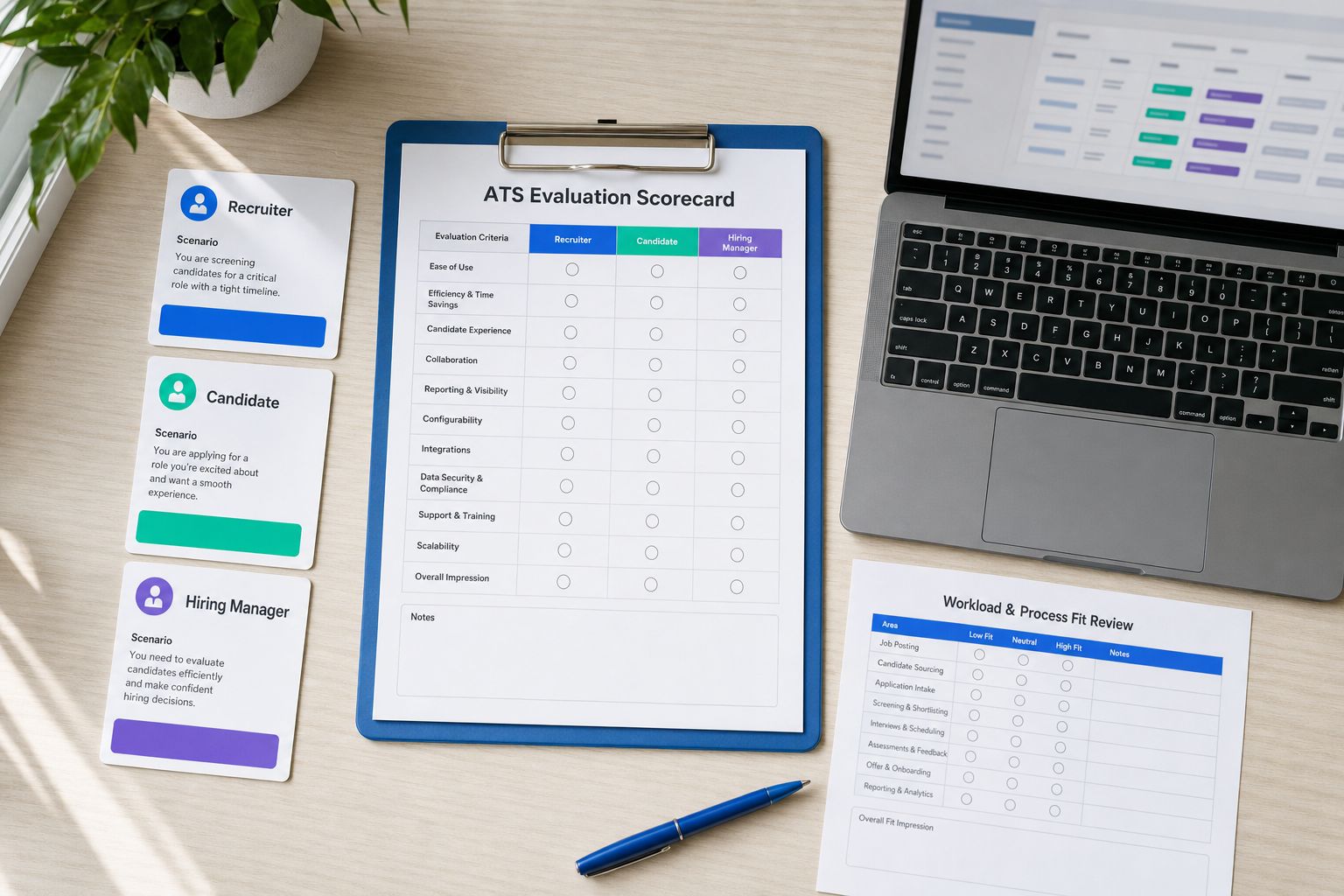
This framework helps recruiting leaders evaluate an applicant tracking system before missing scorecards delay candidate updates.
Without that control, individual recruiters lose hours to status chasing, small agencies absorb avoidable delivery costs, and corporate talent teams leave candidates waiting while overloaded hiring managers postpone feedback. The damage extends beyond speed: fragmented records weaken client confidence, inconsistent communication harms the employer brand, and continuous meetings or after-hours follow-up increase the risk of burnout.
A product-aware response combines an applicant tracking system with carefully governed recruitment automation. Automated acknowledgments, scheduling, reminders, and stage updates can reduce repetitive coordination, while workload dashboards expose stalled requisitions before they become emergencies. Recruiters must still evaluate résumés, interpret job-related evidence, handle exceptions, and make or oversee every consequential decision.
Consider the moment a remote hiring manager declines another interview meeting after returning from company-wide leave. The recruiter checks the requisition list, replies to candidates who were promised updates, and moves completed interviews to the correct stages. While reminding the manager about missing scorecards, the recruiter discovers that several interviewers have postponed feedback because their calendars are dominated by video calls and they have no protected focus time.
This is not simply a scheduling failure. It exposes whether recruitment technology supports sustainable workloads, asynchronous collaboration, clear ownership, and humane communication. Those requirements should shape any applicant tracking system evaluation, including comparisons of top applicant tracking systems and searches for Greenhouse applicant tracking software.
Last reviewed: 2025. Product capabilities and legal requirements can change, so buyers should confirm current vendor documentation and obtain qualified advice where necessary.
Key Takeaways
- An ATS should reduce coordination pressure rather than accelerate every task. Faster workflows have little value if they create more alerts, meetings, or after-hours work.
- Burnout is an operating risk. Candidate delays, missing feedback, inconsistent records, and recruiter turnover can all emerge when workload is invisible.
- Human accountability remains essential. Automation can route work and organize evidence, but recruiters and hiring managers must own employment decisions.
- Top applicant tracking systems require scenario-based comparison. Buyers should test workload management, usability, governance, reporting, integrations, and total operating cost.
- Structured hiring is only effective when people can sustain it. Interview plans and scorecards need realistic deadlines, protected focus time, and simple workflows.
Table of Contents
- What Remote-Work Evidence Teaches Recruiting Teams
- What an Applicant Tracking System Should Control
- Four Principles for Sustainable Recruitment Automation
- Applicant Tracking System Benefits
- How to Compare Top Applicant Tracking Systems
- Evaluating Greenhouse Applicant Tracking Software
- ATS vs. CRM, HRIS, and Related Technology
- Implementation Plan
- Metrics and Reporting
- Responsible Automation and Compliance
- Common Selection Mistakes
- Frequently Asked Questions
What Remote-Work Evidence Teaches Recruiting Teams
The rapid shift to remote work made an existing management problem more visible: digital work can continue long after human attention has been exhausted. Research published during the pandemic documented serious concerns about employee well-being, rising burnout, and reduced focus. These findings are historical rather than current benchmarks, but the operating lesson remains useful for distributed recruiting teams.
A 2020 employee-benefits report found that 44% of surveyed employees had serious concerns about physical, mental, and social health. A later survey reported that 44% of workers felt more burned out than a year earlier. Gallup has also reported that employees who experience burnout very often or always are more likely to take sick leave, seek another job, and feel less confident in their performance.
Recruiting operations are especially exposed because the work contains continuous handoffs. One delayed scorecard can block a debrief; a blocked debrief delays the candidate update; the delayed update prompts more messages; and those messages create additional work for a recruiter already managing several vacancies. An applicant tracking system should make that chain visible rather than merely recording the final delay.
Practitioner insight: A useful ATS does not just show where a candidate sits. It shows who owns the next action, how long the action has been pending, and whether the workload behind the delay is realistic.
What an Applicant Tracking System Should Control
An applicant tracking system is the operating record for jobs, applicants, communications, interview plans, feedback, approvals, offers, and recruiting reports. It should replace fragmented coordination across inboxes, spreadsheets, calendars, and private chat threads without forcing every hiring process into the same design.
Its control function becomes most valuable when work changes hands. Recruiters need to know whether an interviewer has received the correct materials, whether an approval is waiting on finance, whether a candidate needs an accommodation, and whether an automated message actually reached its recipient. Hiring managers need a simpler view: what requires attention, by when, and what evidence is needed.
Different hiring models require different configurations. A high-volume service role may need rapid application review and group scheduling. An executive search may require confidential permissions, longer research periods, and several approval layers. An agency needs clear separation between client records, candidate relationships, submissions, and placements. Buyers should therefore evaluate configurability by role, region, employment type, and business unit.
What the ATS Should Not Control
The system should not become an unchallenged decision maker. It may route applications, organize information, summarize activity, or recommend a next action, but it should not obscure why a person advanced or was rejected. Recruiters remain responsible for résumé review, job-related assessment, candidate communication, exceptions, and decision quality.
Four Principles for Sustainable Recruitment Automation
Remote-work practices offer a useful framework for recruitment technology. Collective breaks, fewer meetings, personal choice, and reduced working time all address the same underlying issue: productivity cannot be sustained by treating human capacity as unlimited. These ideas translate into four practical ATS design principles.
1. Build Workload-Aware Pauses
Company-wide rest periods became valuable because employees could disconnect without transferring unfinished work to colleagues. Recruiting workflows need an equivalent mechanism. When the organization closes, pauses hiring, or enters a holiday period, the ATS should support adjusted service levels, delayed reminders, updated candidate messages, and reassigned urgent tasks.
Avoid leaving automations active without supervision. A reminder sequence that continues during a closure can pressure interviewers who were told to disconnect and can promise candidates a response that no one is available to provide. Before a planned pause, recruiters should review active requisitions, identify time-sensitive candidates, update workflow owners, and publish realistic communication dates.
2. Replace Unnecessary Meetings With Asynchronous Evidence
Video-meeting fatigue matters in hiring because interviews, intake calls, debriefs, and approval meetings compete with employees' primary work. An ATS can reduce this burden by capturing structured intake information, distributing interview kits, collecting independent scorecards, and showing decision-ready evidence before a meeting is scheduled.
This does not mean eliminating discussion. A live debrief is appropriate when evidence conflicts, risk is material, or a decision requires cross-functional judgment. The goal is to stop using meetings for status collection that the system should already provide.
3. Preserve Choice and Accessible Alternatives
Employee well-being programs are more useful when individuals can choose support that fits their circumstances. Recruitment automation follows the same principle. Self-scheduling may help many candidates, but an accessible human-assisted option must remain available. Automated messages may be efficient, but candidates need a contact for questions, accommodations, corrections, and sensitive circumstances.
Recruiters also need controlled flexibility. A system should allow an authorized user to pause a workflow, correct an inaccurate stage, change an owner, or override a recommendation with a documented reason. Automation without a practical exception path creates hidden manual work.
4. Design Around Capacity, Not Constant Availability
The four-day-workweek discussion challenges the assumption that longer availability automatically produces more output. Recruiting leaders should apply the same skepticism to technology. A platform that enables messages, reminders, and reports around the clock can still produce poor results if recruiters lack time for careful review.
Capacity planning should consider active requisitions, pipeline complexity, interview volume, hiring-manager responsiveness, sourcing requirements, and candidate communication. The ATS should help leaders rebalance work before service deteriorates, not simply document how much overdue work accumulated.
Applicant Tracking System Benefits in Practice
The most valuable applicant tracking system benefits appear when software solves a defined operating problem. Each expected benefit should therefore have an observable workflow and a metric.
| Benefit | How It Appears | Metric to Monitor | Sustainable-Work Check |
|---|---|---|---|
| Centralized records | Applications, communications, feedback, and decisions remain attached to one profile | Duplicate records and data completeness | Can users find information without asking colleagues to reconstruct it? |
| Faster coordination | Scheduling, reminders, and approvals move through defined owners | Time in stage and overdue tasks | Do reminders clarify responsibility or merely create more alerts? |
| Structured evaluation | Interviewers use role-specific questions and scorecards | Scorecard completion and stage conversion | Can interviewers submit useful evidence without attending extra meetings? |
| Candidate communication | Candidates receive timely updates and clear next steps | Response time and candidate drop-off | Is there an accessible route to a person? |
| Source analysis | Teams can trace applicants, qualified candidates, offers, and hires to sources | Source conversion and cost per hire | Are attribution rules consistent enough to support decisions? |
| Governance | Permissions, audit records, retention, and deletion are managed systematically | Access exceptions and deletion completion | Can sensitive work be controlled without creating offline records? |
| Capacity visibility | Leaders can see aging requisitions, overloaded owners, and stalled approvals | Workload distribution and stage aging | Does the team act before overload affects candidates? |
The practical test is whether every participant can complete expected work without maintaining a private spreadsheet or relying on repeated follow-up. If offline work remains essential, either the workflow is poorly configured or the selected platform does not fit the operating model.
How to Compare Top Applicant Tracking Systems
A defensible comparison of top applicant tracking systems begins with hiring scenarios, not a universal ranking. Small businesses, global employers, search firms, and high-volume recruiting teams have different requirements. Buyers should compare platforms against the same tasks and evidence.
| ATS Category | Best-Fit Environment | Typical Strengths | Risks to Validate |
|---|---|---|---|
| Small-business ATS | Teams replacing email and spreadsheets | Simple pipelines, job posting, templates, and basic reports | Scalability, permissions, reporting depth, and support |
| Structured-hiring ATS | Organizations standardizing interviews and feedback | Interview plans, scorecards, workflow controls, and adoption reporting | Administrative effort, manager participation, and configuration complexity |
| Enterprise ATS | Organizations with multiple regions, entities, or approval structures | Localization, advanced permissions, complex routing, and broader governance | Implementation duration, administrator workload, and total cost |
| Agency or search ATS | Recruitment agencies and headhunters managing multiple clients | Client records, candidate search, submissions, placements, and activity tracking | Client-data separation, consent, duplicate profiles, and portability |
| HR suite ATS module | Employers prioritizing connected employee records | Recruiting-to-onboarding handoff and shared administration | Recruiting depth, candidate experience, and reporting flexibility |
A Repeatable Evaluation Method
- Define the operating context. Record hiring volumes, role types, locations, languages, user groups, service expectations, and regulatory requirements.
- Map the current workflow. Identify repeated follow-up, unnecessary meetings, after-hours work, missing information, and candidate delays.
- Set business outcomes. Decide whether the priority is faster coordination, stronger governance, more consistent interviews, better reporting, or sustainable workload distribution.
- Create demonstration scripts. Include routine tasks and exceptions such as rescheduling, accommodation requests, duplicate candidates, unavailable interviewers, failed integrations, and paused hiring.
- Score every system consistently. Use weighted criteria rather than changing standards after each demonstration.
- Validate independently. Test security, accessibility, migration, reporting, and integration depth outside the sales presentation.
- Model total cost. Include implementation, integrations, training, support, internal administration, and change management.
Questions That Reveal Workflow Quality
- Can an occasional hiring manager submit a scorecard without additional coaching?
- Can recruiters see workload and overdue actions without building a separate report?
- Can administrators pause or modify an automation safely?
- Does self-scheduling handle time zones, rescheduling, accessibility, and human assistance?
- Can candidates receive accurate updates during closures or hiring pauses?
- Are automated outputs distinguishable from verified human decisions?
- Can reporting definitions be reproduced and audited?
Evaluating Greenhouse Applicant Tracking Software
Buyers searching for Greenhouse applicant tracking software commonly prioritize structured hiring, interview consistency, workflow configuration, and recruiting reporting. Because capabilities and packaging can change, teams should verify current documentation and test the platform against their own process rather than relying on a generic feature list.
Capabilities to Examine
- Interview planning: Test whether job-related competencies, questions, and interviewer responsibilities can be defined before interviews begin.
- Scorecards: Determine whether interviewers can record independent evidence and whether overdue feedback is visible without excessive reminders.
- Scheduling: Review time-zone handling, rescheduling, calendar behavior, accessibility, and the fallback route for candidates who need assistance.
- Workflow configuration: Model different roles, locations, approvals, and exception paths without creating unnecessary administrative complexity.
- Reporting: Reproduce the metrics leadership uses, including stage aging, conversion, source performance, workload, and user adoption.
- Integrations: Validate field-level data flow, permissions, error handling, duplicate management, and support ownership.
- Candidate experience: Complete the application, scheduling, communication, and withdrawal journey on desktop and mobile.
- Automation governance: Document every automated trigger, its owner, its exception path, and the process for reviewing inaccurate outcomes.
Potential Advantages
- A structured framework can help teams prepare role-specific interviews and collect comparable evidence.
- Shared workflows can reduce reliance on inboxes and private notes.
- Visible feedback status can help recruiters resolve blocked decisions.
- Configurable coordination can support different hiring processes when administration is properly governed.
Trade-Offs to Validate
- The configuration and ongoing administration required for the intended process.
- Whether hiring managers will consistently use interview plans and scorecards.
- Whether reminders reduce follow-up or contribute to alert fatigue.
- Whether reporting definitions match internal leadership requirements.
- Whether critical integrations are deep and reliable enough for production use.
- Whether implementation, training, support, and total cost fit available resources.
A representative pilot is more informative than a polished demonstration. Ask recruiters to build a requisition, move candidates, manage a scheduling exception, and produce a report. Ask hiring managers to review a profile, submit evidence, request a change, and approve a decision. The result should be judged on task completion, data quality, workload, and governance—not feature recognition.
ATS vs. CRM, HRIS, Job Board, and Talent Intelligence
Recruitment technology projects often fail because buyers expect one platform to perform every function. Define the primary record for each process and data type before approving an integration.
| Technology | Primary Purpose | Relationship to the ATS | Buying Priority |
|---|---|---|---|
| Applicant tracking system | Manage active applicants, interviews, approvals, offers, and reports | Core operating record for formal hiring | Workflow fit, adoption, governance, and reporting |
| Recruiting CRM | Build relationships with prospects before or between applications | Transfers engaged prospects into active hiring | Consent, ownership, duplicate handling, and synchronization |
| HRIS | Manage organizational and employee records | Provides position data or receives new-hire information | Source-of-truth rules and secure handoff |
| Job board | Advertise openings and attract applicants | Distributes jobs and returns applications or source data | Posting accuracy, attribution, and candidate handoff |
| Talent intelligence platform | Analyze labor markets, skills, or talent pools | Informs sourcing and workforce planning | Data provenance, relevance, explainability, and permitted use |
Integration depth matters more than the number of connections displayed in a catalog. Teams should test direction of travel, field mapping, permissions, retries, error alerts, duplicate handling, and support ownership. A failed transfer that no one notices can recreate the same follow-up burden the technology was purchased to remove.
Applicant Tracking System Implementation Plan
Implementation is a process redesign and behavior-change project, not merely a technical setup. Recruiting operations should lead workflow design, while HR, hiring managers, IT, security, privacy, legal, and accessibility specialists validate relevant controls.
- Establish baselines. Define time-to-hire, time-to-fill, stage aging, candidate response time, scorecard completion, adoption, and workload distribution.
- Remove unnecessary work. Eliminate redundant approvals, status meetings, duplicate entry, and reminders before automating the future process.
- Define ownership. Assign a person to every stage, automation, exception route, report, and integration.
- Set data rules. Decide what information is necessary, who may access it, how long it is retained, and how correction or deletion requests are handled.
- Clean migration data. Deduplicate candidates, standardize stages and sources, and migrate only defensible historical information.
- Configure for capacity. Set realistic deadlines and escalation rules rather than treating every outstanding task as urgent.
- Test difficult scenarios. Include withdrawals, accommodations, duplicate profiles, internal applicants, interviewer absence, hiring pauses, closures, and integration failures.
- Train by role. Recruiters need administrative knowledge; hiring managers need concise task instruction; interviewers need evidence-based feedback guidance.
- Review after launch. Compare speed, quality, workload, candidate experience, data completeness, and governance with the original baseline.
Applying the Opening Scenario
In the earlier remote-hiring scenario, implementation should prevent an overloaded manager from becoming an invisible bottleneck. The team could establish asynchronous scorecard deadlines, appoint a backup approver, suppress nonessential reminders during collective leave, and send candidates an accurate revised timeline. The ATS supports these actions, but recruiting operations must decide the rules and monitor whether they work.
Metrics That Connect ATS Features to Value
Dashboards are reliable only when teams share definitions. For every metric, document the start point, end point, exclusions, owner, review frequency, and expected action. Combine efficiency measures with workload, quality, and candidate-experience indicators.
| Metric | What It Reveals | Useful Breakdown | Likely Action |
|---|---|---|---|
| Time-to-hire | Speed from a defined candidate event to accepted offer | Role, source, location, recruiter, and stage | Investigate slow handoffs and approvals |
| Time-to-fill | Elapsed time from approved opening to hire | Department, role family, location, and priority | Align hiring plans with operational capacity |
| Stage aging | How long candidates remain without movement | Stage, owner, job, and business unit | Resolve blocked decisions and communication gaps |
| Stage conversion | Movement between hiring stages | Source, job, location, and lawful demographic analysis | Review criteria, process consistency, and possible barriers |
| Candidate response time | How quickly candidates receive meaningful updates | Stage, recruiter, role, and message type | Improve ownership and communication capacity |
| Candidate drop-off | Where candidates withdraw or stop progressing | Application step, device, stage, and location | Reduce friction and clarify expectations |
| Scorecard completion | Whether interviewers submit expected evidence | Department, interviewer, role, and interview type | Improve training, deadlines, or workflow design |
| Workload distribution | Whether recruiting work is concentrated unfairly | Recruiter, active requisition, pipeline size, and complexity | Reassign work before service deteriorates |
| Offer acceptance | Share of offers accepted | Role, location, hiring manager, and compensation range | Review speed, expectation setting, and competitiveness |
| User adoption | Whether expected work occurs in the system | User role, task, team, and location | Separate training issues from usability problems |
A shorter process is not automatically healthier or more effective. If speed improves while candidate complaints, recruiter overtime, or incomplete feedback increases, the workflow has shifted cost rather than removed it.
Responsible Automation, AI Governance, and Compliance
Responsible automation begins with an inventory of every automated function and the decision it influences. Routine coordination generally presents less risk than ranking, screening, or recommendation tools, but even a simple message can cause harm when it is inaccurate, inaccessible, or sent at the wrong time.
- Human accountability: Name the person responsible for reviewing outputs, managing exceptions, and making employment decisions.
- Data minimization: Collect only information needed for a legitimate recruiting purpose.
- Access control: Restrict candidate information according to role, location, and business need.
- Accessibility: Test applications, scheduling, communications, and interview workflows with assistive technologies and accommodation scenarios.
- Explainability: Users should understand what an automated output means, what information shaped it, and how it may be challenged.
- Bias monitoring: Investigate unexpected outcome differences, inappropriate proxies, and data-quality problems.
- Auditability: Retain appropriate records of material actions, approvals, workflow changes, outputs, and overrides.
- Change control: Reassess risk when features, models, data sources, workflows, or applicable laws change.
- Location-specific review: Confirm current legal obligations with qualified counsel in every hiring jurisdiction.
Recruiters should know when automation has acted on their behalf. Candidates should have a practical way to request assistance or correction. An automated workflow should never make accountability harder to locate.
Common Applicant Tracking System Selection Mistakes
Buying Features Before Mapping Work
A long feature checklist does not reveal whether the platform solves candidate delays, meeting overload, missing feedback, or fragmented ownership. Map the process and workload first, then convert real problems into test scenarios.
Optimizing Only for Speed
Automation can shorten task time while increasing alert fatigue and after-hours work. Measure candidate experience, data quality, workload, and decision evidence alongside speed.
Ignoring Occasional Users
Hiring managers and interviewers may use the ATS infrequently, but their actions determine whether feedback and approvals remain timely. Include them in task-based testing and simplify their required steps.
Automating Poor Communication
A fast message can still be vague, insensitive, inaccessible, or incorrect. Review message purpose, tone, timing, localization, ownership, and escalation paths.
Assuming Every Connection Is a Complete Integration
Some connections transfer limited fields, operate in one direction, or fail without visible alerts. Test the actual production workflow and define who resolves errors.
Comparing Subscription Price Instead of Total Cost
Implementation, migration, integration, support, security review, training, administration, and change management affect value. Model these costs over the expected contract period without inventing savings the team cannot substantiate.
Frequently Asked Questions
What does an applicant tracking system do?
An applicant tracking system centralizes jobs, applications, candidate records, communications, interviews, feedback, approvals, offers, and recruiting reports. It gives recruiters and hiring managers a shared operating workflow from requisition through hire.
How can an ATS reduce recruiter burnout?
An ATS can reduce repeated data entry, status chasing, manual scheduling, and fragmented communication. It can also expose workload and stalled ownership. It cannot fix unrealistic hiring demand, poor management, inadequate staffing, or a culture of constant availability by itself.
Which recruitment tasks are suitable for automation?
Common candidates include approved job distribution, acknowledgments, interview scheduling, reminders, workflow routing, offer approvals, and report refreshes. Every automation needs an owner, exception path, audit process, and human fallback.
How should a company compare top applicant tracking systems?
Use the same realistic scenarios and weighted criteria for every platform. Evaluate usability, workflow fit, structured interviewing, reporting, candidate experience, workload visibility, integrations, security, accessibility, implementation support, governance, and total cost.
What is the difference between an ATS and a recruiting CRM?
An ATS primarily manages active applicants and formal hiring processes. A recruiting CRM manages relationships with potential candidates before or between applications. Teams using both should define consent, ownership, duplicate handling, and the point at which a prospect becomes an applicant.
What should teams test when evaluating Greenhouse applicant tracking software?
Test interview planning, scorecards, scheduling exceptions, workflow configuration, reporting, integration behavior, candidate experience, permissions, administrative effort, and automation governance. Verify current capabilities and commercial terms directly rather than relying on old reviews.
Which ATS metrics matter most?
Useful measures include time-to-hire, time-to-fill, stage aging, conversion, source performance, candidate response time, drop-off, scorecard completion, offer acceptance, workload distribution, and user adoption. Each metric needs a documented definition and corresponding action.
Is an applicant tracking system suitable for a small business?
Yes, when hiring has outgrown email and spreadsheets or when the business needs more consistent communication and records. Small teams should prioritize usability, essential integrations, support, transparent operating cost, and enough flexibility to grow without unnecessary complexity.
Choosing Technology That People Can Sustain
An applicant tracking system should make hiring easier to operate, easier to govern, and less dependent on constant follow-up. The right platform will support the organization's hiring model while protecting candidate communication, recruiter focus, and accountable human judgment.
Start with the pressure points visible in everyday work: delayed responses, meeting-heavy decisions, missing scorecards, uneven workloads, and unclear ownership. Compare top applicant tracking systems through those scenarios, evaluate Greenhouse applicant tracking software or any alternative against the same standards, and validate implementation effort, integration depth, accessibility, governance, and total cost before committing.
Next step: Build a cross-functional scorecard and require every shortlisted system to complete the same recruiter, candidate, hiring-manager, workload, reporting, and exception-handling scenarios.