When evaluating artificial intelligence for recruiting, recruiting leaders can learn where automation speeds outreach without causing weak judgment, drop-off, or trust loss.
That distinction matters because most hiring problems are not caused by a lack of candidate data. They come from slow follow-up, fragmented communication, rushed screening, and inconsistent hiring criteria. For a solo recruiter, that means missed LinkedIn replies after hours and too much time spent chasing résumés. For a small search firm, it means lower consultant capacity and weaker client confidence. For in-house teams, it means delays that quietly damage candidate experience, employer reputation, and stakeholder trust.
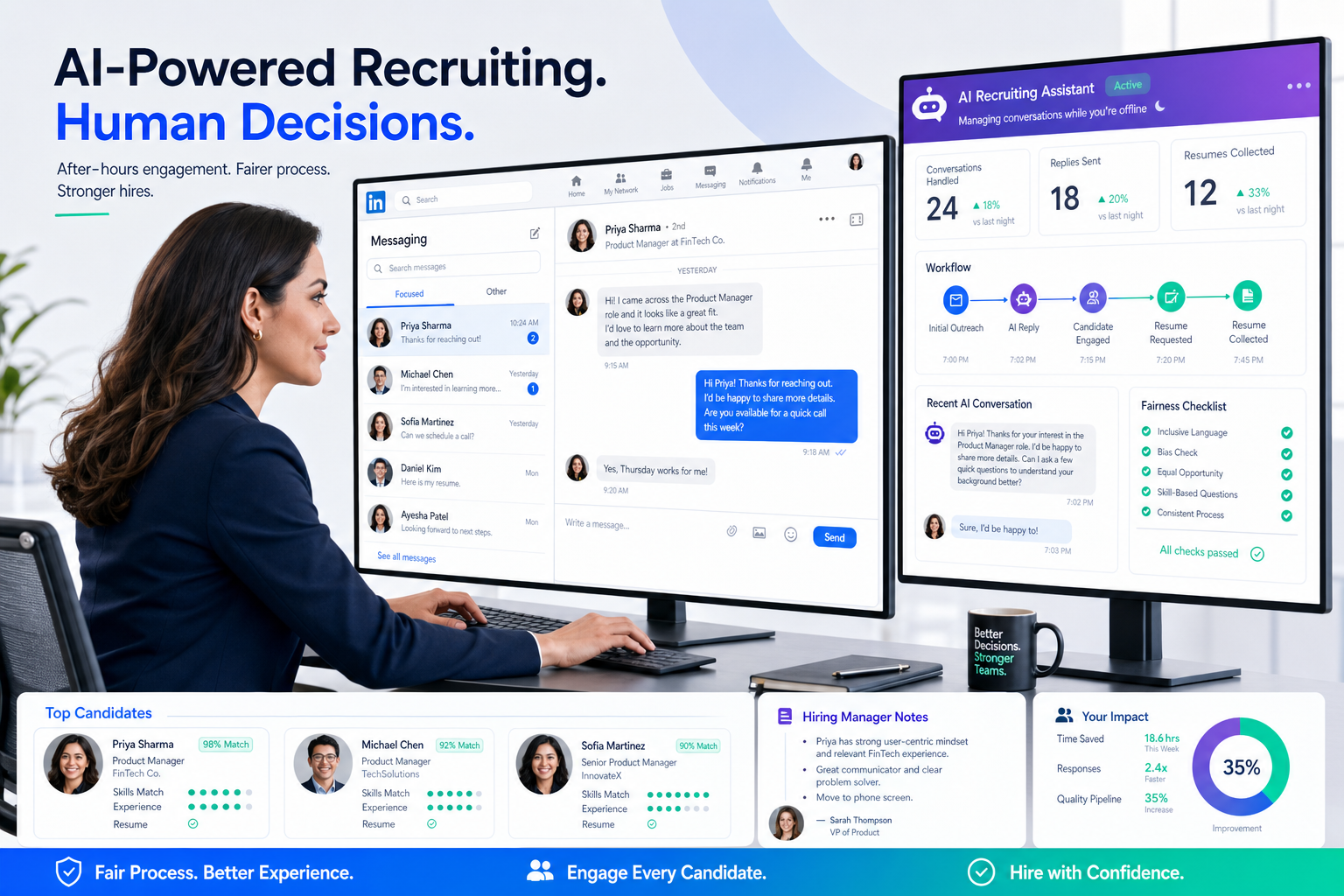
In my own workflow, tools like AI Recruiter are most useful when they handle repetitive LinkedIn conversations, after-hours candidate replies, and résumé collection without taking over final evaluation. The practical value is not that the system decides who should be hired. It does not. It keeps conversations moving, captures interest and contact details, and gives the recruiter more time to review resumes, calibrate with hiring managers, and make the next call with context.
A useful way to understand this is to look at a hiring situation that is not really about software at first. Employers trying to attract more women into their teams, especially into technical and management paths, often discover that the barrier is not only sourcing volume. The real friction shows up when a recruiter drafts a role brief, checks whether the language signals flexibility, answers a candidate asking about work-life balance, and then has to explain whether the employer will treat pregnancy, career breaks, and compensation fairly. Those are not abstract brand questions. They shape whether a strong candidate keeps talking.
That same situation becomes operational very quickly. A recruiter reviews the requisition, follows up on a LinkedIn response, updates candidate notes, and reminds the hiring manager to confirm whether flexible hours are truly available before sending the next message. If that information sits in inboxes and memory instead of a reliable workflow, promising candidates drop out or self-select away. This is exactly where ai in hiring process decisions become practical: the team needs software that speeds communication, preserves context, and supports better judgment about how to use ai in recruiting without automating away accountability.
- Why Context Matters Before Automation
- What Is AI Recruiting Software?
- How AI Fits Into the Hiring Process
- Where AI Helps Attract and Engage Talent
- Types of AI Recruiting Tools
- Benefits for Recruiters and Hiring Teams
- Risks, Fairness, and Governance
- How to Use AI in Recruiting
- What to Look for When Evaluating Software
- Common Mistakes
- FAQ
Why Context Matters Before Automation
Before comparing features, recruiters need to understand the hiring context they are trying to improve. That is one of the clearest lessons from real inclusion work. Employers that genuinely attract more women do not do it through messaging alone. They do it by offering fair treatment, flexible working arrangements, and a more open-minded view of who can succeed in the role. In practice, recruiters are often the people who must translate those promises into candidate conversations.
That creates a useful standard for evaluating AI. If a tool cannot help the recruiter communicate role context accurately, preserve important candidate questions, and keep records of what was discussed, then it is not helping much. In other words, artificial intelligence for recruiting works best when it supports a hiring process that already knows what it stands for.
This is especially relevant in searches where candidates are evaluating more than title and pay. If a prospective hire wants to know whether an employer is flexible around family responsibilities, fair on compensation, or serious about equal treatment, the recruiter needs fast access to reliable information. AI can help organize and accelerate those exchanges, but it cannot invent employer credibility where none exists.
Key insight: Strong AI recruiting software does not just move applicants through stages faster. It helps recruiters keep high-value conversations accurate, consistent, and responsive.
What Is AI Recruiting Software?
AI recruiting software is a broad category of tools that automate or support hiring tasks using technologies such as machine learning, large language models, semantic search, workflow automation, and analytics. In everyday use, these tools may help with sourcing, candidate messaging, scheduling, note summarization, application review, and reporting.
The most useful definition of artificial intelligence for recruiting is practical augmentation. Good systems remove repetitive work and surface relevant signals. Recruiters and hiring managers still own the decisions that affect people’s careers, including shortlist review, interview interpretation, and final selection.
This matters because many teams confuse automation with judgment. A platform may draft outreach, sort application queues, or summarize conversations, but that is not the same as understanding whether a candidate can succeed in a role, whether compensation is fair, or whether a manager is evaluating people consistently.
How AI Fits Into the Hiring Process
To evaluate ai in hiring process choices well, it helps to break hiring into stages. Each stage has different risks, benefits, and oversight needs.
Sourcing and talent discovery
AI can expand search logic beyond exact keywords, identify adjacent skills, and surface candidates with transferable experience. This is useful when recruiters want to widen the funnel and avoid over-reliance on narrow title matching.
For LinkedIn-heavy workflows, I have found that the bigger win is often not the search itself but the ability to keep outreach moving. When candidates reply late, across time zones, or in different languages, a tool such as AI Recruiter can maintain the first layer of communication, answer common role questions, and collect resumes from interested prospects. The recruiter still reviews the profile and decides whether the candidate should advance.
Job description improvement
AI can help recruiters rewrite job descriptions for clarity, readability, and consistency. That becomes particularly important when employers want to broaden their appeal to groups who may self-screen out of a role because the language feels rigid, exclusionary, or unrealistic.
From an operator's perspective, this is one of the most underused areas of how to use ai in recruiting. Better role copy improves the top of funnel before any screening begins.
Application review and resume screening
Screening support is one of the most common use cases. AI can extract skills, cluster applicants, and help prioritize review order. On high-volume searches, that can save real time.
But recruiters should separate sorting from selecting. If the system is ranking candidates, the team should understand what signals it is using and where human review steps remain mandatory.
Scheduling and candidate coordination
Scheduling, reminders, and candidate Q&A are often the easiest places to start. These tasks are repetitive, time-sensitive, and measurable. They also have direct candidate experience impact.
This is where always-on messaging can make a practical difference. In my experience, after-hours replies are one of the biggest hidden bottlenecks in active sourcing. When a system can keep the exchange moving overnight and collect the candidate's contact details or resume before attention fades, recruiter productivity improves without reducing control.
Interview support and summaries
Interview tools can transcribe meetings, summarize discussions, and organize feedback. Used carefully, they reduce note-taking burden and improve documentation quality.
The rule is simple: summaries should remain editable, reviewable, and subordinate to actual interviewer judgment.
Evaluation and decision support
At later stages, AI can compare scorecard themes, summarize panel comments, and highlight mismatches between role requirements and feedback. The closer the software gets to influencing advancement decisions, the stronger the need for transparency and human oversight.
Where AI Helps Attract and Engage Talent
The reference case around attracting female talent points to a broader truth: recruiting effectiveness depends on whether the employer can communicate flexibility, fairness, and respect in a credible way. That requirement applies far beyond gender-focused hiring.
AI can help in three useful ways here.
- It preserves consistency. If multiple recruiters or coordinators are answering the same candidate questions, AI-supported drafts and knowledge prompts can reduce mixed messaging.
- It improves response speed. Candidates weighing several options often disengage when simple questions sit unanswered for too long.
- It captures context. When a recruiter needs to remember whether a candidate asked about schedule flexibility, parental leave, compensation structure, or remote expectations, structured records matter.
These are small workflow gains, but together they affect who stays in the process. A candidate who is already cautious about culture or treatment may interpret slow or vague communication as a warning sign. That is why the best use of AI is often operational discipline rather than flashy prediction.
Types of AI Recruiting Tools
One of the most common buying mistakes is treating all AI recruiting software as the same category. In reality, the market includes several different tool types.
| Tool Category | Primary Use | Best Fit | Oversight Needed |
|---|---|---|---|
| ATS with AI features | Workflow, screening support, reporting | Teams centralizing hiring operations | High for ranking and disposition logic |
| Sourcing tools | Search expansion, matching, lead generation | Recruiters filling specialized roles | High for shortlist quality |
| Messaging and coordination tools | Outreach, follow-up, scheduling, candidate Q&A | LinkedIn-heavy and high-volume teams | Moderate to high |
| Interview intelligence tools | Transcription, summaries, scorecard support | Structured interview environments | High for interpretation |
| Analytics tools | Funnel visibility, drop-off analysis, source trends | TA leaders and recruiting operations | Moderate |
For many recruiters, the immediate question is whether they need a full platform change or simply better support for one broken workflow. If your sourcing and outreach process is where momentum disappears, messaging automation may matter more than replacing your whole stack.
Benefits for Recruiters and Hiring Teams
The most credible case for AI recruiting software is operational improvement. It helps teams move faster, respond more consistently, and spend less time on manual admin.
More recruiter capacity
Recruiters should spend their best hours on intake meetings, market calibration, relationship building, and selection judgment. AI can take some of the repetitive tasks off the desk, including initial outreach drafts, candidate follow-ups, summaries, and contact capture.
Better candidate responsiveness
Candidates often reply outside office hours. If no one answers until the next day or later, momentum drops. A tool designed for always-on communication can help maintain engagement while the recruiter is offline.
Stronger process consistency
When teams are trying to present an employer as flexible, fair, and well organized, inconsistent communication undermines the message. AI-supported templates and conversation flows can improve consistency while still leaving room for recruiter judgment.
Cleaner records and handoffs
One practical advantage I noticed when testing AI Recruiter is that its value increases when multiple candidate conversations are running at once. Instead of manually stitching together message history, resumes, and interest signals from separate threads, the recruiter gets a more orderly handoff into the next review step. That matters most for firms doing active sourcing at scale or handling cross-border outreach in different languages.
Support for broader talent access
Semantic matching and more responsive engagement can help recruiters reach candidates who might otherwise be missed or lost early. That does not automatically create equitable hiring, but it can support more open-minded sourcing and a less title-bound process.
Risks, Fairness, and Governance
Any serious discussion of artificial intelligence for recruiting has to include trust. Candidates are increasingly aware that AI may play some role in communication or screening, and employers need clear rules for its use.
Bias can be accelerated, not removed
If screening criteria are weak, historical data is skewed, or hiring managers are inconsistent, AI can scale those flaws rather than solve them. Structure helps, but structure is only as good as the judgment behind it.
Explainability matters
Recruiters should be able to explain why a candidate was surfaced, why a message was sent, and why a person moved or did not move forward. Total opacity is a bad fit for hiring.
Human review is non-negotiable
The closer software gets to recommending advancement, the more important human review becomes. This includes ranking, matching, summary interpretation, and any predictive guidance tied to selection.
Privacy and data handling still matter
Recruiters should check where candidate data is stored, how access is controlled, and whether the vendor uses customer data to train models. Governance is not just a legal issue. It is part of candidate trust and employer credibility.
- Define which workflows AI may automate.
- Define which actions always require recruiter approval.
- Review candidate-facing messages for accuracy and tone.
- Audit outcomes across different role types.
- Train hiring managers on the limits of AI-generated outputs.
How to Use AI in Recruiting
If your team is asking how to use ai in recruiting, start with visible, repetitive tasks that are easy to monitor.
- Map where momentum is lost.
Look at the stages where candidates wait too long, recruiters repeat the same tasks, or important context gets lost between outreach and review.
- Begin with communication-heavy tasks.
Scheduling, candidate Q&A, outreach follow-up, and resume collection are practical first use cases because they reduce admin without handing over selection authority.
- Keep recruiters responsible for evaluation.
Use AI to suggest, summarize, and organize. Keep shortlist quality, candidate fit review, and final next-step decisions with the recruiter.
- Clarify employer value before automating messages.
If the employer cannot answer questions about flexibility, compensation, or expectations clearly, automation will only spread confusion faster.
- Measure workflow quality.
Track response times, stage movement, admin time saved, candidate drop-off, and handoff quality rather than broad claims about replacing recruiters.
- Review edge cases regularly.
Any workflow involving sensitive candidate questions, compensation, or career-gap context should be reviewed often to make sure the system is supporting good judgment.
What to Look for When Evaluating Software
When evaluating AI recruiting software, buyers should focus on workflow fit more than marketing claims.
Does it solve a specific recruiting bottleneck?
If the problem is after-hours LinkedIn follow-up, a broad analytics suite will not fix it. If the problem is messy interview documentation, sourcing automation will not help much.
Does it preserve recruiter control?
Strong software improves throughput while keeping decision ownership with the recruiting team.
Can it support the way candidates actually communicate?
For globally distributed searches, multilingual communication and round-the-clock responsiveness may be more valuable than another ranking feature.
Does it fit your existing process?
Good software should strengthen your workflow, not force duplicate records or create a second operating system outside the main hiring process.
Can the team trust its outputs?
Recommendations, summaries, and status updates should be understandable and reviewable. Recruiters need enough visibility to challenge the tool when necessary.
Will it help with candidate experience, not just internal efficiency?
That question is easy to overlook. But in searches where candidates are judging employer fairness, flexibility, or seriousness, communication quality is part of the outcome.
Common Mistakes
Most implementation problems come from process design, not from AI itself.
- Automating before clarifying the employer story. If role conditions and working practices are vague, AI just scales vague messaging.
- Overtrusting rankings. Prioritization support is useful, but rankings are not decisions.
- Ignoring communication handoffs. Candidate experience often breaks between sourcing, scheduling, and hiring-manager review.
- Buying too many disconnected tools. Fragmentation creates record gaps and weakens accountability.
- Underestimating candidate concerns. Questions about flexibility, fairness, family responsibilities, and pay need clear human-backed answers.
- Treating every role the same. High-volume coordination and sensitive executive search workflows need different levels of automation.
FAQ
What is AI recruiting software?
AI recruiting software is technology that automates or supports tasks such as sourcing, messaging, screening support, scheduling, interview documentation, and analytics. The most practical use of artificial intelligence for recruiting is to improve speed and consistency while keeping final hiring decisions with human reviewers.
How is AI used in the hiring process?
AI in hiring process workflows is commonly used for search expansion, outreach assistance, candidate Q&A, scheduling, resume collection, note summarization, and reporting. The best results come when recruiters use AI for repetitive work and retain accountability for evaluation and selection.
How should recruiters use AI in recruiting responsibly?
When deciding how to use ai in recruiting, start with low-risk, high-volume tasks, keep humans involved in candidate decisions, review outputs regularly, and make sure the process reflects fair and clearly defined hiring criteria.
Can AI recruiting software help attract more diverse talent?
It can help widen sourcing, improve response speed, and support more consistent communication. But diversity outcomes still depend on employer practices, fair treatment, and whether the organization truly offers the conditions it communicates.
Can AI replace recruiters?
No. It can reduce repetitive work and improve process speed, but recruiters still need to assess fit, manage stakeholder expectations, and make accountable decisions.
What should teams evaluate before buying AI recruiting tools?
Focus on the workflow problem, candidate experience impact, transparency, data handling, integration fit, and whether the software improves real recruiting work rather than adding complexity.
Conclusion
AI recruiting software is most valuable when it improves recruiter effectiveness without pretending to replace recruiter judgment. The opening case around attracting female talent makes that point clearly: strong hiring depends on fair treatment, flexible and credible communication, and a process that does not lose people through delay or inconsistency.
That is the practical future of artificial intelligence for recruiting. Use it to keep conversations moving, organize candidate context, support sourcing and coordination, and reduce manual admin. Keep people responsible for evaluating resumes, interpreting nuance, and making hiring decisions. Teams that approach ai in hiring process choices that way are in a much stronger position to decide how to use ai in recruiting well.