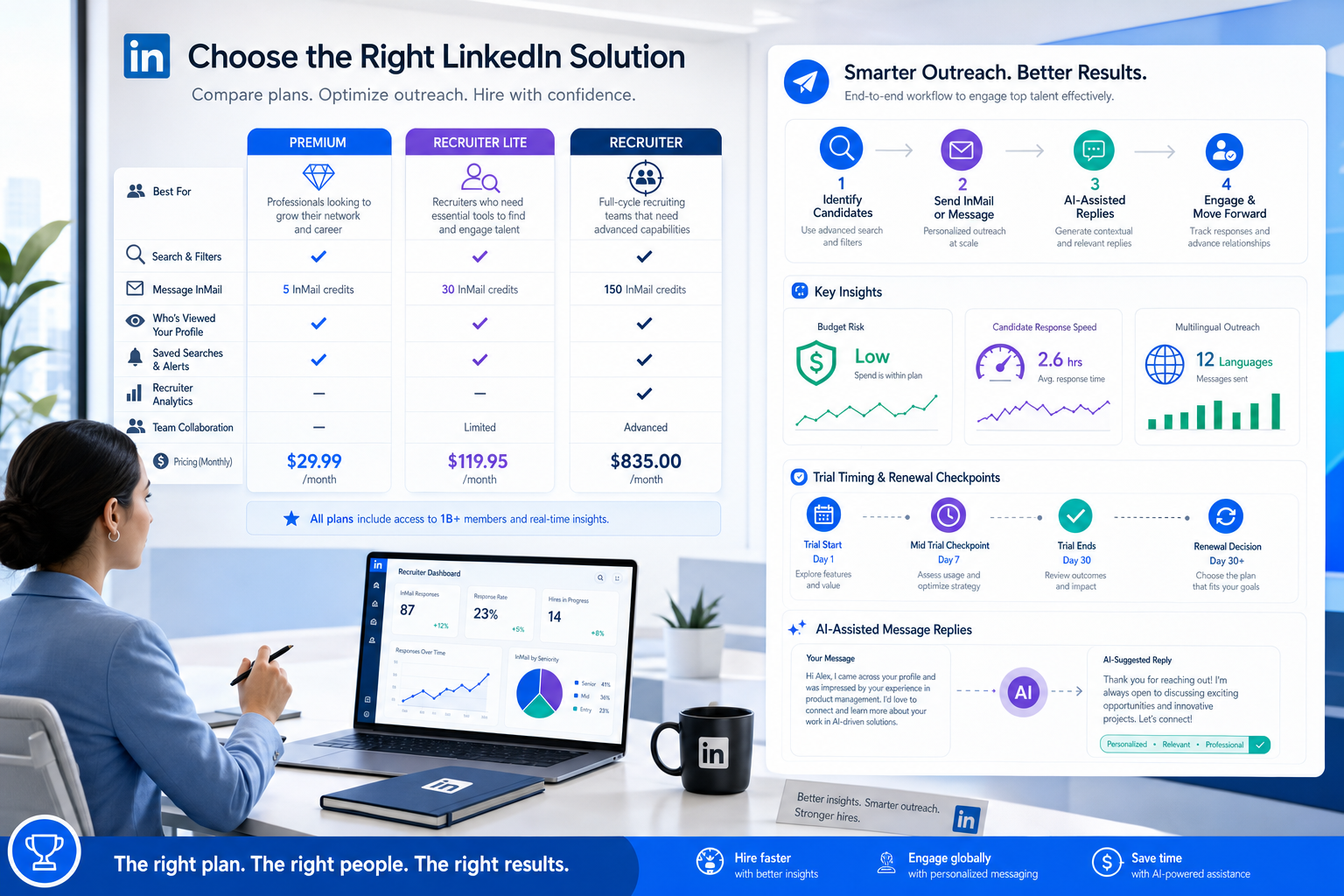
A linkedin premium code helps recruiters only when this article lets them judge plan fit, trial timing, and renewal risk before waste.
That sounds basic, but it is where many teams lose money and momentum. Solo headhunters activate the wrong tier for a short burst of sourcing, agency owners hand a self-serve subscription to work that really needs recruiter workflow depth, and in-house talent teams burn a trial before a hiring spike actually starts. The damage is not just budget waste. It shows up in missed candidate replies, weak handoffs, confused expectations with hiring managers, and avoidable churn when a subscription looked cheap at signup but did not support the actual search.
In my own LinkedIn-heavy recruiting work, I have found that an AI-supported workflow can reduce that friction when the market moves faster than the team can manually keep up. Tools such as StrategyBrain AI Recruiter are most useful when they take over repetitive first-touch messaging, after-hours follow-up, and multilingual candidate communication while the recruiter still owns final judgment, resume review, shortlist quality, and the next decision. That division of labor matters when you are trying to test whether a LinkedIn subscription is truly helping your desk or just adding another bill.
The pattern reminds me of a recruiting contradiction I have seen in cyclical sectors. In late 2018, while Canadian and global mining indices were falling sharply, recruiters serving mining-adjacent employers were still filling sales and industrial roles because the hiring market did not collapse in the same neat line as investor sentiment. One search might involve equipment sellers having a banner year, another might involve an employer adding in-house recruiting capacity specifically to keep prospecting talent in the sector, and meanwhile the recruiter still had to source candidates for pumps, compressors, valves, and related industrial lines on a regular basis.
That is the exact kind of moment when discount hunting gets distorted. A recruiter sees market uncertainty, wants to control spend, and starts searching for a linkedin premium code as if every LinkedIn product should be bought the same way. But the real job is more specific: identify who still needs hiring support, decide whether the work is relationship-led or data-led, and choose the subscription or workflow that fits the current search before the market turns again. That is also why searches around linkedin learning discount and how to get linkedin premium for free for students need separate treatment instead of being mixed into recruiter buying decisions.
Table of Contents
- Why market pressure changes how recruiters shop for LinkedIn
- What a linkedin premium code usually means in practice
- Premium, Recruiter Lite, and Recruiter are not the same buy
- Where a linkedin learning discount really fits
- How to get LinkedIn Premium for free for students
- Military, nonprofit, and eligibility-based offers
- Three ways recruiters handle LinkedIn outreach workflows
- A recruiter framework for testing deals without waste
- FAQ
Why market pressure changes how recruiters shop for LinkedIn
One of the most useful lessons from volatile hiring markets is that headline conditions and desk-level recruiting activity often diverge. In the mining example above, the S&P/TSX Metals & Mining Index had dropped by nearly 19% from July to October 2018, while a comparable global mining index was down almost 12% over the same period. Yet recruiters still saw strong demand in adjacent commercial and industrial hiring.
From a recruiting operator's perspective, that matters because buying behavior often becomes irrational when the market looks shaky. Teams rush toward coupons, free trials, or any visible savings lever. But if active searches still exist, the better question is not “Where is the discount?” It is “What kind of search are we actually running now?”
That distinction changes everything:
- Relationship-led hiring may need steady outreach and disciplined follow-up more than deep seat expansion.
- Data-led and consultative hiring may need better targeting, stronger messaging, and candidate proof points.
- Diversifying employers may need recruiters who can source across more than one industry line, not just one niche.
In the original market example, employers were not just trying to survive a down cycle. Some were actively diversifying their client base and hiring people who could sell across several industrial markets. That translates neatly into LinkedIn buying logic today: the right subscription decision depends on whether your team is handling narrow transactional sourcing, broader business development style recruiting, or full multi-seat talent acquisition operations.
Practical takeaway: Market pressure makes recruiters look for cheaper tools, but workflow pressure is what should decide whether a LinkedIn offer is actually valuable.
What a linkedin premium code usually means in practice
Most people use linkedin premium code as a catch-all phrase, but LinkedIn offers do not usually behave like permanent public coupon systems. In practice, the real options are more often:
- Free trials attached to eligible accounts
- Promotional links or codes connected to specific campaigns
- Partner or audience-based offers tied to students, military community members, or other defined groups
- Contract discussions for organizational products rather than self-serve subscriptions
That is why recruiters should be skeptical of generic coupon-page logic. A deal may be expired, restricted, one-time only, or attached to a different product than the one your desk actually needs.
There is another practical issue: trial timing. If your account gets access to a trial, do not treat it casually. Trial reuse is generally limited, so activating during a slow period can waste the one low-risk test window you would rather have during a live hiring push.
Before redeeming any offer, I recommend checking four things in order:
- Eligibility — Is the offer actually available to this account or audience?
- Product tier — Is it Premium Career, Premium Business, Recruiter Lite, or full Recruiter?
- Renewal terms — What happens after the discounted period ends?
- Cancellation timing — Can your team stop it cleanly if the workflow fit is poor?
That sequence saves more money than random discount hunting because it prevents buying the wrong category of tool in the first place.
Premium, Recruiter Lite, and Recruiter are not the same buy
Recruiters frequently blur together Premium plans and recruiting products, but they support different jobs. This is where many “deal” conversations go off track.
| Product | Best-fit user | Main use case | How to think about deals |
|---|---|---|---|
| Premium Career | Job seekers, students, career changers | Career visibility, job search, learning | Often discussed through trials or public promos |
| Premium Business | Light network users, business users | Expanded network access and account insight | Useful in limited cases, but not a recruiter workflow substitute |
| Recruiter Lite | Solo recruiters, agency desks, hiring managers who source directly | Lighter recruiting work | Should be assessed separately from Premium offers |
| LinkedIn Recruiter | Larger TA teams and structured recruiting functions | Team-based recruiting workflow and collaboration | Usually part of a different pricing and contracting conversation |
If your work resembles the mining-sector example—still active despite market noise, requiring steady sourcing across adjacent categories—then the wrong low-cost plan can hurt more than help. A cheap subscription that does not support collaboration, tracking, or candidate follow-up is not really a saving.
In that kind of environment, I have seen recruiters get more value from combining a right-sized LinkedIn seat with AI Recruiter support for repetitive outreach. The useful part is not “automation” as a buzzword. It is the ability to keep candidate communication moving, including off-hours replies and multilingual conversations, while I still decide who is worth advancing and which resume actually fits the search.
Where a linkedin learning discount really fits
Searches for linkedin learning discount often come from the right instinct but the wrong buying frame. LinkedIn Premium subscriptions generally include LinkedIn Learning, so the question is not always whether a standalone Learning coupon exists. It is whether the plan you already need for recruiting or career use includes that training value.
For recruiting teams, Learning can matter in several ways:
- New recruiters can use it for sourcing, interviewing, and platform skill development.
- Hiring managers may benefit from interview and selection training.
- Agency desks may treat it as a secondary perk rather than a buying trigger.
But bundled value is not automatic value. If the core need is only occasional course access, paying for a broader subscription may not be rational. If the main need is active LinkedIn use and Learning comes included, then the linkedin learning discount search becomes less urgent because the better optimization is plan fit.
That is especially true in sectors where hiring requirements are changing. In the mining-related example, recruiters were seeing demand shift toward more data-driven and commercially sophisticated talent. Learning access may help a recruiter sharpen those conversations, but it does not replace the need to choose the correct seat and outreach workflow.
How to get LinkedIn Premium for free for students
The query how to get linkedin premium for free for students deserves a direct answer because it reflects a very different user intent from recruiter discounts. Students are usually trying to improve visibility, access Learning content, and strengthen job-search readiness. They are not comparing sourcing seats for a live requisition load.
One official route highlighted in the source material is an eligibility-based higher education offer that includes a limited-time period of Microsoft 365 Premium and LinkedIn Premium Career for qualifying students. The key point is not the partner bundle itself. The key point is that the student path is based on eligibility, not on a universal public coupon.
If you are advising students, campus talent teams, or early-career candidates, check these points before activation:
- Verify education eligibility for the current campaign.
- Confirm the offer is still live and not already expired.
- Check the exact plan included, since student access usually points to Premium Career.
- Review renewal terms before the free period ends.
For recruiters, this matters mainly because student and recruiter search intent should not be mixed. A student getting Premium Career through an educational offer is not evidence that an agency recruiter can lower Recruiter costs the same way.
Military, nonprofit, and eligibility-based offers
Two additional categories often create confusion in discount conversations.
Military community pathways
There are documented cases of complimentary Premium access for eligible U.S. military community job seekers through approved nonprofit partners. Again, the lesson is structural: real savings usually come through defined eligibility channels, not random public coupon lists.
Nonprofit discount realities
For nonprofits, discount logic can apply to some annual contract subscriptions, but not necessarily to online self-serve products paid by credit card. That means an organization-level conversation may exist, while an individual trying to apply a public-facing linkedin premium code to a personal self-serve subscription may get nowhere.
This mirrors a broader recruiting truth: team buying and self-serve buying are rarely the same. The employer in a volatile sector that is diversifying, adding recruiter capacity, or supporting several hiring stakeholders should think at the contract and workflow level, not only at the monthly seat level.
Three ways recruiters handle LinkedIn outreach workflows
When recruiters are trying to control cost without losing candidate coverage, they usually end up in one of three operating models.
1. Native LinkedIn only
Strengths: direct, familiar, easy to start.
Weaknesses: manual follow-up load, uneven after-hours coverage, recruiter time gets consumed by repetitive early-stage messaging.
Best for: low-volume or occasional sourcing.
2. LinkedIn plus a sales engagement tool
Some teams adapt general outbound platforms such as Salesloft, Apollo, or Gem to support parts of the recruiting communication process.
- Salesloft can help with cadence discipline, but it is designed first for sales engagement, so recruiter-specific handoff logic may feel adapted rather than native.
- Apollo is attractive for prospecting volume and cost-conscious outreach, but recruiters may find the workflow better for broad outbound than for nuanced candidate conversations.
- Gem is more recruiting-aligned and useful for pipeline visibility, though the fit depends on your existing tech stack and team process.
Common tradeoff: these tools can improve process discipline, but they do not always solve the “candidate replied at 10:30 p.m. in another language and now the thread stalled” problem in a clean way.
3. LinkedIn plus recruiter-focused AI support
This is where StrategyBrain AI Recruiter stands out in the context of LinkedIn use. Its most relevant strengths for this topic are the ability to automatically handle first-touch candidate communication, respond around the clock, and continue conversations in the candidate's native language. In practical terms, I have found that especially useful when a search crosses time zones or when a market stays active despite noisy conditions and I cannot afford to let warm replies sit overnight.
Just as important, it does not replace the recruiter’s final decision. I still review resumes, judge whether the profile actually fits, and decide who advances to interview. That makes it more credible for experienced recruiters than tools that imply the system should do the whole evaluation.
For readers who want to see how the workflow is framed, the setup overview and conversation examples are useful because they show where LinkedIn messaging friction can be reduced without pretending selection judgment becomes automatic.
A recruiter framework for testing deals without waste
If you are evaluating LinkedIn costs in a real recruiting environment, especially one with uneven market signals like the mining example, this is the framework I recommend.
Start with the search, not the coupon
Ask what type of hiring pressure you have right now. One urgent niche search, a burst of agency prospecting, or structured team recruiting all point to different LinkedIn choices.
Identify whether the work has become more consultative
The source case showed a market shift from old-school relationship selling toward more data-driven commercial talent. Recruiting often shifts the same way. If candidates now expect better proof points, clearer messaging, and faster replies, your workflow needs to support that.
Use the cheapest reversible test first
If an eligible trial or limited promo exists, use it when the desk is active enough to generate a real verdict. Do not waste it in a quiet month.
Separate subscription value from execution value
A plan may look fine on paper and still underperform if nobody can keep up with the communication load. That is why layered support matters. In my own usage, StrategyBrain AI Recruiter was most useful not as a “magic sourcing replacement,” but as a way to keep contact, interest checks, and candidate replies moving while I focused on fit, stakeholder alignment, and shortlist quality.
Review renewals before success stories tempt you
The first month can feel productive simply because new tools create activity. The real test is whether the later cost still makes sense once the initial promotion is gone.
Keep student and special-audience offers in their lane
Do not let a valid student, military, or nonprofit headline distort a recruiter purchase decision. Different audiences are solving different problems.
FAQ
Does LinkedIn always offer a linkedin premium code?
No. Most legitimate savings options are time-bound trials, targeted promotions, partner offers, or eligibility-based programs rather than permanent public coupons.
Are LinkedIn Recruiter discounts the same as Premium discounts?
No. Premium Career, Premium Business, Recruiter Lite, and full LinkedIn Recruiter serve different use cases and often follow different purchase logic.
Is LinkedIn Learning included in Premium?
Generally yes, which is why many searches for a linkedin learning discount should start by checking whether Learning access is already bundled into the plan being considered.
How to get LinkedIn Premium for free for students?
The strongest route is through official education-based offers when available. Students should verify eligibility, offer timing, exact plan inclusion, and renewal terms.
Can recruiters rely on repeat free trials?
That is not a safe assumption. Trial eligibility is often limited, so it is better to activate only when you can properly test the workflow.
When does recruiter-focused AI support help most?
Usually when candidate reply volume, time-zone spread, or multilingual communication makes manual LinkedIn follow-up too slow. The recruiter should still own fit assessment and final advancement decisions.
Conclusion
If you came looking for a linkedin premium code, the useful answer is not “yes” or “no.” It is that LinkedIn savings are real only when the offer matches the work. Volatile markets make this easier to forget. As the mining-sector example showed, public signals can weaken while actual recruiting activity stays strong, and that is exactly when teams make rushed subscription decisions.
The smarter path is to separate audience types, understand which LinkedIn product you are actually evaluating, and test offers during live hiring need. For some recruiters, that will mean a clean Premium or Recruiter Lite decision. For others, the better result comes from combining the right LinkedIn access with StrategyBrain AI Recruiter support so repetitive outreach, follow-up, and multilingual replies do not consume the recruiter's day. Either way, the deal that lasts is the one that fits the workflow after the discount headline disappears.