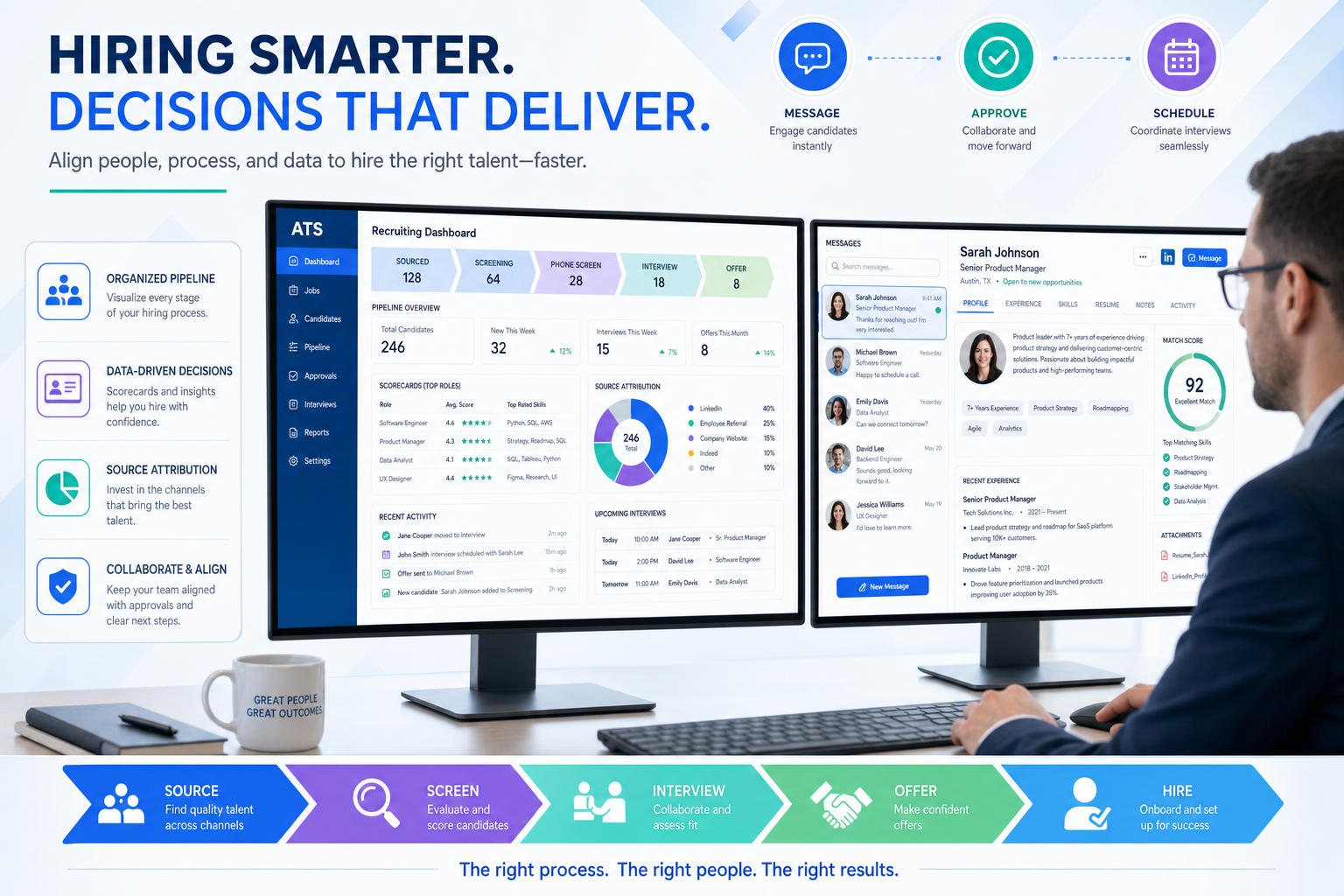
This article helps headhunters judge which ATS for recruiters will stop rushed, vague hiring from becoming costly process mistakes.
That matters because most recruiting pain does not start at interview scheduling or reporting. It starts earlier, when teams open roles too fast, lean on outdated job descriptions, and make decisions under pressure. In a candidate-short market, that creates avoidable damage: recruiters waste hours chasing misaligned briefs, agency owners lose delivery capacity to admin, in-house talent teams frustrate hiring managers with slow progress, and candidates drop when communication feels unclear or reactive.
In my own workflow, tools only started helping once they reduced the specific friction between outreach, candidate replies, and recruiter judgment. That is where StrategyBrain AI Recruiter can be useful as a support layer, especially for repetitive LinkedIn outreach, after-hours candidate follow-up, and multilingual communication when searches span markets. It does not replace recruiter evaluation; I still review resumes, judge relevance, and decide who moves forward, but it can remove a surprising amount of front-end messaging work that often slows ATS hiring before a candidate even enters the formal pipeline.
A useful way to frame the problem comes from a hiring discussion published in March 2022, during a period when employers were trying to fill roughly 875,000 roles in Canada while talent supply stayed tight. The practical warning was not just that hiring was hard. It was that urgency was pushing employers into rushed, emotionally driven decisions. In recruiting terms, that usually shows up in a very familiar sequence: a hiring lead opens a requisition before success criteria are clear, a recruiter starts sourcing against a vague brief, and the team begins reviewing profiles before they have agreed on what the person actually needs to accomplish in the role.
The next actions are where the process breaks down. Someone rewrites the job description from an old template, the recruiter logs candidate outreach and replies in separate places, and the hiring panel tries to compare applicants without a shared scorecard. At that point, the issue is no longer just market pressure. It is a systems problem. The applicant tracking system meaning becomes more practical here: an ATS is the operating layer that should hold role requirements, candidate movement, structured feedback, and communication history together so recruiters can manage urgency without letting the process collapse into guesswork.
If that opening scenario feels familiar, this article is meant to help you evaluate recruitment automation tools with the right lens. We will look at how ats hiring actually works, why sustainable hiring starts with better role definition and structured evaluation, and what experienced recruiters should check before choosing software that claims to streamline the process.
Table of Contents
- Why ATS matters when hiring is urgent
- Applicant tracking system meaning in real recruiting work
- How ATS hiring supports a stronger hiring process
- Five recruiting principles your ATS should support
- Core ATS functions vs recruitment automation layers
- Benefits of an ATS for recruiters and hiring teams
- What to look for when evaluating recruiting software
- ATS comparison table
- Implementation advice from a recruiter workflow view
- Common mistakes in ATS hiring evaluations
- FAQ
Why ATS matters when hiring is urgent
Recruiters usually start shopping for software when volume rises, but urgency alone is not the real reason teams need better systems. The real reason is decision quality under pressure. When demand is high and talent is scarce, people tend to compress steps that should stay distinct: defining the work, aligning the team, evaluating candidates, and documenting decisions.
That is exactly why an ATS for recruiters matters. It is not only there to store resumes. It creates process discipline when market conditions make everyone want to skip it. In difficult hiring periods, the best systems help teams slow down in the right places and speed up in the right places.
From experience, the strongest recruiting operations do three things well in those conditions:
- They define the role around actual business problems, not recycled templates.
- They give recruiters a single place to track outreach, applicants, feedback, and decisions.
- They make candidate communication consistent enough that speed does not destroy trust.
That combination is what turns recruitment automation from a buzzword into something useful.
Applicant tracking system meaning in real recruiting work
When people ask about applicant tracking system meaning, they are often trying to work out whether an ATS is just a resume database or a keyword filter. In real recruiting work, that definition is too narrow.
An applicant tracking system is the system of record for active hiring. It should centralize role setup, application collection, pipeline stages, interview coordination, scorecards, offer approvals, source tracking, and reporting. For recruiters, that means fewer handoffs in inboxes, spreadsheets, and chat threads.
The practical definition I use is this: an ATS is the place where a hiring process becomes visible enough to manage. If a recruiter cannot quickly see what the role requires, where each candidate sits, who owes feedback, and what source is producing qualified people, then the hiring team is still operating on memory and manual effort.
That broader definition also explains why so many teams now combine their ATS with outreach automation, CRM functions, and AI-assisted workflows. The system has to support not only applicant intake, but also everything that happens before and after a candidate formally applies.
How ATS hiring supports a stronger hiring process
The best way to understand ats hiring is not by looking at a feature checklist first. It is by following the hiring process from role creation to final decision and asking where poor structure usually creates mistakes.
1. Requisition planning before sourcing starts
The reference hiring framework behind this article emphasizes a point many teams skip: scaling is impossible without the right people, and the right people are hard to identify if the role itself is underdefined. Before recruiters post anything, the requisition should capture the business need, hiring manager, priority, location, compensation range, and approval path.
Good ATS workflows support this by requiring enough structure before the role goes live. That does not make the process slower. It prevents wasted sourcing effort later.
2. Better job descriptions grounded in real work
One of the strongest ideas from the source material is to stop rushing the job description. That advice translates directly into ATS design. A strong system should help the team document what problems the hire must solve, what success looks like at 3, 6, and 12 months, and which qualifications are truly required versus simply familiar.
Recruiters know the cost of skipping this step. You end up screening against a list of copied qualifications rather than against useful performance criteria.
3. Structured sourcing and applicant intake
Once the role is clear, the ATS should support publishing jobs, collecting applicants, parsing resumes, and tracking source attribution. If your team also relies heavily on LinkedIn outreach, this is often where external automation support becomes valuable.
In my own use, I found that AI Recruiter was most helpful before candidates formally entered the ATS. It handled repetitive connection attempts, initial role introduction, and follow-up with interested prospects who replied outside business hours. That reduced manual message checking, but I still made the real recruiting calls: whether the resume fit, whether the profile matched the brief, and whether the person should move into the tracked hiring workflow.
4. Scorecard-based screening and interviews
The reference article’s advice to build a scorecard is especially important in ATS hiring. Recruiters and hiring managers should agree on what is essential, preferred, and optional before interviews begin. That scorecard then becomes the basis for structured screening, consistent interviews, and clearer comparisons.
This is one of the biggest gaps I see in underused ATS setups. Teams buy software with strong scorecard features, then continue evaluating candidates through unstructured notes and instinct. The technology cannot fix that by itself.
5. Work samples and evidence-based decisions
The original hiring guidance also stresses seeking truth in work samples. That idea matters because resumes and interviews can both overstate fit. For roles where practical output matters, recruiters should look for software that helps track assignments, stakeholder review, and final decision records without losing transparency.
Not every role needs a formal work sample, but every team benefits from clearer evidence standards.
6. Candidate communication and transparency
Another key lesson from the source material is transparency. Candidates are not just being assessed; they are assessing the employer as well. A good ATS should support timely updates, stage-based communication templates, and clean ownership so people do not disappear into the process.
This is also where AI-supported communication can help when used carefully. For global searches or after-hours response windows, multilingual and always-on first-touch communication can keep momentum alive without forcing recruiters to stay online constantly. But again, automation should support human recruiting judgment, not pretend to be the whole process.
Five recruiting principles your ATS should support
The hiring article behind this discussion offered five practical ideas for building stronger teams. Reframed for recruitment automation, those principles become useful ATS evaluation standards.
1. Team context should come before tool configuration
The source advice starts with culture at the team level, not just company slogans. In ATS terms, that means your workflow should capture real decision context: what kind of person thrives with this manager, this pace, and this team structure. If the system only stores generic job text, it misses the context recruiters actually need.
2. Role definition should be sharper than the job ad
Your ATS should help teams document the work behind the posting, including success markers and realistic expectations. If not, recruiters end up managing noise rather than fit.
3. Shared scorecards should reduce bias and drift
The system needs scorecards that are simple enough for hiring managers to complete and structured enough for recruiters to compare candidates consistently.
4. Interviews should be structured, not improvised
Strong ATS hiring workflows support predetermined interview plans, panel visibility, and evaluation criteria tied back to the scorecard.
5. Evidence should matter more than urgency
Whether that evidence comes from work samples, portfolio review, or consistent screening notes, the ATS should make it easier to judge candidate capability on something more concrete than momentum or personality alone.
Practical takeaway: If your recruiting software cannot support role clarity, scorecards, structured interviews, and transparent communication, it will struggle to improve hiring quality no matter how modern its automation sounds.
Core ATS functions vs recruitment automation layers
Many recruiting platforms now mix ATS functions with CRM, messaging automation, analytics, and AI. That can be useful, but only if you separate the system of record from the automation layer.
Core ATS capabilities
- Requisition management
- Application intake
- Resume parsing
- Candidate stage tracking
- Interview coordination
- Structured scorecards
- Offer and approval tracking
- Reporting and funnel visibility
Automation and intelligence layers
- Outreach automation for repetitive prospect messaging
- AI-assisted prioritization to organize review queues
- Recruiting CRM tools for talent pooling and nurture
- Advanced source analytics for attribution and bottlenecks
- Integrations with calendars, HR systems, assessment tools, and communications platforms
- Multilingual messaging support for cross-border recruiting communication
In practice, I prefer teams to get the ATS foundation right first, then add workflow support where manual effort is highest. For many recruiters, that means using the ATS as the hiring backbone and adding AI Recruiter around top-of-funnel LinkedIn outreach if outreach volume, time zones, or follow-up consistency are real constraints.
Benefits of an ATS for recruiters and hiring teams
The main benefits of an ATS for recruiters become clearer when viewed through the opening problem: rushed hiring without shared standards.
- Cleaner role alignment: Recruiters and hiring managers can work from a defined brief rather than assumptions.
- Faster screening: Search, parsing, and stage tracking reduce manual triage.
- Better scorecard discipline: Interviewers evaluate against agreed criteria.
- More consistent candidate communication: Updates stay timely and visible.
- Source clarity: Teams can connect channels to quality, not just application volume.
- Stronger process memory: The system records why candidates moved or stalled.
- Less workflow fragmentation: Recruiters spend less time reconstructing conversations from separate tools.
For agency recruiters, that means more desk capacity and less admin leakage. For in-house teams, it means better stakeholder trust. For hiring managers, it means clearer comparisons and fewer circular discussions late in the process.
What to look for when evaluating recruiting software
If you are comparing systems, evaluate them against real hiring behavior rather than polished demos.
Essential questions to ask
- Can the system capture the real business case for the hire, not just a generic job posting?
- Is requisition approval clear enough to prevent rushed launches?
- Can recruiters track outreach, applicants, and stage movement without side spreadsheets?
- Are scorecards simple enough for hiring managers to complete consistently?
- Can the team distinguish required qualifications from nice-to-have preferences in the workflow?
- Does the platform support transparent candidate communication at every stage?
- Is source attribution tied to interview progression and hires?
- Do integrations reduce fragmentation across calendars, assessments, and HR systems?
- If LinkedIn sourcing is important, what part should stay in the ATS and what part should be supported by outreach automation?
- Does the system improve recruiter adoption, or does it create extra data entry people will avoid?
One practical test I recommend is running a realistic scenario: open a role with incomplete requirements, revise the job definition, source actively, track candidate replies, gather scorecards, and review where the process starts slipping. That reveals much more than a dashboard tour.
ATS comparison table
The table below helps translate broad recruiting goals into practical software checks.
| Evaluation Area | Why It Matters for ATS Hiring | What Recruiters Should Check |
|---|---|---|
| Role setup | Prevents vague or rushed requisitions | Can the team document success criteria, approvals, and hiring context before launch? |
| Job description workflow | Improves sourcing relevance | Does the system support edits around business needs, not just template reuse? |
| Resume parsing | Makes candidate data searchable | Is parsing accurate enough for real screening and search? |
| Pipeline management | Keeps candidate movement visible | Can recruiters customize stages without losing consistency? |
| Scorecards | Reduces bias and evaluation drift | Are scorecards tied to role criteria and easy for managers to complete? |
| Candidate communication | Protects candidate experience | Can the team automate updates without sounding impersonal or losing oversight? |
| Source attribution | Shows channel quality | Can sources be connected to interviews, offers, and hires? |
| Reporting | Reveals bottlenecks | Does reporting support operational decisions, not just executive review? |
| Outreach support | Reduces top-of-funnel admin | Can LinkedIn or similar outreach be supported without breaking ATS discipline? |
| Global communication | Helps cross-border searches | Is multilingual, after-hours candidate communication handled well where needed? |
Implementation advice from a recruiter workflow view
Even a strong platform can fail if implementation focuses on settings instead of process behavior.
Define the hiring method before launch
Start with role planning, scorecard design, stage definitions, communication ownership, and approval logic. If those are unclear, the ATS only makes confusion more visible.
Train hiring managers narrowly and practically
Most hiring managers do not need deep platform training. They need to know how to review candidate profiles, complete scorecards, and respond on time.
Use automation where repetition is real
In my experience, outreach automation helps most when the same first-touch work is repeated at scale. That is why I found StrategyBrain AI Recruiter most useful for LinkedIn prospecting support rather than final evaluation. It reduced the manual load of connecting, introducing roles, and handling replies after hours, while the ATS remained the record for shortlist decisions, interview progression, and documented feedback.
Review early reporting for process truth
Check within the first hiring cycle whether the system is capturing stage aging, source quality, and feedback completion accurately. Those signals usually reveal adoption problems quickly.
Common mistakes in ATS hiring evaluations
- Treating the ATS as a resume filter only: This ignores the wider workflow value.
- Rushing software selection the way teams rush hiring: Urgency creates the same bad decisions in tool buying as in candidate evaluation.
- Skipping role-definition discipline: No platform can fix a weak brief on its own.
- Ignoring scorecards: Teams then compare candidates using inconsistent standards.
- Confusing outreach automation with hiring judgment: Messaging tools can support recruiter work, but they should not replace fit assessment.
- Leaving hiring managers out of workflow testing: Adoption drops fast when manager tasks feel clumsy.
- Failing to define success operationally: You should know whether you want better speed, visibility, communication, or decision quality.
The underlying lesson is the same one implied by the reference article: sustainable hiring depends on process quality, not just urgency management.
FAQ
What does ATS stand for in recruiting?
ATS stands for applicant tracking system. In recruiting, it refers to software used to manage hiring workflows from requisition setup and applications to interviews, offers, and reporting.
What is the applicant tracking system meaning for recruiters?
The applicant tracking system meaning for recruiters is broader than resume storage. It is the central system for tracking candidates, role requirements, communication, feedback, approvals, and hiring outcomes.
How does ATS hiring work?
ATS hiring works by moving candidates through a structured workflow: role setup, posting, application intake, screening, interviews, feedback, offers, and reporting. Good systems make each step visible and easier to manage.
Can an ATS improve hiring quality, not just speed?
Yes, if the team uses it to support clearer job definitions, structured scorecards, transparent communication, and evidence-based decisions. Software helps most when the hiring method is already well designed.
Where does outreach automation fit with an ATS?
Outreach automation often fits at the top of the funnel, especially for proactive sourcing on LinkedIn. It can help with repetitive messaging and follow-up, while the ATS remains the formal record for candidate progression and decisions.
Should recruiters rely on AI to qualify candidates automatically?
AI can help prioritize outreach or organize screening work, but recruiters should still make final decisions on fit, resume quality, and next steps. Human judgment is still essential.
Conclusion
The best way to understand an ATS for recruiters is to see it as protection against rushed hiring, not just as a storage tool. When teams are under pressure, they need a system that keeps role definition, candidate tracking, scorecards, communication, and decisions connected.
That is also why the applicant tracking system meaning matters in practical terms. If your software cannot support clearer briefs, structured ATS hiring, and transparent follow-up, it will struggle to improve outcomes no matter how advanced the automation sounds.
For recruiters, agency leaders, and in-house talent teams, the right next step is simple: map where urgency is hurting your process, decide what belongs in the ATS, and then add automation only where it truly removes repetitive work without weakening judgment.