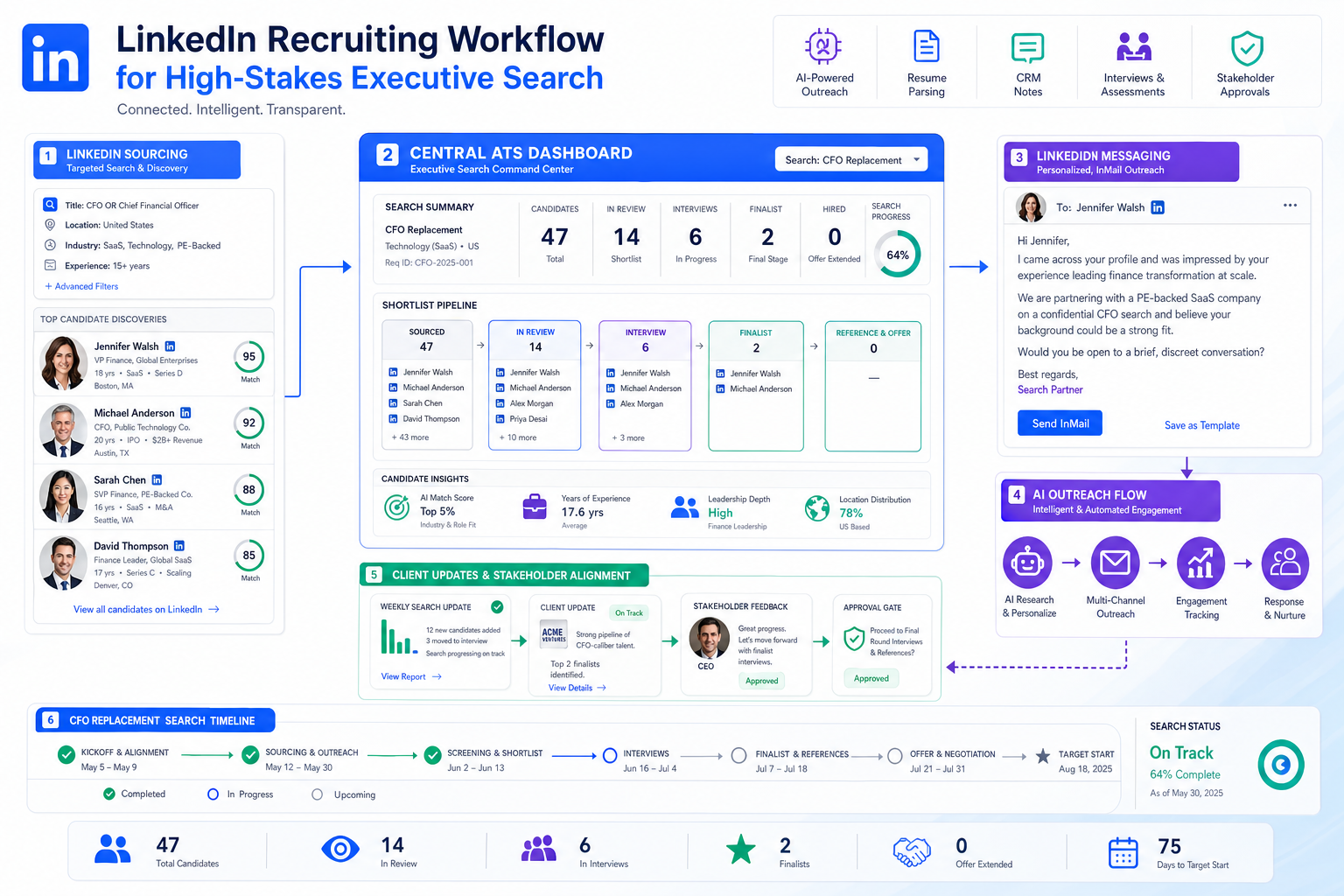
When high-stakes searches expose broken handoffs, this article helps agency leaders judge ATS for recruiting agencies and avoid shortlist delays.
That matters most when a role is hard to replace, the brief is nuanced, and the timeline is tighter than the market allows. In those situations, smaller staffing firms feel the pressure first: recruiters spend too much time switching between notes, LinkedIn messages, candidate records, and client updates; desk managers lose visibility into who has been contacted and what moved forward; and clients experience delays exactly when they expect precision. For individual recruiters, the cost is not just admin. It is missed re-engagement with strong candidates, weaker submission quality, and avoidable strain on client trust.
In my own workflow, I have found that StrategyBrain AI Recruiter is most useful when the bottleneck is early outreach and response handling rather than final assessment. It can keep candidate conversations moving, collect resumes and contact details, and reply across time zones without forcing the recruiter to stay online around the clock. That said, the recruiter still has to review the resume, judge relevance, and decide who should move to shortlist, submission, or interview.
The pressure becomes obvious in executive and specialist searches. One useful reference point comes from a hiring case around replacing a CFO: the challenge was not simply filling another vacancy, but finding a successor for a senior finance leader under time pressure and with demanding role requirements. In a search like that, the team is not just posting a job and waiting. They are reopening old finance profiles, checking prior conversations, comparing slate quality, confirming which stakeholders need updates, and deciding whether the market response is good enough to keep momentum.
If those actions live in separate tools, the search slows down exactly where it should become sharper. A recruiter replies to one candidate on LinkedIn, logs notes later, forgets that another finance leader had shown interest months earlier, then sends a partial update to the client because interview status is sitting in someone else’s spreadsheet. That is the real bridge to recruitment automation tools: when a high-stakes search exposes weak handoffs, fragmented outreach, and poor historical visibility, you stop asking for generic software and start evaluating an ats staffing agency setup built for search execution.
That is also why buyers looking at the best ats systems for staffing agencies should judge them against difficult searches first, not easy ones. If a platform can support a role with a compressed timeline, multiple decision-makers, and a narrow talent pool, it usually handles everyday desk work far better as well.
- Why High-Stakes Searches Expose ATS Gaps
- What an ATS for Recruiting Agencies Should Actually Do
- Recruitment Automation Tools That Help Agency Work
- Where AI Outreach Fits Without Replacing Recruiter Judgment
- Feature Checklist for an ATS Staffing Agency Buying Process
- How to Test the Best ATS Systems for Staffing Agencies
- Mistakes Agencies Make When Buying Software
- Temp, Perm, and Executive Search Workflows
- Implementation From a Recruitment Operations View
- FAQ
Why High-Stakes Searches Expose ATS Gaps
Agency software problems usually stay hidden during easy assignments. They become obvious when a client needs a replacement for a critical leadership or specialist role, expects market insight quickly, and wants a shortlist that reflects judgment rather than volume. The reference hiring case around a CFO successor captures that well: complexity and urgency arrive together, and the recruiter has to manage both.
In practical agency terms, these searches expose four common gaps:
- Weak candidate rediscovery: recruiters cannot quickly find past conversations, old shortlists, or finance leaders who were not available last year but may be open now.
- Broken outreach continuity: messages, follow-ups, and response history live outside the core system.
- Thin client visibility: account managers struggle to give precise updates on market coverage, active conversations, and submission quality.
- Poor stakeholder alignment: search owners, sourcers, and client-facing recruiters work from different records.
That is why an ATS for recruiting agencies should be judged as an operating system for search delivery, not just a place to store resumes. If the software cannot support nuanced succession-style hiring, it will usually create drag across ordinary staffing work too.
What an ATS for Recruiting Agencies Should Actually Do
An agency-ready platform should connect candidates, jobs, submissions, client contacts, interviews, placements, and reporting in one workflow. The baseline definition sounds simple, but the distinction matters. A general employer ATS is often built around one company filling its own vacancies. An ATS for recruiting agencies has to support recruiter desks, repeated client work, business development context, and candidate reuse across multiple searches.
For that reason, the strongest systems usually look like ATS plus CRM rather than applicant tracking alone. They should help a recruiter answer questions such as:
- Who in our database has already been approached for similar roles?
- Which client contact asked for an update, and what was promised?
- How many viable people have been reached, screened, and submitted?
- Where did the process stall: sourcing, outreach, interview scheduling, or client feedback?
Those are day-to-day desk questions, but they become even more important in senior searches where every outreach and every note carries more weight.
Recruitment Automation Tools That Help Agency Work
When people discuss recruitment automation tools, the conversation often gets too broad. For agencies, automation should support the placement cycle rather than add another layer of admin. In my experience, the most useful automation sits in five areas.
1. Candidate database search and resume parsing
A staffing database only creates value if recruiters can trust the search logic. Resume parsing should structure profiles cleanly enough that you can search by title, niche skill, location, compensation band, industry background, or availability. In succession-type searches, this helps you revisit past finance, operations, or commercial leaders without starting from zero.
2. Recruiting CRM and relationship history
A true ats staffing agency workflow must retain conversation history for both candidates and clients. When a search reopens after months, or when a client asks why a candidate was not approached again, relationship memory matters. Good CRM capability reduces guesswork and protects service quality.
3. Workflow automation and task triggers
Automations are most useful when they standardize handoffs: reminders to review candidate replies, alerts after client feedback, submission-stage tasks, interview coordination prompts, and compliance checkpoints. The point is consistency, especially across desks with mixed levels of experience.
4. Job distribution and response capture
For broader staffing assignments, distribution still matters. For narrower searches, the bigger question is whether the system captures inbound replies, sourced-profile activity, and recruiter actions in one place. Otherwise, market coverage becomes hard to prove.
5. Reporting that reflects desk reality
Agency leaders need reporting that connects activity to outcomes: outreach, response, shortlist quality, interviews, placements, and aging requisitions. Executive summaries are not enough. Managers need recruiter-level and client-level visibility that helps them coach and forecast.
Where AI Outreach Fits Without Replacing Recruiter Judgment
One lesson from harder searches is that recruiters should protect their judgment for the work that actually requires judgment. Repetitive outreach, after-hours replies, early interest checks, and basic resume collection can be handled more efficiently with an AI-supported workflow, while the recruiter stays accountable for fit assessment and client advice.
That is where I see a practical role for AI Recruiter. I have used it as a support layer for LinkedIn-heavy sourcing when message volume was high and response timing mattered. The value was not that it magically qualified the shortlist for me. The value was that it kept conversations moving, answered routine candidate questions about the opportunity, and captured resumes or contact details from interested people while I stayed focused on review and submission decisions.
For agencies running cross-border or after-hours sourcing, the multilingual and always-on communication side is also relevant. If your desk covers candidates across time zones, AI Recruiter can reduce the lag between outreach and response. That does not remove the recruiter from the process. It simply means the recruiter comes back to a cleaner queue of interested prospects instead of a cold inbox and scattered message threads.
Used properly, this kind of tool supports an ATS rather than replacing it. The ATS remains the source of truth for records, search history, and process status; AI handles repetitive conversation flow at the top of funnel; the recruiter makes the final call on shortlist quality.
Feature Checklist for an ATS Staffing Agency Buying Process
When comparing an ATS for recruiting agencies, I recommend evaluating each platform against the kind of search described earlier: a critical role, a tight timeline, and a demanding brief. That quickly reveals whether the system is agency-ready.
| Feature Area | Why It Matters | What to Check |
|---|---|---|
| Candidate database | Supports rediscovery in repeat and specialist searches | Search depth, tagging, duplicate control, availability fields |
| Resume parsing | Reduces manual cleanup | Parsing accuracy, structured profiles, bulk import quality |
| Recruiting CRM | Keeps client and candidate history connected | Notes, reminders, account views, conversation timeline |
| Submission workflow | Important for shortlist quality and client delivery | Custom stages, version control, feedback tracking |
| Workflow automation | Prevents handoff gaps | Triggers, alerts, approvals, recruiter tasks |
| Outreach integration | Improves top-of-funnel continuity | Message logging, source capture, LinkedIn workflow compatibility |
| Analytics | Supports desk coaching and forecasting | Conversion reporting, recruiter activity, search aging |
| Compliance and permissions | Protects sensitive candidate and client data | Audit trails, access controls, record completeness |
This comparison is usually more helpful than reading generic feature lists because it stays anchored to real staffing outcomes.
How to Test the Best ATS Systems for Staffing Agencies
If your team is reviewing the best ats systems for staffing agencies, avoid scoring software by feature count alone. Run a workflow-first evaluation.
Start with a difficult live scenario
Use a specialist or leadership search as the test case. A replacement CFO search is a good model because it combines urgency, nuance, and stakeholder scrutiny. Ask the vendor to show how the system handles:
- Importing and parsing candidate records.
- Searching prior finance or leadership profiles in the database.
- Logging outreach and candidate interest.
- Building and submitting a shortlist.
- Tracking interview movement and client feedback.
- Producing an update that a client would actually find useful.
If the process feels clumsy in the demo, it will feel worse under production pressure.
Check whether the platform reflects your business model
An ats staffing agency setup for temp volume is different from one built for permanent placement or executive search. You need to know whether the software supports high-velocity redeployment, relationship-led search work, or both.
Test the manager view, not just the recruiter screen
Many demos look fine from the individual recruiter perspective but fail at desk management. Ask to see aging jobs, recruiter activity, pipeline bottlenecks, and client-level visibility. That is often where the stronger agency systems separate themselves.
Evaluate adoption risk early
The best system is the one people will actually use. If every action requires too many clicks, if records become messy quickly, or if recruiters feel forced to maintain side spreadsheets, you are not buying productivity. You are buying another workaround.
Mistakes Agencies Make When Buying Software
Most buying mistakes come from evaluating software in easy conditions instead of hard ones. Common issues include:
- Choosing an employer ATS with light agency language added on: this often leaves gaps in client management and repeat-search visibility.
- Overweighting AI promises while ignoring database basics: if search, parsing, and notes are weak, automation will not save the workflow.
- Ignoring recruiter behavior: poor usability drives people back to inboxes and spreadsheets.
- Failing to map handoffs: the biggest agency delays happen between sourcing, screening, submission, and client follow-up.
- Not pressure-testing senior or specialist searches: software that handles generic roles may still break under nuanced briefs.
The reference CFO-style scenario is useful here because it exposes these weaknesses quickly. When the role is business-critical, every workflow gap becomes visible.
Temp, Perm, and Executive Search Workflows
Not every staffing team needs the same setup, but the opening case is a reminder that workflow fit matters more than category labels.
Temporary staffing
Temp-heavy agencies usually need rapid pipeline movement, redeployment visibility, and stronger task automation. Speed, record hygiene, and response capture matter most.
Permanent placement
Perm desks rely more heavily on relationship continuity, search depth, shortlist quality, and client communication. Here, ATS plus CRM capability is often the difference-maker.
Executive and specialist search
This is where the CFO replacement example becomes especially relevant. Senior searches demand careful candidate mapping, better historical visibility, tighter stakeholder alignment, and a process that helps recruiters document judgment, not just movement. If a platform handles this well, it usually supports broader agency work with less friction.
Practical takeaway: judge software on the hardest search your team regularly runs, because that is where process truth shows up fastest.
Implementation From a Recruitment Operations View
Even the strongest platform underdelivers if implementation is treated as a technical switch instead of an operational redesign. In agencies, software adoption depends on whether the process is clear enough to standardize.
A practical rollout usually includes:
- Define core stages by desk type: temp, perm, and specialist search should not be forced into one vague pipeline.
- Set data-entry rules: decide how recruiters log notes, tags, submissions, and follow-up actions.
- Clarify ownership: identify who updates candidate status, who owns client notes, and who closes workflow loops.
- Introduce automation gradually: begin with repetitive reminders, outreach support, and status triggers before layering on complex rules.
- Measure adoption early: check whether recruiters are actually using the system as the source of truth.
Where LinkedIn outreach is a major part of the desk, I have seen the cleanest results when the ATS remains the central record and AI Recruiter conversation handling is used to support top-of-funnel activity. That combination helps preserve candidate history while removing some of the repetitive messaging burden that recruiters often carry manually.
FAQ
What makes an ATS for recruiting agencies different from a standard ATS?
An ATS for recruiting agencies should support candidate tracking, recruiting CRM, client communication, submissions, placements, and reporting in one connected workflow. A standard employer ATS is usually built for internal hiring and may not support agency-specific client and desk processes well.
Why does a high-stakes search matter when evaluating software?
Because complex searches reveal whether the platform can handle rediscovery, outreach tracking, stakeholder updates, and nuanced shortlist management. If it only works for simple hiring, agency teams will hit limits quickly.
Does an ats staffing agency platform need CRM features?
Yes, in most cases. Agencies manage both candidate relationships and client relationships. Without CRM capability, activity gets split across tools and visibility drops.
How should agencies use AI in recruiting workflows?
Use AI to support repetitive work such as outreach, candidate replies, interest checks, and resume collection. Recruiters should still own resume review, fit judgment, and next-step decisions.
Are the best ats systems for staffing agencies suitable for small firms too?
Yes, if the system matches the firm’s workflow and is simple enough to adopt. Small agencies usually benefit from cleaner records, faster candidate search, stronger follow-up discipline, and better reporting.
Can one system support temp, perm, and executive search?
Sometimes, but only if the workflows are configurable enough to reflect how each desk operates. Agencies should test all three scenarios during evaluation rather than assuming flexibility.
Conclusion
The right ATS for recruiting agencies is not the one with the longest feature list. It is the one that keeps difficult searches under control: candidate history stays visible, outreach does not disappear into side channels, client updates stay accurate, and recruiter judgment is supported rather than buried under admin.
If you are comparing an ats staffing agency platform or reviewing the best ats systems for staffing agencies, start where agency work gets hardest. A search for a senior successor under tight timing is not an edge case; it is a clear test of whether your recruitment automation tools can support real staffing execution. When the workflow holds up there, the rest of the desk usually gets easier too.