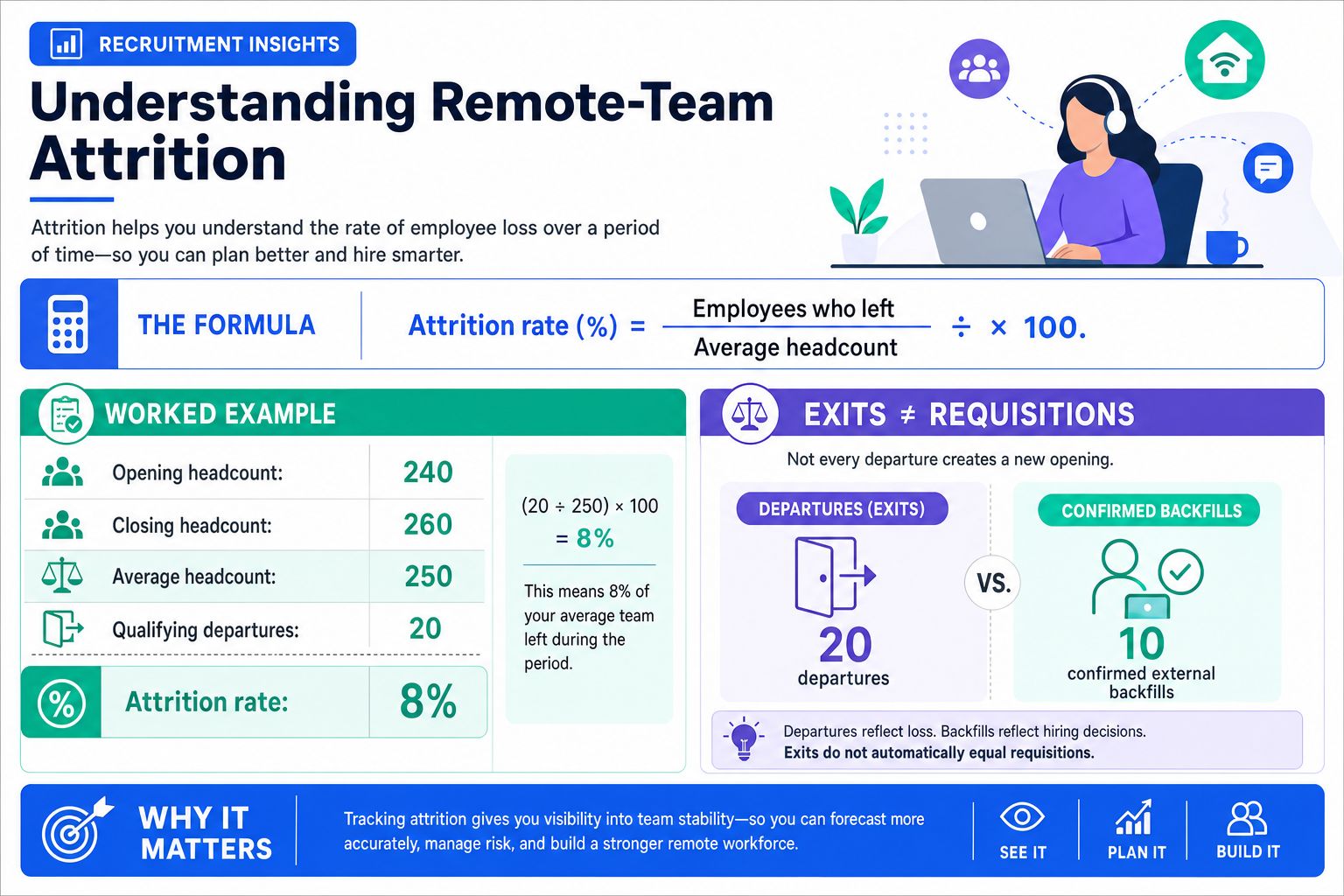
This framework helps recruiters calculate attrition consistently, separate exits from backfills, and avoid wasted sourcing.
When those rules remain vague, a small staffing firm may overestimate replacement demand, an independent recruiter may build pipelines for roles that will not reopen, and an internal talent team may misdirect budget toward the wrong departments. Remote and distributed workforces add another layer: an employee can leave a team through resignation, relocation, internal mobility, or role redesign, and each event may create a different recruiting consequence.
An AI-supported outreach workflow can help when uncertain replacement demand produces sudden sourcing pressure. For example, StrategyBrain AI Recruiter can initiate relevant LinkedIn conversations, respond across languages and time zones, and collect contact details or résumés from interested candidates. Those functions can maintain candidate communication while demand is being confirmed, but the recruiter must still assess each résumé, determine suitability, and decide who advances.
Consider the operating model described by a California marketing-agency founder who began building an all-remote company in the late 2000s. As the organization approached an 80-person distributed workforce, recruiters could not depend on office attendance as evidence of fit. They had to review the requisition list, reply to remote candidates, update candidate stages, and evaluate whether applicants could manage autonomy. The founder had met only two employees in person before hiring them, so the selection process concentrated on where candidates obtained social energy and how they responded when plans changed.
That remote hiring experience exposes the central issue in attrition reporting: the percentage is useful only when it reflects the workforce model and the decisions behind each departure. Understanding what does attrition mean for a distributed team requires more than counting exits. Recruiters must identify which employees left, whether their positions will be replaced, and how the resulting attrition level changes hiring demand.
Core formula: Attrition rate (%) = Employees who left during the period ÷ Average headcount during the same period × 100
Table of Contents
- What attrition means for workforce planning
- The attrition rate formula
- How to calculate attrition step by step
- Worked attrition calculation
- Calculating attrition in remote teams
- How to interpret an attrition level
- Types of attrition to track
- Attrition versus related metrics
- Common calculation mistakes
- A recruiting workflow based on attrition
- Frequently asked questions
What Does Attrition Mean in Workforce Planning?
If you are asking what does attrition mean, the practical answer is that it describes employees leaving a defined workforce during a stated period. Depending on the employer's reporting rules, departures can include resignations, retirements, dismissals, layoffs, deaths, or other employment endings.
Some HR teams use attrition for every departure. Others reserve the term for workforce losses in which the vacated position is eliminated or not immediately replaced. Turnover and attrition are also used interchangeably in some organizations. Consequently, the label alone does not make reports comparable.
Recruiters need to know both the measurement definition and the business decision behind an exit. Suppose a remote employee resigns from a client-facing position. The departure counts in a broad attrition calculation, but replacement demand depends on whether the work will be reassigned, automated, moved to another location, or supported through a new hire. The calculation and the requisition decision are related but separate.
A reliable report should therefore state:
- The workforce population being measured
- The reporting period
- The departure categories included
- How average headcount was calculated
- How internal transfers were treated
- Whether the departed positions are expected to be refilled
The Standard Attrition Rate Formula
The standard formula expresses qualifying departures as a percentage of the average workforce during the same period:
Attrition rate (%) = Number of employees who left ÷ Average headcount × 100
For a relatively stable workforce, average headcount can be estimated as follows:
Average headcount = (Opening headcount + Closing headcount) ÷ 2
The parentheses matter. In a spreadsheet, use (opening headcount + closing headcount) / 2, not opening headcount plus half of closing headcount.
This simple denominator is suitable when staffing remains reasonably stable. A monthly or daily average will usually be more representative when an organization grows quickly, restructures, employs seasonal workers, or adds remote teams in several countries during the period.
How to Calculate Attrition Rate Step by Step
The arithmetic is straightforward, but the scope decisions require care. Use the following process before presenting an attrition figure to hiring managers.
- Select the period. Use a month, quarter, calendar year, fiscal year, or rolling 12-month period. Label it explicitly.
- Define the employee population. Specify whether the calculation covers the whole company, a location, a department, a job family, or a remote-work category.
- Define qualifying departures. Decide whether the numerator includes all separations or only selected events, such as voluntary resignations.
- Count people consistently. Count employees rather than positions, vacancies, or requisitions unless the organization deliberately uses another unit.
- Calculate average headcount. Use opening and closing headcount for a stable population or a more frequent average for a workforce that changed materially.
- Apply the formula. Divide qualifying departures by average headcount and multiply by 100.
- Connect exits to hiring demand. Mark which roles require backfills and which will be removed, redesigned, or absorbed internally.
- Record the methodology. Keep the rules with the result so the next reporting period uses the same method.
A useful label might read: annual voluntary attrition for the remote customer-support team, calculated with monthly average headcount and excluding internal transfers. That wording makes the percentage easier for recruiters and business leaders to interpret.
Worked Attrition Rate Calculation
Assume an organization began the year with 240 employees, ended with 260, and recorded 20 qualifying departures.
| Calculation input | Value |
|---|---|
| Opening headcount | 240 employees |
| Closing headcount | 260 employees |
| Qualifying departures | 20 employees |
| Average headcount | (240 + 260) ÷ 2 = 250 employees |
| Attrition rate | 20 ÷ 250 × 100 = 8% |
The annual attrition rate is 8%. Departures during the year were equivalent to 8% of the organization's average headcount under the stated reporting rules.
That does not automatically mean recruiters should open 20 requisitions. If five positions were eliminated, three were filled through internal mobility, and two were consolidated into other jobs, the immediate external replacement requirement would be ten. Recruitment capacity should be planned from confirmed backfill demand rather than the attrition percentage alone.
Calculating Attrition in Remote and Distributed Teams
The formula does not change for a remote workforce, but the population and event definitions can become more complicated. Employees may be attached to a legal entity, business unit, manager, project, country, or cost center. Recruiters and HR analysts should agree which structure controls the calculation.
The remote-agency experience introduced earlier offers three useful principles for interpreting attrition.
1. Measure the workforce model, not desk occupancy
A remote employee is part of the workforce even when the employer never meets that person in a physical office. Headcount data should come from employment records rather than office rosters, badge access, or assumptions about where work is performed.
2. Preserve the business context behind departures
The agency founder framed remote work as work-life integration: employees could protect important personal commitments while completing non-customer-facing work at suitable times. If employees leave because the actual schedule no longer supports that arrangement, the raw attrition rate cannot explain the cause. Exit categories, role requirements, manager practices, and schedule expectations provide the necessary context.
3. Connect selection criteria with later outcomes
The founder's remote hiring approach examined whether candidates gained energy from independent work and whether they could adapt when priorities shifted. Those criteria should not be treated as universal predictors, but they illustrate a useful feedback loop. If a team hires for autonomy and resilience, HR can later examine whether early exits are concentrated among people whose jobs lacked clear expectations, support, or the flexibility originally discussed.
Remote onboarding can also affect the interpretation. The agency used short introductory conversations in which new employees discussed non-work interests, helping distributed colleagues form connections beyond departmental boundaries. When early attrition rises, recruiters should review whether promised team integration, manager access, and first-week support were actually delivered rather than assuming the hiring decision alone was wrong.
How to Interpret an Attrition Level
An attrition level normally refers to the resulting rate and the significance assigned to it. An annual attrition level of 8% means that qualifying departures equaled 8% of average headcount during the year. It does not, by itself, establish whether workforce stability was good or poor.
There is no universally healthy attrition level. Expected movement differs by occupation, industry, location, company maturity, employment model, and labor-market conditions. Public separation data, including information from the U.S. Bureau of Labor Statistics Job Openings and Labor Turnover Survey, shows substantial differences across industries. External data should still be compared cautiously because separation definitions and denominator methods may not match an employer's internal calculation.
Use these comparison rules:
- Compare the same workforce population across equivalent periods.
- Separate voluntary and involuntary departures where possible.
- Review remote, hybrid, and office-based groups only when sample sizes and job profiles support the comparison.
- Compare similar roles operating in similar labor markets.
- Examine trends rather than relying on one isolated rate.
- Pair the percentage with regrettable departures, tenure, vacancy impact, and confirmed backfills.
A moderate company-wide rate can conceal serious losses in a small specialist group. Conversely, a high rate may reflect a planned restructuring rather than a retention emergency. Recruiters should investigate the roles and decisions beneath the percentage before changing sourcing targets.
Types of Attrition to Track
Voluntary attrition
Voluntary attrition covers employee-initiated departures, commonly including resignations and some retirements. Breakdowns by role, manager, location, tenure, and work arrangement can help identify where replacement demand is developing.
Involuntary attrition
Involuntary attrition includes employer-initiated departures such as dismissals and workforce reductions when those events fall within the reporting definition. It should be available separately because its causes and recruiting implications differ from voluntary attrition.
Regrettable attrition
Regrettable attrition refers to departures the employer would have preferred to prevent, often involving strong performers or people in critical roles. Because the classification involves judgment, the organization should document who assigns it and which criteria are used.
Early-tenure attrition
Early-tenure attrition measures employees who leave within a defined period after starting, such as 90 days or one year. It can prompt reviews of job expectations, assessment methods, onboarding, manager support, and whether advertised flexibility matched the working reality.
Team-level attrition and internal mobility
An internal transfer removes an employee from one team's headcount without removing that person from the organization. Decide whether transfers count in the team rate, the company rate, both, or neither. The rule matters because a transfer can create a backfill even though it is not an organizational exit.
Attrition vs. Turnover, Retention, and Layoffs
| Term | Typical meaning | Recruiting relevance |
|---|---|---|
| Attrition | Employees leaving a defined workforce; some employers emphasize positions that are not replaced | Indicates workforce loss but does not equal confirmed hiring demand |
| Turnover | Employee departures, often associated with replacement activity | Can indicate recurring backfill workload |
| Retention | The proportion of a defined employee group that remains through a period | Shows stability from the perspective of employees who stayed |
| Churn | An informal term for repeated employee movement | Often describes persistent hiring and exit cycles in high-volume roles |
| Layoffs | Employer-initiated job losses associated with workforce reduction | May be included in involuntary attrition but should be identified separately |
Attrition and retention are not necessarily exact mathematical opposites. They may use different starting populations, event rules, and denominator methods. Always inspect the formula before comparing two reports.
Common Attrition Calculation Mistakes
- Using closing headcount alone: This can distort the denominator when staffing grew or contracted during the period.
- Mixing monthly and annual figures: Rates with different time bases should not appear in an unlabeled comparison.
- Changing departure rules: Including layoffs in one period but excluding them in another makes the trend unreliable.
- Combining unlike populations: A company-wide rate should not be compared directly with a department-only result.
- Ignoring workforce volatility: Opening and closing averages can conceal seasonal peaks or rapid expansion.
- Counting internal transfers inconsistently: This can inflate team attrition or company departures.
- Equating departures with requisitions: Not every vacated position will be replaced.
- Using remote status as a causal explanation: A difference between remote and office groups is a signal to investigate, not proof that location caused the exits.
- Treating an external benchmark as a target: Industry averages may use different events, periods, or populations.
Turning Attrition Data Into a Recruiting Workflow
Attrition becomes actionable when HR, finance, hiring managers, and recruiters move from the rate to a verified requisition plan.
- Validate the exits. Confirm departure dates, categories, teams, and employment status.
- Confirm replacement decisions. Ask the business owner whether each position will be refilled, redesigned, relocated, or closed.
- Prioritize operational risk. Rank confirmed backfills by skill scarcity, customer impact, workload, and expected time to hire.
- Choose an appropriate sourcing response. Use targeted outreach for specialist roles and scalable processes for high-volume demand.
- Maintain candidate communication. Record replies, interest, résumé receipt, and next actions so candidates do not disappear between outreach and review.
- Close the feedback loop. Compare eventual hiring, onboarding, and early-tenure outcomes with the assumptions that created the requisition.
In an AI-assisted version of this workflow, I would keep the attrition analysis and backfill approval outside the outreach system. Once a hiring manager confirms a role, AI Recruiter can support initial LinkedIn contact, explain supplied role information, answer routine candidate questions, and request résumés or contact details from people who express interest. This is particularly relevant to distributed hiring, where replies may arrive outside the recruiter's working hours or in another language.
The practical boundary is important. The system can identify willingness to continue a conversation, but it does not replace professional résumé evaluation. I would require a recruiter to review the candidate's evidence, confirm alignment with the role, address sensitive questions, and decide whether to schedule an interview. That division prevents an automated outreach activity from being mistaken for a hiring judgment.
Reporting checklist: Record the period, population, departure categories, headcount method, attrition rate, confirmed backfills, role priorities, and any methodology changes.
Frequently Asked Questions
How do you calculate monthly attrition?
Count qualifying departures during the month, divide by average headcount for that month, and multiply by 100. Label the result as a monthly rate. A daily average headcount can improve accuracy when staffing changes substantially within the month.
How do you calculate annual attrition?
Count qualifying departures during the year, divide by the year's average headcount, and multiply by 100. A monthly average of headcount is often more representative than a simple opening-and-closing average for growing, seasonal, or distributed organizations.
What is an acceptable attrition level?
There is no universal acceptable attrition level. Evaluate the rate against consistent internal trends and genuinely comparable external data. Consider job type, location, work arrangement, departure category, tenure, business strategy, and calculation method.
Should remote and office attrition be compared?
They can be compared when the populations contain similar roles and the same event definitions, period, and denominator method are used. Differences should be investigated alongside manager practices, tenure, location, compensation, schedule expectations, and onboarding quality. The comparison alone does not establish causation.
What is the difference between attrition and turnover?
Attrition generally describes workforce loss, while turnover often refers to departures and related replacement activity. Usage varies among employers. Confirm the underlying population, departure categories, period, and denominator before comparing the metrics.
Can attrition be calculated for one department?
Yes. Use qualifying departures from that department as the numerator and its average headcount as the denominator. State how internal transfers and reorganizations are treated. Department-level results are often more useful to recruiters than a single company-wide rate.
Does every departure create a recruiting requirement?
No. A position may be eliminated, redesigned, consolidated, moved, automated, or filled internally. Recruiters should distinguish total departures from approved external backfills before estimating workload.
Conclusion
An accurate attrition rate calculation divides qualifying employee departures by average headcount for the same period and multiplies the result by 100. The formula is simple; the difficult work is defining the population, classifying departures consistently, and selecting a denominator that reflects how the workforce actually changed.
For recruiters, the final attrition level is not a requisition count. Examine which employees left, why their roles matter, whether those positions will reopen, and how the workforce model affects replacement strategy. That discipline turns attrition from an isolated HR percentage into a credible input for hiring capacity, candidate outreach, and long-term workforce planning.