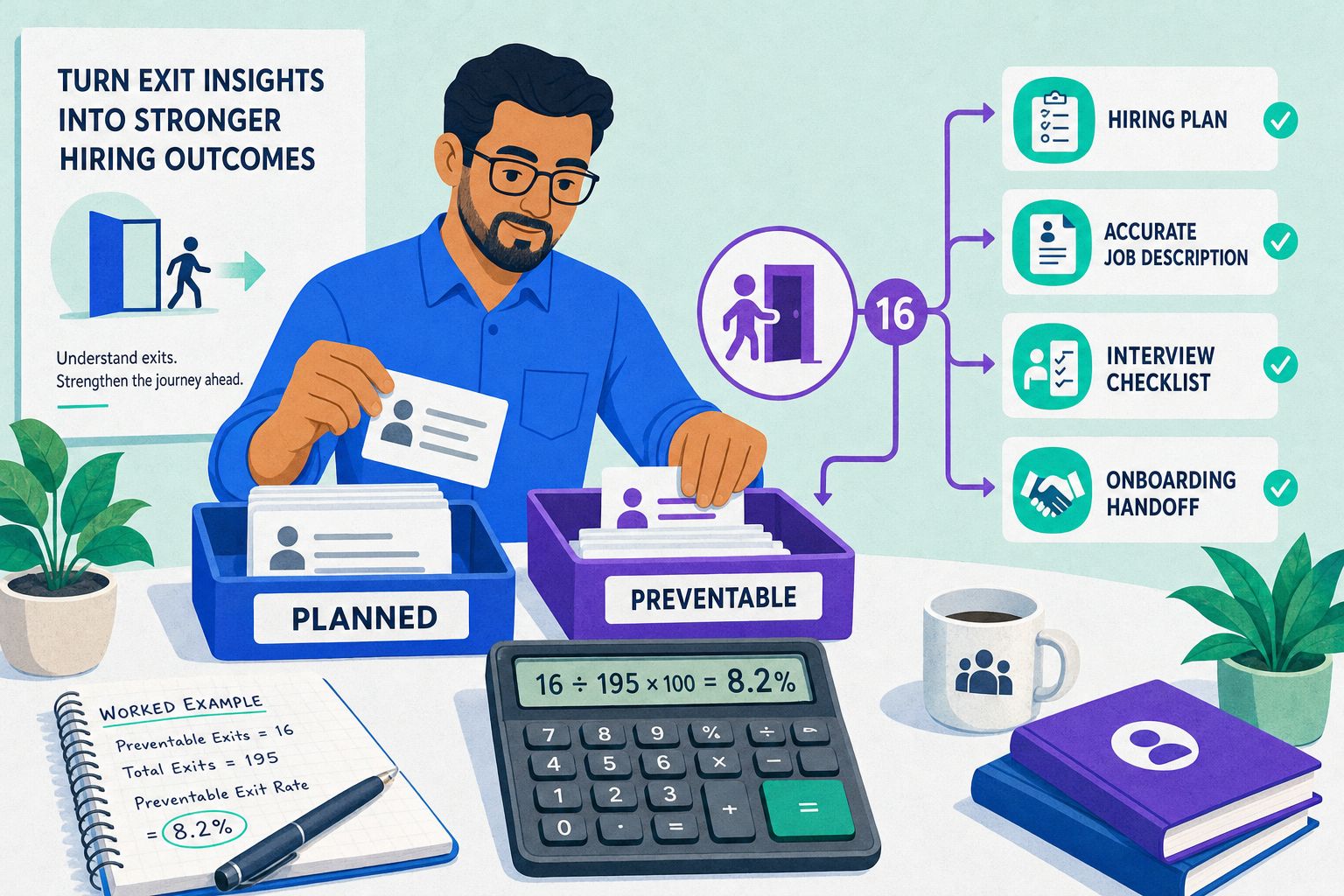
This guide helps recruiters interpret attrition rate meaning, separate planned exits from retention issues, and forecast hiring demand.
Without that distinction, a small recruitment firm may allocate sourcing time to roles that will never be approved, an independent headhunter may misjudge a client’s replacement demand, and an in-house recruiter may repeatedly fill jobs whose underlying retention problems remain unresolved. The resulting losses include wasted outreach, slower delivery, strained hiring-manager relationships, inconsistent candidate communication, and damage to the employer’s reputation.
Recruiting automation can reduce the communication burden by supporting timely outreach, answering routine role questions, and collecting information from interested candidates. It is most useful when paired with accurate job expectations and a documented follow-up process; the recruiter must still assess each résumé, investigate fit, and decide who should advance.
Consider a hospitality recruiter responding to persistent departures from customer-facing roles. As a new requisition opens, the recruiter reviews the vacancy list, rewrites the advertisement to present a career path rather than a temporary stop, and follows up with candidates awaiting interviews. During each interview, the recruiter explains the duties, schedule, development options, and working conditions in detail before updating the candidate stage. The hiring manager then checks whether internal employees could progress into the opening and whether position-specific training and peer support will be available after the hire starts.
This sequence shows why attrition cannot be treated as a percentage detached from recruitment and employee experience. The attrition rate meaning depends on which departures count, whether jobs will be replaced, and whether the measured attrition level reflects planned workforce change or preventable losses caused by unclear expectations, weak onboarding, limited progression, or workplace conditions.
Table of Contents
- What attrition rate means
- How recruitment influences attrition
- Attrition rate formula
- Worked calculation example
- Attrition versus turnover and retention
- Types of employee attrition
- What causes a rising attrition level
- How to interpret the result
- How to reduce unwanted attrition
- Measurement mistakes to avoid
- Frequently asked questions
What Does Attrition Rate Mean in HR?
Attrition is a gradual reduction in the size of a workforce as employees leave. In many workforce-planning contexts, the term emphasizes departures for which positions remain unfilled, are removed, or are not immediately replaced. Employers may also use attrition as a broad synonym for employee turnover, however, so the local reporting policy matters more than the label.
The attrition rate expresses counted departures as a percentage of average headcount over a defined period. A defensible report therefore answers four questions:
- Which employee population is being measured?
- What is the start and end date of the reporting period?
- Which types of departure are included?
- How is average headcount calculated?
The term attrition level usually describes the magnitude or direction of the result. A team may have a low, high, stable, rising, or falling attrition level. It is not a separate standardized formula.
Key principle: An attrition percentage is meaningful only when the workforce, period, denominator, and separation rules are stated beside it.
How Recruitment Decisions Influence Attrition
A recruiter cannot solve every cause of employee loss. Compensation policy, management behavior, workload, scheduling, and job design often sit outside recruitment’s control. Recruiters can nevertheless influence early-tenure attrition by improving the accuracy of expectations and the quality of the transition from candidate to employee.
1. Make job advertising specific and credible
Job advertisements should explain what employees will do, when and where they will work, which conditions may be demanding, and what development opportunities genuinely exist. Career progression can make a high-turnover role more attractive, but it should not be presented as a vague promise. Candidates need to know what development involves, which skills are required, and how internal opportunities are considered.
This is particularly important in hospitality, retail, logistics, care, and other environments where schedules, physical conditions, customer interaction, or seasonal demand can affect retention. Increasing application volume with an incomplete description may improve the top of the funnel while creating preventable departures later.
2. Use interviews to test mutual alignment
An effective interview is not only an assessment of the candidate. It also gives the candidate enough information to decide whether the job supports their goals and practical needs. Clear scheduling instructions, a welcoming interview environment, and an accurate explanation of duties can reduce avoidable confusion.
Recruiters should cover responsibilities, performance expectations, working patterns, development options, and what the employer will provide. A relaxed but structured conversation often gives candidates more room to discuss their ambitions and concerns. That information helps the recruiter determine whether expectations align before an offer is accepted.
3. Connect hiring promises to onboarding
Recruitment responsibility does not end when a candidate accepts. If an advertisement emphasizes training or progression, the onboarding plan should identify who provides that training, what the first weeks will cover, and how progress will be reviewed. Position-specific learning plans, experienced peer support, and regular manager check-ins can make the employment proposition more credible.
A practical handoff should record the role expectations discussed during recruitment. The hiring manager can then reinforce those expectations rather than unintentionally presenting the new employee with a different job.
4. Preserve the candidate relationship
Prompt, respectful communication matters even when a candidate is unsuccessful. People may apply for another position, recommend the employer, or encounter the organization as customers or professional contacts. Candidate experience, employee experience, and employer reputation are connected rather than isolated stages.
Automation can support acknowledgment messages, interview reminders, routine questions, and follow-up consistency. It should not be used to disguise decisions or avoid personal communication when a candidate needs substantive feedback. Recruiters remain accountable for judgment, accuracy, data handling, and the final candidate experience.
Attrition Rate Meaning and Formula
A commonly used formula is:
Attrition rate = (Counted employee departures during the period ÷ Average headcount during the period) × 100
When only opening and closing headcount are available, average headcount can be estimated as:
Average headcount = (Opening headcount + Closing headcount) ÷ 2
If headcount fluctuates substantially, monthly or payroll-period snapshots usually provide a more representative denominator than a simple opening-and-closing average. Whichever method is selected should be applied consistently when comparing periods or business units.
Decide which departures count
An organization’s policy may include or exclude:
- Voluntary resignations
- Retirements
- Employer-initiated terminations
- Redundancies or layoffs
- Fixed-term contract completions
- Internal transfers
- Departures followed by immediate replacement
A useful report might state: Annual attrition rate: 8.2%, including resignations and retirements but excluding internal transfers, dismissals, and fixed-term contract completions. This is more actionable than reporting a percentage without its rules.
Worked Attrition Rate Example
Suppose a division starts the year with 200 employees and ends with 190. During the year, 16 departures meet its documented attrition definition.
- Calculate average headcount: (200 + 190) ÷ 2 = 195.
- Divide counted departures by average headcount: 16 ÷ 195 = 0.0821.
- Convert the result to a percentage: 0.0821 × 100 = 8.2%.
The annual attrition rate is therefore 8.2%. This calculation does not independently explain the net change in headcount because the division may also have hired employees or experienced departures excluded by its policy.
Nor does 8.2% establish whether the attrition level is acceptable. If the employees who left occupied specialized roles with long training periods, the operational impact could be serious. If the positions were already scheduled for removal, the same percentage might be consistent with the workforce plan.
Attrition Rate Versus Related Workforce Metrics
| Metric | What it generally measures | Recruiting implication |
|---|---|---|
| Attrition rate | Counted departures as a percentage of average headcount | May include positions that will not be replaced |
| Turnover rate | Employee departures under an employer’s turnover policy | Often used when replacement hiring is expected, although definitions vary |
| Retention rate | The proportion of a defined employee group that remains | Helps identify where employees are staying rather than leaving |
| Quits rate | Voluntary resignations | Focuses attention on employee-initiated exits |
| Total separations | All exits included by the reporting policy | Provides a broader view than voluntary attrition alone |
| Internal mobility rate | Movement between roles, teams, or locations | May create local vacancies without reducing company headcount |
Attrition and turnover are often distinguished by whether a position is replaced, but that distinction is not universal. When comparing employers, teams, or published benchmarks, examine the numerator and denominator instead of assuming that identical labels use identical methods.
Types of Employee Attrition
Voluntary attrition
Voluntary attrition occurs when an employee chooses to leave, including through resignation or retirement. Planned retirements should be separated from potentially avoidable resignations because they require different responses. One calls for succession and knowledge-transfer planning; the other may require investigation into job expectations or workplace conditions.
Involuntary attrition
Involuntary attrition covers employer-initiated exits such as dismissal or redundancy when the reporting policy includes them. Repeated performance-related exits may indicate several possible issues, including selection criteria, role design, onboarding, management, or performance support. It should not automatically be classified as a sourcing failure.
Internal attrition
Internal attrition occurs when an employee leaves a team, department, or location while remaining with the organization. It does not reduce organization-wide headcount, but it can create a local capability gap and a new requisition. Recruitment forecasts should distinguish internal movement from external loss.
Demographic attrition
Demographic analysis examines departure patterns across appropriately defined employee groups. It can show whether an apparently stable company-wide rate conceals concentrated losses. Access should be controlled, group sizes should protect privacy, and interpretation should account for workforce composition rather than relying on raw percentages alone.
Early-tenure attrition
Early-tenure attrition tracks employees who leave within a specified period after joining. It is especially relevant to the recruitment-to-onboarding workflow because repeated early exits may indicate inaccurate advertising, expectation gaps, weak selection, or an inconsistent handoff to the hiring manager.
What Causes a Rising Attrition Level?
A rising attrition level is a signal to investigate, not a diagnosis. Common contributing factors include:
- Unrealistic job expectations: Actual duties, schedules, conditions, or performance demands differ from the hiring message.
- Limited progression: Employees cannot see a credible path to develop skills or move into broader roles.
- Management conditions: Communication, feedback, work allocation, or local leadership contributes to departures.
- Compensation concerns: Employees consider pay or rewards inconsistent with the job or available alternatives.
- Workload pressure: Vacancies shift more work to remaining employees, potentially leading to further exits.
- Schedule or location constraints: Shift patterns, commuting requirements, relocation, or workplace arrangements become unsustainable.
- Insufficient onboarding: New hires do not receive the training, context, equipment, or support needed to succeed.
- Planned workforce reduction: Leadership intentionally leaves positions vacant or removes them from the workforce plan.
- Retirement and contract completion: Predictable exits raise the measured rate without necessarily indicating dissatisfaction.
Recruiters can help by comparing early exits with job advertisements, interview notes, offer discussions, candidate questions, and onboarding handoffs. Hiring managers and HR leaders should then test those findings against workload, leadership, pay, development, and exit information.
How to Interpret an Attrition Rate
There is no universal good attrition rate. The significance of a result depends on workforce strategy, role scarcity, labor-market conditions, training time, service requirements, and the capabilities that were lost.
Use the following questions to interpret the attrition level:
- Is the methodology consistent? Confirm that periods, populations, departure rules, and headcount methods have not changed.
- What is the trend? Compare equivalent periods rather than judging one isolated percentage.
- Where are exits concentrated? Segment the data by role, tenure, team, manager, location, and relevant employee group.
- Why did people leave? Separate resignations, retirements, dismissals, internal moves, and planned reductions.
- Which capabilities were lost? Consider operational dependence, customer relationships, institutional knowledge, and replacement difficulty.
- Will the positions be replaced? Confirm approved requisitions instead of assuming every exit creates hiring demand.
- Did the employment experience match recruitment? Review whether job advertising, interviews, onboarding, and actual work were aligned.
For a recruiter, segmentation is generally more useful than the organization-wide figure. A stable overall rate can conceal rapid losses among recent hires, retirement exposure in a technical function, and healthy internal progression elsewhere.
How to Reduce Unwanted Attrition
The objective is not to prevent every departure. Healthy internal mobility, planned retirements, and deliberate workforce changes may support business goals. The priority is to reduce avoidable losses that damage capability, service, or employee experience.
- Define the affected segment. Identify the roles, locations, managers, tenure groups, or shifts in which attrition is concentrated.
- Separate planned and unplanned exits. Do not mix intentional headcount reduction with preventable resignation patterns when deciding what action to take.
- Improve role accuracy. Describe duties, schedules, conditions, development opportunities, and performance expectations honestly.
- Use interviews for mutual assessment. Give candidates enough information to evaluate the opportunity as carefully as the employer evaluates them.
- Review selection criteria. Check whether repeated early departures reflect rushed hiring, unclear requirements, or assessments unrelated to the real work.
- Create a documented handoff. Ensure hiring managers know what was discussed and promised during recruitment.
- Deliver structured onboarding. Assign role-specific training, peer support, first-week goals, and manager check-ins.
- Build credible internal paths. Make development and promotion practices visible, consistent, and connected to actual opportunities.
- Maintain candidate communication. Timely updates and respectful rejections protect relationships and employer reputation.
- Measure again under the same rules. Determine whether the attrition level changes without altering the calculation method.
Recruiters should lead the actions connected to job messaging, candidate alignment, assessment, and handoff. Managers and HR leaders remain responsible for workplace causes that recruitment cannot repair, including poor supervision, unsustainable workload, or compensation policy.
Common Attrition Measurement Mistakes
Publishing a percentage without its definition
Readers cannot interpret an attrition rate if they do not know whether it includes retirement, dismissal, redundancy, contract completion, or internal transfers. Put the counting policy beside the result.
Comparing incompatible periods or populations
A monthly rate should not be compared casually with an annual rate, and a department figure should not be compared with a company-wide figure without acknowledging the different populations.
Changing the denominator
Opening headcount, closing headcount, a two-point average, and monthly averages can produce different results. Select an appropriate method and apply it consistently.
Assuming every exit creates a vacancy
A departure may lead to replacement hiring, internal promotion, role redesign, delayed approval, or permanent removal of the position. Recruiters should use approved workforce decisions, not attrition alone, to forecast requisitions.
Focusing only on the company-wide result
An overall percentage can conceal retention problems in a particular role or recently hired cohort. Segmenting the data helps identify where intervention is justified.
Treating a high rate as automatically bad
A high attrition level may accompany planned restructuring or retirement. Conversely, a low rate may still hide the loss of a few critical employees. Business impact matters alongside volume.
Frequently Asked Questions
What does attrition mean?
Attrition broadly means a gradual reduction in people, customers, participants, or organizational strength. In HR, it refers to employees leaving a workforce and often emphasizes positions that remain unfilled or are not immediately replaced.
What is the attrition rate meaning in HR?
The attrition rate meaning in HR is the percentage of employees who leave a defined workforce during a stated period under a documented counting policy. The report should explain which departures count and how average headcount was calculated.
How do you calculate attrition rate?
Divide counted employee departures during the period by average headcount for that period, then multiply by 100. Use consistent departure rules and headcount methods for comparisons.
What does attrition level mean?
Attrition level describes the magnitude or direction of attrition, such as low, high, rising, falling, or stable. It is a descriptive term rather than a separate standardized calculation.
What is the difference between attrition and turnover?
Attrition often emphasizes departures without immediate replacement, while turnover is frequently associated with roles that will be refilled. Employers do not use these terms consistently, so their documented calculation rules should be compared.
Is a high attrition rate always bad?
No. It may reflect planned retirement, restructuring, contract completion, or deliberate headcount reduction. It becomes concerning when unexpected departures remove important capabilities, increase workload, disrupt service, or reveal recurring employee-experience problems.
Can recruiters reduce employee attrition?
Recruiters can influence attrition associated with unrealistic expectations, poor candidate-role alignment, inconsistent communication, and weak onboarding handoffs. They cannot independently correct compensation, management, workload, or workplace-culture problems.
Should internal transfers count as attrition?
They may count as team-level attrition because the employee leaves a local unit, but they should not normally be treated as organization-wide workforce loss. The reporting policy should make this distinction explicit.
Conclusion
The core attrition rate meaning is straightforward: counted employee departures divided by average headcount over a defined period, expressed as a percentage. Interpretation requires more care because employers use different definitions and because the same number can represent planned change, predictable retirement, or preventable employee loss.
Recruiters should connect the attrition rate to the roles affected, reasons for leaving, replacement decisions, and promises made during hiring. Accurate advertising, informative interviews, structured onboarding handoffs, credible development paths, and respectful candidate communication create a recruitment process that supports retention rather than merely replacing departures.
Before acting on an attrition level, document the calculation, segment the result, identify the capabilities lost, and confirm which positions will actually be filled. That turns an isolated HR percentage into a practical workforce and recruitment decision.