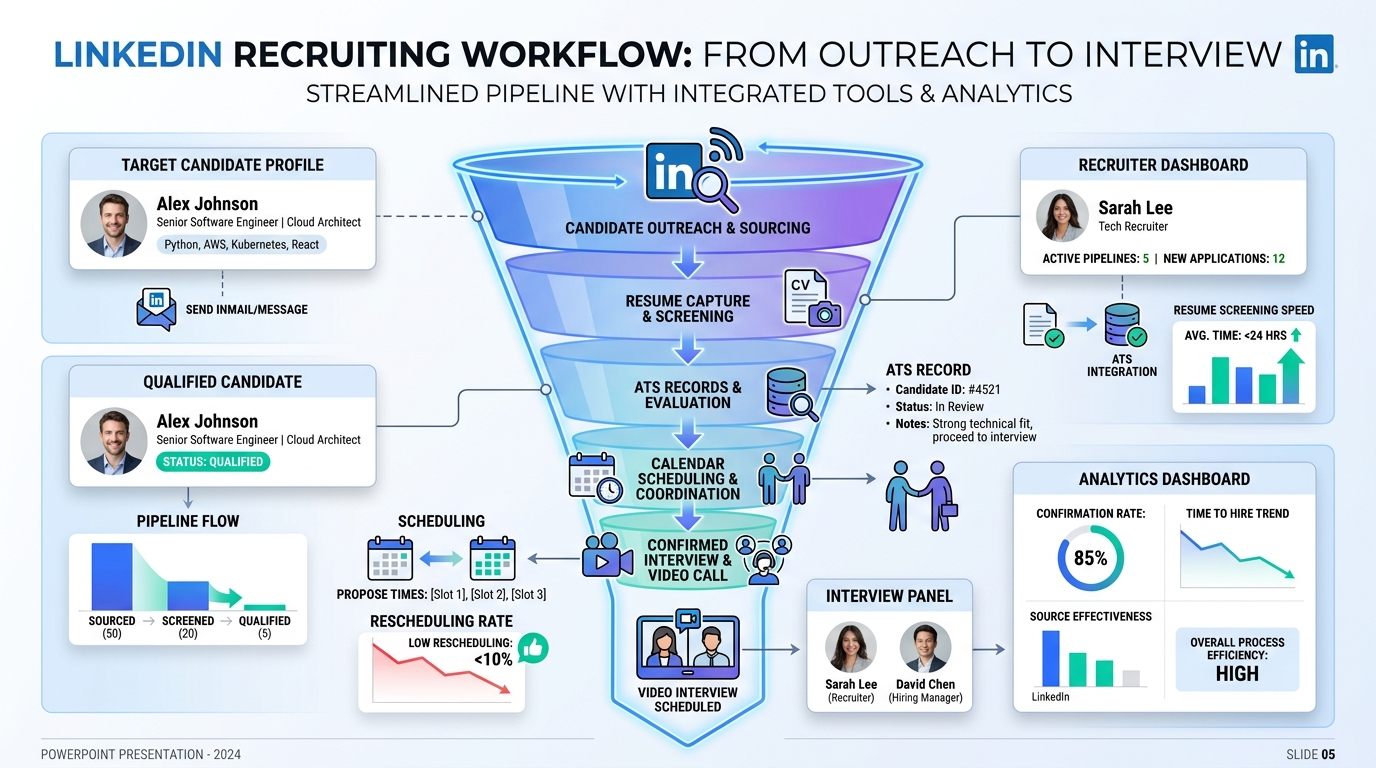
Headhunters evaluating an ai hiring platform can use this article to spot workflow gaps that delay interviews and lose candidates.
That matters because interview delays rarely start with the calendar itself. They start when a recruiter is juggling outreach, resume follow-up, hiring manager availability, and candidate questions across inboxes, LinkedIn, phone calls, and the ATS. For a solo recruiter or a small agency owner, the cost is not just slower booking. It is lost momentum, extra admin work after hours, weaker candidate confidence, and more risk that a candidate who was interested yesterday is no longer available by the time the interview is finally confirmed.
In my own recruiting workflow, tools like StrategyBrain AI Recruiter have been most useful when the real bottleneck sits one step before scheduling: reaching candidates, handling replies at odd hours, and collecting resumes and contact details without dropping the thread. Its 24/7 multilingual messaging, automated role introduction, and resume capture can reduce the early-stage friction that often makes scheduling feel harder than it should. The recruiter still owns final judgment, resume review, shortlist decisions, and whether someone should move to interview.
You can see the same logic in contract hiring. A finance or accounting contractor weighing short-term opportunities is usually not only thinking about hourly rate. They are judging whether the assignment will expand their experience across different companies, help them build stronger connections, and let them learn new systems quickly enough to stay marketable. For the recruiter handling that search, the work comes in a sequence: reply to a candidate who wants details, explain the project scope, collect the resume, confirm whether they are open to interview, then line up conversations with a client team that often needs specialized skills fast.
That is exactly where automated interview scheduling becomes more than calendar automation. When candidates are assessing opportunity quality and recruiters are trying to move specialized talent through the funnel before interest cools, the real question is how an ai hiring platform, an ai interview application, and an interview intelligence platform fit together to remove friction without removing human judgment. This article focuses on that operating reality.
- Automated interview scheduling works best when upstream candidate communication is already organized.
- Contract, consulting, and specialist hiring make speed especially important because candidates are actively weighing opportunity value.
- An ai hiring platform should connect outreach, resume capture, stage movement, and interview booking.
- An ai interview application should keep the candidate journey consistent from initial interest through booked interview.
- An interview intelligence platform adds value after scheduling by improving interview quality, documentation, and coaching.
- Recruiters should evaluate scheduling by workflow reliability, not demo simplicity.
- Why speed matters in opportunity-driven hiring
- What automated interview scheduling really solves
- How it fits inside an ai hiring platform
- Workflows and features to evaluate
- Why integrations decide whether it works
- Scheduling vs interview intelligence platform capabilities
- A practical selection checklist
- Common rollout mistakes
- FAQ
Why speed matters in opportunity-driven hiring
One useful lesson from contract recruiting is that candidates often evaluate an opportunity the way buyers evaluate a service: by the value it may create next, not just by the title in front of them. A contractor may accept an assignment because it broadens experience across industries, introduces new senior stakeholders, or gives paid exposure to unfamiliar systems and processes. That means recruiting teams are not simply filling interview slots. They are helping candidates decide whether the next step is worth their time.
When that decision window is short, every manual handoff matters. If a recruiter takes too long to collect a resume, confirm interest, answer a practical question, or propose interview times, the candidate may interpret the delay as disorganization. In specialist hiring, that perception can be enough to cool interest.
For agency recruiters and in-house teams alike, this is why automated interview scheduling should be viewed as part of a larger response system. Speed supports candidate confidence. Consistency supports trust. And both are especially important when the role is project-based, hard to fill, or time-sensitive.
Key insight: In many searches, candidates are not only comparing employers. They are comparing learning value, access, speed, and how professionally the opportunity is handled from the first reply onward.
What automated interview scheduling really solves
Automated interview scheduling is the use of availability logic, workflow rules, and candidate-facing booking tools to move someone from interest to confirmed interview without long email chains and repeated manual checks. In practice, the system checks calendars, applies scheduling rules, offers valid slots, sends confirmations, and updates participants when plans change.
But in day-to-day recruiting, the scheduling problem usually starts earlier. Candidates respond after work hours. Hiring managers suggest times that no longer work. Coordinators wait on resume review before sending links. A recruiter may still be clarifying whether the person is genuinely open to a move. That is why simple booking software often underdelivers. It addresses the calendar, but not the full chain of recruiting actions around it.
In my experience, the strongest process combines early communication support with disciplined scheduling. For example, if a recruiter is using AI Recruiter to keep candidate conversations moving on LinkedIn, gather resumes, and maintain after-hours responsiveness, it becomes much easier to trigger scheduling at the right moment rather than losing candidates in the gap between interest and action.
That is also where an ai interview application becomes a useful framing device. Candidates do not care which internal system owns which stage. They experience one hiring flow. If the outreach feels personal but the interview booking feels clumsy, the process still feels broken.
How it fits inside an ai hiring platform
Most buyers begin by looking for help with scheduling, then realize the larger issue is orchestration. A modern ai hiring platform should connect sourcing, candidate communication, screening, interview coordination, feedback collection, and reporting. Scheduling sits in the middle of that chain, not outside it.
That platform view matters because interview booking should respond to what happened one step before and support what happens one step after. In practical recruiting terms, the platform should help teams:
- capture candidate interest and contact details efficiently
- move qualified applicants into the right interview stage
- apply role-specific scheduling rules automatically
- notify interviewers with the right context
- preserve activity data for pipeline reporting
For recruiters handling contract or consulting searches, this connected model is especially useful. Candidates are often deciding quickly whether a project is worth exploring, while clients want to compare specialized profiles without delay. If outreach, resume collection, and booking sit in separate tools with weak handoffs, the workflow becomes fragile.
| Platform Area | Operational Role | Why It Matters |
|---|---|---|
| Candidate outreach | Starts conversations and confirms interest | Prevents cold scheduling attempts |
| Resume and contact capture | Collects what recruiters need to qualify | Reduces admin delays before interview booking |
| Automated interview scheduling | Offers approved slots and confirms meetings | Speeds up movement from interest to interview |
| Interview execution | Supports links, instructions, and stakeholder coordination | Keeps the process organized across rounds |
| Interview intelligence platform layer | Adds transcripts, analytics, and coaching insight | Improves interview quality after scheduling is complete |
Workflows and features to evaluate
If you are comparing solutions, evaluate them against real recruiting complexity, not a clean one-person demo flow. The more your hiring resembles specialist, project-based, or multi-stakeholder recruiting, the more workflow depth matters.
1. Candidate self-scheduling
This is the baseline. Candidates should receive a secure link and book from approved slots without waiting for a recruiter to manually coordinate every option. For fast-moving searches, this keeps momentum while interest is still high.
2. Early-stage communication support
Scheduling automation works better when candidate communication is already moving. That is why some recruiters pair scheduling workflows with tools that keep outreach active, respond quickly, and gather resumes before handoff. I have found that when StrategyBrain AI Recruiter conversations keep those first interactions moving, fewer prospects disappear between initial interest and interview setup.
3. Panel and multi-person coordination
Many tools work for a recruiter screen but struggle with structured interviews. If your hiring process includes technical panels, client interviews, or cross-functional loops, the system must find overlapping availability accurately.
4. Virtual and onsite logistics
Look beyond the calendar invite. Good tools should handle video links, room booking, location details, time zones, and buffer rules. This is where the gap between simple schedulers and recruiting-grade workflow tools becomes obvious.
5. Rescheduling without chaos
Rescheduling is normal, especially when candidates are balancing projects, billable work, or multiple interview processes. The system should let recruiters and candidates change plans without restarting from zero or creating conflicting records.
6. Group and event scheduling
For some hiring models, especially volume recruiting or coordinated client interview days, event-based scheduling matters as much as one-to-one booking. If that applies to your team, test it early.
7. Candidate experience across the journey
An ai interview application should not feel like a disconnected add-on. The move from apply, or from recruiter outreach, into booked interview should stay mobile-friendly, clear, and fast.
Why integrations decide whether it works
Integrations are where many promising scheduling tools fail under real conditions. If the scheduler does not sync cleanly with your ATS and calendar environment, recruiters end up doing manual cleanup, and the process loses credibility internally.
At minimum, verify these points during evaluation:
- Does it update your ATS without duplicate records?
- Can stage movement trigger scheduling actions automatically?
- Does it respect interviewer calendar availability accurately?
- Can it handle time zones and distributed hiring teams?
- Do reschedules update calendar events, candidate notifications, and ATS data together?
- Can reporting preserve time-to-schedule and interview completion data?
This is where many teams underestimate the value of upstream workflow discipline. If candidate contact details are incomplete, resume collection is inconsistent, or communication history lives in scattered channels, even a good scheduling engine struggles. In contrast, when early-stage tools are already collecting resumes and candidate details in a structured way, the handoff into interview booking is much cleaner.
Automated interview scheduling vs an interview intelligence platform
These categories are related but not interchangeable. Automated scheduling handles the mechanics of getting the interview onto the calendar. An interview intelligence platform helps teams improve what happens during and after the interview.
Typical interview intelligence capabilities may include:
- transcripts and searchable interview records
- competency tagging and structured analysis
- interviewer coaching and calibration insight
- post-interview documentation support
- analytics on interviewer behavior or decision patterns
If your biggest pain today is candidate drop-off before the interview happens, focus first on communication flow and scheduling reliability. If your pain starts after the interview begins, such as weak note quality, poor interviewer consistency, or limited visibility into assessment patterns, then an interview intelligence platform is the next layer to evaluate.
The best long-term setup often combines both inside an ai hiring platform. That gives teams a way to connect speed metrics with interview quality, rather than treating them as separate problems.
A practical selection checklist
Selection should begin with workflow truth, not category language. I usually recommend testing a product against the interview types and candidate behaviors your team sees every week.
- Map your hiring scenarios. Include recruiter screens, hiring manager rounds, panels, client interviews, and events.
- Audit the handoff before scheduling. How are resumes, contact details, and candidate intent captured now?
- Define candidate channels. Decide whether email is enough or whether LinkedIn, SMS, or multilingual support matter.
- Test rescheduling. A tool that handles only perfect first bookings is not enough.
- Review stakeholder usability. Recruiters, candidates, coordinators, and interviewers should all be able to use it easily.
- Look at downstream reporting. Make sure interview activity still supports operational analysis.
- Separate scheduling needs from intelligence needs. Do not buy one category expecting it to solve the other.
For firms doing heavy LinkedIn sourcing, another practical question is whether outreach and scheduling should be connected operationally even if they are not in the same interface. That is one area where recruiters often benefit from combining their scheduling stack with tools such as StrategyBrain AI Recruiter in active sourcing workflows, because it reduces the lag between first response and interview readiness.
Common rollout mistakes
Most failures in this category come from process design, not from the scheduler itself.
Mistake 1: Treating scheduling as an isolated problem
If candidate communication is still fragmented, scheduling automation will not fix the upstream disorder.
Mistake 2: Testing only simple interview types
Single-interviewer screens are the easiest use case. Real pain usually appears in panels, client coordination, or reschedules.
Mistake 3: Ignoring candidate decision windows
This is especially risky in contract or specialist hiring, where candidates are actively weighing opportunity value, learning potential, and access to decision-makers.
Mistake 4: Over-automating judgment
Automation should handle coordination, not replace recruiter judgment. Recruiters still need to review resumes, validate fit, and decide who advances.
Mistake 5: Buying category language instead of process reliability
Terms like conversational scheduling, ai interview application, and interview intelligence platform sound attractive, but the real test is whether the workflow works cleanly under pressure.
Practical takeaway: Pilot any scheduling workflow across at least two interview types and include both first-time booking and rescheduling before wider rollout.
FAQ
Can interview scheduling really be automated?
Yes. It can automate availability checks, approved booking options, confirmations, reminders, and rescheduling steps. The biggest gains usually come from removing back-and-forth rather than removing recruiter judgment.
Why does early-stage candidate communication affect scheduling so much?
Because scheduling starts only after interest is real and the recruiter has enough information to move forward. If resume collection, candidate replies, or contact capture are delayed, the calendar step gets delayed too.
How does an ai hiring platform help more than a standalone scheduler?
It connects sourcing, screening, scheduling, interview execution, and reporting. That reduces the handoff errors that often make standalone scheduling tools feel incomplete.
What is the difference between an ai interview application and scheduling automation?
An ai interview application usually refers to the broader candidate-facing experience around applying and moving through interviews. Scheduling automation is one part of that journey.
Is automated scheduling the same as an interview intelligence platform?
No. Scheduling solves coordination. An interview intelligence platform focuses on transcripts, coaching, analytics, and interview quality after the meeting is underway or complete.
What should recruiters test before buying?
Test self-scheduling, panel coordination, rescheduling, integrations, time zone handling, and how well the tool fits the way your team actually works under hiring pressure.
Conclusion
Automated interview scheduling is one of the most practical upgrades an ai hiring platform can deliver, but only when it is evaluated as part of the full recruiting workflow. The lesson from contract and specialist hiring is straightforward: candidates move fastest when they can quickly understand the opportunity, stay engaged through early communication, and book the next step without friction.
For teams comparing scheduling tools, an ai interview application, or an interview intelligence platform, the best decision usually comes from mapping the whole chain from first candidate response to completed interview. When those handoffs are tight, recruiters save time, candidates stay engaged, and hiring teams operate with much more consistency.