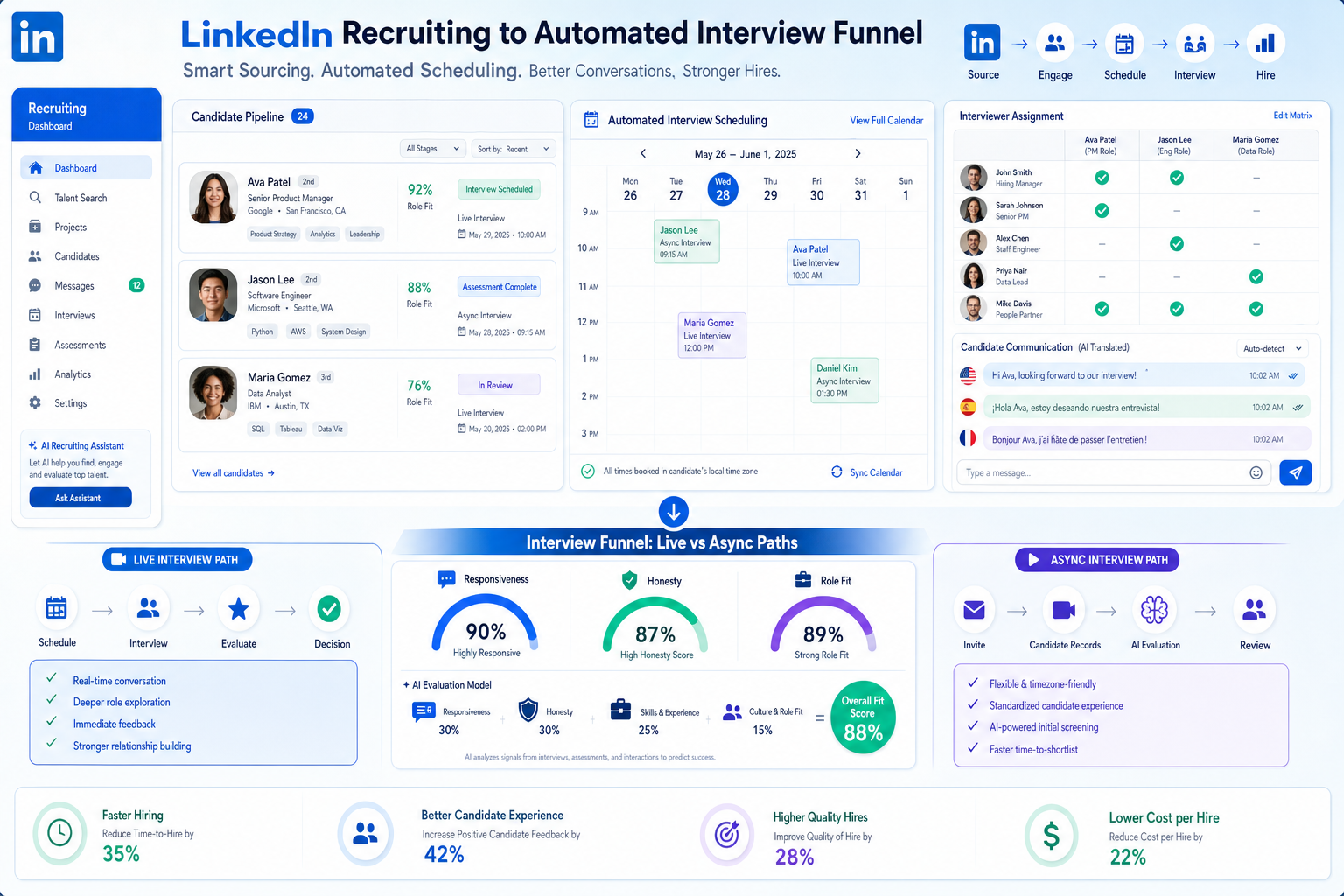
This ai hiring platform guide helps hiring leaders judge scheduling logic before delays erode shortlist speed and team credibility.
That distinction matters more than most teams admit. When interview booking is handled through inbox chasing and fragmented calendar checks, the damage spreads beyond speed. Recruiters lose credibility with clients and hiring managers, candidates wait too long, specialist interviewers get pulled in inconsistently, and the process starts to feel reactive instead of well run. For smaller search firms and lean internal talent teams, those delays also become commercial problems: slower shortlist movement, more falloff, and more time spent on admin that does not improve hiring quality.
In my own workflow, I have found that StrategyBrain AI Recruiter helps most when the real issue is not decision-making itself but the repetitive communication around it. Its always-on candidate messaging, multilingual follow-up, and automated collection of candidate contact details and resumes reduce the back-and-forth that often blocks interview coordination, especially across time zones. The recruiter still owns the final judgment, resume review, and whether a person should move into a live interview, but the operational drag gets lighter.
The pressure usually starts at the same moment described in many real hiring situations: a team is suddenly missing someone, the role needs attention quickly, and the recruiter has to decide whether the person helping on the search is actually capable of delivering. In that moment, speed alone is not enough. You need someone who understands the company background, the objectives behind the hire, and what a realistic market response looks like. If those signals are vague, the hiring process becomes harder before the first interview is even booked.
That is why the old tests for a strong recruiter, honesty, responsiveness, and role knowledge, still matter when you evaluate automated interview scheduling. They translate directly into workflow design. An honest process sets realistic timing and candidate expectations. A responsive process removes dead air between stages. A knowledgeable process routes candidates to the right interviewer set instead of whoever happens to be free. This is exactly where an ai hiring platform, an interview intelligence platform, and the right ai tool for interviews begin to overlap.
What follows is a practical breakdown of automated interview scheduling through that lens: not just how to book interviews faster, but how to choose systems and workflows that behave like a good recruiter would.
In this guide, you will learn:
- What automated interview scheduling includes in real recruiting operations
- Why recruiter-quality signals like honesty, responsiveness, and specialization matter in automation design
- How an ai hiring platform connects scheduling with structured interviews and cleaner handoffs
- When an interview intelligence platform or an ai tool for interviews is the better fit
Table of Contents
- What Good Scheduling Actually Solves
- The Three Signals of a Recruiter-Grade Process
- How an AI Hiring Platform Handles Scheduling
- Live vs. Async Interview Workflows
- Where Interview Intelligence Fits
- Features That Matter Most
- My Workflow Experience Using AI Recruiter Support
- Mistakes to Avoid
- How to Evaluate Your System
- FAQ
What Good Scheduling Actually Solves
Automated interview scheduling is often described as a convenience layer, but experienced recruiters know it is closer to an execution discipline. The point is not simply to stop the back-and-forth emails. The point is to make sure a candidate moves through the hiring process with the same consistency you would expect from a strong recruiter or coordinator.
In practice, automated interview scheduling means software can identify mutual availability, send booking options, apply interviewer rules, update calendars, trigger reminders, manage reschedules, and keep candidate status visible across the team. Inside an ai hiring platform, that usually extends further into workflow logic: stage-based automation, interviewer assignment, communication templates, and progress tracking.
The reason this matters is simple. When a team is hiring under pressure, every weak handoff becomes visible. A role that needed quick action now sits between stages. A hiring manager thinks recruiting is slow. A candidate assumes the company has lost interest. A specialist interviewer is added late because no one mapped the process in advance. None of those issues are just calendar problems.
Key insight: Automated interview scheduling works best when it reflects recruiter standards for communication, realism, and role fit rather than just maximizing booking speed.
The Three Signals of a Recruiter-Grade Process
The strongest concept borrowed from classic recruiter evaluation is that quality shows up through a few observable behaviors. In the reference frame behind this article, a good recruiter is defined by three traits: honesty, responsiveness, and knowledge of the role or market. Those same traits are useful for evaluating automated interview scheduling workflows.
1. Honest workflow design
A strong system should help your team set realistic expectations. That means interview timing, stage requirements, and candidate communication should match the actual market and internal availability. If your interview plan assumes five stakeholder calendars will align instantly for every role, the workflow is not honest. It is just optimistic.
Honesty in automation also means admitting when live interviews are not the right first step. For some high-volume or globally distributed searches, an ai tool for interviews can handle asynchronous screening first, allowing recruiters to reserve live time for qualified candidates who have already shown interest and basic fit.
2. Responsive process behavior
Recruiting is still a service function, whether you work in-house or in search. A responsive hiring process acknowledges that candidates and hiring managers are judging your process while it runs. A good ai hiring platform improves responsiveness through self-scheduling links, automatic follow-up, reminders, and stage movement that does not rely on one recruiter manually nudging every next step.
Responsiveness also matters internally. Hiring managers want to know whether interviews are booked, delayed, completed, or stuck waiting for feedback. If the scheduling layer hides that, recruiters still end up acting as human middleware.
3. Knowledge built into the workflow
One of the most underrated scheduling problems is mismatch between role complexity and interview design. Specialist hiring needs specialist routing. If you are hiring finance, engineering, or executive talent, the scheduling process should know which interviewer pool applies, what sequence makes sense, and where executive discretion is required.
This is where an interview intelligence platform often adds value. Once interviews are scheduled, the system can support structured plans, consistent note capture, and better debrief inputs so the knowledge built into the process continues beyond the booking step.
How an AI Hiring Platform Handles Scheduling
A modern ai hiring platform usually handles scheduling as part of a connected hiring operation rather than a standalone calendar utility. That matters because recruiters rarely need just one task solved. They need candidate movement, interviewer coordination, and communication to stay aligned.
Typical capabilities include:
- Self-scheduling options: candidates choose from approved slots rather than negotiating by email
- Calendar orchestration: interviewer availability is pulled into one workflow
- Stage-based triggers: advancing a candidate launches the next scheduling action
- Role-based interviewer assignment: the right panel or specialist pool is selected for each stage
- Buffer and load controls: interviews are spaced realistically
- Real-time status tracking: recruiters and hiring managers can see what is booked, pending, and blocked
- Global communication support: useful when candidates are spread across time zones or languages
For agency recruiters and headhunters, the operational benefit is usually reduced coordinator work. For in-house teams, it is cleaner alignment between recruiters, hiring managers, and interviewers. In both cases, the value increases if automation is tied to broader candidate communication and documentation rather than isolated inside a calendar tool.
Live vs. Async Interview Workflows
Teams evaluating automated interview scheduling should separate two different use cases that often get lumped together.
Live interview scheduling
This is the standard workflow for recruiter screens, hiring manager conversations, panel rounds, and final interviews. The system finds available times, sends invites, handles reminders, and supports rescheduling. Most organizations still rely heavily on this model because later-stage hiring decisions benefit from real interaction.
Asynchronous interview workflows
An ai tool for interviews can reduce scheduling pressure by letting candidates respond to structured prompts on their own time. This works best in early-stage screening, high-volume intake, or searches where time-zone coordination is a real barrier.
The most practical approach is often mixed. Use asynchronous steps where they remove low-value friction, then move qualified candidates into live structured interviews when human judgment matters most.
| Workflow Type | Best For | Main Advantage | Main Risk |
|---|---|---|---|
| Live automated scheduling | Manager screens, panels, final rounds | Faster coordination for real conversations | Still depends on interviewer discipline |
| Async interview workflow | Early screening, high-volume roles, global intake | Removes scheduling at the first step | Needs clear review and candidate disclosure |
Where Interview Intelligence Fits
Scheduling solves access. Interview quality still requires structure. That is where an interview intelligence platform becomes useful.
Typical capabilities include transcripts, summaries, scorecards, structured interview plans, note support, and candidate comparison views. Recruiters should not think of these as separate from scheduling. If the first part of the process gets candidates into interviews quickly but the second part produces poor recall and inconsistent feedback, the hiring team has only shifted the problem.
The better model is continuity. A candidate is booked through the ai hiring platform, interviewers receive the right context, notes are captured consistently, and debriefs happen with evidence rather than memory. This is especially important when multiple stakeholders are involved or when specialist interviewers are hard to coordinate in the first place.
Features That Matter Most
When recruiting teams evaluate scheduling software, flashy demos often hide the basics that actually decide whether adoption will stick. These are the features I would prioritize.
1. Candidate communication that reduces dead time
The system should support timely confirmations, reminders, and follow-up without making the experience feel robotic or opaque.
2. Interviewer logic, not just calendar matching
If the platform cannot apply role-based interviewer pools, stage templates, and sensible buffers, it will not support specialist hiring well.
3. Async options for the right roles
A good ai tool for interviews can reduce unnecessary live scheduling, but only when used selectively and with human review.
4. Evaluation continuity
If you need stronger debriefs, look for overlap with an interview intelligence platform so notes, summaries, and scorecards stay close to the interview flow.
5. Global and multilingual support
This matters more than buyers expect when outreach, candidate replies, and scheduling happen across regions.
6. Privacy and oversight controls
Any AI-supported recruiting workflow should support clear access permissions, responsible data handling, and explicit human ownership of final decisions.
My Workflow Experience Using AI Recruiter Support
One place I have seen support technology help most is before the scheduling step even begins. In searches where candidate outreach happens through LinkedIn and replies arrive outside working hours, I have used AI Recruiter to keep communication moving without forcing recruiters to babysit every thread. The value was not that it replaced recruiter judgment. It did not. The value was that it could introduce roles, respond in the candidate's language, confirm interest, and collect resumes or contact details so live interview scheduling started with a warmer, cleaner handoff.
That was especially useful when candidates were spread across multiple countries. The multilingual follow-up reduced the delay between initial interest and actual recruiter review, and the 24/7 responsiveness meant fewer conversations went cold overnight. Once interested candidates shared resumes, the recruiter still had to evaluate fit, decide who should advance, and choose the right live or asynchronous interview path. But the front end of the process became much easier to manage.
If your bottleneck sits at that handoff point, candidate interest exists but scheduling never starts cleanly, reviewing StrategyBrain AI Recruiter or its public examples of recruiter conversations at this conversation library can be useful. In my experience, it works best as workflow support for recruiters handling repetitive outreach and qualification steps before a formal interview process begins.
Mistakes to Avoid
Confusing fast booking with strong recruiting
The process is not healthy just because an interview is on the calendar. If the wrong interviewer is booked or expectations were unrealistic from the start, speed only hides the problem briefly.
Using the same workflow for every role
Generalist hiring, specialist hiring, and executive hiring need different interviewer logic and candidate handling.
Letting automation weaken service
Responsive systems should feel clearer, not colder. Candidates still need transparency and options.
Separating communication from scheduling
When outreach, candidate replies, resume collection, and interview booking live in disconnected tools, recruiters spend too much time stitching the process together manually.
Skipping human review in AI-supported stages
AI can assist with messaging, coordination, summaries, and structured prompts, but a recruiter or hiring manager should still own advancement decisions.
How to Evaluate Your System
The easiest way to evaluate automated interview scheduling is to borrow the same lens you would use when assessing a recruiter.
| Evaluation Lens | What to Ask | Why It Matters |
|---|---|---|
| Honesty | Does the workflow reflect realistic timing, role complexity, and candidate expectations? | Prevents process design that fails under real hiring pressure |
| Responsiveness | Can the system keep candidates and stakeholders updated without manual chasing? | Improves experience and reduces hidden delays |
| Knowledge | Does it support specialist routing, stage logic, and structured follow-through? | Protects interview quality and consistency |
| Workflow breadth | Is it just a scheduler, or part of a broader ai hiring platform? | Determines whether it reduces admin beyond calendar booking |
| Interview support | Does it connect with an interview intelligence platform? | Helps convert booked interviews into better decisions |
| Screening flexibility | Can an ai tool for interviews handle async first steps where appropriate? | Removes low-value scheduling friction |
If a system cannot meet those standards, it may still book meetings, but it will not meaningfully improve your hiring operation.
FAQ
What is automated interview scheduling?
It is software-supported coordination of interviews using availability rules, candidate booking options, reminders, rescheduling, and status tracking instead of manual email negotiation.
How does an ai hiring platform improve scheduling?
It adds workflow context, stage logic, interviewer assignment, communication automation, and visibility that go beyond basic calendar matching.
When should recruiters use an ai tool for interviews?
Usually in early-stage screening, high-volume intake, or global pipelines where live scheduling too early creates unnecessary friction.
What does an interview intelligence platform add?
It supports transcripts, summaries, scorecards, structured plans, and debrief quality so faster scheduling leads to better hiring decisions.
Can AI replace recruiter judgment in interview scheduling?
No. It can reduce repetitive work and improve coordination, but recruiters and hiring managers should still decide who advances and how candidates are evaluated.
Where can AI Recruiter help before scheduling?
It can help with outreach, role introduction, multilingual follow-up, candidate interest checks, and collecting resumes or contact details before a recruiter decides to move someone into interviews.
Conclusion
The most useful way to think about automated interview scheduling is not as a calendar feature, but as a test of process quality. If a good recruiter is honest, responsive, and knowledgeable, your scheduling workflow should behave the same way.
That is why the best ai hiring platform decisions are rarely about booking speed alone. They are about whether the workflow sets realistic expectations, keeps people informed, routes candidates intelligently, and supports stronger interviews after the slot is confirmed. Once you evaluate automation through that recruiter-grade lens, it becomes much easier to tell the difference between a tool that only moves meetings and a system that actually improves hiring.