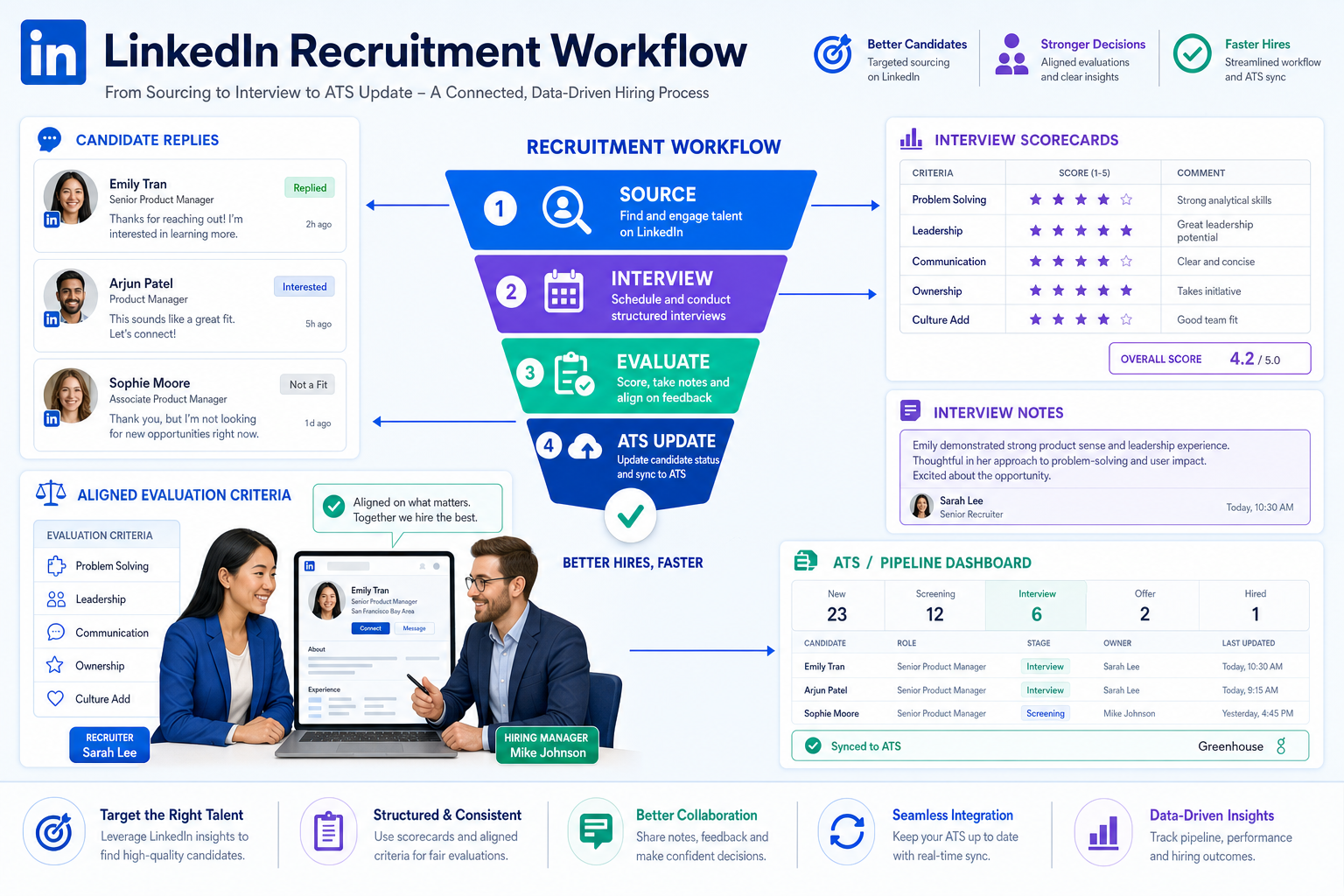
When hiring teams try to automatiser LinkedIn, this article helps recruiters spot where outreach scale breaks interview quality and process control.
That distinction matters because most recruiting teams do not really struggle with sending first messages. They struggle when sourcing, candidate replies, interviewer alignment, note-taking, and stage updates start drifting apart. For a solo recruiter, that means late-night catch-up and missed follow-ups. For a small search firm, it means inconsistent delivery and harder client communication. For an in-house talent team, it can damage candidate experience, hiring-manager trust, and employer brand.
In my own workflow, StrategyBrain AI Recruiter became useful when I treated it as a support layer rather than a replacement for recruiting judgment. It helped handle repetitive LinkedIn outreach, after-hours candidate replies, and résumé collection in a more structured way, while I still made the final call on fit, résumé quality, and whether a candidate should move to interview. That balance is important if you want automation to reduce admin without letting the process become careless.
The pressure usually becomes visible at interview stage, not at sourcing stage. A candidate arrives nervous, the hiring team is only partly aligned on what the role really needs, and someone in the panel is still scanning the résumé for the first time. Another interviewer asks broad questions that do not test the right skills, while the recruiter tries to build rapport, keep the discussion moving, and remember what needs to be recorded afterward. The interview itself becomes harder for everyone than it should be.
That is why the real challenge behind automatiser LinkedIn is not message volume. It is whether your automation stack supports the full hiring chain: role clarity before outreach, better candidate preparation, cleaner recruiter handoffs, stronger interview discipline, and reliable ATS updates after every conversation. In that sense, recruiting can borrow sequencing ideas from automated sales prospecting and automated lead generation software, but it still needs a more human and better-governed workflow.
- Automatiser LinkedIn works best when automation supports sourcing, interview prep, follow-up, and record keeping together.
- Recruiters should automate repetitive communication and admin, while keeping candidate evaluation and final decisions under human review.
- Good hiring automation starts with knowing what the role needs and ensuring all interviewers assess against the same criteria.
- An ATS becomes more valuable when LinkedIn sourcing, candidate messaging, interview notes, and stage changes are connected.
- Recruiting teams can learn from automated sales prospecting, but candidate relationships require more trust, timing, and judgment than outbound selling.
- Why LinkedIn automation fails without interview discipline
- What it really means to automatiser LinkedIn in recruitment
- Start with role clarity before adding automation
- Native recruiting workflows vs third-party outreach tools
- How AI-assisted search and follow-up help recruiters
- What a practical recruitment automation stack should include
- Why the ATS stays at the center
- Comparison of automation categories
- How to implement without hurting candidate experience
- Common mistakes teams make
- FAQ
Why LinkedIn Automation Fails Without Interview Discipline
Experienced recruiters learn this quickly: workflow problems that begin in sourcing usually show up most clearly in interviews. If the recruiter does not know exactly what the hiring team wants, the outreach goes broad. If the team is not aligned on evaluation criteria, interviews become repetitive or contradictory. If notes are scattered, promising candidates look weaker than they are because nobody captured the evidence properly.
That is why the older advice on interviewing candidates still matters in an automation-heavy market. Before any tool sends messages or collects responses, recruiters need to know what they are looking for, make sure interviewers are aligned, review each candidate’s background in advance, ask useful behavioural questions, take notes, and avoid over-relying on gut feel. Those are not old-school habits that automation replaces. They are the controls that make automation safe and useful.
Practical takeaway: If your sourcing is automated but your interview team is unprepared, you have only accelerated confusion.
For recruiting leaders, this changes how software should be evaluated. The best tools are not just faster at top-of-funnel activity. They help preserve structure between candidate search, outreach, interview preparation, communication history, and post-interview decision-making.
What It Really Means to Automatiser LinkedIn in Recruitment
In recruitment, automatiser LinkedIn should mean building an approved, repeatable workflow around sourcing and candidate communication. That can include AI-assisted search, shortlist building, saved projects, follow-up reminders, message support, and syncing records into recruiting systems.
It should not automatically mean uncontrolled scraping, careless bulk messaging, or turning candidates into anonymous names in a sequence. The useful overlap with automated sales prospecting is in segmentation, prioritization, and follow-up logic. The limit is that hiring requires more context. A recruiter is not only trying to get a reply. They are trying to assess timing, motivation, credibility, and long-term fit.
That is also why generic automated lead generation software can feel incomplete for recruiting teams. It may help identify contacts or run outbound workflows, but it often lacks the hiring-specific controls needed for interview management, note capture, collaboration, and stage-based process ownership.
What recruiters usually want when they try to automate LinkedIn
- Faster sourcing for hard-to-fill roles
- Cleaner segmentation by title, market, skill set, and seniority
- Consistent outreach with room for recruiter review
- Better visibility into who replied, who is interested, and who moved forward
- Reliable sync with interview workflow and ATS records
If a tool does not improve those outcomes, it is not solving the real recruiting problem. It is only increasing activity.
Start With Role Clarity Before Adding Automation
One of the strongest lessons from good interviewing practice is that recruiters need to know exactly what they are hiring for before they automate anything. That sounds obvious, but it is where many workflows break. Teams often launch sourcing before they have decided what matters most in the role: technical depth, leadership, stakeholder management, pace, or team fit.
In practice, I have found that LinkedIn automation performs best when I first define three things:
- The non-negotiables
What skills or experiences absolutely need to be present?
- The trade-offs
Is the team willing to swap years of experience for learning speed, or domain depth for leadership range?
- The interview proof points
What evidence should come from the interview rather than from the profile alone?
That third point matters more than many teams expect. A profile may suggest technical capability, but only a well-run interview can show how someone handles disagreement, ambiguity, teamwork, or pressure. If automation floods the top of funnel before those proof points are defined, the recruiter ends up moving volume into a weak assessment process.
When I used AI Recruiter in a sourcing-heavy workflow, the value was highest after role criteria were already clear. The system could handle repetitive connection and message steps, respond to candidates outside working hours, and help collect résumés from interested people. But it only worked well because I had already set the search criteria and knew what would move a candidate into interview. That is the difference between automation and delegation without control.
Native Recruiting Workflows vs Third-Party Outreach Tools
When teams search for ways to automatiser LinkedIn, they often mix together two separate needs. One is approved recruiting workflow support: search, projects, candidate organization, and connected follow-up. The other is broader outreach sequencing closer to sales-style outbound tools.
Native or recruiting-specific workflows usually fit better when your priorities are governance, hiring-manager collaboration, and auditable records. Third-party outreach tools may offer more flexibility, but they need stricter review because recruiting is not judged only by reply rate. It is judged by candidate experience, process quality, and decision consistency.
A useful rule is to ask whether the tool helps your team prepare better interviews, not just start more conversations. If it speeds up sourcing but leaves recruiter notes, interview scorecards, and stage ownership fragmented, it creates more operational risk than value.
How to choose between the two approaches
- Choose recruiting-native workflows when you need stronger controls, cleaner collaboration, and more dependable handoffs.
- Choose broader outreach tooling carefully when agency-style proactive sourcing is central to the model and you have clear oversight of messaging and records.
- Keep one source of truth for candidate stage, interview progress, and recruiter notes regardless of where the first outreach happens.
That last point matters most. Once interviews begin, speed matters less than continuity.
How AI-Assisted Search and Follow-Up Help Recruiters
AI-assisted recruiting is most useful when it shortens repetitive steps without replacing recruiter judgment. In practice, that usually means helping recruiters move from a plain-language description of the ideal candidate into a more refined search, then supporting the follow-up process once candidates start responding.
There are three workflow gains worth paying attention to:
1. Faster search setup
A recruiter can start with natural-language intent, then refine by title, location, company background, skills, or seniority. This reduces the time spent rebuilding searches from scratch for every role.
2. More consistent candidate follow-up
One of the biggest reasons good candidates disappear is simple delay. They respond after hours, the recruiter plans to answer later, and the thread drops. Tools that support ongoing communication can reduce that gap if they are used with clear recruiter oversight.
3. Better handoff into interview
Once a candidate shows interest, the process should move quickly into résumé review, interview preparation, and stage updates. This is where recruitment automation tools should help create continuity, not just more outreach.
My experience using StrategyBrain AI Recruiter was strongest in that middle zone between first message and recruiter review. It could continue candidate conversations across time zones, communicate in the candidate’s preferred language where needed, and gather contact details or résumés from interested people. But I still had to review the actual résumé, decide whether the profile matched the role, and prepare the interview around the evidence that was still missing. That is exactly how it should work.
The connection to automated sales prospecting is obvious here: segmentation, sequence logic, timing, and response handling. The difference is that in recruiting, each response changes not only funnel status but the quality of a human decision process that follows.
What a Practical Recruitment Automation Stack Should Include
The best stacks do not treat recruiting automation as a messaging tool alone. They support the full path from role definition to candidate interview readiness.
Core categories to evaluate
- Sourcing automation: search assistance, saved searches, shortlist building, and talent pool organization
- Outreach automation: message support, multi-step follow-ups, and candidate response handling
- Interview preparation support: candidate history, résumé access, notes, and shared evaluation criteria
- Pipeline management: stage tracking, ownership, reminders, and recruiter-hiring manager visibility
- ATS or CRM sync: profile capture, deduplication, communication history, and status updates
- Reporting: source quality, stage movement, interviewer consistency, and process bottlenecks
That interview preparation layer is often missing from generic tools. Yet it is where many hiring mistakes begin. A well-prepared interview can reveal personality, judgment, and behavioural evidence that a résumé cannot show. A poorly prepared one wastes everyone’s time and creates false confidence or false rejection.
For that reason, any serious evaluation of recruitment automation tools should include questions such as:
- Can recruiters review the candidate’s basic information before interviews easily?
- Can multiple interviewers align on what they are assessing?
- Can the system preserve communication history and notes in one place?
- Does the workflow support behavioural interviewing and structured feedback?
- Will the tool improve candidate experience or just increase top-of-funnel noise?
Why the ATS Stays at the Center
An ATS is still the operating core of a structured hiring process. Automation can help find candidates faster, but the ATS is what keeps the process coherent once real evaluation begins.
The strongest applicant tracking system benefits appear when LinkedIn sourcing is active and interview volume rises. Recruiters need one place to see who was sourced, who replied, who shared a résumé, what the hiring team learned in interview, and what should happen next. Without that, the organization ends up with activity but not accountability.
Where ATS discipline matters most in LinkedIn-heavy hiring
- Before interviews: role requirements, ownership, and candidate history are easier to review
- During interviews: note capture and interviewer consistency improve
- After interviews: decision rationale, next steps, and hiring-manager communication become clearer
- Across the team: no one has to reconstruct the process from message threads and memory
This is also where recruiting differs from classic automated lead generation software. In lead generation, the key handoff is often to sales. In recruiting, the handoff moves into assessment, interview quality, and long-cycle decision-making. That demands a better record.
Comparison of Recruitment Automation Categories
| Category | Main Use | Best For | Overlap With Sales Prospecting | Recruiter Caution |
|---|---|---|---|---|
| LinkedIn recruiting workflow tools | Sourcing, search refinement, projects, follow-up support | In-house teams, agencies, specialist recruiters | Segmentation and shortlist building | Must connect to interview and ATS workflow |
| Outreach sequencing tools | Multi-step candidate messaging | Proactive sourcing teams and agencies | High overlap with automated sales prospecting | Can become impersonal if not reviewed |
| Automated lead generation software | Contact discovery and outbound scale | Commercial prospecting teams | Very high | Usually weak on hiring stages and interviewer collaboration |
| Applicant tracking system | Candidate records, stages, collaboration, reporting | All structured hiring teams | Limited direct overlap | Needs disciplined adoption to be useful |
| AI communication support tools | After-hours replies, multilingual messaging, résumé collection | High-volume sourcing and global hiring | Shared response-handling logic | Final fit assessment must stay with recruiter |
This comparison helps clarify why the search intent behind automatiser LinkedIn is often broader than message automation alone. What recruiters usually need is a workflow that starts with sourcing and ends in better hiring decisions.
How to Implement Without Hurting Candidate Experience
The safest implementation path is to start with one repeatable hiring case and build outward. For example, a firm might begin with one function, one geography, or one difficult talent segment rather than trying to automate every requisition at once.
A practical rollout sequence
- Clarify the role and interview criteria
Decide what the team truly needs, what can be flexed, and what evidence should be gathered in interview.
- Align interviewers before sourcing scales
Make sure everyone is working from the same understanding of the role, the same basic interview flow, and the same evaluation goals.
- Automate repetitive sourcing tasks first
Use automation for connection steps, basic follow-up, and administrative continuity rather than for final evaluation.
- Keep recruiter review points visible
Every workflow should show where a human reviews candidate responses, résumé content, and interview-readiness.
- Track notes and outcomes centrally
The process only improves if recruiter actions, interview feedback, and next steps are visible to the wider team.
One useful lesson from candidate interviewing is that rapport still matters. People perform better when they know what to expect and feel treated with respect. So even if part of the outreach is automated, your process should still make room for clarity, timing, and thoughtful communication. That is especially important when candidates are highly sought after and are judging your organization as much as you are judging them.
Key insight: The best automation removes repetitive effort before and after interviews, not the judgment inside them.
Common Mistakes Teams Make
1. Automating before defining the role
If you do not know what success looks like in the role, automation only helps you contact the wrong people faster.
2. Letting interviewers work at cross-purposes
When interviewers are not aligned, candidates get mixed signals and recruiters cannot compare feedback reliably.
3. Doing too much talking and too little listening
Some recruiters over-script the process. The interview should still let the candidate provide evidence, not just hear the company pitch.
4. Forgetting to review the candidate’s background before interview
If the panel is seeing the résumé for the first time in the meeting, the process is already less efficient than it should be.
5. Trusting gut feel over evidence
First impressions and likeability can distort decisions. Structured questions and notes create a better basis for judgment.
6. Buying generic automated lead generation software for recruiting problems
These tools may be strong at finding contacts, but they usually do not solve recruiter collaboration, interview structure, or ATS continuity.
7. Expecting AI to qualify final fit on its own
Automation can identify interest, maintain communication, and collect résumés. It cannot replace recruiter assessment of relevance, credibility, and interview evidence.
FAQ
What does automatiser LinkedIn mean for recruiters?
For recruiters, automatiser LinkedIn usually means improving sourcing and candidate communication through approved workflows, AI support, follow-up structure, and ATS-connected processes. It should improve consistency, not just message volume.
How is recruitment automation different from automated sales prospecting?
Automated sales prospecting and recruiting share some mechanics such as list building, segmentation, and sequences. The difference is that recruiting must support interview quality, candidate experience, and documented hiring decisions.
Is automated lead generation software enough for recruiting?
Usually not on its own. Automated lead generation software may help with contact discovery and outreach, but recruiters also need interview alignment, candidate records, behavioural assessment support, and ATS workflows.
What should recruiters automate first on LinkedIn?
Start with repetitive tasks such as search support, initial outreach steps, response handling, reminders, and résumé collection. Keep final qualification, résumé review, and interview decisions under recruiter control.
Can AI help with after-hours candidate communication?
Yes, that is one of the most practical uses. AI-supported communication can keep candidate conversations moving outside recruiter working hours, especially across time zones, while the recruiter still handles final assessment and next-step decisions.
Why does interview preparation matter in an article about LinkedIn automation?
Because poor interview preparation exposes the real weakness of bad automation. If sourcing is faster but the hiring team is unclear, unprepared, or inconsistent, the process still fails where the decision matters most.
Conclusion
The smartest way to automatiser LinkedIn is to treat it as one part of a better hiring system. Good automation supports sourcing, follow-up, résumé collection, interview preparation, and ATS discipline together.
The lesson from experienced interviewing practice is simple: know what you are looking for, align the people making the decision, review the candidate properly, ask for evidence, take notes, and do not let instinct replace process. Recruitment automation tools are most valuable when they strengthen those habits rather than bypass them.
If your current workflow feels busy but not controlled, start there. Audit where candidate conversations slow down, where interviewer alignment breaks, and where records get lost after a promising LinkedIn reply. That is usually where automation should help first.