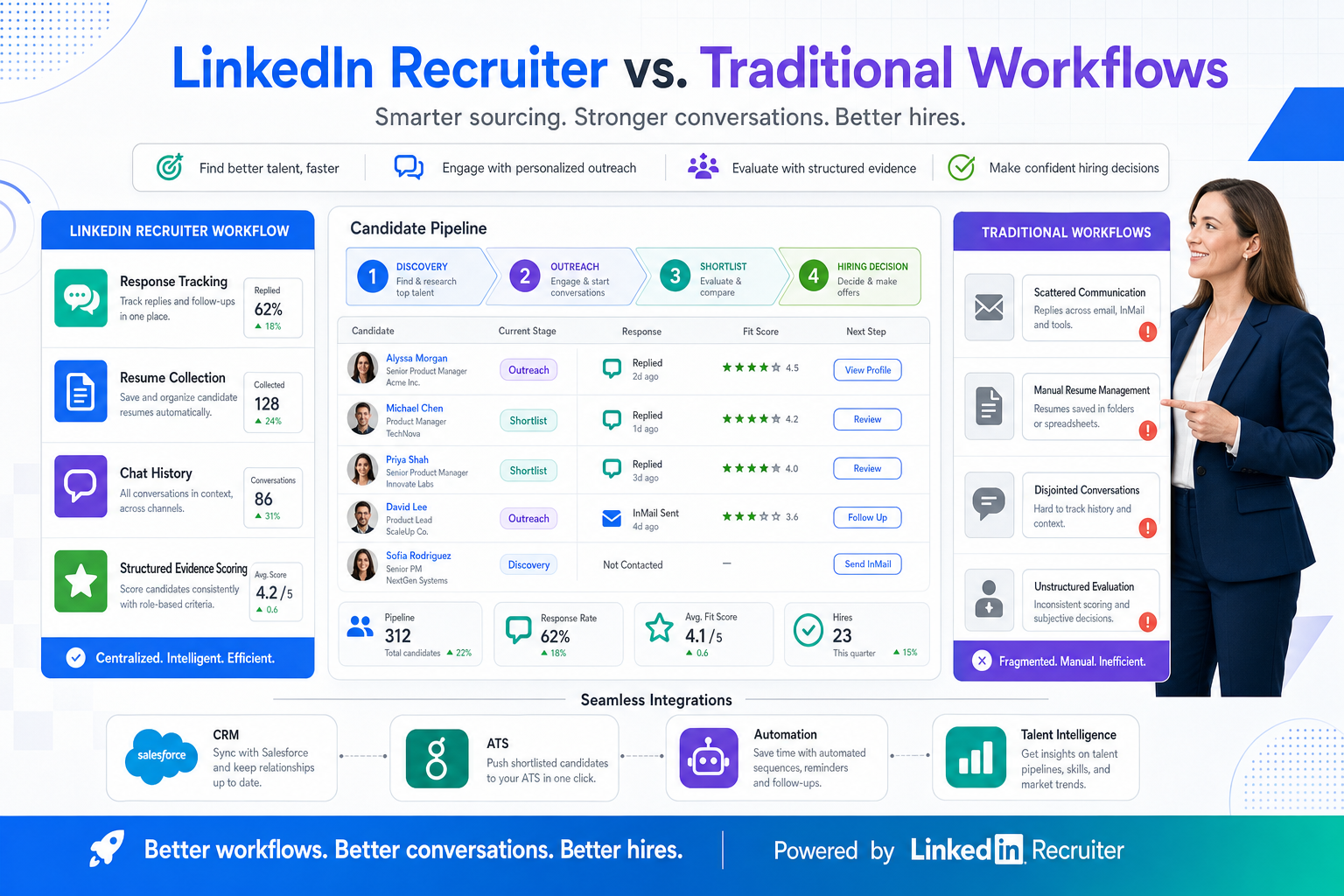
When linkedin recruiter competitors are judged by workflow and hiring evidence—not profile volume—recruiting leaders can avoid slower shortlists and weaker hiring calls.
That distinction matters more than most teams admit. Recruiters do not usually struggle because there are no profiles to find; they struggle because too many decisions are still made from partial signals, scattered follow-up, weak response tracking, and inconsistent handoff between sourcing and selection. For a solo headhunter, that means lost placements and late nights. For a small agency owner, it means uneven desk performance and shaky client confidence. For an internal TA lead, it means slower shortlists, more noise in the funnel, and hiring managers who no longer trust the pipeline.
One reason I have become more selective about sourcing stacks is that workflow support matters as much as database access. In my own LinkedIn-heavy recruiting work, StrategyBrain AI Recruiter helped most when the real bottleneck was repetitive first-touch messaging, after-hours replies, and résumé collection from interested candidates. It can automate outreach conversations, keep communication moving across time zones, and capture candidate details without forcing the recruiter to stay online constantly. The recruiter still owns the final judgment, résumé review, and next-step decision, which is exactly how it should be.
The underlying issue is the same one experienced recruiters see later in the hiring process: decisions fail less from a lack of candidates than from weak evidence between qualified people. Once a shortlist forms, interviews, resumes, references, and message history all matter, but each signal on its own leaves room for bias, overconfidence, or simple misreading. In practice, that means a recruiter may source five solid people for a technical role, run outreach, get interest from three, and still struggle to advise the hiring manager because the search record is fragmented and the strongest evidence sits in different places.
That is why evaluating linkedin competitors and linkedin recruiter competitors should start with a better question than who has the biggest profile index. The real comparison is about where sourcing fits in a structured recruiting flow, how candidate evidence gets organized after initial screening, and whether the tool helps recruiters move from discovery to selection without adding friction. Once you look at the market that way, LinkedIn Recruiter alternatives make much more sense.
Table of Contents
What a Real LinkedIn Recruiter Alternative Should Fix
When teams search for linkedin recruiter competitors, they often describe the problem as cost, seat limits, or channel fatigue. Those are real issues, but they are usually symptoms rather than the root problem.
In most searches, a replacement needs to improve one or more of these areas:
- Candidate discovery: finding talent beyond one professional network
- Recruiter workflow: running outreach, follow-up, and collaboration consistently
- Decision quality: organizing better evidence before the final shortlist and hire
That third point is often missed in generic software roundups. A tool that shows more names is helpful, but it does not automatically improve hiring decisions. Recruiters still need structured signals: who replied, who shared a resume, who answered key qualification questions, who advanced, and where uncertainty remains.
That is also why the competitive set extends beyond direct linkedin competitors. In real buying cycles, teams compare:
- Multi-source candidate sourcing platforms
- Talent intelligence tools
- Recruitment CRM systems
- Recruiting suites and ATS platforms with sourcing support
From experience, the best alternatives are rarely the ones that try to mimic LinkedIn screen for screen. They are the ones that reduce weak signals early and create cleaner evidence later.
Where LinkedIn Recruiter Fits in a Structured Hiring Flow
LinkedIn Recruiter is often treated as if it covers the entire sourcing problem. In practice, it fills only part of the hiring flow.
It helps recruiters identify people, initiate outreach, and build top-of-funnel momentum. But most employers still need a broader process around it: resume review, interview sequencing, manager alignment, shortlist validation, and final decision-making.
That matters because the strongest recruiting process separates stages clearly:
- Initial screening establishes baseline fit
- Sourcing expands the candidate pool
- Outreach and qualification test interest and availability
- Selection methods add more role-relevant evidence
- Structured decision-making determines who gets hired
If your current tool improves only discovery but not the handoff into qualification and selection, recruiters still end up doing manual repair work. That is where many buyers start looking for linkedin recruiter competitors even when they are not unhappy with LinkedIn search itself.
In my own workflow, that gap becomes obvious when candidate replies arrive outside working hours or across multiple time zones. One of the practical uses I found with StrategyBrain AI Recruiter was keeping first-stage LinkedIn conversations active, answering candidate questions about the role, and collecting resumes or contact details before I reviewed the file myself. It did not replace recruiter judgment. It reduced delay between candidate interest and recruiter action, which is often where momentum is lost.
LinkedIn Recruiter vs Recruiter Lite: Compare Like for Like
Before comparing alternatives, separate the product tiers you are actually benchmarking.
Recruiter Lite generally serves lighter individual usage with fewer advanced team capabilities. LinkedIn Recruiter is the broader product designed for heavier sourcing and more robust recruiting activity.
This matters because many comparison pages about linkedin recruiter competitors blend them together and create bad assumptions about value, cost, and workflow fit.
If you are using Lite today, your pain points may be:
- Search depth
- Response management
- Team collaboration
- Scaling outreach without more manual work
If you are comparing against full Recruiter, the evaluation usually shifts toward:
- Broader talent coverage
- Workflow control
- Recruiter productivity
- Integration into the wider hiring stack
That distinction should shape every vendor demo and every internal buying conversation.
Quick Comparison Table
| Option Type | Best For | Coverage | Workflow Strength | Decision Support | Pricing Pattern |
|---|---|---|---|---|---|
| Multi-source sourcing platform | Teams needing more talent sources | Public web and cross-channel profiles | Moderate | Useful if records are structured well | Mixed |
| Talent intelligence tool | Niche, strategic, or hard-to-fill roles | Broad and often enriched | Varies | Strong for market mapping | Often quote-based |
| Recruitment CRM | Outbound-heavy teams | Depends on sourcing integrations | Strong | Good for response tracking and follow-up | Mixed |
| ATS suite | Teams prioritizing process control | Often integration-dependent | Moderate | High for final-stage consistency | Tiered or custom |
| LinkedIn automation support tool | Recruiters needing scale in first-touch outreach | LinkedIn-centered | Strong for repetitive messaging | Helpful before recruiter review | Varies |
This framework is more useful than a flat top-10 list because it reflects how recruiters actually work. Sourcing, qualification, and selection are connected steps, and the best tool depends on which step is breaking down.
The Main Types of LinkedIn Recruiter Competitors
1. Multi-source sourcing platforms
These are the most obvious linkedin competitors for teams that want broader candidate reach. They are designed to find talent beyond a single professional network, which can be especially useful for technical, creative, research, and specialist roles.
What matters in practice is not just source count, but search relevance, profile freshness, and how quickly recruiters can move shortlisted people into the next step.
2. Talent intelligence tools
These are stronger when the real challenge is not profile volume but target accuracy. They can help map talent pools, adjacent skill sets, target companies, and strategic markets.
They tend to outperform simpler search tools when the hiring question is complex and the shortlist needs to be more deliberate.
3. Recruitment CRM and workflow tools
Some teams already have enough sourcing channels. Their problem is that candidate follow-up, ownership, and recruiter activity are inconsistent. In those cases, a CRM-style alternative can produce more value than another profile database.
This is also the category where response management and disciplined evidence gathering start to improve final hiring quality.
4. ATS and recruiting suites
These belong in the conversation because many organizations do not need a one-for-one search replacement. They need a cleaner recruiting system.
When a suite improves records, stage movement, collaboration, and visibility, it can reduce dependence on LinkedIn as the center of the workflow.
5. LinkedIn automation and communication support tools
This category matters for teams whose main issue is manual outreach rather than profile discovery. Recruiters still source on LinkedIn, but the repetitive work of connecting, answering basic role questions, and collecting resumes becomes the bottleneck.
That is where tools such as StrategyBrain AI Recruiter fit best. Used properly, they help keep candidate conversations moving and hand the recruiter a more organized next-step file instead of a pile of half-finished chats.
11 LinkedIn Recruiter Alternatives to Consider
Below is a practical shortlist by use case rather than a brand leaderboard. That is the fairest way to compare linkedin recruiter competitors without pretending every team buys for the same reason.
1. A multi-source sourcing platform for broader discovery
Best for: recruiters who keep seeing the same candidate pool on LinkedIn.
These platforms are the closest direct answer when a team wants broader search coverage and less channel dependency.
Look for:
- Cross-source profile discovery
- Good filtering and search logic
- Export and handoff speed
- Deduplication against existing records
2. A talent intelligence platform for mapped search
Best for: senior, niche, or strategic hiring.
If your search requires target-company logic, adjacent-skill mapping, or market intelligence, this category may beat standard linkedin competitors.
3. A recruiting CRM for outbound-heavy desks
Best for: agencies and in-house teams doing a high volume of recruiter-led outreach.
This option is often better when the pain is not finding names but managing messaging, follow-up, and ownership.
4. An ATS suite with sourcing support
Best for: teams trying to reduce tool sprawl.
If your current process falls apart after candidate discovery, a broader platform may create more value than another sourcing subscription.
5. A lower-cost sourcing tool for budget control
Best for: smaller teams that cannot justify enterprise pricing.
This category makes sense when current LinkedIn usage is light and a simpler sourcing layer could cover most needs.
6. A public-web and portfolio search tool
Best for: engineering, design, freelance, and creator-led hiring.
For some role families, LinkedIn is useful but incomplete. Portfolio-heavy profiles often tell a more reliable story than a polished network resume.
7. An agency workflow platform
Best for: contingent and retained search firms.
Agency recruiters often need submission tracking, ownership rules, and team coordination as much as they need search access.
8. A recruiter collaboration platform
Best for: larger internal TA teams.
Where multiple recruiters and hiring managers touch the same search, collaboration quality can become a bigger issue than sourcing depth.
9. A contact enrichment and off-platform outreach tool
Best for: teams trying to improve contact paths beyond one network.
This works when the core challenge is getting the right message to the right person through the most effective channel.
10. A LinkedIn communication automation layer
Best for: recruiters who already rely on LinkedIn but need help scaling repetitive activity.
This is the use case where I would place StrategyBrain AI Recruiter. It is most helpful when you still want recruiter control over search strategy and final qualification, but need support with repetitive connection requests, role introductions, candidate Q&A, and resume capture. For after-hours replies and multilingual communication, that can remove a surprising amount of operational drag.
My own takeaway after testing this kind of workflow is simple: if the recruiter remains responsible for final fit assessment, automation can improve speed without weakening judgment. If the recruiter tries to outsource the final decision, the process gets worse, not better.
11. A hybrid stack: sourcing tool plus ATS plus LinkedIn workflow support
Best for: teams that want specialization without losing process control.
In many real environments, the best answer to linkedin recruiter competitors is not a single replacement. It is a stack where sourcing expands reach, workflow support keeps conversations moving, and the ATS holds the structured record that supports the final decision.
How to Evaluate LinkedIn Recruiter Alternatives With Better Evidence
The strongest way to compare alternatives is to borrow a principle from good selection practice: each tool should answer a specific hiring question.
Ask these questions in order:
1. What problem in the hiring flow are we trying to fix?
- Not enough candidate reach?
- Too much manual outreach?
- Poor visibility into recruiter activity?
- Weak evidence at shortlist stage?
2. At what stage should this tool be used?
- Early sourcing
- Pre-qualification outreach
- Shortlist validation
- End-to-end process management
3. What evidence will it add that we do not have now?
- More candidate sources
- Better response tracking
- Cleaner notes and handoff records
- More consistent candidate comparison
4. Can we apply it consistently?
Consistency matters. A tool that one power user loves but the wider team never adopts will not improve hiring decisions. The same lesson applies to selection methods generally: structure beats improvisation.
5. Does it respect candidate experience?
If a workflow creates slow replies, duplicated asks, or irrelevant outreach, strong candidates disengage. That is one reason automation support can help when used carefully. Candidates are often more responsive when they receive timely, clear communication and understand what the next step is.
Practical rule: if an alternative does not clearly improve either candidate reach, recruiter discipline, or hiring evidence, it is probably not a real upgrade.
Common Mistakes When Comparing LinkedIn Recruiter Competitors
Focusing only on profile volume
More records do not automatically produce better hires. Relevance, workflow, and evidence quality matter just as much.
Ignoring where the tool fits in the hiring sequence
A sourcing product should not be judged like an ATS, and an ATS should not be judged like a sourcing engine. Many weak software decisions come from comparing tools without a stage-based framework.
Blending Recruiter and Recruiter Lite in the same benchmark
This distorts value and pricing assumptions from the start.
Overlooking candidate experience
Slow replies, scattered follow-up, and repeated requests for the same information make recruiters look disorganized. In competitive hiring markets, that costs real candidates.
Automating without preserving recruiter judgment
Support tools should reduce repetitive work, not replace assessment. I would apply that principle to any LinkedIn workflow automation: helpful for first touch, scheduling momentum, and resume capture; not a substitute for recruiter evaluation.
Buying around a single recruiter’s style
The right stack has to work across the whole desk or team, not just for one heavy user.
FAQ
What is the best alternative to LinkedIn Recruiter?
The best alternative depends on your bottleneck. For broader talent discovery, a multi-source sourcing platform is usually the best fit. For repetitive LinkedIn outreach and candidate follow-up, a LinkedIn workflow support tool may create more value. For process control, an ATS or recruiting suite may be the stronger answer.
Are there cheaper linkedin recruiter competitors?
Yes. Some lower-cost sourcing tools and lighter workflow platforms can reduce spend, especially for smaller teams. The key is to evaluate actual recruiter usage and workflow fit, not just contract price.
What are the main linkedin competitors for recruiters?
The main categories are multi-source sourcing platforms, talent intelligence tools, recruitment CRMs, ATS suites, and LinkedIn communication support tools. Which one counts as a real competitor depends on what part of your recruiting process needs improvement.
Should I replace LinkedIn Recruiter completely?
Not always. Many teams get better results by reducing dependence on LinkedIn rather than replacing it entirely. A hybrid stack often works better than forcing one system to do everything.
Where does StrategyBrain AI Recruiter fit?
It fits best for recruiters who still want to source through LinkedIn but need help with repetitive outreach, candidate communication, multilingual follow-up, and resume collection. The recruiter should still make the final qualification and hiring decision.
Final Takeaway
The market for linkedin recruiter competitors is broader than a simple list of copycat databases. The better alternatives are usually the ones that make recruiters more evidence-driven at the exact point where decisions become expensive: after sourcing starts, before final selection is made.
If you are comparing linkedin competitors in 2026, separate candidate discovery from workflow support, and separate workflow support from final hiring judgment. That lens will help you choose a tool that does more than surface profiles. It will help you build a recruiting process that is faster, fairer, and easier to trust.