Buying recruitment agency software gets easier when agency leaders use this article to spot follow-through gaps, compare fit, and avoid costly workflow mismatches.
That matters because most agency delivery problems do not start with a lack of features. They start when recruiters cannot consistently communicate, capture intent, follow up at the right moment, or finish what they started across candidates, clients, and open jobs. For a small agency owner, that means lost fees and patchy desk visibility. For an individual consultant, it means missed replies, weak market coverage, and too much admin living in inboxes. For an internal talent lead working with agencies, it often shows up as slower shortlists, uneven updates, and poor stakeholder confidence.
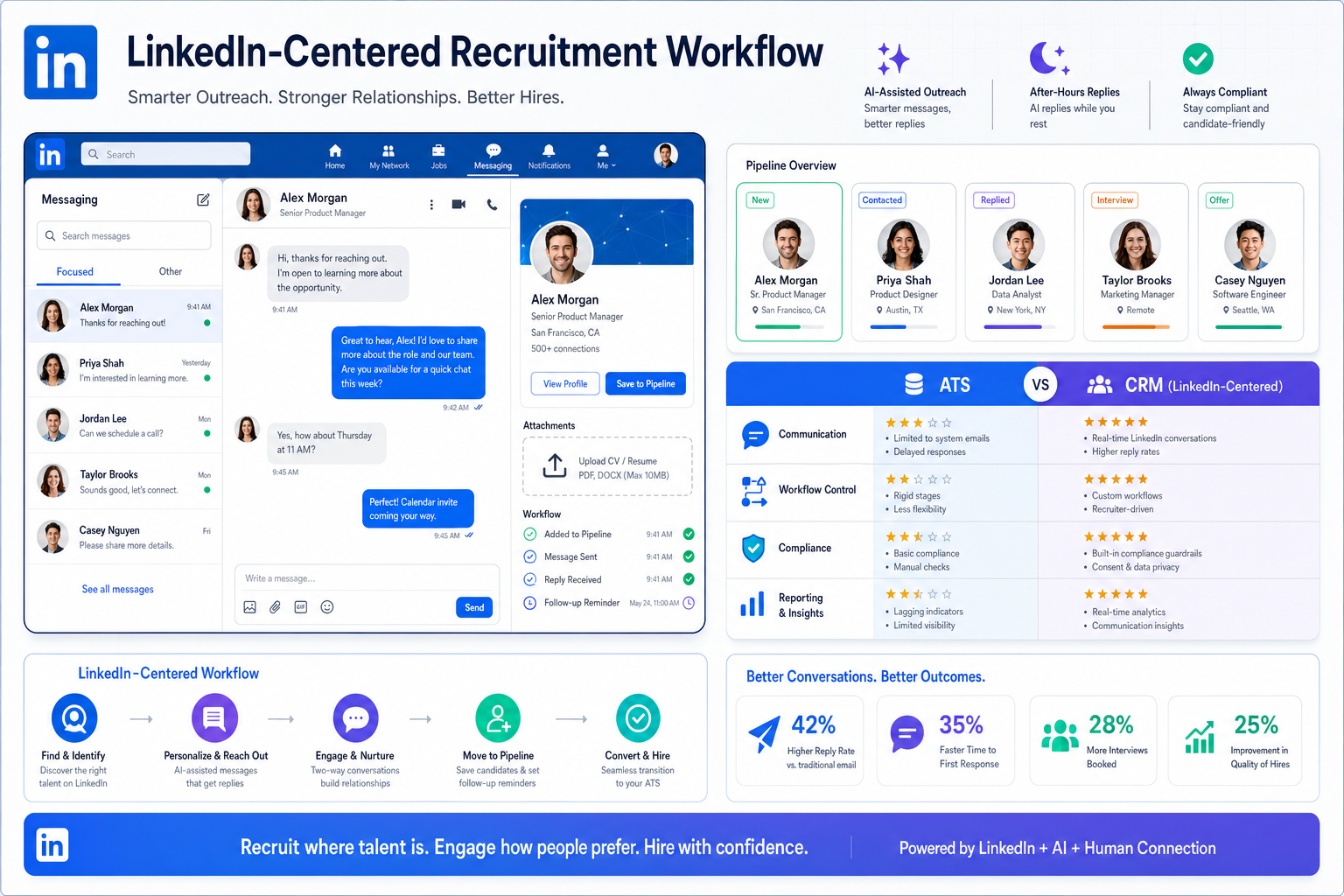
One way I have reduced that pressure is by using StrategyBrain AI Recruiter to handle the repetitive front end of LinkedIn outreach, after-hours replies, and early candidate interest checks. In practice, that helps when strong communication and consistent follow-through are the real bottlenecks, not sourcing volume alone. It keeps conversations active, collects CVs and contact details from interested candidates, and supports multilingual outreach when a market is wider than one geography. The recruiter still makes the final call on CV quality, suitability, and next steps, but the workflow is far less likely to stall between first contact and real review.
That mirrors a pattern recruiters see in other professional markets. When finance and accounting candidates try to build stronger careers, the people who advance are rarely just the most technically sound. The ones who move forward communicate well, stay curious, take initiative, and actually finish the work in front of them. The same weak spots also hold people back: entitlement, clock watching, and starting tasks without seeing them through. In recruitment, those traits surface differently, but the operational consequence is familiar. A recruiter sends outreach, forgets to circle back, loses context on why a candidate was promising, or lets a client update sit too long because the process depends on personal memory instead of system discipline.
Once you look at agency software through that lens, the buying question changes. The best recruiting software is not simply the platform with the longest checklist. It is the one that helps recruiters communicate consistently, stay motivated through long workflows, maintain full context, and complete each hiring action from first touch to placement. That is why recruitment agency software now sits at the center of most serious buying decisions, and why criteria for recruitment software UK and healthcare recruitment software deserve separate attention rather than being treated as minor feature variations.
Table of Contents
- Why agencies outgrow a basic ATS
- From recruiter traits to software evaluation criteria
- Quick comparison by agency type
- Communication and follow-through in real workflows
- Best fit for executive search agencies
- Best fit for temp staffing agencies
- Best fit for healthcare staffing agencies
- Best fit for high-volume recruitment teams
- Best fit for small and growing agencies
- What matters in recruitment software UK
- ATS vs CRM for recruiters
- How pricing usually works
- Common selection mistakes
- FAQ
Why agencies outgrow a basic ATS
Agencies do not fail on recruiting volume alone. They fail when communication breaks down, ownership becomes vague, and no one can see whether the team is actually moving each search forward. That is why the conversation around the best recruiting software has shifted from standalone applicant tracking to broader recruitment agency software that combines ATS and CRM functions.
A simple ATS may organise applicants, but agency work also depends on client records, business development activity, submission history, notes, task ownership, and commercial reporting. If those functions live in separate systems, recruiters often become the bridge between tools. That usually means duplicated entry, incomplete records, and delayed follow-up.
Key insight: The strongest systems do not just store recruitment data. They support the behaviours that make recruiters effective: clear communication, curiosity about the market, sustained motivation, and consistent follow-through.
From recruiter traits to software evaluation criteria
A useful way to assess software is to start with the behaviours strong recruiters already rely on. Good software should reinforce them, not fight them.
1. Strong communication
Recruiters who progress build trust with candidates, clients, and internal stakeholders. Software should therefore support communication history, outreach workflows, reminders, shared notes, and visibility across accounts. If a recruiter changes desk focus or goes on leave, another consultant should be able to step in without losing the thread.
2. Curiosity and market awareness
Great recruiters ask better questions and build a sharper picture of the market. That means search depth, segmentation, talent pooling, and fast access to prior conversations matter more than generic automation claims. A platform should help recruiters connect the dots between candidate intent, skills, timing, and client demand.
3. Motivation and initiative
Motivated recruiters move work forward before it becomes urgent. Useful software supports task ownership, structured pipelines, alerts, and activity prompts so opportunities do not sit untouched. Managers should be able to see where momentum is strong and where it is slipping.
4. Finishing what gets started
One of the most common agency problems is partial execution. Recruiters source well but do not follow up, qualify interest but do not capture the CV, or submit candidates without closing the loop with the client. The best recruiting software reduces those drop-off points with workflow structure, stage discipline, and auditable activity history.
Those four ideas create a practical evaluation framework:
- Data capture and sourcing: CV parsing, imports, search quality, and talent pooling
- Workflow control: stages, submissions, tasks, reminders, and ownership
- Communication support: email history, outreach sequencing, notes, and collaboration
- Client management: accounts, contacts, opportunities, and business development visibility
- Compliance and risk control: permissions, audit trails, documents, and sector-specific checks
- Reporting and accountability: activity, conversion, pipeline health, and forecast visibility
Quick comparison: which type of recruitment agency software fits which agency?
| Agency type | Core software need | What matters most | Main limitation to watch |
|---|---|---|---|
| Executive search | ATS + CRM with relationship depth | Long-cycle candidate nurturing, client mapping, confidentiality | Weak relationship tracking |
| Temp staffing | Operational workflow platform | Speed, redeployment, outreach consistency | Manual handoffs and delayed follow-up |
| Healthcare staffing | Healthcare recruitment software | Credentialing, compliance tracking, expiry alerts, scheduling | Generic ATS without sector controls |
| High-volume recruitment | Automation-focused ATS | Bulk processing, candidate matching, recruiter efficiency | Too many clicks and weak reporting |
| SMB agency | Easy-to-run recruitment agency software | Usability, adoption, visibility, manageable setup | Overly complex implementation |
If you are comparing the best recruiting software, use case should narrow the field early. A retained search firm, a temp desk, and a compliance-heavy healthcare team are solving different operational problems even when they use the same broad category label.
Communication and follow-through in real workflows
In daily recruiting, communication and follow-through are where many systems either prove their worth or get exposed. A polished database can still fail if recruiters cannot pick up conversations quickly, see what was promised, or keep momentum with candidates who reply outside office hours.
I have seen this most clearly in LinkedIn-heavy sourcing. Recruiters often do the hard part of identifying relevant people, then lose time on repetitive messaging, delayed replies, and manual CV collection. In those situations, I have used AI Recruiter alongside the main ATS or CRM to keep early outreach moving while preserving recruiter judgement. It can introduce roles, respond when candidates answer after hours, and gather contact details or CVs from interested prospects. What I found useful was not just speed, but consistency. Conversations that would normally fade out stayed alive long enough for a recruiter to review the resume and decide whether the profile was worth progressing.
That kind of support does not replace core recruitment agency software. It strengthens one part of the workflow where agencies regularly lose ground: first contact to qualified response. For desk models that depend heavily on active sourcing, that can be a meaningful operational advantage.
Best fit for executive search agencies
Executive search firms need memory, context, and discretion. Their work often stretches across long cycles, multiple stakeholders, and candidate relationships that predate the live assignment. In that environment, software should help consultants communicate clearly, retain strategic context, and finish each touchpoint properly.
For this type of agency, the best recruitment agency software should include:
- Advanced search and segmentation across senior profiles
- Relationship history by candidate and client contact
- Structured longlist and shortlist workflows
- Confidential assignment controls
- Reporting that supports partner-level visibility
If a system is weak on notes, contact history, or account mapping, it will not support the kind of trust-based advisory work search firms are expected to deliver.
Best fit for temp staffing agencies
Temp desks run on pace and repeatability. The best recruiting software in this setting should make it easy to search the live pool, confirm availability, manage urgent communication, and move candidates quickly without dropping detail.
Useful capabilities include:
- Fast CV parsing and searchable talent pools
- Availability tracking and redeployment visibility
- Automated outreach for urgent roles
- Task reminders and recruiter workload management
- Simple reporting on fill rates and desk activity
This is also where communication discipline matters. A recruiter can identify a suitable temporary worker in minutes, but if follow-up is delayed or records are incomplete, the placement opportunity disappears just as quickly.
Best fit for healthcare staffing agencies
Healthcare recruitment software should be treated as a separate category because healthcare staffing is not only about sourcing and matching. It is also about proving that a worker is eligible, current, and safe to place.
Strong healthcare-oriented systems should support:
- Credentialing and document collection
- Compliance tracking across licences and checks
- Certification expiry alerts
- Scheduling or shift coordination where relevant
- Provider self-service for updates, availability, and documents
A general ATS can still help with searching, parsing, pipeline control, and outreach. But if compliance work is left outside the system, recruiters and operations teams usually end up maintaining parallel processes. That is risky and inefficient.
Best fit for high-volume recruitment teams
High-volume teams need throughput without losing control. They also feel the cost of weak follow-through more quickly than almost any other desk model. If recruiters cannot process applications, contact candidates, and update statuses efficiently, the pipeline becomes noisy and unreliable.
Look for:
- Bulk application or CV processing
- Reliable resume parsing
- Search filters that work in real use
- Automated sequences for outreach and follow-up
- Candidate matching that reduces shortlist time
- Dashboards for bottlenecks and conversion rates
When sourcing depends heavily on LinkedIn outreach, add-on support can also help. I have found StrategyBrain AI Recruiter particularly useful when candidate replies arrive outside working hours or in multiple languages. It does not replace recruiter judgement, but it does remove some of the dead time between outreach and initial interest capture.
Best fit for small and growing agencies
Small agencies often buy software that is far more complex than their workflow actually requires. The better choice is usually a platform that enforces discipline without creating operational drag.
For a growing agency, useful priorities are:
- Clear pipeline stages
- Simple candidate search and applicant tracking
- Integrated client records
- Email and activity history in one place
- Reporting that a founder or desk lead can use easily
- Enough automation to reduce admin without overwhelming users
If your team is still building habits around CRM usage and workflow compliance, usability matters more than theoretical feature depth. Full adoption usually beats a more advanced system that consultants avoid.
What matters in recruitment software UK
Buying recruitment software UK requires more than checking whether the interface supports British spelling or local currency. UK agencies often have practical requirements that affect daily operations and risk management.
Key considerations include:
- UK job-board integrations aligned to the channels your team actually uses
- GDPR readiness with strong permissions, retention discipline, and process control
- Data residency expectations where clients or policy require additional scrutiny
- Agency Workers Regulations considerations for temporary staffing models
For UK buyers, local workflow fit should be tested in the same way as feature fit. A system that looks strong in demo can still create friction if it does not support the practical compliance and record-keeping expectations agencies live with every day.
ATS vs CRM for recruiters: what is the difference?
An ATS mainly manages jobs, applicants, and hiring workflow. A CRM manages clients, contacts, and business development activity. Agencies typically need both.
| Function | ATS | CRM |
|---|---|---|
| Job and vacancy management | Yes | Limited |
| Applicant stage tracking | Yes | No |
| CV parsing and candidate search | Yes | Limited |
| Client account management | Limited | Yes |
| Business development tracking | Limited | Yes |
| Relationship history across contacts | Partial | Yes |
The reason this matters is simple: agency recruitment depends on both delivery and relationship management. Candidate activity without client context is incomplete. Client development without live recruitment workflow is not enough to run a desk well.
How pricing usually works for recruiting software
Pricing models vary, but most agencies will encounter some combination of per-user fees, feature tiers, implementation costs, and extra charges for integrations or specialist modules. In healthcare recruitment software, pricing may also reflect compliance or scheduling functionality.
The more useful question is not just what the system costs, but what it replaces and how reliably your team will use it. A lower-cost product can still be expensive if recruiters need workarounds, duplicate systems, or manual admin to keep communication and follow-through on track.
Questions worth asking include:
- Is pricing transparent enough to compare options clearly?
- Which functions are included and which are add-ons?
- Does the price cover both ATS and CRM capability?
- Will UK or healthcare requirements require extra modules?
- How much internal time will migration, setup, and training consume?
Common mistakes agencies make when choosing the best recruiting software
1. Buying for a demo instead of a desk workflow
Recruiters live in search, outreach, notes, updates, and follow-up. If a system looks polished but slows those actions down, adoption will drop.
2. Treating all agencies as operationally identical
Executive search, temp staffing, and healthcare staffing all have different workflow demands. One shortlist should not serve every model.
3. Underestimating communication history
Many teams focus on database structure and overlook how often placements are won or lost because conversation history is weak, inaccessible, or scattered.
4. Ignoring local UK criteria
For recruitment software UK, data handling, local integrations, and worker-regulation needs can be just as important as sourcing features.
5. Assuming healthcare can run on a generic ATS alone
Healthcare recruitment software often needs compliance and credentialing controls that general systems do not handle well enough on their own.
6. Separating sourcing automation from recruiter judgement
Automation works best when it supports the recruiter rather than pretending to replace decision-making. Early outreach, reply handling, and CV capture can be assisted; final suitability calls still need human judgement.
How to make the final choice
If you are narrowing down the best recruiting software, keep the process grounded in how your team actually works. A practical sequence usually looks like this:
- Define the desk model by sector, volume, and client expectations
- List non-negotiables for ATS, CRM, reporting, and compliance
- Test communication workflows including outreach, notes, reminders, and handoffs
- Separate specialist needs such as healthcare compliance or UK-specific requirements
- Review live recruiter scenarios rather than summary demos alone
- Assess adoption risk across consultants, managers, and operations users
In my experience, the strongest selection decisions come from watching whether a system helps recruiters do four things well: communicate clearly, stay curious about the market, maintain momentum, and finish each step of the process properly. That is what turns software into better delivery rather than just another database.
FAQ
What is recruitment agency software?
Recruitment agency software is a platform that helps agencies manage candidates, vacancies, clients, communications, and reporting in one operating environment. The strongest systems usually combine ATS and CRM functionality rather than treating them as separate tools.
What is the difference between an ATS and a CRM in recruiting?
An ATS manages jobs, applicants, and hiring stages. A CRM manages client accounts, contacts, and business development activity. Agencies typically need both because delivery and client management are tightly connected.
What features matter most in the best recruiting software?
The most useful features usually include candidate search, CV parsing, applicant tracking, communication history, outreach workflows, reporting, and client management. In regulated sectors, compliance controls also become central.
What should agencies look for in recruitment software UK?
For recruitment software UK, agencies should review local job-board integrations, GDPR process controls, data-handling expectations, and any requirements connected to temporary staffing regulations.
What makes healthcare recruitment software different?
Healthcare recruitment software usually needs credentialing, compliance tracking, document management, expiry alerts, and sometimes scheduling support in addition to standard recruiting workflow features.
Can LinkedIn outreach automation work alongside recruitment agency software?
Yes. Many teams use separate outreach support for the earliest part of sourcing while keeping the ATS or CRM as the system of record. Tools such as AI Recruiter can help maintain candidate conversations, capture CVs, and support after-hours or multilingual engagement, while the recruiter still reviews fit and decides what happens next.
How do I know which recruiting software is right for my agency?
Start with your workflow. Look at how recruiters source, communicate, track progress, manage client context, and maintain compliance. The right system is the one that improves those day-to-day actions with the least operational friction.
Conclusion
The best recruiting software is usually the system that helps recruiters work like strong operators: communicate well, ask better questions, stay proactive, and follow through to the end. That is why choosing recruitment agency software should be about workflow fit, not just feature volume.
If you recruit in the UK, build a local checklist. If you place clinical staff, treat healthcare recruitment software as its own category. And if your team relies heavily on active sourcing, especially on LinkedIn, support tools such as StrategyBrain AI Recruiter can strengthen the early outreach layer without removing recruiter judgement from the decision itself. In practice, that combination of system discipline and human judgement is what usually creates the most reliable agency workflow.