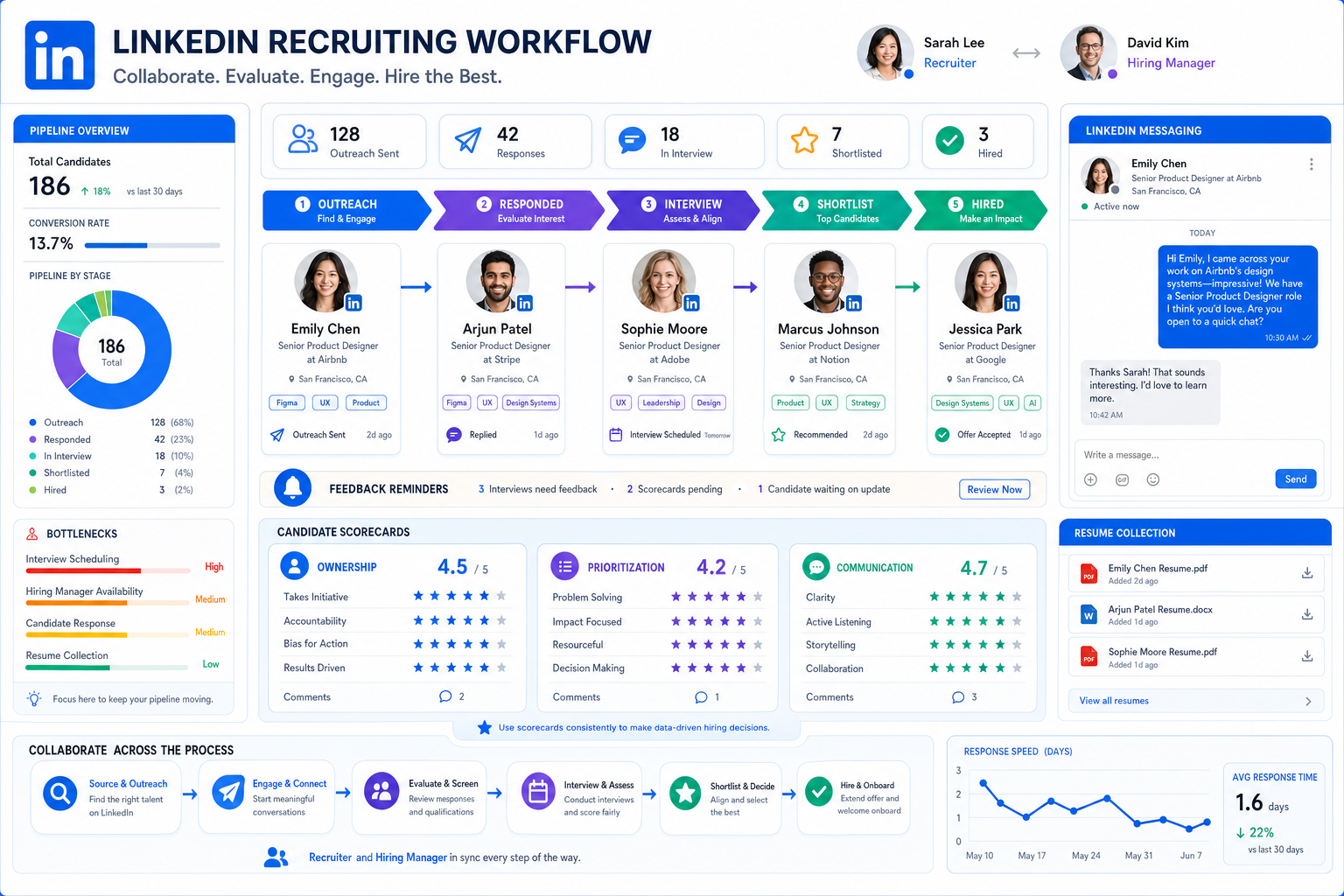
When hiring systems hide ownership signals and stall feedback, this article helps headhunters judge better options, avoid weak shortlists, and protect client trust.
That matters because recruiting breakdowns rarely start with sourcing alone. They start when recruiters cannot see who actually carried work from start to finish, when candidate notes live in too many places, and when hiring managers react late. For a solo recruiter, that means wasted follow-up and weak shortlists. For a small agency owner, it can mean damaged client trust and lower placement efficiency. For an internal talent team, it often shows up as slower employee recruiting, inconsistent feedback, and more drop-off from a strong hiring candidate who expected a clearer process.
In that kind of workflow, I have found it useful to pair core hiring systems with tools that reduce repetitive outreach and candidate handoff work. Used carefully, AI Recruiter can help by handling initial LinkedIn communication, following up after hours, and collecting resumes and contact details from interested people while the recruiter still owns final judgment, resume review, and next-step decisions. That matters most when the bottleneck is not finding names, but keeping momentum without letting communication gaps slow down the search.
A useful way to frame the problem comes from a familiar hiring conversation. A senior manager says they do not just want a qualified accountant, analyst, or operations hire. They want someone who gets things done. In recruiting terms, that immediately changes the intake. The recruiter is no longer screening for title match alone. They start asking whether the person owned a project from start to finish, whether they kept moving when a system rollout or process change became messy, and what result they personally drove rather than merely supported.
Once that standard is in play, the search gets harder in a very practical way. The recruiter has to compare resume claims against actual delivery, check whether the hiring candidate can prioritize under pressure, and judge whether their communication style creates buy-in across stakeholders instead of friction. That is exactly where the best recruiting software becomes more than an admin tool. Strong hiring systems help teams capture those signals consistently, move candidate evidence through the process, and support employee recruiting decisions that are tied to how work really gets done.
Why the best software starts with hiring criteria
When teams search for the best recruiting software, they often begin with features. In practice, experienced recruiters usually begin with decision quality. If the role requires someone who can take ownership, prioritize under pressure, and communicate across functions, your hiring systems have to make those traits visible in the workflow.
That is the deeper lesson behind many difficult searches. The strongest candidates are not always the ones with the broadest project exposure on paper. They are often the ones who can explain what they owned, where the work became complicated, how they kept stakeholders aligned, and what they delivered at the end. Good recruiting systems should make it easier to collect that evidence, not bury it in disconnected notes and email threads.
In other words, the best recruiting software should help teams answer three questions consistently:
- Did this hiring candidate move work from start to finish, or only participate at the edges?
- Can they prioritize when deadlines compress and priorities collide?
- Does their communication style help teams make decisions faster?
Key insight: The real value of hiring systems is not only processing applications faster. It is preserving the evidence recruiters need to judge execution, prioritization, and collaboration well.
What hiring systems need to track
Recruiting software is the set of tools a team uses to manage sourcing, applications, screening, interviews, team feedback, and offers. But if you stop there, you miss what strong employee recruiting actually requires. Good systems also need to capture decision context.
That means your workflow should not only show where a candidate is in the funnel. It should also make it easy to record what they accomplished, what pressure points they handled, and how hiring managers interpreted their communication and ownership. For many teams, that is the difference between a basic applicant database and a functioning hiring system.
The most useful hiring systems usually combine these layers:
- Workflow control: stages, statuses, ownership, and approvals
- Candidate evidence: resume details, project history, scorecards, and interview notes
- Team collaboration: comments, feedback, scheduling, and decisions in one place
- Operational visibility: reporting on time to hire, conversion, bottlenecks, and source quality
If a recruiter is trying to assess whether an accountant, analyst, or specialist can truly deliver under pressure, those details cannot live only in memory. The best recruiting software turns them into structured, reusable hiring data.
Features that support better judgment
Teams comparing hiring systems tend to see long feature lists that sound similar. I usually recommend judging features by one standard: do they help you identify a stronger hiring candidate with less confusion and less wasted effort?
1. Pipeline management that preserves context
A pipeline should do more than show stage names. Recruiters need to see why someone advanced, what evidence supports the decision, and what remains unresolved. If a candidate says they helped with a major implementation, your notes should show whether they led part of it, solved issues when things went wrong, and owned a measurable outcome.
2. Structured scorecards tied to delivery
Scorecards are one of the quietest but most important parts of modern employee recruiting. They let hiring managers rate ownership, prioritization, and communication in a repeatable way instead of relying on vague impressions after interviews.
3. Interview workflows that reduce drift
Delays between recruiter screen, manager review, and panel feedback often cause the strongest candidates to disappear. Good hiring systems assign owners, trigger reminders, and make follow-up visible so evaluation happens while candidate interest is still warm.
4. Candidate relationship tools for ongoing searches
If your team revisits past applicants or silver medalists, recruiting CRM functionality matters. It helps preserve the history behind a hiring candidate, including prior conversations about project ownership, timing, or preferred scope of work.
5. Search and sourcing support
For headhunters and in-house teams using LinkedIn heavily, communication speed matters. In my own workflow, I have used AI Recruiter to keep first-touch conversations moving when I was tied up in client calls and interview debriefs. What I found most helpful was not a promise of magic matching, but the practical support: it could initiate outreach within my criteria, respond in a candidate's language when needed, and collect resumes from interested people so I could review the actual documents later. That separation matters. The recruiter still decides who is credible, who fits the brief, and who moves forward.
6. Reporting that exposes weak judgment patterns
Reporting should not only satisfy leadership. It should help recruiters see whether the team keeps advancing candidates with broad exposure but weak ownership signals, or whether a certain department consistently slows feedback and loses strong talent. Those are hiring system issues, not just workload issues.
| Feature Area | What It Solves | Why It Matters |
|---|---|---|
| Pipeline management | Keeps stage movement and evidence together | Improves candidate judgment |
| Scorecards | Standardizes evaluation of ownership and communication | Reduces inconsistent feedback |
| Scheduling and reminders | Prevents stalled interviews | Protects candidate momentum |
| Recruiting CRM | Preserves history with known talent | Supports repeat searches |
| Outreach support | Maintains initial candidate contact and follow-up | Reduces recruiter admin load |
| Reporting | Shows bottlenecks and conversion patterns | Improves process design |
Best recruiting software by hiring model
The phrase best recruiting software only becomes meaningful when you tie it to an actual operating model. The right hiring systems for a retained search consultant are not always the same as the right systems for a lean internal team.
Small agency and independent headhunter workflows
Smaller firms need speed, clean records, and easy talent rediscovery. They also need to avoid losing candidate conversations after hours or across time zones. In this model, a strong ATS or CRM paired with light automation for outreach can work well if the recruiter remains disciplined about final qualification.
What matters most: searchability, candidate notes, communication history, and easy movement from outreach to interview.
Internal corporate recruiting teams
Internal teams usually deal with more stakeholders, more approvals, and more variation in manager quality. Good hiring systems here need stronger scorecards, permissions, and reporting. If the role depends on a candidate's ability to prioritize and influence across teams, the software should support structured manager feedback rather than free-form opinions scattered across email.
What matters most: collaboration design, stage governance, and reporting clarity.
High-volume employee recruiting
When hiring volume rises, process friction compounds quickly. Screening, scheduling, and candidate communication need to move fast. This is where workflow automation and always-on messaging can reduce lag, especially in the earliest contact stages.
What matters most: quick application processing, stage automation, and candidate communication speed.
Specialist and project-based hiring
For roles where execution matters more than broad title match, the system has to help recruiters document project ownership, resilience, and stakeholder communication. That includes accounting, finance, operations, transformation, and implementation-heavy roles.
What matters most: detailed note capture, scorecards, and strong search across prior candidate histories.
ATS vs broader recruiting software
An ATS is usually the core application workflow system. It tracks applicants, stages, and status changes. Broader recruiting software may include ATS functionality plus sourcing tools, CRM, scheduling, analytics, and communication support.
For many teams, the distinction becomes practical when they realize that processing applicants is not the same as building a repeatable judgment system. If you only need to manage inbound applicants, a focused ATS may be enough. If you are actively building pipelines, nurturing passive talent, or coordinating multi-step outreach, broader recruiting software can be the better fit.
- Choose ATS-led hiring systems when your main pain is stage visibility and process discipline
- Choose broader recruiting software when sourcing, relationship management, and outreach coordination matter equally
How to evaluate your options
The cleanest way to evaluate hiring systems is to start with real hiring decisions, not demos. Build your review around the same practical questions that showed up in the opening case.
- Map the evidence you need. If the role requires ownership, prioritization, and cross-functional communication, define where each signal should be captured.
- Test a real workflow. Move a sample hiring candidate from outreach to screen to hiring manager review. See where context gets lost.
- Check how hiring managers participate. A system is only as strong as its weakest user group. If feedback is too clumsy, decisions will slow.
- Review outreach and handoff speed. If LinkedIn sourcing is part of your motion, test how fast the team can open conversations, respond, and collect resumes without losing control of qualification.
- Audit reporting depth. Make sure you can measure time to hire, stage conversion, manager responsiveness, and source quality.
- Assess candidate experience. The strongest people often judge your process by how clearly you communicate and how quickly you move.
When I have tested workflows that relied heavily on LinkedIn outreach, one lesson kept repeating: recruiter energy disappears fastest in repetitive first-touch communication and follow-up. That is where AI Recruiter was useful as a support layer rather than a replacement for judgment. It kept conversations moving, gathered contact details from interested talent, and reduced after-hours message pileups, but I still had to read the resume, assess project ownership, and decide whether the candidate's experience truly matched the brief.
Implementation mistakes to avoid
Even good recruiting software disappoints when teams implement it around the wrong assumptions.
Choosing software before defining what good looks like
If your hiring team cannot define what execution, prioritization, and communication look like for the role, no system will solve the decision problem.
Letting intake stay too vague
Managers often ask for someone who can "own" work or "operate independently." Good hiring systems only help if those expectations are translated into scorecards, screening questions, and review criteria.
Separating sourcing from evaluation
Teams sometimes automate or speed up sourcing but fail to connect that activity to structured assessment. The result is more top-of-funnel activity without better shortlists.
Ignoring hiring manager usability
If managers do not leave timely, structured feedback, the recruiter ends up carrying the process alone. That weakens both speed and judgment quality.
Overcomplicating the workflow
Too many stages, labels, and approval layers make software harder to use than the problem it was meant to fix. Start with the smallest process that still captures real decision evidence.
FAQ
What is the best recruiting software for small teams?
The best recruiting software for small teams is usually the one that keeps pipeline movement, candidate notes, and communication history simple and visible. Small teams benefit most from hiring systems that are easy to adopt and that reduce follow-up work without hiding decision quality.
How do hiring systems improve candidate quality?
Good hiring systems improve candidate quality by making evaluation more consistent. They help recruiters and managers document whether a hiring candidate actually carried work from start to finish, prioritized under pressure, and communicated effectively with stakeholders.
Is an ATS enough for employee recruiting?
Sometimes. If your employee recruiting process is mostly inbound and application-driven, an ATS may be enough. If your team relies on proactive sourcing, long-term talent pools, or heavy outreach coordination, broader recruiting software may serve you better.
What features matter most for headhunters?
Headhunters usually need strong search, candidate history, CRM functionality, workflow visibility, and reliable communication support. If LinkedIn is a major channel, tools that help maintain first-touch conversations and resume collection can save meaningful time, as long as the recruiter keeps final qualification control.
How should I assess a hiring candidate beyond resume keywords?
Look for evidence of end-to-end ownership, prioritization, and communication. Ask what the candidate was specifically responsible for, how they handled setbacks, and how they aligned others to finish the work. Your recruiting software should make it easy to record and compare those answers across the process.
Conclusion
The best recruiting software does not simply process applicants. It strengthens the hiring systems behind better decisions. When managers want people who can get work done, recruiters need software that captures more than titles and timelines. They need workflows that preserve evidence of ownership, prioritization, and communication.
That is why the best approach is usually practical rather than flashy: define the judgment criteria first, choose tools that support those criteria, and use automation selectively where it removes repetitive admin without taking away recruiter control. When that balance is right, employee recruiting becomes faster, clearer, and more reliable for every hiring candidate in the process.