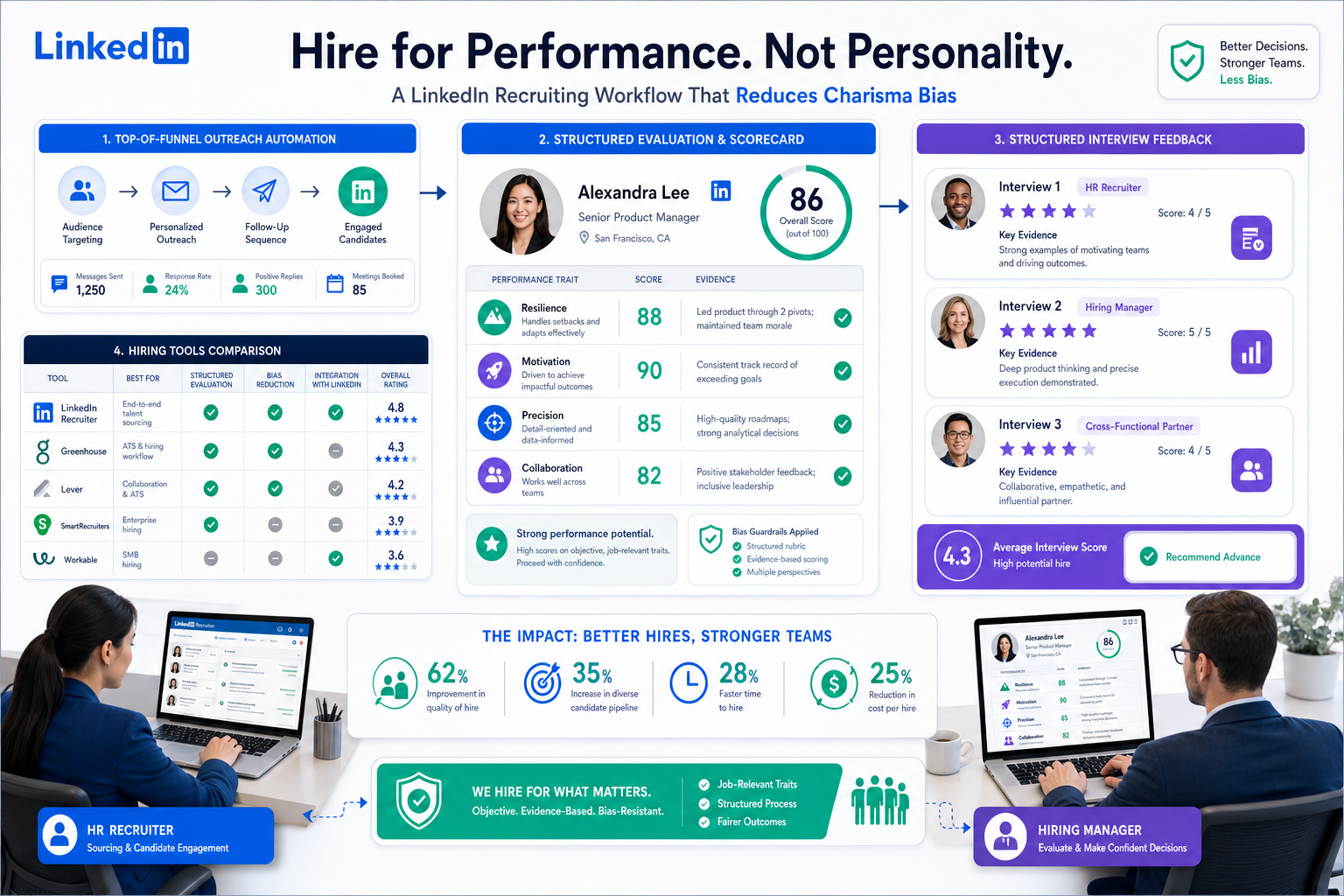
This article helps hiring leaders judge hiring tools by whether they reduce charisma bias, improve signal, and avoid costly mis-hires.
That sounds simple until you see where searches actually break down. Recruiters lose time chasing resumes without enough signal, hiring managers drift toward the most polished interview presence, and smaller firms pay for every delay twice: once in productivity, and again when a weak hire damages trust with clients, teams, or finance leaders who needed someone dependable rather than merely impressive.
In my own workflow, I have found that StrategyBrain AI Recruiter is most useful when the problem is repetitive outreach and slow candidate response rather than final selection itself. Its always-on messaging, multilingual communication, and automated collection of resumes and contact details can keep the top of funnel moving while recruiters still make the final judgment on fit, resume quality, and whether a candidate should advance.
A useful reminder comes from an older hiring research angle that still holds up: when managers hire for a key finance or accounting role, likeability can distract from the traits that actually sustain performance. The better interview conversation is often about resilience, motivation, and how the person handles pressure once they are inside a demanding team, not just how persuasive they sound in a first meeting.
That shift matters because it changes what the best recruiting software should help you do. If your system only stores applicants, it will not protect your process from charisma bias, uneven interviewer feedback, or candidate drop-off before you learn what really matters. The right hiring tools, candidate experience tools, and hiring platforms for small business should make performance-based hiring easier to run, document, and repeat.
- How to evaluate recruiting software beyond ATS labels
- Why performance-trait hiring should shape your workflow
- Which candidate experience tools actually reduce friction
- What hiring platforms for small business need most
- How automation can support recruiters without replacing judgment
Table of Contents
- Start With Decision Quality, Not Feature Volume
- What the Best Recruiting Software Should Actually Do
- Build Hiring Around Performance Traits, Not Charisma
- How to Review Candidate Experience Tools
- What Small Teams Need From Hiring Platforms for Small Business
- Where Automation Helps in Real Recruiting Work
- Integrations, Oversight, and Process Discipline
- A Practical Comparison Framework
- Common Buying Mistakes
- FAQ
Start With Decision Quality, Not Feature Volume
Most teams start shopping for the best recruiting software because hiring feels slow or messy. In practice, the deeper issue is usually decision quality. You may be reviewing too many candidates with too little context, relying on scattered notes, or allowing hiring managers to react to confidence and chemistry instead of evidence.
That is why I rarely begin evaluation with feature checklists alone. I start with a simpler question: will this system help recruiters and hiring managers identify the people who are most likely to perform well after they are hired?
The research framing behind performance traits is useful here. For critical roles, especially in structured functions such as finance, accounting, operations, and other detail-sensitive work, strong hiring processes look past personal polish and get clearer on what the team actually values. Software should reinforce that discipline, not weaken it.
What the Best Recruiting Software Should Actually Do
Recruiting software is a broad category of hiring tools used to manage job posting, candidate flow, communication, evaluation, scheduling, collaboration, and reporting. In many organizations, an applicant tracking system is the workflow core, but the best recruiting software usually extends further into candidate communication, analytics, and operational visibility.
That distinction matters because an ATS can keep records without materially improving the way your team hires. Better systems support three outcomes at once:
- Cleaner process control: recruiters know where each candidate stands and what the next action is.
- Stronger interviewer discipline: hiring managers give structured feedback against agreed criteria.
- Better candidate flow: applicants get timely communication and less avoidable friction.
If your current process depends on inbox memory, spreadsheets, and side conversations, then the value of new hiring tools is not just organization. It is the ability to turn hiring into a repeatable operating system.
| Category | Main Focus | Why Buyers Care |
|---|---|---|
| Applicant Tracking System | Stages, records, workflow control | Creates structure and a source of truth |
| Recruiting Software | End-to-end hiring operations | Improves coordination, speed, and visibility |
| Candidate Experience Tools | Apply flow, communication, scheduling, branding | Protects conversion and employer perception |
| Hiring Platforms for Small Business | Fast setup, practical usability, low admin load | Helps lean teams get value quickly |
Build Hiring Around Performance Traits, Not Charisma
One of the most useful lessons from hiring research is that interviewers often overweight personality and likeability, especially when they are under pressure to fill a key role. That is understandable, but it is risky. A smooth interview does not tell you enough about stamina, motivation, consistency, or how someone will operate when expectations rise.
For me, this is where the best recruiting software earns its place. It should help interviewers capture evidence around performance traits rather than just impressions. That can show up in several practical ways:
- Structured scorecards tied to role requirements
- Interview kits that push managers toward consistent questions
- Stage-specific feedback forms instead of open-ended email commentary
- Shared visibility into what the team values most and least
- Reporting that shows where decisions stall or become inconsistent
The original research lens was especially relevant for hiring managers and interviewers who needed to understand which traits senior leaders valued most. That same logic applies to software selection today. If the tool does not make your evaluation criteria visible and repeatable, it will not meaningfully improve hiring decisions.
Practical takeaway: The strongest recruiting software does not just help you process candidates faster. It helps your team interview for evidence of performance.
That also shapes how recruiters should brief hiring managers. Before opening a requisition, align on the traits that matter in the real role. Are you looking for resilience in a high-change environment? Motivation in a lean team? Precision under deadline pressure? Once those answers are clear, the software can support the process. Without that alignment, even a polished platform becomes a storage layer for weak decisions.
Three workflow moments where this matters most
The performance-trait lens is not abstract. It affects at least three recurring recruiting moments:
- Intake: define what the business actually needs, not just a recycled job description.
- Interview design: ask questions that reveal how the candidate performs under real conditions.
- Final debrief: compare evidence against role-critical traits, not just confidence in the room.
When hiring tools support those steps well, recruiters are less likely to advance candidates who interview well but fit the role poorly.
How to Review Candidate Experience Tools
Candidate experience tools matter because good evaluation only works if the right candidates stay engaged long enough to complete the process. Teams sometimes separate internal hiring quality from candidate experience, but in practice the two are connected. A vague, slow, or repetitive process makes it harder to assess the very traits you care about.
When reviewing candidate experience tools, I focus on whether they support clarity and momentum:
Career site and role presentation
Candidates should understand the role, expectations, and process without digging through jargon. This is especially important when you are hiring for positions where motivation and resilience matter. Strong applicants want to know what they are stepping into.
Application flow
If the application is long, duplicative, or clumsy on mobile, candidate quality in your funnel can fall before screening even starts. Good hiring tools reduce avoidable friction.
Scheduling
Interview scheduling is one of the fastest ways to signal professionalism. Delays and unnecessary back-and-forth create doubt, especially in competitive markets.
Communication updates
Silence pushes candidates to assume the process lacks coordination. Systems should make it easy to send useful updates without turning every message into a template-heavy, impersonal exchange.
Feedback loops
Some of the best recruiting software also helps teams gather light process feedback from candidates. That can reveal where confusion, delay, or poor handoffs are hurting completion rates.
| Candidate Experience Area | What to Check | Why It Matters |
|---|---|---|
| Career site | Clarity, credibility, mobile usability | Shapes the first serious impression |
| Application flow | Duplicate steps, resume parsing, speed | Reduces drop-off |
| Scheduling | Coordination tools, reminders, visibility | Keeps momentum high |
| Communication | Status updates, templates, personalization | Builds candidate trust |
| Feedback | Surveys or checkpoints after stages | Shows where the process is breaking |
What Small Teams Need From Hiring Platforms for Small Business
Small companies usually do not need the deepest platform on the market. They need software that keeps the process disciplined without forcing enterprise-level overhead on a lean team. That is why buyers looking at hiring platforms for small business should weight usability more heavily than raw feature count.
In small firms, the hiring team may include a founder, an HR generalist, a recruiter, and a few busy department leaders. If the system is hard to adopt, manager participation slips and feedback quality drops. Then the same charisma bias returns, just inside a nicer interface.
For smaller buyers, the best recruiting software usually offers:
- Fast setup without a heavy implementation project
- Simple stage design and scorecard configuration
- Easy job posting and candidate tracking
- Manager-friendly feedback workflows
- Clear reporting on bottlenecks and stage conversion
- Practical integrations with the systems already in place
This is one reason small teams often benefit from candidate experience tools that are built into broader hiring tools. They need one system that helps with communication, scheduling, and stage control, rather than a patchwork of disconnected apps.
Where Automation Helps in Real Recruiting Work
Automation is most helpful when it removes repetitive admin while leaving final judgment with the recruiter. That is the standard I use when reviewing sourcing and outreach workflows, especially on LinkedIn-heavy searches.
I have used AI Recruiter in situations where top-of-funnel communication was slowing down search momentum. The value was not in outsourcing hiring decisions. It was in keeping candidate contact active outside normal working hours, handling early back-and-forth more consistently, and collecting resumes or contact information from interested prospects so I could focus on actual evaluation.
In that sense, StrategyBrain fit best as a workflow support layer for repetitive sourcing communication. The capabilities that mattered most in practice were:
- Automated candidate outreach and reply handling on LinkedIn-style workflows
- 24/7 multilingual communication for candidates across time zones
- Resume and contact capture from interested candidates for recruiter review
I would still never hand over final screening logic or hiring judgment. The recruiter has to review the resume, test for the right performance traits, and decide whether the person belongs in the process. But when outreach volume is high, automating those first repetitive steps can keep strong candidates from going cold before a human recruiter gets to them.
That support matters even more when your opening problem is not lack of applicants, but lack of signal. If the system can move routine communication forward quickly, recruiters gain more time to design better interviews and collect better evidence from hiring managers.
Integrations, Oversight, and Process Discipline
One common mistake in software selection is treating integrations as a technical afterthought. In reality, they determine whether your process remains coherent from sourcing through offer acceptance.
Before you choose among hiring tools, confirm how the system connects to the workflows your team actually uses:
- Job boards: for simpler role distribution and less duplicate posting work
- Calendar and scheduling tools: to reduce coordination friction
- HRIS or onboarding systems: for a cleaner handoff after acceptance
- Candidate communication tools: to centralize status and outreach history
- Assessment or interview feedback tools: if you rely on more structured evaluation
Governance matters just as much. If your platform includes automation or AI-supported messaging, define who reviews outputs, where candidate records live, and how final decisions are documented. Good recruiting software should make your process easier to explain, not harder.
A Practical Comparison Framework
If you are comparing the best recruiting software, use a scorecard tied to your actual hiring process.
| Evaluation Area | What Good Looks Like | Why It Matters |
|---|---|---|
| Core workflow | Clear stages, easy tracking, visible ownership | Creates process discipline |
| Performance-trait support | Structured scorecards and feedback prompts | Improves decision quality |
| Candidate experience | Smooth apply flow and timely updates | Protects engagement and conversion |
| Manager usability | Simple review and feedback workflows | Increases adoption |
| Automation | Reduces repetitive work without hiding logic | Saves time while preserving oversight |
| Integrations | Fits your current hiring stack | Prevents duplicate work |
| Implementation fit | Realistic setup effort and support | Reduces rollout risk |
| Cost clarity | Easy-to-understand pricing model | Helps budget planning |
Questions worth asking in demos
- How does this system help us evaluate performance traits consistently?
- Can hiring managers give structured feedback quickly?
- Where does candidate communication become easier immediately?
- What repetitive recruiter work can be automated safely?
- What still depends on human review and judgment?
- Will this work for our team size, or is it too heavy for daily use?
Common Buying Mistakes
Confusing volume management with better hiring
Software can help you process more applicants without helping you choose better people. If the platform does not improve evaluation quality, the funnel just gets wider.
Letting interview charisma drive decisions
This is the core lesson from the research thread behind this article. Teams often overvalue polish and underweight resilience, motivation, and role-specific behavior under pressure.
Ignoring candidate experience tools
If scheduling, communication, or apply flow are weak, your process loses strong candidates before meaningful evaluation happens.
Buying too much software for a small team
Many hiring platforms for small business fail because they are too complex to maintain consistently.
Overtrusting automation
Automation should help with outreach, follow-up, and admin. It should not replace recruiter judgment, resume review, or the final decision on fit.
FAQ
What is the best recruiting software for most teams?
The best recruiting software is the platform that matches your hiring volume, team structure, and evaluation discipline. In practice, the strongest systems combine ATS control, hiring-manager usability, candidate experience tools, and enough reporting to improve decision quality.
How is recruiting software different from an ATS?
An ATS is usually the core record and stage-tracking system. Recruiting software is often broader, adding communication, scheduling, analytics, integrations, and workflow support across the full hiring process.
Why do candidate experience tools matter so much?
They affect whether qualified candidates stay engaged. Clear communication, easy scheduling, and a smooth apply flow reduce drop-off and improve how candidates perceive your process.
What should hiring platforms for small business prioritize?
Small teams should prioritize fast setup, simple workflows, easy manager adoption, and low admin overhead. Practical usability usually matters more than enterprise-level customization.
Can automation improve recruiting without reducing quality?
Yes, when it handles repetitive tasks like outreach, follow-up, and scheduling support while recruiters retain control over screening, interview design, and final decisions.
How should recruiters use AI-supported outreach tools?
Use them to maintain candidate communication and reduce manual admin, especially in high-volume or time-zone-spread searches. Recruiters should still review resumes, assess fit, and decide who advances.
Conclusion
The best recruiting software is not just a faster database. It is a set of hiring tools that helps recruiters and hiring managers make better decisions, especially when the risk is mistaking likeability for lasting performance.
If you are evaluating candidate experience tools or hiring platforms for small business, start with the process you want to protect: clear criteria, structured feedback, smooth candidate communication, and enough operational support to keep the funnel moving. Then choose software that reinforces those habits every day.
That is ultimately where good systems create value: less admin, better visibility, stronger interviewer discipline, and a hiring process that gives performance traits a fair chance to surface.