This article helps staffing leaders judge which ai recruiting tool reduces underprepared interviews through better prep and handoff.
That matters because interview quality rarely breaks down inside the interview itself. It usually breaks earlier, when outreach is generic, candidate context is scattered, follow-up is delayed, and no one has a reliable record of what the candidate already asked, learned, or signaled. For a solo recruiter, that means wasted sourcing hours and lower reply quality. For a staffing owner, it means fewer submittable candidates and less predictable desk output. For an in-house recruiter, it means hiring managers meeting candidates who are interested in the role but not fully prepared for the conversation that follows.
One way I have reduced that friction is by using StrategyBrain AI Recruiter to handle the repetitive front end of LinkedIn outreach, follow-up, and after-hours candidate replies. In practice, the most useful parts were not flashy claims but simple workflow support: it kept conversations moving across time zones, collected resumes and contact details from interested candidates, and helped maintain continuity before the recruiter stepped in. The recruiter still owns resume review, qualification depth, and whether the person should advance, but the handoff becomes much cleaner.
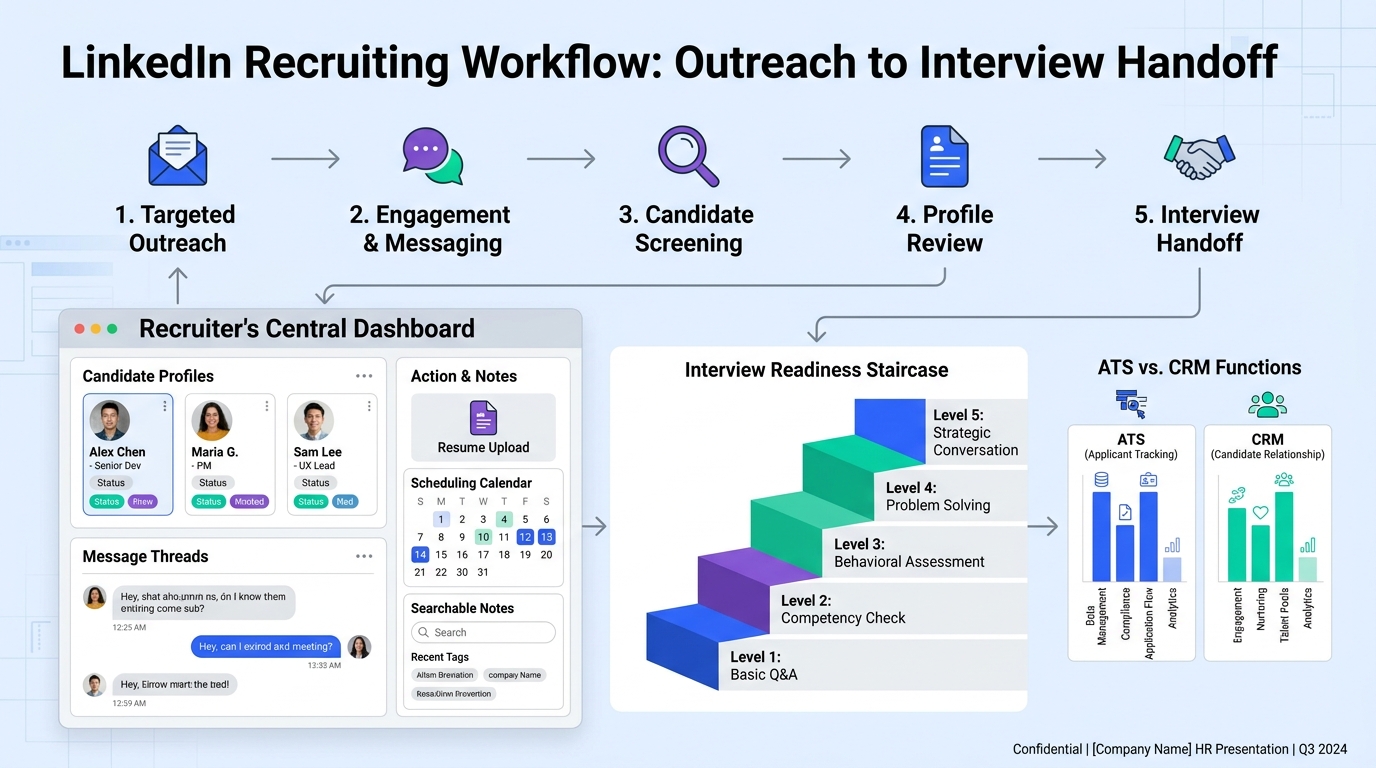
The interview framework that changed how I think about recruiting software did not start with software at all. It started with a simple observation: interviews rise in quality by levels. At the most basic level, the conversation is just question and answer, with the hiring manager doing the heavy lifting. At the next level, both sides have done their homework and the discussion gets sharper. Then the candidate shows knowledge of the market and competitors. By the time the conversation reaches the highest levels, the candidate is not only answering well but asking the kind of questions that make the employer stop, think, and start selling the opportunity back.
That progression exposes a software problem most teams miss. If your system cannot support stronger preparation before the interview, better rediscovery from your database, and cleaner candidate communication before the handoff, you are not really choosing the best recruiting software at all. You are choosing how often your recruiters will send underprepared people into interviews. That is why this article looks at the best recruiting software through the lens of interview readiness, talent acquisition tools, and what a real crm for staffing agency workflows should do before, during, and after candidate conversations.
Key takeaway: The best recruiting software does more than track applicants. It improves the quality of candidate preparation, recruiter follow-up, and interview context so conversations move from basic screening toward stronger, more informed interviews.
Table of Contents
- Why interview quality should shape software choice
- ATS vs recruiting CRM vs talent acquisition suite
- What an AI recruiting tool should actually do
- Using the five-level interview lens to evaluate software
- Best recruiting software by team type and hiring model
- How to compare the best recruiting software
- Must-have features and applicant tracking system benefits
- Implementation considerations before you buy
- Common mistakes buyers make
- FAQ
Why interview quality should shape software choice
Most software evaluations focus on features, pricing structure, integrations, or workflow labels such as ATS, CRM, and sourcing automation. Those matter, but they do not always reveal whether the system helps recruiters produce better candidate conversations. In day-to-day recruiting, that is the difference between moving names through stages and actually generating hires.
When candidates enter interviews at a basic, low-context level, the recruiter has usually lost leverage earlier in the process. Maybe the outreach was too broad. Maybe the candidate never received enough context to understand the opportunity. Maybe the notes from the first conversation never made it into the system. Maybe a promising person from six months ago was buried in the database and never re-engaged. These are not just interview issues. They are recruiting software issues.
That is also why the advantages of applicant tracking system discipline still matter. Good applicant tracking system benefits include process visibility, stage control, and cleaner handoffs. But in modern recruiting, process control by itself is not enough. You also need the relationship layer that helps a candidate arrive informed, interested, and ready for a stronger conversation.
For staffing firms, this challenge is even more visible. A recruiter might source well, but if the crm for staffing agency side is weak, client context and candidate context drift apart. The result is familiar: rushed briefing calls, duplicated outreach, poor rediscovery, and interviews that stay stuck at the most basic question-and-answer level.
ATS vs recruiting CRM vs talent acquisition suite
One of the most useful ways to evaluate an ai recruiting tool is to first understand what job the underlying platform is supposed to do. Buyers often blur these categories together, but each one shapes interview readiness in a different way.
| Category | Main Purpose | Best For | Where It Helps Most | Where It Can Fall Short |
|---|---|---|---|---|
| Applicant Tracking System | Manage active candidates inside structured hiring workflows | Internal hiring teams and process-heavy recruiting | Stages, interview coordination, approvals, compliance | Often weaker for long-term candidate nurturing |
| Recruitment CRM | Manage relationships before and between active openings | Proactive sourcing and warm pipeline building | Outreach, follow-up, rediscovery, talent pools | May need ATS support for deeper process control |
| Talent Acquisition Suite | Combine ATS, CRM, analytics, and automation | Teams reducing tool sprawl | Unified visibility across recruiting workflows | Can be heavier to implement and govern |
| Agency-Native CRM | Blend recruiting, sales, and account activity | Staffing and search firms | Clients, jobs, candidates, submissions, placements | May include complexity internal HR teams do not need |
If your goal is better interview quality, an ATS helps by creating structure around who is in process, what stage they are in, and what feedback has been captured. That supports consistency. But if your candidates are arriving underprepared or going cold between first contact and interview, you need CRM capabilities too.
For internal talent teams, many of the best talent acquisition tools are the ones that connect sourcing, scheduling, feedback, and rediscovery. For agencies, the requirement is broader. A true crm for staffing agency use cases must preserve the relationship history on both sides of the desk, not just candidate status.
That overlap is why many teams now shop for the best recruiting software as a blended category. They want ATS discipline, CRM memory, and automation that shortens the gap between first outreach and a well-prepared interview.
What an AI recruiting tool should actually do
The phrase ai recruiting tool gets used so loosely that it can hide weak workflow design. In practical recruiting terms, the best AI support is not abstract intelligence. It is useful help in the places recruiters lose time and candidates lose momentum.
When I test recruiting software, I look for AI that improves six parts of the workflow:
- Sourcing support: helping find likely-fit people faster
- Matching and ranking: surfacing relevant candidates from current and past pipelines
- Outreach automation: keeping early communication moving without sounding robotic
- Scheduling: reducing coordination drag before interviews
- Note capture: preserving context from messages and calls
- Database rediscovery: bringing previously known talent back into view
In my own LinkedIn-heavy workflows, AI Recruiter was most useful when candidate replies came in after hours or from different regions. Instead of waking up to broken threads and missed momentum, I had ongoing communication, cleaner interest signals, and collected resumes waiting for review. That did not replace recruiter judgment. It protected it by making sure the recruiter entered the next step with more context and less admin clutter.
That distinction matters. A good AI layer should not decide who gets hired. It should make it easier for recruiters to run thoughtful searches, maintain candidate rhythm, and send better-prepared people into real conversations.
Using the five-level interview lens to evaluate software
The reference framework on interview quality is surprisingly useful for software selection because it shows where recruiting systems either support or weaken candidate readiness.
Level 0: Basic question-and-answer interviews
At this level, the hiring manager carries the conversation. The candidate knows the job title and a few basics, but the discussion depends heavily on the interviewer to create substance. If too many of your interviews feel like this, your system may be failing earlier in the funnel by not supporting candidate briefing, clean note capture, or timely recruiter follow-up.
Level 1: Both sides have done research
This is where better software starts to show value. A recruiter can share stronger context, preserve prior interaction history, and keep communication active long enough for the candidate to arrive informed. Strong applicant tracking system benefits matter here because the workflow around scheduling, stage updates, and preparation becomes more consistent.
Level 2: The candidate understands the market
When a candidate can discuss market conditions, competitor realities, or where the role fits, the recruiter has usually done a better job of framing the opportunity. Software helps when it centralizes job details, keeps outreach relevant, and gives recruiters enough visibility to personalize the conversation rather than restarting it every time.
Level 3: The conversation becomes more strategic
At this point, the candidate is not just responding well. They are asking sharper questions and changing the quality of the discussion. Systems that support this level tend to be strong at relationship history, rediscovery, and recruiter notes because they help the recruiter position the opportunity with more nuance before the interview ever starts.
Level 4: The candidate starts evaluating the employer
This is not a software-generated outcome, but good software can make it easier to create the conditions for it. Candidates who arrive at this level often had stronger prep, more complete context, and better communication all the way through. That is why the best recruiting software should be judged partly by whether it helps your team produce richer interviews, not just faster workflows.
Each level builds on the one before it. In the same way, software value compounds when sourcing, messaging, scheduling, and recordkeeping work together. Teams that only evaluate features in isolation often miss that bigger operational truth.
Best recruiting software by team type and hiring model
The best recruiting software depends heavily on who is hiring and how the work is structured.
Best for internal talent acquisition teams
Internal TA teams usually need clear requisition control, manager collaboration, interview coordination, and approval paths. The right applicant tracking system for recruiters should support those basics while also helping candidates arrive with enough context to have stronger interviews.
For these teams, useful talent acquisition tools usually prioritize:
- Requisition and stage management
- Interview scheduling and scorecards
- Candidate relationship tracking
- Rediscovery from prior applicants
- Automation that reduces admin without confusing hiring managers
If interview quality is a concern, test the platform with a real hiring sequence. Ask how the recruiter briefs the candidate, how notes are preserved, and how a hiring manager sees relevant context before the meeting.
Best for staffing agencies and search firms
Agency needs are different. A strong crm for staffing agency setup has to support recruiter activity, client history, candidate ownership, submissions, placements, and desk reporting. If those records are fragmented, candidate preparation suffers because recruiters spend too much time rebuilding context from email, LinkedIn, and spreadsheets.
In agency settings, I have found that AI support is most useful on repetitive LinkedIn sourcing and follow-up work. That is where StrategyBrain AI Recruiter fit well alongside a broader CRM workflow: it helped keep outreach active, handled multilingual communication when needed, and captured resumes from interested candidates while I focused on shortlist judgment and client calibration.
Agency leaders should look closely at:
- Shared visibility across sales and recruiting
- Submission and placement workflow
- Client and candidate activity history
- Reporting by recruiter, account, and job
- AI support for outreach without losing human control of qualification
Best for firms consolidating multiple tools
Some teams are not buying their first platform. They are cleaning up a stack that grew too messy. In those cases, a unified suite can help if recruiters are constantly switching between ATS records, sourcing trackers, LinkedIn messages, scheduling links, and personal notes.
The key question is whether consolidation improves the handoff into stronger interviews. If not, you may just be centralizing clutter.
How to compare the best recruiting software
If you want a practical evaluation process, compare software according to the real moments where recruiting quality rises or falls.
| Evaluation Area | What to Review | Why It Matters |
|---|---|---|
| Team fit | Internal TA, staffing, executive search, high-volume hiring | Prevents buying the wrong category |
| Workflow fit | Sourcing, pipeline movement, interviews, submissions, offers | Shows whether users can stay inside one system |
| AI usefulness | Matching, outreach, scheduling, note capture, rediscovery | Tests whether the AI recruiting tool saves real recruiter time |
| Interview readiness support | Candidate context, reminders, notes, briefing continuity | Improves conversation quality before live interviews |
| Reporting fit | Pipeline health, recruiter activity, placements, hiring velocity | Ensures leaders can manage performance |
| Implementation fit | Migration, training, permissions, integrations | Reduces rollout pain and adoption risk |
In demos, ask vendors to show a realistic path from first contact to interview. Do not just ask how candidates are stored. Ask how context is preserved, how outreach is tracked, how rediscovery works, and what the recruiter sees before handing a candidate to a client or hiring manager.
Also force tradeoffs into the conversation. Some systems are strong at ATS structure but weak on proactive relationship management. Others are better as a recruiting CRM but less disciplined in formal process control. Mature buyers identify those limits early.
Must-have features and applicant tracking system benefits
Regardless of category, the best recruiting software should solve a few core execution problems.
1. Structured pipeline management
This remains one of the clearest advantages of applicant tracking system software. Recruiters need visible stages, ownership, and bottleneck tracking. Without that, interview prep gets inconsistent because nobody is sure what happened in the last touchpoint.
2. Relationship management and rediscovery
A modern recruitment CRM should make it easy to revisit silver medalists, prior applicants, referrals, and passive talent. This is one of the strongest use cases for an ai recruiting tool, especially when it can surface overlooked candidates from your existing database.
3. Communication and outreach automation
Outreach should support cadence and follow-up without making communication feel generic. In practice, this is one place where AI Recruiter can help by carrying the repetitive early messaging load on LinkedIn while the recruiter stays responsible for evaluation and final next steps.
4. Scheduling and coordination
Interview quality often suffers when scheduling drags on and candidates lose context or motivation. Automation here is not glamorous, but it protects conversion.
5. Notes, feedback, and searchable records
Searchable notes improve handoffs, rediscovery, and candidate briefing. Without them, every interview starts colder than it should.
6. Reporting tied to operating goals
For internal teams, that may mean stage movement and source quality. For agencies, it often means submissions, placements, recruiter activity, and account-level output. A serious crm for staffing agency environment should make those views easy to review.
Implementation considerations before you buy
Even strong software can fail if implementation is weak. Start with migration quality. Candidate records, notes, client history, and communication logs are only useful if they move cleanly into the new platform.
Then review integration behavior. If recruiters spend most of their day in email, calendar tools, sourcing channels, and LinkedIn, the new system needs to support that reality. A disconnected implementation creates more admin and weaker candidate continuity.
Training matters too. The best applicant tracking system for recruiters is not the one with the most features on a slide. It is the one that your team will actually use consistently enough to improve candidate conversations and reporting quality.
Finally, define ownership. Someone should own workflow changes, permissions, automations, reporting definitions, and data hygiene. Without that, even the best talent acquisition tools become noisy systems that degrade over time.
Common mistakes buyers make
Several mistakes come up repeatedly in recruiting software evaluations:
- Buying by label instead of workflow reality. A platform can call itself ATS-first, CRM-first, or AI-first and still fail your actual process.
- Ignoring interview readiness. If the software does not improve candidate prep and recruiter continuity, faster sourcing alone may not help much.
- Overvaluing vague AI language. If the AI does not improve outreach, scheduling, note capture, matching, or rediscovery, it is probably not doing enough.
- Confusing internal and agency needs. A strong internal hiring system may be weak as a crm for staffing agency workflow.
- Skipping real-world scenario tests. Use one active req or one placement workflow in the demo. That reveals fit much faster than a broad feature tour.
- Not protecting recruiter judgment. Automation should reduce repetitive work, not blur responsibility for final evaluation.
The practical fix is to test software against a live recruiting path: first touch, follow-up, resume capture, interview scheduling, candidate briefing, and handoff. If the system breaks that chain, it will break performance later too.
FAQ
What is the difference between an ATS and a recruiting CRM?
An ATS manages candidates in an active hiring process, while a recruiting CRM focuses more on relationship building, outreach, and nurture over time. The best recruiting software often combines both.
Why does interview quality matter when choosing recruiting software?
Because poor interviews often start with weak recruiting workflow before the interview happens. If your software does not support preparation, follow-up, and context sharing, candidate conversations stay shallow.
What makes software suitable as a crm for staffing agency workflows?
It should support clients, candidates, recruiter activity, submissions, placements, and reporting in one operational flow. Agency teams need both relationship history and commercial visibility.
Which AI features actually save recruiters time?
The most useful ones are sourcing support, candidate matching, outreach automation, scheduling, note capture, and database rediscovery. These help reduce repetitive work without replacing recruiter judgment.
Do all-in-one talent acquisition tools always beat a multi-tool stack?
No. They work best when your current stack creates too many handoffs and hidden records. If your existing tools are well integrated and well adopted, a focused stack can still be the better choice.
Conclusion
The best recruiting software is not just the platform with the longest feature list. It is the system that helps your team move candidates from low-context screening toward stronger, more informed interviews. For internal TA teams, that often means ATS discipline plus CRM memory and useful automation. For agencies, it usually means a real crm for staffing agency workflow that supports both candidate and client context. And for teams leaning on LinkedIn outreach, the best ai recruiting tool is the one that keeps conversations moving, captures interest cleanly, and still leaves final judgment with the recruiter.
If you are evaluating options now, map your process from first outreach to final interview. The software that strengthens that chain is far more likely to become the right long-term recruiting system.