See how recruiting leaders can assess ai talent management software to avoid ATS-only gaps that weaken passive-candidate hiring.
That matters because recruiting teams rarely lose searches on sourcing volume alone. They lose when promising people reply late, when outreach lacks continuity, when candidate context lives in scattered inboxes, and when recruiters cannot keep a service-minded process moving across multiple roles at once. For a small search firm owner, that means slower placements and weaker client confidence. For an individual recruiter, it means missed follow-ups and more after-hours admin. For an in-house talent lead, it means hiring managers see activity but not consistent progress.
In my own workflow, one useful way to reduce that friction has been using StrategyBrain AI Recruiter for the repetitive first layer of LinkedIn outreach and candidate response handling. It is most helpful when the bottleneck is keeping conversations alive with passive candidates, replying across time zones, and collecting resumes or contact details without losing momentum. What it does not replace is recruiter judgment. I still review resumes, decide who truly fits, and make the final call on whether someone should move forward.
You can see the underlying problem clearly in specialist recruiting. When a recruiter is trying to identify strong accountants or finance talent, the challenge is not simply finding people with the right keywords on paper. The stronger recruiters tend to stay deeply engaged with the market, offer useful guidance, and build relationships before a search becomes urgent. They know quality because they speak with finance professionals constantly, and they stay connected to people who are already employed but may move if the opportunity is genuinely right.
That same pattern exposes why software selection matters. If your recruiting system is built only to process active applicants, it may support order but not the service posture, passive-candidate relationships, and long-cycle judgment that strong recruiters rely on. That is where the discussion shifts from a basic ATS to broader talent management software and, in some cases, a connected talent development platform that helps teams treat hiring as an ongoing talent relationship instead of a one-time transaction.
- What the best recruiting software means now
- Why service and passive talent still matter
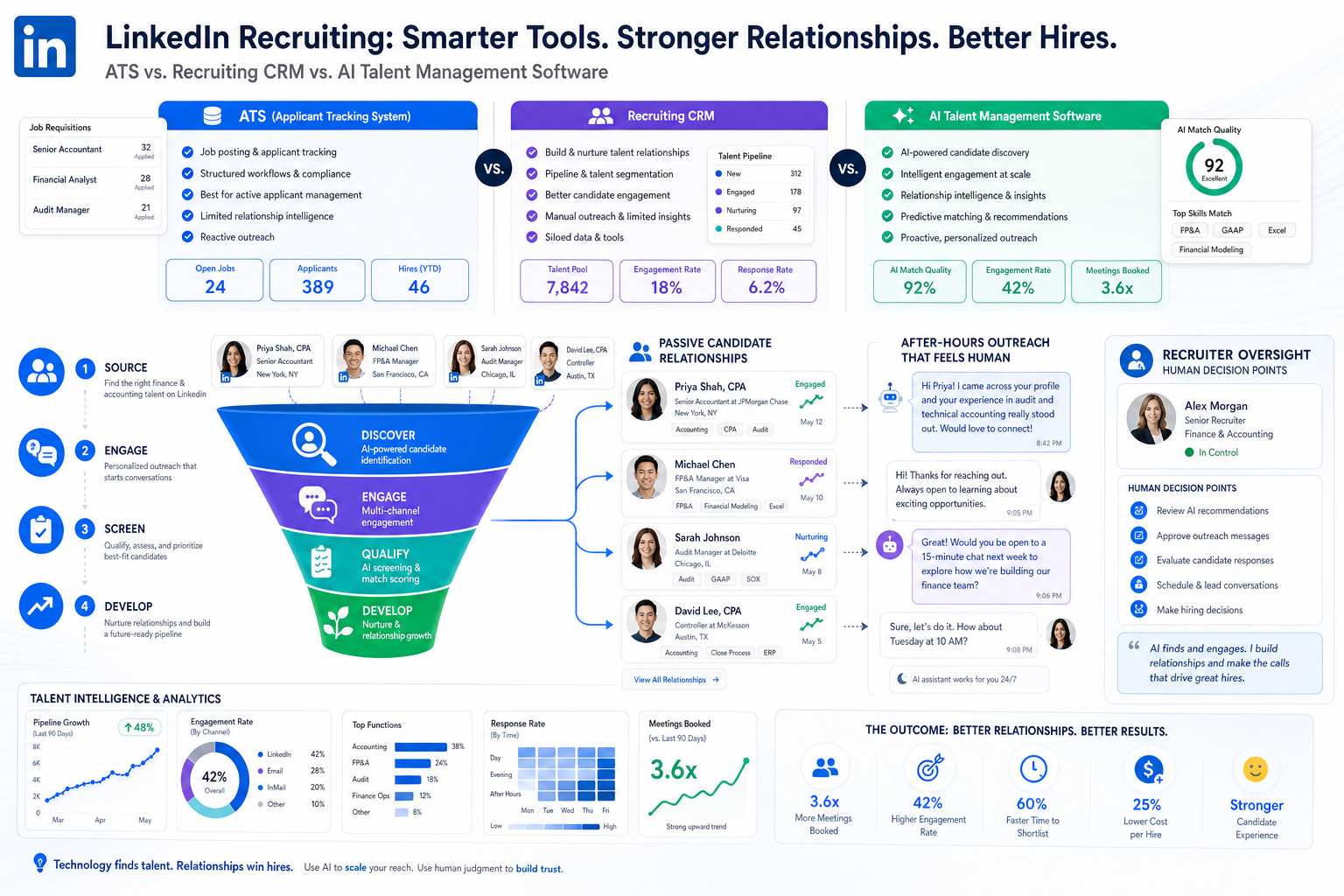
- ATS vs CRM vs AI talent management software
- Quick comparison table
- Features that actually improve recruiter work
- Which teams need which kind of system
- Where ATS benefits start and stop
- Why recruiting and development now connect
- How to evaluate recruiting software well
- Common buying mistakes
- FAQ
What the best recruiting software means now
The best recruiting software in 2026 is not the platform with the longest feature checklist. It is the one that helps a hiring team handle real recruiting pressure: sourcing consistently, responding quickly, tracking candidate quality, supporting manager decisions, and carrying useful talent data beyond the offer stage.
For many teams, that is why ai talent management software has become part of the buying conversation. A standard ATS can bring order to open roles and interview stages. A recruiting CRM can strengthen outreach and pipeline nurturing. But once the business starts asking how hiring connects to onboarding, internal mobility, skills visibility, and development planning, a broader system becomes more relevant.
In practice, the best recruiting software should help you answer four questions:
- Can we manage hiring operations cleanly?
- Can we build relationships with passive talent, not just process applicants?
- Can recruiters and hiring managers make better decisions with the information inside the system?
- Can hiring data support employee growth after someone joins?
If your team cares about the second and fourth questions as much as the first, you are usually comparing more than an ATS. You are looking at a wider talent management software decision.
Why service and passive talent still matter
One of the most overlooked truths in recruiting technology is that good systems should support good recruiter behavior, not just automate steps. The strongest recruiters in specialist markets tend to operate from a posture of service. They help candidates think through opportunities, keep communication clear, and earn trust long before an offer is on the table.
That matters especially when the best prospects are passive. In fields like accounting, finance, engineering, healthcare, or executive hiring, top candidates are often employed and selective. They do not always enter your process through a job ad. They respond because the recruiter communicates well, understands quality, and makes the opportunity feel worth considering.
Software cannot manufacture credibility on its own, but it can make that kind of recruiting easier or harder. If the system only tracks applicants after they apply, it leaves a gap where some of the most valuable recruiting work actually happens.
Practical takeaway: The best recruiting software should support service, continuity, and passive-candidate relationship building, not just stage movement.
That is also why I have found tools like AI Recruiter most useful in sourcing-heavy work. When passive candidates reply after hours or from other regions, consistent follow-up matters. Letting automation handle repetitive introductions, interest checks, and resume collection can preserve momentum, while the recruiter stays focused on fit, nuance, and relationship judgment.
ATS vs CRM vs AI talent management software
Recruiting teams often blur software categories together, but the differences matter because each system solves a different bottleneck.
Applicant tracking system
An ATS is built to manage requisitions, applications, interview stages, feedback, and hiring records. It is usually the operational backbone of structured hiring. For teams relying on spreadsheets and inboxes, the benefits are immediate: clearer workflows, better visibility, cleaner documentation, and less confusion across recruiters and managers.
Recruiting CRM
A recruiting CRM is more focused on candidate relationship management before someone applies. It supports sourcing, segmentation, nurture campaigns, rediscovery, and outreach continuity. If your team wins by engaging passive talent, CRM depth matters more than many first-time buyers expect.
AI talent management software
Ai talent management software sits at a broader level. It may include recruiting workflows, but it also connects hiring with onboarding, learning, performance, skills frameworks, succession planning, career pathing, and internal mobility. This is where hiring starts to become part of a full workforce strategy instead of a standalone function.
Talent development platform
A talent development platform usually focuses on employee growth after hire, but it increasingly influences recruiting decisions too. If your organization wants to hire for long-term capability, not just near-term vacancy coverage, then development systems and recruiting systems need to share more context.
Core HR or HRIS layer
Many organizations also rely on an HRIS as the employee system of record. Some keep recruiting separate; others prefer an integrated setup. The right choice depends on reporting needs, process maturity, and how tightly HR and talent acquisition operate together.
Quick comparison table
| Category | Primary purpose | Best for | Main strengths | Main limitations |
|---|---|---|---|---|
| ATS | Manage applicants and hiring stages | Teams needing process consistency and visibility | Structured workflow, interview tracking, compliance support, stage reporting | Often weaker for passive pipeline building and post-hire talent continuity |
| Recruiting CRM | Build and nurture talent pipelines | Sourcing-heavy teams and search environments | Outreach continuity, relationship history, candidate segmentation, passive talent engagement | May not replace ATS workflow control |
| AI talent management software | Connect hiring with the broader employee lifecycle | Organizations linking hiring to skills, growth, and mobility | Lifecycle visibility, skills-based hiring, workforce alignment, internal mobility support | Usually requires broader stakeholder buy-in and implementation discipline |
| Talent development platform | Support employee learning and growth | Companies investing in long-term capability building | Career pathing, learning alignment, development planning | Recruiting workflow depth may be limited unless connected well |
Features that actually improve recruiter work
Feature lists are easy to overvalue. The better question is which capabilities remove friction in daily recruiting without weakening judgment.
Passive-candidate outreach support
This matters more than many buyer guides admit. If your recruiters spend significant time on outbound sourcing, follow-up cadence, and first-touch messaging, the system should help them sustain those conversations. In my experience, this is where StrategyBrain AI Recruiter can be genuinely practical for LinkedIn-heavy recruiting. It helps keep communication moving, including outside standard working hours, while the recruiter stays in control of qualification.
AI matching and recommendation support
Matching can be useful when it improves prioritization, but it should be understandable and reviewable. Recruiters should be able to see why candidates are surfaced, not just receive a ranked list without context.
Automated screening support
Automation at the screening stage can reduce manual load, especially in high-volume environments. But the software should support recruiter review, not overrule it. The final read on resume quality, transferable experience, and real fit still needs a human decision-maker.
Scheduling automation
Scheduling is not glamorous, but it is one of the clearest productivity wins. Faster scheduling reduces time between steps, lowers drop-off risk, and improves the manager experience.
Conversation continuity and multilingual communication
For teams hiring across regions or time zones, communication continuity becomes operationally important. If candidate replies arrive overnight or in multiple languages, delays can kill momentum. This is one reason AI-assisted recruiter workflows have become more attractive in distributed hiring models.
Analytics that show bottlenecks
The best recruiting software should show more than total applicants and time to fill. Teams need source quality, stage conversion, recruiter workload, manager responsiveness, and passive pipeline health. Broader talent management software may also expose skills gaps and internal mobility indicators.
Compliance and oversight
Any system using AI for screening, ranking, or communication needs transparent controls. Ask what gets logged, what can be reviewed, and where humans retain decision authority.
Which teams need which kind of system
Small search firms and independent recruiters
Smaller recruiting businesses often need two things at once: basic workflow discipline and stronger passive outreach capacity. An ATS creates order, but outbound-heavy work usually benefits from CRM functionality or AI-supported messaging help. If LinkedIn sourcing is central to your desk, support for conversation volume can matter as much as candidate database structure.
In-house teams with moderate hiring volume
Midsize internal talent teams usually hit the point where an ATS alone is no longer enough. They need better reporting, stronger hiring-manager collaboration, and more proactive pipeline building. This is often where the best recruiting software decision becomes less about category labels and more about process gaps.
Enterprise organizations
Large employers often need more than recruiting operations. They need to connect external hiring with internal mobility, performance context, succession planning, and workforce planning. That is where ai talent management software becomes a stronger fit than point solutions.
Skills-driven organizations
If your company is hiring for long-term potential rather than exact background matches, a talent development platform becomes part of the recruiting conversation. The business may want to know which gaps can be trained, which roles can be filled internally, and where external recruiting should focus.
Agency teams serving specialist markets
Recruiters in specialist markets often succeed because they understand quality and maintain live relationships with passive talent. Their software should reinforce that strength. That usually means good search workflow control plus strong candidate relationship management, not just applicant processing.
Where ATS benefits start and stop
The benefits of an ATS are real and often essential:
- Centralized candidate records
- More consistent hiring stages
- Cleaner recruiter and manager coordination
- Better reporting on funnel activity
- More reliable compliance documentation
But this is where many buyers stop thinking too early. An ATS does not automatically help you build trust with passive talent. It does not guarantee service quality. And it rarely carries recruiting insight into career development, learning, or internal mobility without broader platform support.
That gap matters because the strongest recruiters are not only good at processing applicants. They are good at identifying quality, staying active in the market, and maintaining relationships with people who may not be looking today. Software that ignores that reality may improve order while still limiting outcomes.
Why recruiting and development now connect
Hiring and development used to sit in different conversations. Increasingly, they should not. The same business that wants better recruiting usually also wants stronger retention, clearer skills visibility, and more internal movement.
A broader talent management software approach can support that by connecting:
- Skills identified during hiring
- Onboarding and role ramp-up
- Learning and development priorities
- Succession planning
- Internal mobility decisions
This is where a talent development platform becomes strategically relevant to recruiting. If a company understands where internal capability can be built, recruiters can focus external searches more intelligently. If not, the organization may keep overbuying in the market for gaps it could have developed internally.
Key insight: The best recruiting software is often the one that helps your team understand not only who to hire, but also what the business can build after hire.
How to evaluate recruiting software well
Good software selection starts with workflow reality, not demo polish.
- Map how your best recruiters actually work. If they rely on passive relationships, service-minded follow-up, and long-cycle judgment, your software should support those behaviors.
- Identify where searches stall. Is the issue applicant volume, outreach continuity, hiring-manager delay, data fragmentation, or poor post-hire connection?
- Separate sourcing problems from processing problems. An ATS solves different issues than a CRM or broader ai talent management software.
- Test human oversight in AI workflows. Ask where the recruiter remains the decision-maker.
- Review communication support. If your team sources on LinkedIn or across time zones, test how the system handles response speed and follow-up continuity.
- Check post-hire alignment. If internal mobility, skills tracking, or learning matter, assess whether the software links to a broader talent model.
My own rule is simple: if a system improves activity but weakens judgment, it is not the best recruiting software. If it reduces repetitive admin while keeping recruiter control intact, it is worth serious consideration.
That is also the lens I use when applying AI Recruiter conversation workflows in sourcing. The gain is not that AI decides who is best. The gain is that repetitive outreach, first-response handling, and resume collection no longer consume the same amount of recruiter attention, so judgment can move to the work that actually matters.
Common buying mistakes
Buying for workflow theater
Some tools look impressive in demos but do not make everyday recruiting easier. If they complicate outreach, status tracking, or manager collaboration, adoption will fade.
Confusing more automation with better recruiting
Automation helps with repetition. It does not replace market judgment, relationship quality, or recruiter credibility.
Ignoring passive talent realities
If the best candidates are employed and selective, a process built only for active applicants will underperform. This is one of the most common reasons teams outgrow a basic ATS.
Separating recruiting from development entirely
When the business wants to hire for long-term value, development context matters. That is where a talent development platform or broader talent management software can shift the quality of decision-making.
Letting AI recommendations go unexamined
Any recommendation, rank, or screening output should remain reviewable. Recruiters still need to test for quality, fit, and context.
FAQ
What is the best recruiting software for passive candidate hiring?
Usually, it is not an ATS alone. Teams that depend on passive talent often need CRM capability or broader ai talent management software that supports ongoing engagement, communication continuity, and stronger recruiter visibility into relationship history.
How is talent management software different from an ATS?
Talent management software usually goes beyond applicant processing. It can connect hiring with onboarding, performance, learning, succession planning, and internal mobility. An ATS focuses mainly on open jobs and hiring workflow.
When does a talent development platform matter in recruiting?
A talent development platform matters when the organization wants to hire for future capability, not only current vacancies. It helps connect hiring decisions to learning paths, growth planning, and internal mobility.
Can AI recruiting tools replace recruiter judgment?
No. Useful AI tools can reduce repetitive work like outreach, early communication, scheduling, or first-pass organization. Recruiters should still make the final call on resume quality, fit, and next steps.
What should recruiters ask in a software demo?
Ask how the system supports passive talent engagement, what the recruiter can review inside AI-driven workflows, how communication history is tracked, how managers interact with the process, and whether post-hire talent data stays connected.
Is LinkedIn outreach support enough to count as the best recruiting software?
Not by itself. It can be valuable in sourcing-heavy environments, especially when paired with disciplined recruiter review. But the best recruiting software still needs to fit your broader workflow, reporting, and talent strategy.
Conclusion
The best recruiting software is the system that supports how strong recruiters actually win searches. That means more than processing applicants. It means helping teams recognize quality, stay active in the market, build trust with passive candidates, and carry useful talent insight forward after hire.
For some employers, that starts with a solid ATS. For others, it means adding CRM depth or moving toward broader ai talent management software. And for organizations thinking beyond the offer letter, a connected talent development platform can make recruiting decisions smarter over the long run.
If you are evaluating options now, start with this question: does the software only organize hiring, or does it also strengthen the service, judgment, and relationship work that great recruiters depend on? That is usually where the real answer lives.