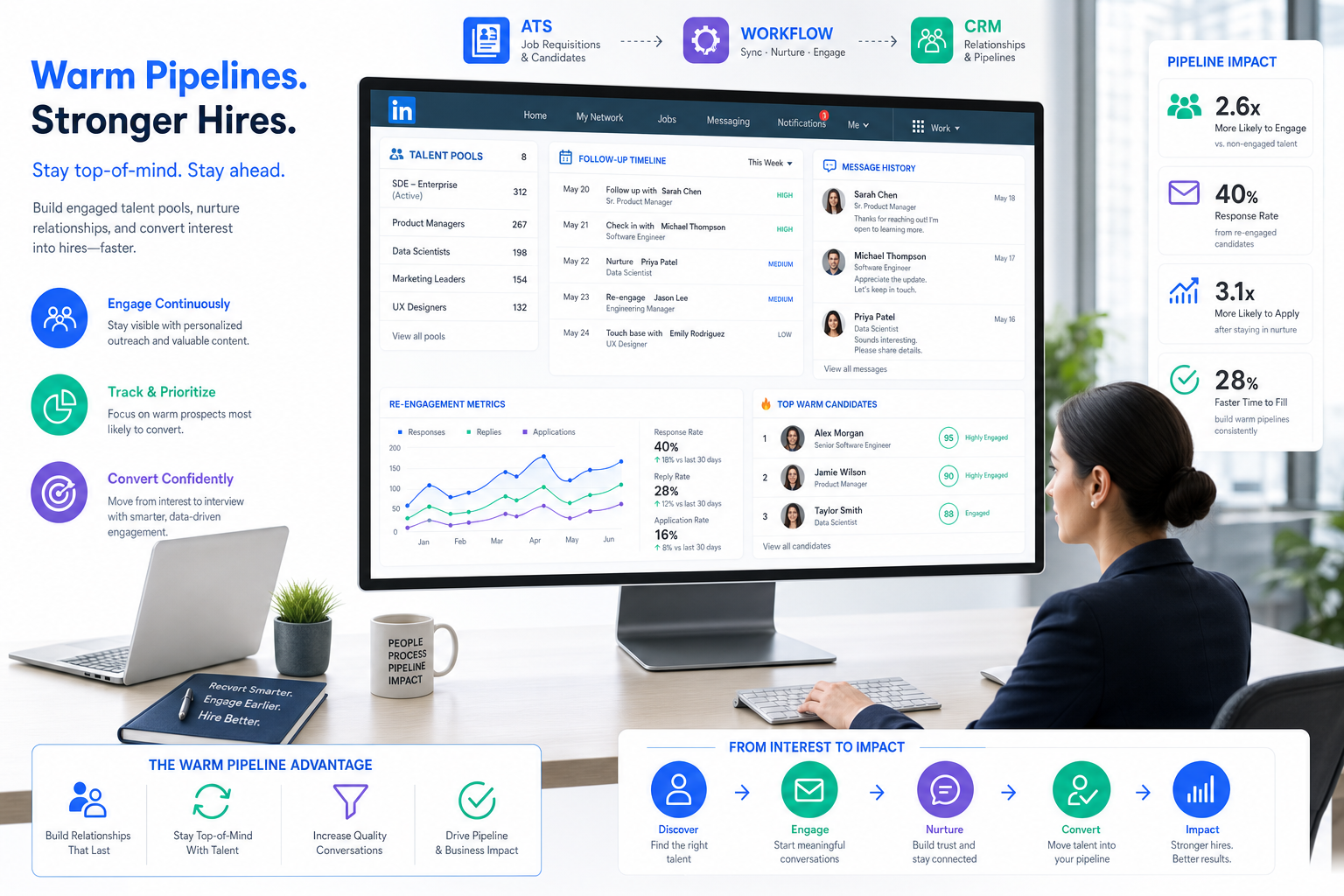
When repeated sourcing and weak follow-up slow hiring, this article helps recruiting leaders evaluate candidate crm options to preserve warm pipelines.
Without that relationship layer, recruiting teams keep repeating the same sourcing work, miss warm candidates who were already engaged, and struggle to maintain trust with hiring managers who expect faster shortlists. For a solo recruiter, that means late-night follow-up and messy notes. For a small agency owner, it means productivity loss across multiple searches. For an in-house talent leader, it often shows up as weak pipeline continuity between one requisition and the next.
In my own workflow, tools like StrategyBrain AI Recruiter have been most useful when the real bottleneck is not judgment but repetitive outreach, after-hours replies, and resume collection. Used carefully, it can keep candidate conversations moving on LinkedIn, respond across time zones, and capture resumes and contact details while the recruiter still handles final fit assessment, shortlist decisions, and the next human step.
That distinction matters because the strongest recruiters are not just process administrators. They act more like relationship builders who can see both the larger hiring plan and the smaller interaction details. In practice, that means understanding why one stakeholder cares about speed, another cares about role clarity, and a high-value prospect cares about whether this opportunity fits a longer career direction. The recruiting work breaks down when those signals live in separate inboxes, spreadsheets, and recruiter memory.
Once you look at recruiting that way, the software question changes. The issue is no longer just whether an applicant tracking system for recruiters can move applicants through stages. It becomes whether your candidate crm, your search process, and your outreach tools can support the kind of relationship-building, accountability, and forward planning that modern hiring actually requires. That is exactly where candidate relationship management tools and the best candidate relationship management software deserve a closer look.
Table of Contents
- Why Candidate CRM Matters in Modern Recruiting
- The Relationship-Builder Framework for Software Selection
- Candidate CRM vs ATS: Where Each One Wins
- Best Recruiting Software Types for Candidate CRM Needs
- Features That Matter Most in Candidate Relationship Management Tools
- Standalone Candidate CRM or ATS-Plus-CRM Suite?
- How to Evaluate the Best Candidate Relationship Management Software
- My Workflow Experience Using AI Support With Candidate CRM
- Common Buying Mistakes Recruiting Teams Make
- FAQ
Why Candidate CRM Matters in Modern Recruiting
If you are searching for the best recruiting software, it helps to separate applicant management from relationship management. Most recruiting teams already understand the operational value of an ATS: track openings, move applicants through stages, document interviews, and preserve compliance. What often remains underbuilt is the system that helps you stay connected to people before they apply, after they withdraw, or long after a role closes.
A candidate crm is built for that missing layer. It helps recruiters source, segment, nurture, and re-engage talent over time instead of treating every search as a fresh start. You will also hear the category described as recruitment CRM or talent CRM, but the practical question is always the same: can your team build relationships that stay useful beyond a single requisition?
That is why candidate relationship management tools matter most for teams with recurring hiring, niche roles, event-driven lead capture, alumni pipelines, and silver medalist rediscovery. They give recruiters a structured way to remember context, continue conversations, and act on future-fit talent without depending on personal inboxes or memory.
The Relationship-Builder Framework for Software Selection
One of the most useful ways to evaluate recruiting technology is to borrow a lesson from strong people leadership: the best operators combine relationship-building, example-setting, and forward thinking. That logic translates surprisingly well to software selection.
1. Relationship-building
Great recruiters need software that supports collaboration with candidates, hiring managers, and internal teams. The right candidate crm should make communication history visible, allow practical segmentation, and help recruiters tailor outreach without losing speed. If your system makes every interaction feel isolated, recruiter credibility drops quickly.
2. Process accountability
Strong recruiting teams do not rely on good intentions alone. They need workflows that encourage note discipline, clear ownership, and accurate handoffs from outreach to application to interview. The best recruiting software supports that behavior by design rather than forcing teams to patch together spreadsheets and reminders.
3. Forward planning
The most valuable candidate relationship management tools are not just reactive. They help teams think beyond this week's openings and connect current outreach to future hiring goals. That larger view matters when leadership asks not only who can fill a role today, but what pipeline health will look like next quarter.
Practical takeaway: If a platform helps your recruiters build trust, document decisions clearly, and maintain future-ready talent pools, it is much closer to the real definition of the best candidate relationship management software than a feature-heavy tool that nobody adopts.
Candidate CRM vs ATS: Where Each One Wins
A common buying mistake is assuming an ATS and a candidate CRM are interchangeable. They are not. The best recruiting software often combines both, but each solves a different recruiting problem.
| Category | Primary Job | Best Use Case | Main Users |
|---|---|---|---|
| Applicant Tracking System for Recruiters | Manage active applicants through hiring stages | Job posting, screening, interviews, compliance | Recruiters, coordinators, hiring managers |
| Candidate CRM | Build and maintain relationships with talent over time | Sourcing, nurture campaigns, talent pools, re-engagement | Sourcers, recruiters, recruiting ops, talent marketing |
The applicant tracking system benefits are process control, visibility, and consistency once someone enters an active hiring flow. A candidate crm becomes more valuable before that point and between hiring cycles. It supports passive talent, event leads, previous finalists, referral communities, and future-fit prospects who are not ready to apply today.
Use a simple rule. If your recruiting model begins only after a requisition opens, your ATS may carry most of the load. If your team is expected to shorten time-to-shortlist, preserve past sourcing effort, and keep warm pipelines alive, candidate relationship management tools become strategically important.
Best Recruiting Software Types for Candidate CRM Needs
Buyers looking for the best recruiting software usually face several paths. Rather than focusing on vendor lists, it is more useful to match software type to recruiting motion.
1. Dedicated candidate CRM platforms
These tools are designed primarily for pipelining, segmented outreach, nurture automation, and rediscovery. They are often the best fit for larger in-house talent teams, search firms with repeat specialty hiring, and recruiting operations functions that need deeper control.
- Best for: Proactive hiring teams with recurring roles and long-cycle pipeline work
- Strengths: Better segmentation, stronger nurture workflows, cleaner long-term relationship tracking
- Tradeoffs: More integration planning and process ownership required
2. ATS-plus-CRM suites
These combine applicant tracking and relationship management in one platform. They are often a sensible fit for smaller teams that need simpler administration and one system of record.
- Best for: Lean recruiting teams and mid-market employers
- Strengths: Easier adoption, fewer system handoffs, simpler administration
- Tradeoffs: CRM depth may be limited compared with standalone tools
3. Relationship-first platforms for agency and search workflows
Agency recruiters often need rapid rediscovery, flexible pool search, and recruiter-owned relationship continuity across many clients. Their version of candidate crm typically emphasizes searchability, communication history, and reuse of talent across multiple assignments.
- Best for: Staffing firms, boutique search practices, and executive recruiters
- Strengths: Faster recall of known talent, efficient reuse of sourcing effort
- Tradeoffs: In-house employer brand and campaign features may matter less
4. Talent CRM tools with strong lead capture
Some organizations depend heavily on events, campus recruiting, newsletters, and talent community signups. In those cases, lead capture and segmentation are just as important as search.
- Best for: Campus, high-volume, and employer brand-led recruiting teams
- Strengths: Better event follow-up, stronger top-of-funnel capture, smoother nurture entry
- Tradeoffs: Success depends on clear ownership between recruiting and marketing support
Features That Matter Most in Candidate Relationship Management Tools
In practice, recruiters do not adopt software because of the longest feature list. They adopt tools that help them maintain real relationships while keeping detail accuracy high. That is why the following capabilities matter most when comparing the best candidate relationship management software.
Talent pools and segmentation
A useful candidate crm should make it easy to group people by skill set, geography, seniority, past process status, event source, alumni status, or likely readiness to move. This is the foundation of rediscovery and personalized outreach.
What to test: Can a recruiter quickly find silver medalists from a previous search or event leads tied to a specific role family?
Unified communication history
Recruiters need to see who was contacted, what was discussed, and how the candidate responded. If conversation history is fragmented, relationship quality suffers and duplicate outreach becomes more common.
What to test: Can outreach history be reviewed without bouncing between inboxes, spreadsheets, and browser tabs?
Automation that supports recruiters, not replaces them
Automation is one of the strongest reasons to invest in candidate relationship management tools, but only when it removes repetitive work while preserving recruiter judgment. Follow-up sequences, reminders, and re-engagement workflows should feel usable without requiring a marketing operations background.
What to test: Can the team launch and adjust nurturing without becoming dependent on a technical specialist?
Lead capture from events, forms, and landing pages
If your team hosts webinars, campus sessions, open houses, or talent community campaigns, capture quality matters. A system should route that interest into appropriate pools and trigger the next action reliably.
What to test: Do captured leads flow cleanly into both relationship workflows and ATS workflows?
Analytics that support action
Reporting should show more than top-line activity. It should help recruiters understand which segments respond, which campaigns stall, and where handoffs break down.
What to test: Can reporting improve list quality, follow-up timing, or re-engagement strategy?
ATS integration
Even the best candidate crm becomes frustrating if passive prospects cannot move smoothly into active hiring stages. The handoff from nurture to application should be clear, visible, and low-friction.
What to test: Watch the exact workflow for converting a warm prospect into an applicant record.
Data handling and recruiter trust
Recruiters will only rely on a system they trust. That means contact records should be clear, communication history should be dependable, and privacy expectations should be understandable for the team.
What to test: Does the platform make data ownership, access, and record quality easy to manage?
Standalone Candidate CRM or ATS-Plus-CRM Suite?
This is one of the most important buying decisions in the category. The answer depends less on theory and more on team maturity, process complexity, and hiring rhythm.
Choose standalone candidate CRM software if:
- You hire repeatedly for the same talent segments
- You need strong segmentation and long-cycle nurturing
- You run events, alumni programs, or talent communities at scale
- Your ATS handles workflow control reasonably well but relationship-building poorly
- You have recruiting ops support to manage process design and adoption
Choose an ATS-plus-CRM suite if:
- You want simpler administration and fewer systems
- You have a smaller team with limited ops support
- You need practical relationship features but not complex campaign orchestration
- You value quick rollout and a more unified recruiter experience
- Your hiring motion is mostly active requisitions with some proactive outreach
Depth usually favors standalone tools. Convenience usually favors suites. The best recruiting software for your team is the one that aligns with the way recruiters actually work day to day.
How to Evaluate the Best Candidate Relationship Management Software
If you are running a formal review, use an evaluation process that mirrors real recruiting behavior rather than demo theater. A practical framework usually works best.
- Start with your hiring model. Are you mostly processing applicants, or are you building long-term talent relationships?
- Document current friction. Is the issue repeated sourcing, poor rediscovery, weak follow-up, or disconnected data?
- Check recruiter usability. If daily users resist the workflow, the rollout will stall.
- Test segmentation and recall. The system should help recruiters find relevant people fast.
- Validate communication workflows. Outreach, reminders, and re-engagement should feel practical.
- Observe ATS handoffs. Watch what happens when a passive lead becomes an active applicant.
- Review reporting. Analytics should support action, not just dashboard viewing.
- Clarify ownership. Decide who manages templates, pools, integrations, and process hygiene.
A useful internal lens is to ask whether the platform helps your team do three things better: build stronger relationships, model better process discipline, and plan further ahead. That framing keeps the evaluation anchored in outcomes that matter to recruiting leaders and frontline recruiters alike.
My Workflow Experience Using AI Support With Candidate CRM
In my own recruiting work, I have found that AI support is most valuable when it sits beside a solid candidate crm instead of trying to replace the whole recruiting function. One practical example is using AI Recruiter to keep LinkedIn outreach active outside recruiter working hours while the CRM remains the system for segmentation, notes, and relationship memory.
The specific benefit is operational. When candidates reply late, ask basic role questions, or want to send a resume before a recruiter is back online, that early conversation can continue through StrategyBrain AI Recruiter without leaving every message waiting until the next day. It is especially useful for cross-border recruiting, high-volume outreach windows, and solo desk workflows where follow-up speed often slips first.
What I would not delegate is final decision-making. Resume review, actual qualification against the brief, and whether a candidate should move into shortlist or interview still belong with the recruiter. That division of labor matters. AI can support contact continuity, information capture, and first-response coverage, but recruiter judgment is still what protects quality.
For teams comparing candidate relationship management tools, that experience is a reminder that outreach automation and CRM are related but not identical. One helps keep conversations moving. The other preserves structure, segmentation, and future usability of those conversations. The strongest recruiting setup usually combines both functions deliberately rather than confusing one for the other.
Common Buying Mistakes Recruiting Teams Make
Even experienced teams can get this category wrong. Most failures come from mismatching the tool to the recruiting motion.
- Buying for feature headlines instead of recruiter behavior. If daily workflows feel heavy, adoption falls.
- Assuming the ATS already covers candidate crm well enough. Sometimes it does, but often only at a basic level.
- Ignoring segmentation depth. Weak pool structure leads to generic outreach and poor rediscovery.
- Overlooking relationship continuity. Previous finalists and alumni are often among the best future candidates.
- Underestimating change management. Even strong software needs ownership, standards, and training.
- Separating outreach from record quality. Fast communication is not enough if candidate context cannot be reused later.
One more point from experience: hiring managers often focus on immediate pipeline speed, while recruiting operations focuses on scale and consistency. Good software selection should serve both. That means maintaining applicant tracking system benefits while building a stronger relationship engine behind them.
FAQ
What is candidate relationship management software?
Candidate relationship management software helps recruiters source, segment, nurture, and re-engage talent over time. It is designed for relationship continuity, not just active applicant processing.
How is a candidate CRM different from an ATS?
An ATS manages active applicants through the hiring process. A candidate crm manages longer-term talent relationships before and between live requisitions.
What features matter most in candidate relationship management tools?
The most important features usually include segmentation, searchable talent pools, communication history, automation, lead capture, analytics, and strong ATS integration.
Who benefits most from the best candidate relationship management software?
It is especially useful for teams with recurring hiring, hard-to-fill roles, talent communities, alumni pipelines, and a need to reduce repetitive sourcing.
Should smaller teams buy a standalone CRM or a suite?
Smaller teams often do well with an ATS-plus-CRM suite if they need simplicity. Teams with more mature pipeline strategy or complex segmentation needs often benefit from standalone software.
Can AI tools replace candidate relationship management software?
No. AI can support outreach, response speed, and information capture, but candidate relationship management tools are still needed to structure talent pools, preserve context, and support long-term recruiting strategy.
Conclusion
The search for the best recruiting software should not stop at applicant tracking. If your team wants to build reusable pipelines, improve candidate follow-up, and reduce repeated sourcing work, a strong candidate crm becomes essential.
The best candidate relationship management software is not necessarily the one with the biggest demo. It is the one that helps recruiters build better relationships, maintain better workflow discipline, and think further ahead. When those three elements come together, candidate relationship management tools become less of a nice-to-have and more of a core part of modern recruiting infrastructure.