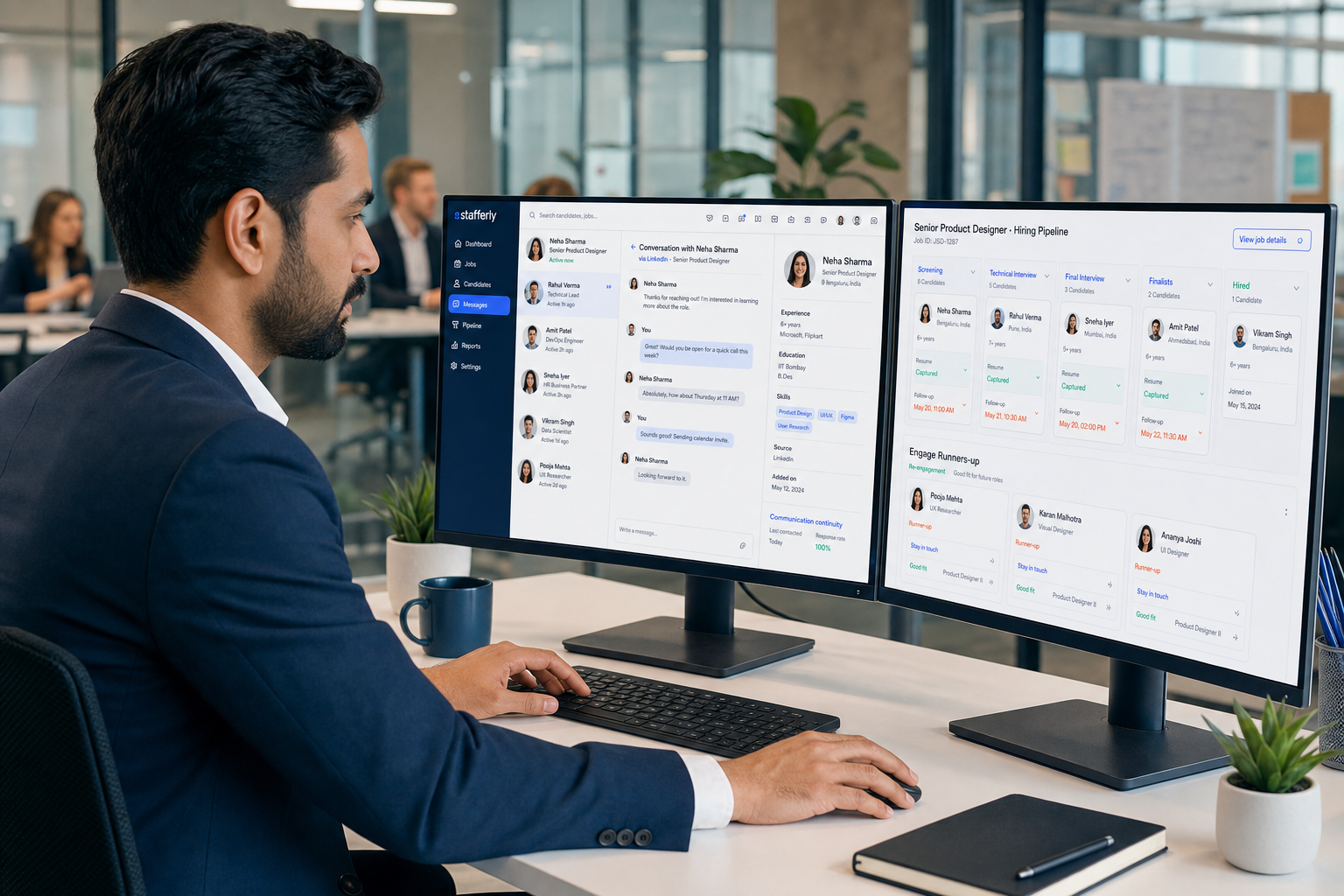
A hire platform choice should help recruiters recover rejected finalists, cut repeat sourcing, and avoid losing warm candidates after close searches.
That matters because many hiring teams lose value after the final interview stage. A recruiter spends time sourcing, qualifying, coordinating feedback, and building trust, only to let runner-up candidates disappear once one offer is accepted. For a solo headhunter, that means wasted relationship equity. For a small agency owner, it means slower future fills and higher sourcing cost. For an in-house talent team, it can damage candidate perception, weaken response rates, and force the team to restart searches that were already close to done.
In my own workflow, I have used StrategyBrain AI Recruiter to reduce that drop-off in the follow-up stage, especially when LinkedIn conversations start well but recruiters cannot keep pace with replies. What helped most was its ability to maintain candidate communication around the clock, continue multilingual outreach where needed, and collect resumes and contact details from interested people without losing the thread. The recruiter still does the actual resume review, judgment, and shortlist decision, but the administrative gap between first interest and next action gets much smaller.
The opening problem is easy to recognize from the candidate side too. Someone reaches the interview round, gets close enough that the team knows their name, and then receives a rejection note because another person was selected. That candidate is not really back at zero. They are already near the end zone of the process: known by the recruiter, recognized by the hiring manager, and potentially relevant again if the new hire leaves or a similar role opens in the next 12 to 18 months.
The practical difference is what happens next. A strong candidate sends a thank-you note, stays connected with the recruiter or hiring manager, follows up with a positive message, and remains visible without becoming pushy. On the recruiting side, that only works if somebody records the interaction, preserves the relationship, and can actually find that person again later. This is where the best recruiting software stops being just a database and becomes a real hire platform and, in many cases, a candidate experience platform that helps teams hire employees online without repeatedly starting from scratch.
Table of Contents
- Why Follow-Up Matters When You Compare Recruiting Software
- What Best Recruiting Software Means Today
- The Core Components of a Modern Hire Platform
- How to Evaluate the Best Recruiting Software
- Why Candidate Experience Should Shape Your Decision
- How Recruiting Software Helps You Hire Employees Online
- How AI, LinkedIn Follow-Up, and Automation Fit In
- Choosing by Company Size and Hiring Complexity
- Common Mistakes Buyers Make
- A Practical Selection Checklist
- FAQ
Why Follow-Up Matters When You Compare Recruiting Software
One of the most overlooked tests of recruiting software is what it helps you do with near-miss candidates. In hiring, rejection is rarely the real end of the story. A meaningful share of new hires do not stay long enough to make the original search feel finished, and similar openings often reappear. When that happens, the recruiter who can re-engage credible runner-up talent has a major operational advantage over the team that has to reopen the market from zero.
That is why I do not evaluate the best recruiting software only by job posting or resume storage. I look at whether the system helps preserve momentum after interviews. Can I keep notes from recruiter screens, manager impressions, and candidate communication in one place? Can I reconnect with a person who was strong but not selected? Can I see who thanked the team, who stayed engaged, and who asked to remain in consideration for future roles?
Those are not edge cases. They are common recruiting realities. A platform that supports follow-up well tends to support the full recruiting process well too.
What Best Recruiting Software Means Today
The phrase best recruiting software now covers several connected systems: applicant tracking, recruiting CRM, sourcing workflows, recruitment marketing, analytics, scheduling, onboarding support, and communication tools. A modern hire platform should not be treated as a narrow posting engine, because the real work of hiring happens across multiple stages and multiple stakeholders.
For recruiters, an applicant tracking system should do more than hold resumes. It should help manage requisitions, structure screening, route candidates through stages, capture interviewer feedback, and keep follow-up consistent even when a candidate is rejected for the current role. In practice, the best applicant tracking system benefits usually show up in visibility, discipline, and speed rather than in flashy positioning.
A useful way to compare systems is by workflow coverage:
- Source: attract and capture talent
- Screen: review, rank, and route applicants
- Coordinate: schedule interviews and collect feedback
- Reconnect: preserve high-potential candidates for later opportunities
- Onboard: transition new hires cleanly after acceptance
If a platform handles only active applicants but fails at relationship continuity, it may still serve basic hiring needs, but it is not ideal for teams trying to hire employees online through a connected source-to-hire process.
The Core Components of a Modern Hire Platform
When teams search for the best recruiting software, they are usually evaluating a combination of capabilities rather than one isolated tool. The strongest platforms cover the day-to-day needs of recruiters while also supporting candidate communication and longer-term talent reuse.
Applicant Tracking System (ATS)
An ATS is the operational backbone. It manages open roles, candidate records, stage movement, permissions, scorecards, and reporting. The main advantages of applicant tracking system use are centralization and consistency. Recruiters stop chasing updates across inboxes and spreadsheets, and hiring managers can review candidates inside a shared process.
Recruiting CRM
A CRM matters when not every valuable candidate gets hired immediately. If someone reached final interviews and handled rejection professionally, that person should not disappear. A recruiting CRM helps store prior conversations, organize nurture workflows, and re-engage talent for reopened or similar jobs.
Candidate Experience Platform Features
A real candidate experience platform layer reduces friction across the journey. That often includes branded career pages, mobile applications, self-scheduling, chat or text communication, and clear status updates. In the follow-up context, it also means candidates are not left with silence after investing time in interviews.
Outreach and Messaging Support
Many recruiting teams now need stronger communication support, especially on LinkedIn and across time zones. In my own process, I have found that AI Recruiter works best as a communication and handoff layer rather than as a replacement for recruiter judgment. It can keep outreach active, answer routine candidate questions, and gather resumes from interested contacts, while I still evaluate fit, priorities, and next steps myself.
Analytics and Reporting
One of the clearest applicant tracking system benefits is better measurement. You should be able to track source quality, time in stage, interview conversion, response lag, and where strong candidates drop out of your process. If rejected finalists later convert into hires for other roles, your system should make that pattern visible.
How to Evaluate the Best Recruiting Software
Experienced recruiting teams compare platforms by hiring context rather than vendor categories. The right system for a lean internal talent team may not work for a retained search consultant, and a high-volume employer has different workflow needs from a boutique agency.
Use the following framework when evaluating a hire platform:
| Evaluation Area | What to Check | Practical Advice |
|---|---|---|
| Workflow coverage | Posting, sourcing, screening, scheduling, offers, re-engagement, onboarding | Map your real process before any demo |
| User experience | Recruiter workflow, hiring manager feedback flow, candidate application steps | Ask how many clicks common tasks actually take |
| Candidate communication | Email, text, LinkedIn messaging, templates, reminders, status updates | Prioritize tools that reduce silence after interviews |
| Automation | Screening rules, scheduling, follow-up reminders, message sequencing | Automate admin work, not final hiring decisions |
| Talent reuse | Pools, tags, rediscovery, prior interview history | Test how easily you can find strong rejected candidates later |
| Analytics | Time-to-hire, funnel conversion, source quality, candidate drop-off | Request reports tied to real recruiting decisions |
| Integrations | HRIS, calendars, job boards, assessments, background checks, LinkedIn workflows | Check the depth of integration, not the logo page |
For recruiters, strong software should feel operationally clean. You should be able to open a role, publish it, source into it, move candidates through stages, capture notes, and later revisit someone who was good but not chosen. If the platform cannot support that cycle, it will create extra work the moment a role reopens.
Why Candidate Experience Should Shape Your Decision
Candidate experience is not separate from recruiter efficiency. It is part of it. A poor process creates more ghosting, more rescheduling, and more lost goodwill. A better process keeps candidates informed and makes it easier to bring them back into consideration later.
The best recruiting software usually improves candidate experience in practical ways:
- Low-friction applications that work on mobile
- Branded career pages that explain the role clearly
- Automated updates so candidates are not left guessing
- Self-scheduling options that reduce back-and-forth
- Relationship continuity after rejection, not just before interview
The lesson from follow-up recruiting is simple: when a candidate has already invested enough to reach the interview stage, silence is expensive. It hurts employer reputation, but it also wastes a qualified relationship that may be useful again soon.
If a platform is efficient only while a requisition is open, but weak once a strong candidate is declined, it is solving only half of the recruiting problem.
How Recruiting Software Helps You Hire Employees Online
Teams that need to hire employees online usually need an end-to-end answer, not only a way to post jobs. This is where a connected hire platform becomes valuable.
A typical online hiring workflow includes:
- Create and publish jobs across the career site and external channels
- Capture applicants into one structured pipeline
- Screen efficiently with filters, knockout questions, and scorecards
- Coordinate interviews with calendar-based scheduling and shared feedback
- Communicate consistently before, during, and after interviews
- Re-engage strong runners-up when similar openings appear
- Move to onboarding without manual handoff confusion
This is where applicant tracking system benefits become tangible. Recruiters gain visibility into active and prior candidates, hiring managers get cleaner evaluation workflows, and candidates experience a process that feels responsive rather than fragmented.
For agency and headhunter workflows, the same logic applies. Even when the process is relationship-driven, the best recruiting software should help preserve context from earlier conversations so future outreach feels informed instead of cold.
How AI, LinkedIn Follow-Up, and Automation Fit In
AI is now part of almost every recruiting software conversation, but it should be framed realistically. In recruiting operations, AI is most useful when it reduces repetitive communication and administrative delay while leaving hiring judgment with people.
In a modern hire platform, AI may support:
- Talent matching based on skills or job criteria
- Sourcing assistance for finding relevant profiles
- Screening support to organize review queues
- Interview coordination and reminders
- Conversational follow-up for routine candidate questions
- Resume and contact capture from interested prospects
My own experience with StrategyBrain AI Recruiter is that it is most useful when LinkedIn becomes the bottleneck. Candidates often respond after work hours or from other time zones, and that is exactly when a manual workflow starts to leak opportunities. I have used it to keep those conversations moving, answer common role questions, and make sure interested candidates actually send resumes instead of going cold. That has been particularly useful when I want to keep a warm talent pool for future roles, not just fill the current one.
It is important, though, to keep the boundary clear. AI can maintain momentum, but it should not make the final call on whether someone is right for the job. Recruiters still need to review resumes, compare context, assess communication quality, and decide who moves forward.
Choosing by Company Size and Hiring Complexity
The best recruiting software depends heavily on hiring volume, team structure, and process complexity. The follow-up and re-engagement issue appears everywhere, but the right solution looks different by environment.
Small and Growing Teams
Smaller businesses usually need clarity and speed first. They benefit from a hire platform that handles posting, tracking, interview coordination, and basic candidate communication without heavy setup. Simplicity matters more than deep customization, but the system should still let you revisit good prior candidates easily.
Mid-Sized Organizations
As hiring volume rises, workflow discipline matters more. You may need stronger automation, approval flows, talent pools, integrations, and analytics. This is also where a candidate experience platform perspective becomes more important, because communication gaps and candidate drop-off become more visible at scale.
Enterprise and Multi-Team Hiring
Larger organizations usually need integration depth, permission controls, standardized reporting, and governance across departments. In those settings, the advantages of applicant tracking system design include consistency, visibility, and the ability to preserve quality candidates across teams instead of letting them vanish after one decision.
Agency, Search, and Headhunter Workflows
External recruiters often prioritize sourcing flexibility, search speed, relationship notes, and rapid shortlisting. Even so, structure still matters. The best recruiting software in this setting is usually the one that balances CRM strength with execution discipline. If a consultant cannot quickly find a nearly placed candidate from six months ago, the system is underperforming.
Common Mistakes Buyers Make
Even experienced teams make avoidable mistakes when selecting recruiting software. Most of them come from buying around feature claims instead of workflow reality.
- Buying for job posting, not for relationship continuity
If the system is weak after interview stages, you lose some of your highest-value candidates.
- Ignoring candidate friction
If applications are clumsy or communication is inconsistent, candidate experience suffers before automation can help.
- Overvaluing AI claims
AI can help with outreach, follow-up, and capture, but recruiters still need to handle fit assessment and hiring decisions.
- Underestimating hiring manager adoption
The software must work for the people giving feedback, not only for the recruiting team.
- Skipping LinkedIn workflow questions
If a large share of your recruiting happens in LinkedIn messages, ask how those interactions are sustained, tracked, and handed off.
- Not defining success before rollout
You cannot measure applicant tracking system benefits if you never decide whether success means speed, quality, candidate experience, or better reuse of warm talent.
A Practical Selection Checklist
If you are evaluating the best recruiting software now, use this shortlist in internal reviews.
Must-Have Questions
- Does this hire platform support our real hiring workflow from sourcing to onboarding?
- Will it help us hire employees online with fewer manual steps and fewer communication gaps?
- Does it function as a practical candidate experience platform, not just an internal tracker?
- Can we rediscover and re-engage strong rejected candidates quickly?
- Can recruiters search, screen, and collaborate without depending on spreadsheets?
- Can hiring managers review and respond fast enough to avoid delays?
- Do the reporting features help us spot where good candidates are lost?
Nice-to-Have Questions
- Does it support skills-based hiring workflows?
- Does it offer conversational support for routine candidate communication?
- Can it support future internal mobility or talent marketplace initiatives?
- Can LinkedIn outreach and follow-up be handled more consistently with tools like AI Recruiter while keeping human review in place?
A good buying decision usually comes down to this: choose the system that makes your recruiters more consistent, your hiring managers more responsive, and your strongest candidates easier to recover when timing changes.
FAQ
What is the difference between recruiting software and an ATS?
Recruiting software is the broad category. It can include an ATS, CRM, sourcing tools, messaging support, candidate experience features, analytics, and onboarding workflows. An ATS is usually the process backbone inside a larger hire platform.
What are the main advantages of applicant tracking system tools?
The main advantages of applicant tracking system use are centralized candidate data, structured workflow management, better collaboration, and more reliable reporting. For recruiters, that means less manual tracking. For hiring managers, it means faster, cleaner candidate review.
How does a candidate experience platform improve hiring?
A candidate experience platform improves hiring by reducing friction in the application process, keeping candidates informed, enabling self-scheduling, and improving communication throughout the journey. It also helps preserve goodwill with candidates who may fit future roles.
Can recruiting software help us hire employees online from start to finish?
Yes. The right system can support posting, applicant capture, screening, scheduling, feedback, offers, and onboarding handoff. The best platforms also help you re-engage strong candidates later, which is especially useful when roles reopen.
What should recruiters look for in a hire platform?
Recruiters should look for workflow usability, strong search and filtering, collaboration tools, automation for repetitive tasks, candidate communication support, and reporting that shows where delays and drop-offs happen.
How does LinkedIn follow-up fit into recruiting software selection?
If LinkedIn is a meaningful sourcing channel for your team, the software stack should support timely follow-up, conversation continuity, and resume capture. Many teams use separate AI-supported outreach tools to keep those conversations moving while recruiters retain final judgment.
Is AI replacing recruiters in the best recruiting software?
No. AI is most useful for sourcing help, messaging, follow-up, scheduling, and administrative support. Recruiters still need to make the final calls on fit, fairness, and hiring decisions.
Final Thoughts
The best recruiting software is not just the platform with the longest feature list. It is the one that fits your hiring reality and protects the value you already created in past searches. A strong hire platform should help your team move faster, communicate better, and keep good candidates in play even when they do not get the first offer.
If you are selecting a system now, compare options through the lens of workflow coverage, candidate experience, follow-up strength, analytics, and integration depth. That will give you a better answer than any generic top-tools list. And if your team relies heavily on LinkedIn outreach, adding structured communication support such as StrategyBrain AI Recruiter can help close the gap between initial interest and recruiter action without taking judgment away from the recruiter.