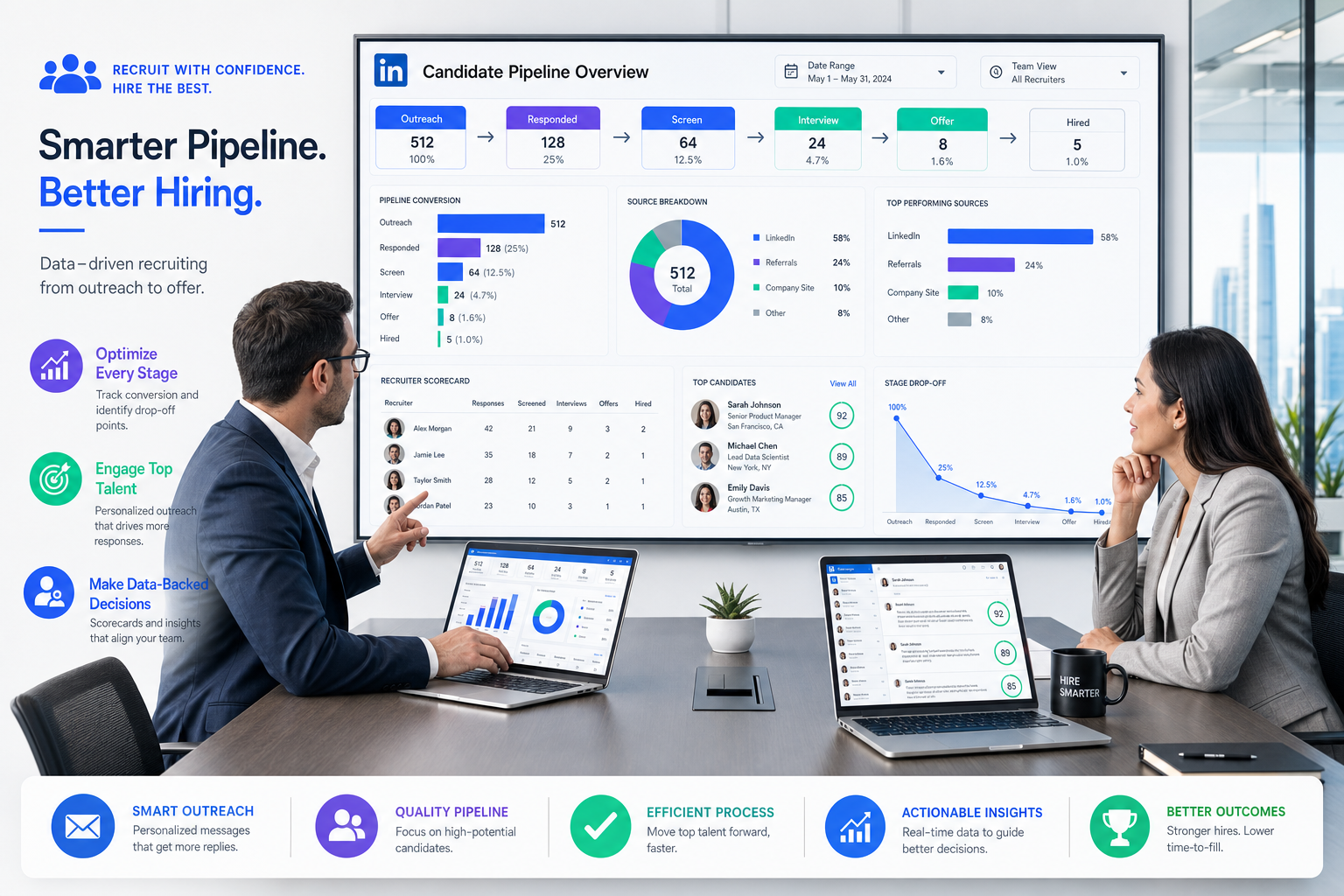
This article helps hiring leaders evaluate recruitment monitoring before live searches slip into lost candidates and untrusted metrics.
That sounds simple until a live search starts slipping. A founder wants to hire quickly, a hiring manager keeps refining what “great” looks like, recruiters rely on instinct, and candidate conversations scatter across email, LinkedIn, notes, and side spreadsheets. The cost is not just slower hiring. It shows up in lost candidates, weak source visibility, unclear accountability, and reporting no one fully trusts when reviewing talent acquisition metrics or HR hiring metrics.
In that gap between activity and control, I have found tools like StrategyBrain AI Recruiter useful for the top-of-funnel work that often breaks first. Used carefully, it can keep candidate outreach moving, respond across time zones, and collect resumes or contact details while recruiters remain responsible for final qualification, resume review, and the next decision. In practice, that kind of support matters most when teams are trying to scale without letting early pipeline discipline fall apart.
A useful way to frame this comes from hiring advice often given to entrepreneurs and start-ups. The point is not that hiring is easy; it is that growth speeds up when leaders stop treating hiring as instinct alone. Founders have to know their limits, define the role properly, and decide what capability the business actually needs next. When a company tries to build out a team quickly, those choices shape everything that follows, from the job description to the shortlist to the culture that forms around the first hires.
That founder-side reality maps directly to recruiting software selection. If a team has to fill multiple roles in a short period, wants a more deliberate process, and needs better alignment around interview structure, knockout criteria, and work-sample evidence, then the best recruiting software is the system that supports recruitment monitoring from the first outreach through final disposition. That is why the rest of this article focuses on how to evaluate software through process discipline, talent acquisition metrics, and HR hiring metrics rather than feature hype.
- The best recruiting software should make recruitment monitoring easier before it promises advanced analytics.
- Founders and hiring teams need software that supports role clarity, structured interviews, and evidence-based selection.
- Reliable talent acquisition metrics depend on clean stages, timestamps, and consistent recruiter behavior.
- HR hiring metrics are only useful when hiring managers follow the same process inside the system.
- Automation can help with outreach and follow-up, but final screening judgment should stay with recruiters.
Why hiring control matters before software choice
When people search for the best recruiting software, they are usually trying to solve a process problem, not just buy technology. The trigger may be growth hiring, poor visibility, scattered recruiter workflows, or frustration that hiring reviews are built on incomplete data. For start-ups especially, the issue often begins earlier: the business has not fully defined what it needs from the role, who should assess it, or which signals actually predict success.
That is why founder-focused hiring advice is still useful in a software discussion. Strong hiring starts with a few basic disciplines: put effort into the job description, decide your knockout criteria early, use a structured interview, understand that culture is shaped within the team rather than guessed in advance, and look for evidence through work samples. Those are not just hiring tips. They are software requirements.
If your system cannot support a clear requisition, standardized evaluation steps, candidate disposition logic, and consistent interviewer inputs, then recruitment monitoring becomes cosmetic. You may still get dashboards, but you will not get dependable operating insight.
Key insight: The best recruiting software does not rescue an undefined hiring process; it strengthens a disciplined one and exposes where discipline is missing.
That is also why many teams overestimate flashy reporting and underestimate workflow design. In practice, recruiting leaders need a system that helps busy recruiters and hiring managers do the right thing by default. Clean process design is what makes talent acquisition metrics and HR hiring metrics trustworthy later.
What the best recruiting software includes now
Recruiting software is no longer just an applicant tracking system. For most hiring teams, the stack spans ATS workflows, sourcing tools, CRM functions, scheduling, reporting, and increasingly some level of automation. The question is not whether one tool has the most features. The question is whether the stack supports how your team actually hires.
Applicant tracking systems as the operational core
An ATS remains the system of record for open jobs, applications, stage movement, and disposition history. If you care about recruitment monitoring, this is where structure begins. Good ATS design should support:
- Standard pipeline stages
- Timestamps by stage change
- Clear disposition reasons
- Offer tracking
- Basic source attribution
- Hiring manager collaboration
Most applicant tracking system benefits come from consistency rather than speed alone. Recruiters can work faster, but the bigger gain is that weekly reviews stop depending on memory and spreadsheet cleanup.
CRM and sourcing layers for earlier pipeline visibility
Many teams discover that ATS data starts too late. By the time a candidate applies, the sourcing effort, nurture history, and early interest signals may already be fragmented. That is where CRM and sourcing tools help. They give recruiters a better view of outreach activity, talent pools, and conversion from first touch to interview-ready candidate.
For teams doing LinkedIn-heavy outreach, I have used AI Recruiter as a support layer when the issue was not final assessment quality but repetitive contact work. It helped keep outreach moving after hours, handled multilingual candidate communication more smoothly than manual recruiter coverage alone, and captured resumes from interested candidates so the recruiter could focus on review and calibration. That is not a replacement for screening judgment. It is a way to keep the funnel from going stale before a human recruiter even gets to the serious evaluation step.
Scheduling and coordination tools
Delays often hide between stages rather than within them. Recruiters may have candidates ready, but hiring managers take too long to confirm availability, panel loops stretch out, or feedback arrives in fragments. Software that improves coordination can have an outsized effect on time-to-hire because it reduces dead space in the process.
Analytics and reporting tools
Analytics software should answer operational questions, not just decorate them. If your reports cannot explain where candidates are dropping out, which sources create qualified slates, or which roles absorb the most recruiter capacity, then the reporting layer is underperforming no matter how polished it looks.
How founders and hiring teams should evaluate software
In founder-led and scaling environments, software choice should reflect the hiring mistakes teams make under pressure. The most common pattern is trying to accelerate output before defining the process. A better evaluation sequence is to ask what the business needs from hiring, where the current workflow breaks, and which system can make those steps measurable.
1. Start with role definition, not feature lists
One of the best lessons from start-up hiring advice is to sweat the job description. Software cannot compensate for a vague role. If different stakeholders mean different things by “qualified,” your reports will never settle. Before comparing platforms, confirm that your team can define:
- What success in the role looks like
- Which requirements are non-negotiable
- Who owns each interview step
- Which evidence counts most in selection
Without that groundwork, recruitment monitoring turns into activity tracking instead of hiring control.
2. Check whether the system supports knockout criteria
Many hiring teams talk about must-have criteria but do not encode them well in their process. Strong software should let recruiters capture screening standards clearly enough that early-stage review stays consistent across multiple openings and recruiters. This matters even more in periods of rapid hiring where the business needs several roles filled in parallel.
3. Evaluate structured interview support
Structured interviews improve data quality because they reduce improvisation in evaluation. When interview feedback is inconsistent, HR hiring metrics become difficult to interpret. Was a drop in final-stage conversion caused by candidate quality, changing standards, or scattered interviewer judgment? Good software should support standardized scorecards, interviewer accountability, and timely feedback capture.
4. Look for evidence-based selection features
Work samples, practical exercises, and role-relevant assessments are often more reliable than intuition alone. The best recruiting software should make it easy to attach, review, and compare these artifacts. If the system buries them or forces teams into email chains, the hiring process will drift back toward instinct.
5. Test reporting trust, not just reporting depth
A useful demo question is not “How many dashboards can this system build?” It is “Can I trust the numbers after six recruiters and twelve hiring managers use it for three months?” That means checking required fields, duplicate controls, stage permissions, source logic, and whether data definitions stay stable across roles.
In one LinkedIn-driven workflow I ran, the pain point was not candidate supply. It was the manual lag between outreach, candidate replies overnight, follow-up, and resume capture. Using StrategyBrain AI Recruiter in practice, I found it most useful as a coverage tool: it kept first-touch conversations moving, answered basic role questions, and surfaced interested people with contact details already gathered. What it did not do, and should not be expected to do, was decide whether the resume actually met the brief. That line matters if you want automation without losing recruiter accountability.
6. Review privacy, security, and human oversight
Any automation layer that touches candidate communication or screening deserves governance review. Ask how candidate data is stored, whether customer data is used to train models, and how decision accountability is handled. Recruiters should always be able to inspect the workflow and own the final move.
The metrics that actually help
Recruitment monitoring works best when teams track a focused set of operational measures linked to clear decisions. The goal is not to generate more charts. It is to make hiring conversations more specific and more useful.
Time-to-fill
Definition: days from approved requisition opening to accepted offer or filled role, depending on your internal policy.
Why it matters: It shows business exposure from unfilled roles and reveals whether hiring speed is improving in a meaningful way.
What to watch: approval lag, hiring manager response time, interview scheduling delays, and offer turnaround.
Time-to-hire
Definition: days from candidate entry into process to accepted offer.
Why it matters: It is one of the clearest measures of whether your workflow moves viable candidates efficiently.
What to watch: compare by role family, source, recruiter, and stage path.
Qualified candidates per opening
Definition: the number of candidates who meet your agreed threshold for serious consideration.
Why it matters: It is often more useful than raw applicant count because it reflects sourcing quality and role clarity.
What to watch: if this metric is unstable, your job definition or knockout criteria may be drifting.
Offer acceptance rate
Definition: accepted offers divided by total offers extended.
Why it matters: It can expose compensation gaps, weak process pacing, or candidate expectation problems.
What to watch: role level, source, and total cycle length.
Application completion rate
Definition: completed applications divided by started applications.
Why it matters: It helps teams diagnose friction in the apply flow.
What to watch: mobile experience, repeated data requests, and form length.
Source quality
Definition: source performance measured by downstream outcomes, not just volume.
Why it matters: It links recruiting effort to actual pipeline value.
What to watch: qualified candidate rate, interview progression, offers, and hires by source.
Stage conversion rate
Definition: the percentage of candidates who move from one stage to the next.
Why it matters: It is often the fastest way to spot broken calibration or process friction.
What to watch: low recruiter-screen conversion may point to poor intake quality; low final-stage conversion may indicate weak shortlist quality or inconsistent interview standards.
What about quality of hire?
Quality of hire remains worth discussing, but most teams should treat it carefully. Definitions vary, timelines differ, and post-hire performance data is often inconsistent. A more practical approach is to connect hiring outcomes with retention, early ramp expectations, manager satisfaction, and role-specific milestones rather than pretend the metric is universally precise.
Quick comparison: what software should support by team type
| Team type | Top software priority | Best-fit workflow need | Metrics focus |
|---|---|---|---|
| Start-up | Role clarity, structured process, fast adoption | Basic ATS plus reliable sourcing and interview discipline | Time-to-fill, qualified candidates per opening, offer acceptance |
| SMB agency | Pipeline control, outreach consistency, recruiter productivity | ATS plus CRM and top-of-funnel automation support | Time-to-hire, source quality, stage conversion |
| Mid-market in-house | Manager collaboration, dashboards, integration depth | Structured hiring with cleaner scorecards and reporting | Talent acquisition metrics by department, recruiter, and source |
| Enterprise | Governance, reporting consistency, cross-region standards | Complex workflow support with auditability | HR hiring metrics, funnel consistency, capacity planning |
This is not a product ranking. It is a buying lens grounded in the reality that different teams fail in different ways. Start-ups often struggle with role definition. Agencies struggle with throughput and follow-up consistency. Larger internal teams struggle with governance and comparability.
Common software buying errors
Buying for breadth instead of process fit
A long feature list does not matter if recruiters still work outside the system. The best recruiting software usually reduces side channels rather than adding more of them.
Letting instinct outrun structure
Founder-led teams can move quickly, but hiring decisions become harder to audit when the process is informal. If your software cannot support structured evaluation, your reporting will mirror that inconsistency.
Tracking too many metrics too early
Most teams learn more from five well-defined measures than from thirty inconsistent dashboards. Start narrow and operational.
Ignoring the hiring manager workflow
Recruitment monitoring weakens when hiring managers delay feedback, skip scorecards, or redefine requirements mid-search. Software should make their role visible and accountable too.
Overstating what automation should do
Automation can handle repetitive outreach and follow-up, especially in LinkedIn-heavy workflows. It should not be treated as a substitute for recruiter judgment, resume evaluation, or final fit assessment.
Implementation steps for better recruitment monitoring
Once software is selected, the real work begins. Teams that implement carefully tend to get far more value from the same platform than teams that rush rollout.
- Define each stage clearly. Every recruiter and hiring manager should interpret pipeline movement the same way.
- Set knockout criteria before launch. This keeps early review disciplined across openings.
- Standardize interview scorecards. If feedback is free-form, reporting quality will drift.
- Use work-sample evidence where relevant. This helps reduce overreliance on instinct.
- Limit the first dashboard. Start with speed, conversion, and source quality.
- Assign data ownership. Decide who maintains source tags, disposition reasons, and requisition hygiene.
- Audit monthly. Check duplicates, skipped stages, stale jobs, and missing feedback.
For teams doing heavy outbound recruiting, it can also help to separate communication coverage from final evaluation. In my own workflow, AI Recruiter was most useful when candidate replies were arriving after hours or across regions and recruiters were losing momentum simply because no one could keep up with first-response volume. Let automation keep the conversation warm and gather the basics; let recruiters make the decision that actually matters.
FAQ
What is the best recruiting software for recruitment monitoring?
The best recruiting software for recruitment monitoring is the one that supports structured workflows, reliable stage data, clear source tracking, and reporting your team can actually trust. For most organizations, that means an ATS at the core with useful sourcing, CRM, scheduling, and analytics support around it.
Why does recruitment monitoring matter so much?
Because hiring decisions become harder to improve when the process is invisible. Recruitment monitoring helps teams see bottlenecks, source quality, recruiter workload, and stage conversion patterns before delays become expensive.
Which talent acquisition metrics should most teams start with?
Start with time-to-fill, time-to-hire, qualified candidates per opening, source quality, offer acceptance rate, and stage conversion. These are practical, decision-ready talent acquisition metrics.
How are HR hiring metrics different?
HR hiring metrics often need broader consistency across departments, locations, and managers. They are usually used for governance, planning, and cross-functional reporting rather than recruiter coaching alone.
Can automation improve LinkedIn recruiting workflows?
Yes, especially for repetitive outreach, follow-up, and initial candidate response handling. The main value is often speed and consistency at the top of the funnel, while recruiters remain responsible for assessing resumes and deciding who advances.
What should start-ups prioritize when choosing recruiting software?
Start-ups should prioritize role clarity, structured interviewing, easy adoption, and clean reporting. Software is most helpful when it supports disciplined hiring rather than simply adding more activity.
Conclusion
The best recruiting software is rarely the one with the most impressive demo. It is the system that helps your team define the role, run a structured process, and keep evidence intact from first contact through final offer. That is the real foundation of recruitment monitoring.
If you want talent acquisition metrics and HR hiring metrics that stand up in real hiring reviews, start where founders and experienced recruiters eventually all arrive: clear requirements, consistent workflow, accountable evaluation, and software that makes those habits easier to maintain under pressure.