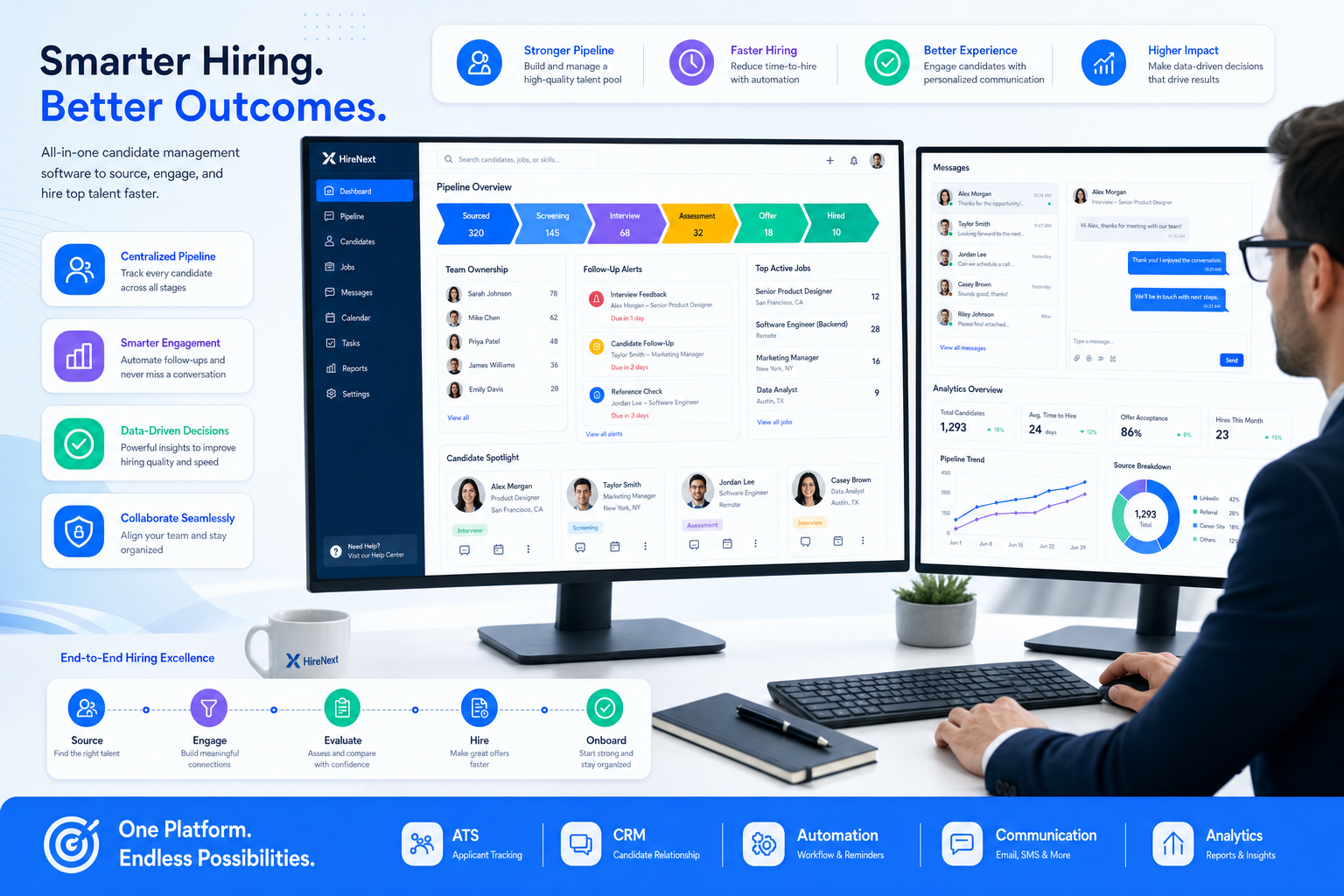
When growth hiring gets messy, this article helps headhunters judge candidate management software by follow-up risk, ownership gaps, and funnel control.
That matters because growth hiring rarely fails for lack of interest alone. It usually breaks when recruiters are asked to move faster across more roles, more stakeholders, and more candidate conversations without a system that keeps records clean, communication timely, and ownership visible. For a solo recruiter, that means missed replies and weaker shortlist quality. For a small agency owner, it means consultants spending prime hours on admin instead of placements. For an internal talent team, it means hiring managers lose trust when updates are late, duplicate outreach happens, or strong candidates disappear into a messy funnel.
In my own workflow, one of the more practical ways to relieve that pressure has been using StrategyBrain AI Recruiter to handle repetitive LinkedIn outreach, after-hours candidate replies, and initial interest checks while the recruiter still owns résumé review, final qualification, and the next decision. That matters most when the bottleneck is not strategy but response discipline: candidates reply late, recruiters are in meetings, and the gap between first contact and real follow-up quietly widens. Used carefully, tools like AI Recruiter can support candidate engagement software needs without replacing recruiter judgment.
The pressure behind this is familiar to any team hiring through a growth phase. In 2022, BNN Bloomberg reported that Canada’s technology sector recorded $3.26 billion in IPO value in the first quarter alone, the strongest opening in fifteen years. Around that kind of market momentum, CEOs, founders, and CFOs were all asking the same practical question: how do we invest early enough, aggressively enough, and in the right places to support growth based on the data we have now? In recruiting, that question shows up at desk level as a sequence of very ordinary actions. A recruiter opens a requisition list that has expanded faster than expected, checks which shortlisted candidates have gone quiet, updates stages after hiring manager calls, and then realizes three promising LinkedIn replies came in overnight with no clean handoff into the database.
That is the transition point where software selection becomes an operating issue, not just a feature discussion. If a company is trying to achieve breakout growth, candidate management software has to support the same discipline finance teams bring to scaling decisions: identify what is slowing progress, understand the difference between startup, scale-up, and enterprise needs, and invest before the process becomes chaotic. The best recruiting software does that by combining reliable pipeline control with candidate engagement software and candidate experience software features that keep communication moving as volume rises.
Table of Contents
- Why growth changes recruiting software needs
- Recruiting software vs ATS vs CRM vs engagement vs experience
- What the best recruiting software must do
- How needs change from startup to enterprise
- Quick comparison by hiring model
- How to choose the right system
- What to test during evaluation
- Implementation lessons from recruiting operations
- FAQ
Why growth changes recruiting software needs
The easiest mistake in a recruiting software search is treating it as a feature race. Growth-stage hiring does not usually collapse because a platform lacks one impressive function. It stalls because the operating model changes faster than the recruiting team’s process. New roles open across departments, approval chains get longer, candidate volume rises unevenly, and recruiters need to preserve quality while moving faster.
That is why the underlying logic from high-growth finance teams transfers so well here. Growth leaders do not invest randomly. They look for the pain points slowing expansion, the differences between one stage of growth and the next, and the moment when earlier tools stop being enough. Recruiting teams should evaluate software the same way.
In practice, candidate management software becomes the center of that decision because every other recruiting activity depends on it. Whether you are reviewing applicants, rediscovering silver-medalist talent, coordinating interviews, or reporting to leadership, the quality of candidate records and workflow visibility determines whether the rest of your process scales or fragments.
Key insight: The best recruiting software is less about owning the most features and more about knowing when your current process can no longer support your growth stage.
That framing also helps separate software categories that buyers often mix together. A team might believe it needs more sourcing tools when the real issue is stage visibility. Another may think it needs a complete suite when the immediate pain is delayed follow-up that stronger candidate engagement software would solve.
Recruiting software vs ATS vs CRM vs candidate engagement vs candidate experience
Software evaluations drag on because the market uses overlapping labels for different problems. The same vendor may call itself recruiting software, an ATS, a CRM, candidate engagement software, or candidate experience software. The overlap is real, but the buying logic should stay clear.
Applicant tracking system for recruiters
An applicant tracking system for recruiters is designed to capture applicants, move them through defined stages, maintain records, and keep the process auditable. The classic applicant tracking system benefits are control, consistency, and easier reporting. If your team is still relying on inboxes and spreadsheets to manage live requisitions, these basics matter immediately.
Candidate management software
Candidate management software is the broader operating layer. It includes ATS functions, but in day-to-day recruiting it is really about one dependable record per person, searchable history, ownership tracking, duplicate control, notes, communication logs, and database reuse. A recruiter should be able to see not only where a candidate is in the funnel, but what happened last, who owns the next action, and whether there is prior relationship history worth using.
Candidate engagement software
Candidate engagement software handles the communication load that grows before and around the formal application flow. Email sequences, SMS, messaging automation, reminders, and nurture campaigns all sit here. In high-volume recruiting and agency sourcing, this category matters because response speed directly changes outcomes.
That is also where I have found support tools useful. When LinkedIn replies come in outside working hours, using StrategyBrain AI Recruiter for multilingual follow-up, first-response handling, and résumé collection can reduce dead time between candidate interest and recruiter review. The recruiter still decides whether the résumé fits the role, but candidate communication no longer waits for the next open calendar slot.
Candidate experience software
Candidate experience software focuses on what the process feels like from the candidate side. It covers easier applications, mobile-friendly flows, career pages, portals, status visibility, and communication clarity. Teams often underweight this category until they see completion rates drop or candidates start chasing updates after every stage.
A practical way to map the categories
| Category | Primary focus | What teams gain |
|---|---|---|
| Recruiting software | End-to-end hiring operations | Workflow control, collaboration, automation, and analytics in one system |
| ATS | Application tracking and recordkeeping | Structured stages, compliance support, and process consistency |
| Candidate management software | Centralized candidate records and pipeline visibility | Searchability, ownership, follow-up discipline, and database reuse |
| Candidate engagement software | Outreach and nurture communication | Faster response, scalable communication, and less manual messaging |
| Candidate experience software | Candidate-facing journey | Smoother applications, clearer updates, and less candidate friction |
The cleanest buying question is not what label a platform uses. It is which operating problem it solves in your hiring model today.
What the best recruiting software must do
The strongest systems remove friction where growth hiring creates it. That usually means five pressure points: record quality, communication speed, collaboration, automation, and visibility.
1. Maintain one usable source of truth
Good candidate management software gives recruiters a complete profile, history of interactions, searchable fields, notes, ownership, and next-step visibility. This is one of the biggest advantages of applicant tracking system adoption: fewer hidden candidate conversations and less rework.
From experience, this is worth stress-testing early. A database can look excellent in a polished demo and become frustrating once six recruiters start tagging, searching, and reusing talent simultaneously.
2. Reduce response lag without removing recruiter control
Growth hiring often fails in the time between outreach and follow-up. Strong automation should handle reminders, status changes, scheduling prompts, routing, and repetitive candidate messaging. It should not take final hiring judgment away from recruiters.
That is why AI-supported workflows work best in narrow, high-friction zones. For example, I have seen the most value when AI Recruiter is used to keep LinkedIn conversations moving, answer routine role questions, and collect contact details while the recruiter remains responsible for fit assessment and shortlist decisions.
3. Support candidate engagement at scale
Teams with recurring roles, agency pipelines, or high-volume funnels need real candidate engagement software capabilities: segmentation, personalization, message history, reminders, and communication across channels. Without that, recruiters either spam candidates or fail to follow up consistently.
4. Improve the candidate journey, not just internal admin
Good candidate experience software reduces confusion after apply, after screening, and after interviews. Look for easy applications, mobile usability, transparent status handling, and human-sounding templates. Candidate experience is not just branding. It is operational clarity from the candidate side.
5. Make team collaboration visible
As growth continues, delays usually come from handoffs: recruiter to hiring manager, manager to panel, panel back to recruiter. The best recruiting software keeps these actions visible with scheduling workflows, reminders, scorecards, and overdue action tracking.
6. Produce useful hiring analytics
Analytics should reveal where the process is slowing down by stage, role, source, or team. In a growth environment, those insights matter because they tell leaders where to invest earlier rather than later, just as finance teams identify constraints before they limit expansion.
7. Fit the rest of the stack
Recruiting software should connect cleanly with calendars, email, HR systems, assessments, job distribution, and reporting tools. Integration weaknesses often become visible only when hiring volume rises, so map real handoffs before evaluation starts.
How needs change from startup to enterprise
One of the most useful ideas borrowed from growth-stage operating teams is that needs change by company stage. Recruiting software that feels ideal for an early-stage team can become restrictive later, while enterprise-grade platforms can be unnecessarily heavy for a lean hiring function.
Startup stage
At this stage, speed and adoption matter most. Teams usually need a straightforward applicant tracking system for recruiters with dependable candidate management software, basic automation, and enough reporting to show bottlenecks. Overbuying here often creates more admin than value.
Scale-up stage
This is where the pressure increases sharply. More roles open at once, recruiters need better sequencing, and candidate communication starts to break under volume. Scale-ups often need stronger candidate engagement software features, better ownership controls, and cleaner analytics to spot what is slowing hiring growth.
Enterprise stage
Enterprise teams need governance, permissions, integrations, standardized workflows, and richer analytics. They also need more mature candidate experience software because inconsistent communication across departments creates visible brand damage much faster.
The key is to buy for the next stage you are genuinely moving into, not the one you imagine in a distant roadmap.
Quick comparison by hiring model
There is no universal winner for the best recruiting software. The right profile depends on your operating model.
| Use case | Best software profile | Why it fits | Main caution |
|---|---|---|---|
| SMB hiring | Simple ATS with strong candidate management software | Fast setup, easier adoption, lower admin burden | May become limiting as workflows and analytics needs grow |
| Enterprise recruiting | Configurable suite with governance and integrations | Supports multiple teams, approvals, and reporting structures | Can become complex if workflows are overbuilt |
| High-volume recruiting | Platform with automation, messaging, and scheduling strength | Reduces response lag and repetitive communication work | Poor controls can hurt candidate experience |
| Staffing and search | Database-first system with CRM-style search and relationship tracking | Improves rediscovery, redeployment, and repeat outreach | Weak process controls can create inconsistency |
The practical takeaway is simple: compare systems against the hiring model you run today and the one you expect to run next year.
How to choose the right system
When buyers ask for the best recruiting software, the most reliable approach is to score platforms against a small set of operating questions rather than a giant feature checklist.
- Where is growth currently slowing the hiring process? Is the real issue sourcing, follow-up, stage movement, manager feedback, or database reuse?
- What growth stage are you buying for? Startup, scale-up, and enterprise teams do not need the same depth.
- Which actions must remain recruiter-led? This matters especially when AI or automation enters screening and outreach.
- How much communication happens before formal application? If that load is high, candidate engagement software deserves more weight.
- Where do candidates feel friction? That is where candidate experience software becomes more than a nice-to-have.
I also recommend running one realistic workflow through every demo: source a candidate, send outreach, receive a reply, move the person into a live process, schedule an interview, collect feedback, and report status. That sequence exposes whether a tool helps real recruiting work or just looks polished in slides.
What to test during evaluation
Ease of use
If recruiters and hiring managers avoid the platform, even strong applicant tracking system benefits never materialize. Test navigation with real users, not just procurement stakeholders.
Search and rediscovery
For any serious candidate management software, search quality is a core function, not a nice extra. Test duplicate handling, note retrieval, and past interaction visibility.
Automation logic
Ask whether automation can adapt by role type, geography, or workflow. Generic triggers often fail once hiring becomes more complex.
Candidate communication controls
If you need candidate engagement software, test message personalization, reply handling, sequence governance, and opt-out controls. Communication volume without control creates both compliance and brand risk.
Candidate-facing clarity
For candidate experience software, review application flow, status communication, and portal design from a candidate point of view, not just an admin view.
Reporting usefulness
Dashboards should answer operational questions, not just executive curiosity. Can your team quickly identify where movement stalls and who owns the next action?
Operational tip: During testing, include at least one scenario where a candidate replies after hours, asks a follow-up question, and needs to submit a résumé or contact details. That is where many teams discover whether their workflow can really scale.
Implementation lessons from recruiting operations
Software rarely fails because the platform alone is bad. It fails because process decisions were left vague at launch. Before turning on automation, define stage names, ownership rules, communication timing, and what counts as complete recruiter notes.
- Keep stage architecture simple: Too many stages create noise and poor reporting.
- Set communication standards: Decide how quickly candidates should hear back after key moments.
- Assign visible ownership: Every stage needs a named next-step owner.
- Review AI and automation boundaries: Recruiters should retain final résumé review and qualification decisions.
- Train hiring managers on response expectations: Adoption breaks when managers treat the system as optional.
- Use analytics monthly to remove bottlenecks: Reporting should feed process changes, not just summaries.
One lesson I would add from practice is that LinkedIn-heavy teams should decide early how external conversations are captured. If recruiters are doing large amounts of outreach there, using a support layer like StrategyBrain AI Recruiter for repetitive first-contact work can help keep conversations alive, but only if the team also defines how replies, résumés, and next actions are recorded inside the broader recruiting workflow.
FAQ
What is the difference between recruiting software and an ATS?
Recruiting software is the broader category. An ATS usually focuses on application tracking, stage movement, and records. The best recruiting software often combines ATS functionality with stronger candidate management, analytics, collaboration, candidate engagement software tools, and candidate experience software improvements.
What matters most in candidate management software?
The essentials are centralized profiles, searchable records, communication history, stage visibility, duplicate control, notes, owner tracking, and reporting. Those are the daily-use features that make a recruiting system dependable under growth pressure.
When does candidate engagement software become necessary?
It becomes more important when hiring volume rises, outreach happens across multiple channels, or recruiters cannot manually keep up with follow-up. Teams with recurring roles, agency models, and top-of-funnel sourcing usually feel this need first.
How is candidate experience software different?
Candidate experience software focuses on the candidate-facing journey: easier applications, clearer updates, mobile usability, and less confusion between stages. It improves how the hiring process feels and functions from the outside in.
Should recruiters use AI for outreach?
AI can help with repetitive communication, first-response handling, and information capture, especially when candidates reply outside standard work hours. Recruiters should still control qualification, résumé review, shortlist decisions, and final next steps.
How should growth-stage companies choose recruiting software?
Start by identifying what is slowing hiring growth today, then choose software that fits your next operating stage. Do not buy only for current pain if you are clearly moving from startup to scale-up, but do not overbuy for enterprise complexity you do not yet need.
Conclusion
The best recruiting software is the one that helps a hiring team grow without losing discipline. In real terms, that means dependable candidate management software, automation that reduces admin instead of obscuring judgment, candidate engagement software that keeps communication moving, and candidate experience software that reduces friction at every stage.
When growth accelerates, recruiting needs the same clarity that finance brings to scaling decisions: identify what is slowing progress, understand your current stage, and invest in the systems that remove the constraint before it gets expensive. If you evaluate software through that lens, your team is far more likely to choose a platform that supports hiring performance instead of adding another tool people work around.