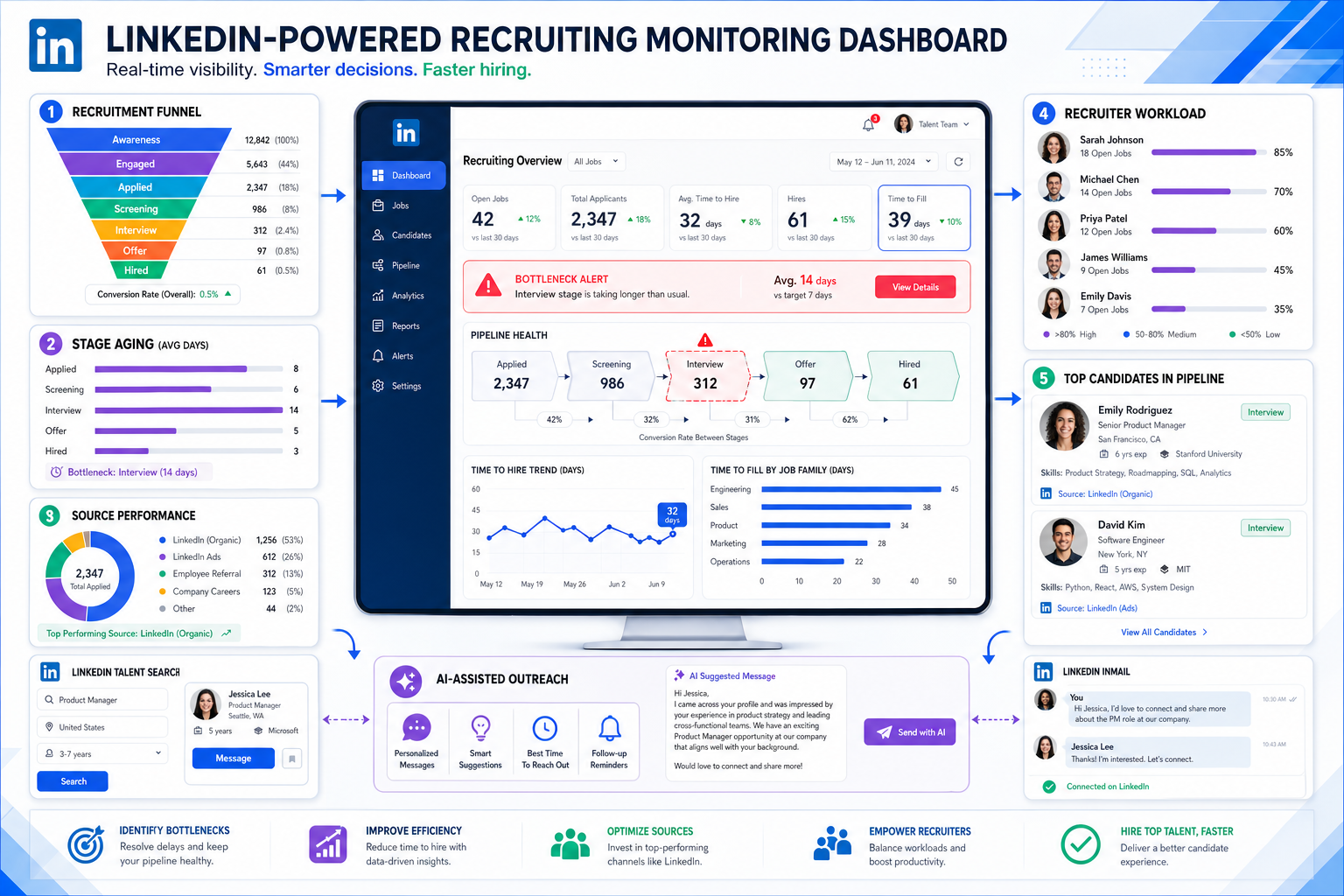
This article helps recruiting leaders judge recruitment monitoring, catch bottlenecks, and avoid weak source and workload decisions.
That matters most when the market shifts unevenly. A recruiter may be hiring into one function where demand softens, another where candidates stay scarce, and a third where hiring managers still expect speed. Without clean monitoring, those mixed signals get buried in inboxes, spreadsheets, and half-updated pipelines. The result is familiar: slower shortlist delivery, weak source decisions, stressed client or hiring-manager relationships, and too much time spent arguing over what the numbers actually mean.
In practice, I have found that tools like StrategyBrain AI Recruiter help most when they reduce the repetitive front-end work that hides those patterns. For LinkedIn-heavy recruiting, its always-on candidate messaging, multilingual communication, and automated collection of resumes and contact details can keep outreach moving while the recruiter still owns final judgment, resume review, and next-step decisions. Used that way, it supports recruitment monitoring instead of replacing recruiter thinking.
A useful reminder comes from a July 2014 labor snapshot that showed how uneven job demand can become. In Canada, construction fell sharply while education and manufacturing added jobs; in the United States, professional and business services expanded strongly at the same time. For a recruiter covering more than one sector, that kind of split creates a very specific workflow problem. You open the requisition list, recheck which roles still deserve sourcing effort, scan candidate replies from the night before, and update stages job by job because yesterday's priority role may no longer be today's easiest or most urgent hire.
The pressure grows when training, mobility, and self-employment shifts change where candidates are willing to move. A recruiter following that market has to log new resumes, chase missing contact details, remind a hiring manager that one role is slowing at review while another suddenly has viable supply, and keep source notes clean enough to compare outcomes later. That is exactly where the best recruiting software matters: it gives structure to recruitment monitoring, makes hiring metrics usable, and helps teams apply recruiting metrics benchmarks with context instead of guesswork.
Table of Contents
- Why Uneven Hiring Markets Expose Weak Recruiting Systems
- What Recruitment Monitoring Should Actually Cover
- Hiring Metrics the Best Recruiting Software Must Track
- How to Use Recruiting Metrics Benchmarks Correctly
- Features That Matter Most in Recruiting Software
- Where AI-Supported LinkedIn Workflow Fits
- How to Compare Recruiting Software Options
- Common Buying Mistakes
- FAQ
Why Uneven Hiring Markets Expose Weak Recruiting Systems
Recruiters do not operate in a stable hiring environment for long. One month, construction demand drops, government-funded functions slow, and health-related hiring changes pace; another month, education or manufacturing opens up and sourcing priorities shift again. The operational lesson is simple: when hiring demand changes unevenly across sectors, weak systems fail first.
That is why the best recruiting software should not be judged only by posting, storage, or scheduling features. It should be judged by how well it supports recruitment monitoring when priorities change. Can your team see which requisitions are aging? Can you tell whether a role is hard because the market is tight, because response quality is poor, or because hiring-manager review is slow? Can you separate a sourcing problem from a process problem?
From experience, this is where many firms hit the wall. They have activity everywhere but visibility nowhere. Recruiters are working, candidates are replying, hiring managers are giving some feedback, but no one has a shared view of which jobs are gaining traction and which are just consuming effort.
Key insight: The best recruiting software earns its value when market noise increases, because it helps recruiters decide where to spend attention, not just where to store data.
What Recruitment Monitoring Should Actually Cover
Recruitment monitoring is the discipline of watching how hiring work moves from demand to outreach to interview to hire, and of identifying where progress slows or quality drops. It is broader than ATS administration and more practical than executive dashboards alone.
At minimum, effective monitoring should cover:
- Open requisition health and aging
- Candidate movement by stage
- Source quality, not just source volume
- Time spent waiting on recruiter action versus manager action
- Workload distribution across recruiters
- Offer and hire outcomes by role type and business unit
The reason this matters is the same one exposed by uneven labor-market data: different functions move differently. A recruiter supporting education roles, industrial hiring, and white-collar business positions should not expect one funnel pattern across all of them. Good software makes those differences visible without forcing constant spreadsheet rebuilding.
For most organizations, the base layer is an applicant tracking system. The more mature layer is analytics that lets recruiters, TA leaders, and hiring managers interpret the work in context. One of the most practical applicant tracking system benefits is consistency. If stage definitions and activity logging stay inconsistent, even the best dashboards become decorative.
Hiring Metrics the Best Recruiting Software Must Track
If your evaluation starts with vanity numbers, you will buy reporting that looks busy but does not improve decisions. Strong hiring metrics are the ones that change recruiter behavior, manager responsiveness, or budget allocation.
1. Time-to-fill
Time-to-fill tracks how long a requisition remains open before it closes with a hire. This is essential for workforce planning, but it is also a useful diagnostic signal. If one role family consistently stays open longer, your software should let you break that down by location, function, and recruiter.
2. Time-to-hire
This metric focuses on candidate speed after entry into the process. It is often the cleaner measure for candidate experience, especially in markets where good candidates disappear quickly. If time-to-hire grows, you need to know whether delay sits in screening, scheduling, interviewer feedback, or approval steps.
3. Stage conversion rates
Stage conversion tells you where the funnel loses force. Application-to-screen, screen-to-interview, and final-round-to-offer ratios reveal very different problems. Low screen conversion can signal poor source targeting. Low interview conversion may reflect weak calibration. Low offer conversion may point to compensation mismatch or late-stage drift.
4. Time in stage
This is one of the most actionable metrics in day-to-day recruiting. A role can still close on time overall while quietly losing candidates because they sit too long between steps. Good recruiting software should show stage aging at both requisition and team level.
5. Requisitions per recruiter
Workload matters because overloaded recruiters create hidden delays long before final outcomes deteriorate. This metric is especially useful for agencies and lean in-house teams that cover several job families at once.
6. Hires per recruiter
Used carefully, this shows output and capacity. Used carelessly, it rewards easy reqs and punishes specialization. The best recruiting software should let you compare this metric with role complexity and req load rather than presenting it as an isolated score.
7. Source performance
Source reporting should connect channels to progression and hires, not just applications. Otherwise, teams overinvest in channels that create admin work rather than placements.
8. Quality of hire
This is harder to measure, but it still matters. Software does not solve quality-of-hire by itself, yet it should support some way to connect recruiting data with retention, performance, or manager satisfaction signals over time.
| Metric | What It Reveals | Why It Matters |
|---|---|---|
| Time-to-fill | Req closing speed | Shows planning accuracy and bottlenecks |
| Time-to-hire | Candidate process speed | Protects candidate experience and competitiveness |
| Stage conversion | Funnel efficiency | Identifies weak sourcing or assessment points |
| Time in stage | Step-by-step delays | Exposes where candidates stall |
| Reqs per recruiter | Workload balance | Prevents overload and hidden process slippage |
| Hires per recruiter | Output with context | Supports staffing and coaching decisions |
| Source performance | Channel quality | Improves sourcing focus and spend decisions |
| Quality of hire | Longer-term hiring value | Links recruiting activity to business outcomes |
How to Use Recruiting Metrics Benchmarks Correctly
Recruiting metrics benchmarks are useful only when you treat them as context, not commandments. A slower time-to-fill in a niche industrial role is not automatically failure. A faster cycle in a repetitive hiring stream is not automatically excellence.
The labor-market example from 2014 is a good reminder of why. When one country adds jobs heavily in business services while another loses ground there but gains in education, no recruiter should expect one benchmark to fit both situations. The same applies inside one company: engineering, education, operations, and field hiring do not behave alike.
Use benchmarks in this order:
- Standardize definitions first. Decide what counts as screen, interview, submission, offer, and hire.
- Segment before comparing. Separate role families, locations, seniority levels, and hiring models.
- Read trends before snapshots. Six months of movement tells more than one dramatic month.
- Balance speed with quality. Fast hiring is not a win if retention or manager satisfaction weakens.
- Review results with stakeholders. Benchmarks should improve alignment, not trigger blame.
In other words, the value of recruiting metrics benchmarks is not that they give you one answer. It is that they help you ask better questions with cleaner evidence.
Features That Matter Most in Recruiting Software
When I evaluate the best recruiting software, I look for features that make decisions easier during real recruiting pressure, not just during demos.
Pipeline visibility
You should be able to see active candidates, aging by stage, bottlenecks, and role-level momentum quickly. If a recruiter cannot tell which req is cooling down, the software is not supporting recruitment monitoring well enough.
Role and team segmentation
Because labor demand shifts unevenly, the system should let you compare by function, location, recruiter, and business unit. This is especially important if your team supports both stable and cyclical hiring areas.
Source analytics tied to outcomes
Volume alone is not useful. The best recruiting software shows which channels produce qualified screens, interviews, offers, and hires.
Recruiter productivity reporting
Leaders need req load, follow-up activity, and output views that support coaching and staffing choices, not simplistic leaderboard culture.
Stage aging and bottleneck alerts
If a candidate sits too long after an interview, the system should make that obvious. Recruiting often fails through delay, not through lack of effort.
Cross-system reporting
As teams mature, they need to compare sourcing, ATS movement, and hiring outcomes across multiple tools. If data stays trapped in silos, reporting loses trust quickly.
Where AI-Supported LinkedIn Workflow Fits
Not every recruiting problem is solved by software alone, but front-end sourcing and follow-up are still major leak points. In LinkedIn-heavy searches, I have seen that a disciplined AI-assisted workflow can protect recruiter time while improving data capture.
My own view is that AI Recruiter is most useful when you treat it as operational support for the top of funnel. It can keep candidate conversations moving around the clock, respond in the candidate's language when international outreach is involved, and collect resumes or contact details from interested prospects. That matters in exactly the kind of uneven market described earlier, where recruiters may be juggling multiple sectors and cannot manually chase every reply at the right time.
What I would not outsource is final qualification. The recruiter still needs to review the resume, assess fit, decide whether the opportunity is worth advancing, and calibrate with the hiring manager. In that sense, AI support helps because it preserves responsiveness and cleaner records, which then improve recruitment monitoring and later reporting.
If your work depends heavily on LinkedIn sourcing, it is worth reviewing examples like the LinkedIn workflow notes here or broader implementation guidance at the StrategyBrain site. The operational takeaway is simple: automation is strongest when it protects recruiter attention, not when it pretends to replace recruiter judgment.
How to Compare Recruiting Software Options
A practical buying process starts by deciding what kind of system problem you actually have.
If your problem is process inconsistency
Choose software that enforces structured stages, manager participation, and reliable status updates. Without this, no metric becomes trustworthy.
If your problem is poor visibility
Prioritize reporting depth, stage aging, source analysis, and recruiter workload dashboards.
If your problem is front-end outreach capacity
Look at workflow support for messaging, response handling, resume capture, and cross-time-zone communication, especially if LinkedIn is a core sourcing channel.
If your problem is executive reporting
Focus on segmentation, benchmark support, and the ability to compare trends across locations and business units.
During demos, ask vendors to show how they would handle a mixed hiring month: one function down, one growing, one stable, and recruiters splitting time across all three. That test is far more revealing than a polished generic funnel view.
Common Buying Mistakes
Buying for feature count
More features do not help if they do not answer real recruiting questions.
Ignoring market context
Software should help you adjust to uneven labor conditions, not assume every role follows one clean funnel.
Skipping data definitions
If teams use different meanings for stages and outcomes, your hiring metrics will become unreliable fast.
Confusing activity with progress
Lots of outreach and applications can still produce weak hiring results. Watch conversions and aging, not just volume.
Expecting automation to make decisions
Automation can improve speed and record quality, but recruiters still need to make fit judgments, manage stakeholders, and close candidates.
FAQ
What is the best recruiting software?
The best recruiting software is the system that gives your team dependable pipeline visibility, strong recruitment monitoring, and reporting that improves real hiring decisions rather than just documenting activity.
What does recruitment monitoring mean?
Recruitment monitoring means tracking candidate movement, requisition health, recruiter activity, delays, and source performance across the hiring funnel so teams can identify problems early and act with evidence.
Which hiring metrics matter most?
The most useful hiring metrics typically include time-to-fill, time-to-hire, stage conversion, time in stage, reqs per recruiter, hires per recruiter, source performance, and quality of hire.
How should teams use recruiting metrics benchmarks?
Use recruiting metrics benchmarks as directional context. Start with internal comparisons by role type, team, and location, then compare externally once your definitions are consistent.
Can AI help with recruiting software workflows?
Yes, especially in sourcing and early candidate communication. AI-supported tools can improve response coverage, multilingual outreach, and resume capture, while the recruiter still owns fit assessment and final decisions.
Conclusion
The real test of the best recruiting software is not whether it looks modern. It is whether it helps your team stay clear-headed when hiring conditions move unevenly, priorities shift by function, and pipeline noise starts hiding the truth.
If your goal is better recruitment monitoring, focus on systems that make hiring metrics actionable, treat recruiting metrics benchmarks with context, and support the recruiter's actual workflow from outreach through decision. That is how software stops being a record-keeping tool and starts becoming a hiring advantage.