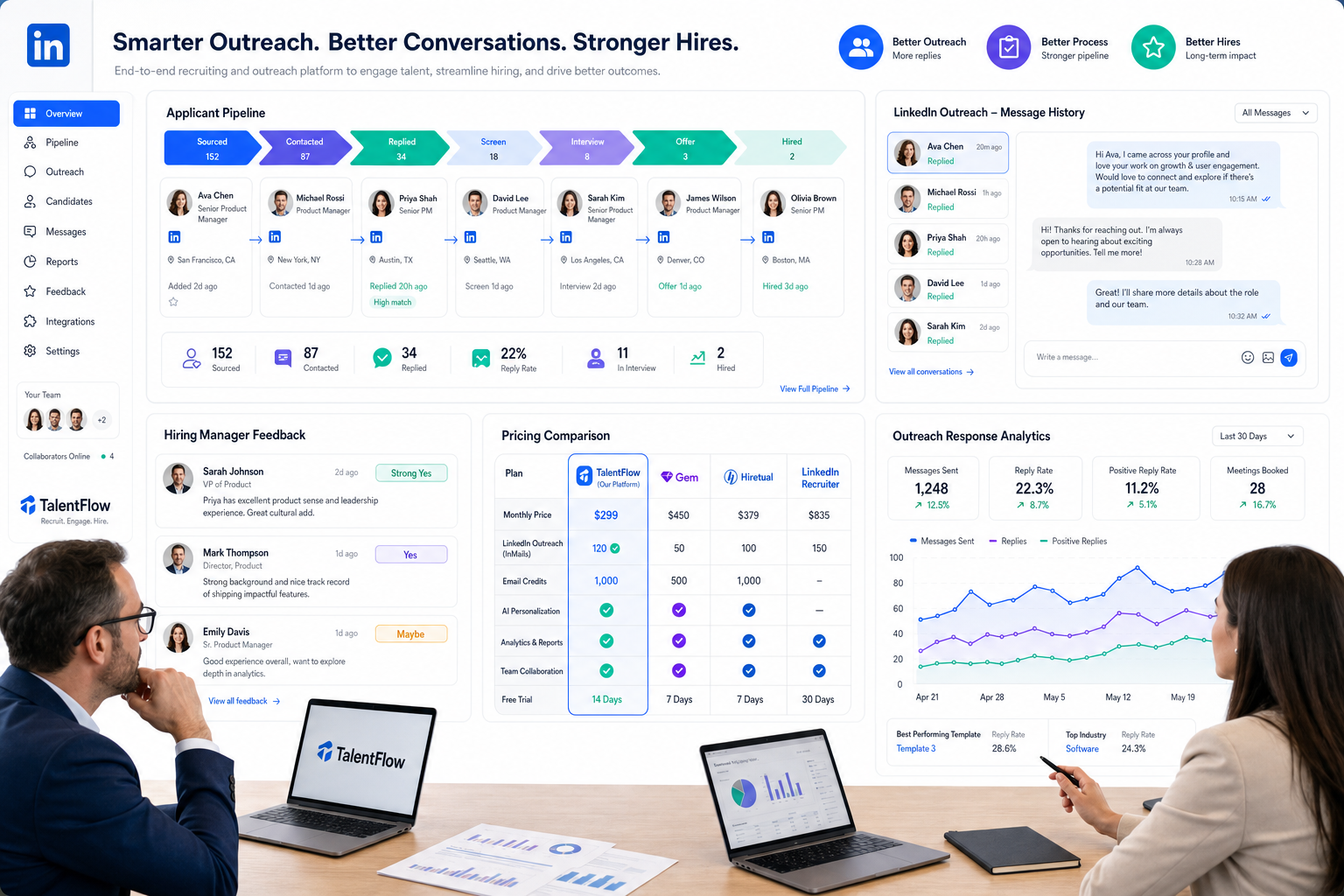
When a live search starts slipping, this article helps hiring leaders judge recruiting and applicant tracking software by partnership fit, context retention, and hidden buying risks.
That sounds obvious until a live search starts to slip. Agency owners feel it in slower fills and weaker client trust. Solo recruiters feel it in missed follow-ups, scattered notes, and after-hours message backlogs. In-house talent teams feel it when hiring managers disengage because the system adds steps without adding clarity. The cost is not just time. It shows up in damaged credibility, poor handoffs, and decisions made with incomplete candidate context.
In my own workflow, tools that support outreach and response coverage can reduce that friction before candidates even reach the formal pipeline. I have found that StrategyBrain AI Recruiter is most useful when the bottleneck is repetitive LinkedIn outreach, late candidate replies, and multilingual back-and-forth that would otherwise sit until the next morning. It can handle first-touch messaging, answer common role questions, and collect resumes or contact details, while the recruiter still makes the final call on fit, resume review, and who moves to interview.
The partnership point matters because good recruiters are rarely just resume brokers. In a well-run finance search, for example, a hiring manager does not only want names. They want someone who understands what has worked on the team before, which skills actually matter in the role, and how the business operates. The recruiter, in turn, needs enough continuity with that manager to move quickly when a vacancy opens instead of starting from zero.
There is another side to that same relationship. In finance and accounting especially, restructures and role changes can happen fast, and the person giving the brief today can become a candidate tomorrow. That reality exposes why the best recruiting software is not just a database. Strong recruiting and applicant tracking software should preserve relationship history, communication context, and decision patterns so recruiters can support both client and candidate moments without rebuilding the story from memory.
That opening case leads directly to the software question buyers actually face: which system helps recruiters manage relationships, candidate flow, and stakeholder context at the same time? The answer usually sits inside recruiting and applicant tracking software, but the evaluation should also cover applicant tracking software pricing, admin training, and whether applicant tracking system certification is relevant for long-term adoption.
- Recruiting software is broader than an ATS, but for most teams the ATS remains the workflow core.
- The best recruiting software supports recruiter-hiring manager partnership, not just candidate storage.
- Applicant tracking software pricing often depends on seats, employee count, open jobs, feature tiers, and onboarding scope.
- Applicant tracking system certification is usually platform-specific training rather than one universal standard.
- Relationship context, communication history, and stakeholder adoption are often more decisive than feature count alone.
- Why hiring partnerships matter in software selection
- What recruiting and applicant tracking software means today
- Best recruiting software by use case
- Quick comparison table
- Features that matter most
- How applicant tracking software pricing works
- Benefits for recruiters and hiring managers
- What applicant tracking system certification means
- How to choose the right system
- Common buying mistakes
- FAQ
Why hiring partnerships matter in software selection
One lesson experienced recruiters learn early is that the search does not succeed because a platform has more buttons. It succeeds because the recruiter and hiring manager stay aligned on what the team needs, what success looks like, and how fast decisions need to happen. The reference point from finance recruiting is useful here: a tenured recruiter becomes more effective over time because they learn the manager's standards, preferred traits, and business context. Software should help preserve and operationalize that advantage.
When systems fail, they usually fail in one of three ways. First, they separate communication from the pipeline, so recruiters hold key context in inboxes or LinkedIn threads instead of in the system. Second, they make hiring manager participation too clumsy, so feedback quality drops. Third, they capture transactions without capturing relationship memory, which means every new requisition feels like a reset.
That is why buyers comparing the best recruiting software should ask a more grounded question: does this system help us become better partners in hiring, or does it just make administration more formal?
What recruiting and applicant tracking software means today
The fastest way to understand this market is to treat recruiting software as the umbrella and applicant tracking software as the operating core inside it. In practice, the ATS manages structured steps like job posting, application capture, stage movement, interview scheduling, feedback, and reporting. The broader recruiting layer may also include sourcing, outreach, relationship management, career site tools, and integrations into HR systems.
For recruiters, the distinction matters less than the workflow. A contingent recruiter may care most about search speed, talent pools, and communication tracking. An internal talent lead may care more about approvals, compliance, and offer workflow. A hiring manager may simply want candidate review and feedback to be easy enough that they actually do it on time.
That is why the best recruiting and applicant tracking software usually combines structure with enough flexibility to reflect how people really hire. If the workflow is too rigid, users work outside the system. If it is too loose, reporting becomes unreliable and decision quality suffers.
A useful buying test is simple: if the software cannot hold both candidate progress and stakeholder context, it will struggle the moment hiring gets busy or relationships become complex.
Best recruiting software by use case
There is no universal winner. The best recruiting software depends on team size, hiring volume, stakeholder complexity, and how much relationship history you need the system to retain.
Best for small businesses
Smaller employers usually need clean basics: job posting, a simple career page, candidate stages, and enough collaboration to avoid email chaos. Ease of use matters more than deep customization. If one recruiter or an HR generalist runs hiring, the system should reduce admin work immediately.
Best for growing agency or in-house teams
Once multiple recruiters are involved, the pressure shifts to consistency and visibility. Mid-sized teams benefit from workflows that preserve client or hiring-manager preferences, standardize communication records, and support reporting by recruiter, role, or business unit.
Best for enterprise operations
Large organizations need configurability, governance, integration depth, and auditability. The key question is whether the system supports complex approval paths without making the daily recruiter experience slower than it needs to be.
Best for high-volume hiring
At scale, the priority is throughput. Pipeline automation, scheduling efficiency, and source-level analytics matter more than elegant but slow workflows. Recruiters still need enough context to avoid treating every role as interchangeable.
Best for relationship-led search work
Executive, specialist, and consultative recruiting models depend heavily on continuity. In those environments, software should make it easy to track conversations, store nuanced hiring-manager expectations, and revisit prior candidate interactions when priorities shift.
From experience, this is also where pairing an ATS with a targeted outreach layer can help. If a recruiter spends too much time chasing first responses on LinkedIn, a tool like AI Recruiter can keep outreach moving and collect early interest while the core ATS remains the source of record for evaluation and hiring steps.
Quick comparison table for recruiting and applicant tracking software
| Buyer scenario | Best fit | What to look for | Potential tradeoff |
|---|---|---|---|
| Small business with occasional hiring | Simple ATS-first platform | Easy setup, career page hosting, basic reporting, simple manager review | May lack deeper customization and talent pooling |
| Growing team with several recruiters | Mid-market recruiting software | Custom workflows, source tracking, collaboration records, role-based permissions | Seat-based pricing can rise quickly |
| Enterprise with formal governance | Highly configurable suite | Approvals, audit trails, integrations, implementation support | Longer rollout and heavier admin overhead |
| High-volume recruiting | Automation-oriented ATS | Bulk actions, scheduling, mobile workflow, funnel reporting | Less ideal for nuanced relationship-led search |
| Search work built on long-term hiring partnerships | Relationship-aware recruiting stack | Communication history, talent pools, stakeholder notes, flexible workflows | May require stronger process discipline to keep data clean |
Features that matter most
The best systems do not just organize applicants. They reduce friction in the exact places where recruiter-hiring manager partnerships tend to weaken.
Candidate pipeline management
This remains the center of any ATS. Recruiters need clear stage visibility, fast movement between steps, and role-specific flexibility. If a recruiter cannot tell what is blocked and why, the system is not helping enough.
Communication and relationship history
This is where many teams underbuy. The finance recruiter example is a reminder that context compounds over time. Good software should help preserve prior conversations, hiring preferences, and candidate history so future searches move faster and with better judgment.
Hiring manager collaboration
Reviewing profiles, giving feedback, and making decisions should feel lightweight. If occasional users find the system annoying, recruiters end up carrying administrative tasks that should be shared.
Job posting and career site management
These basics still matter, especially for lean teams. Roles should be easy to publish, update, and present clearly to candidates.
Integrations
Calendars, email, HR systems, and sourcing workflows need to connect smoothly. Disconnected tools create duplicate work and fragmented records.
Analytics
Leaders need reporting on time to hire, cost per hire, stage conversion, and source quality. But the more practical question is whether reporting explains where partnership and process break down. If managers delay feedback or candidates disappear after long gaps, the system should make that visible.
Outreach support where sourcing is heavy
When much of the work happens on LinkedIn, separate outreach support can be worth considering. I have used StrategyBrain AI Recruiter most effectively for after-hours candidate replies and multilingual messaging, particularly when live searches spanned time zones. It reduced repetitive back-and-forth and captured contact details, but I still reviewed resumes myself and decided who advanced.
How applicant tracking software pricing works
Applicant tracking software pricing often looks simpler than it is. Buyers see a base subscription, then later discover user limits, implementation fees, support tiers, integration charges, and workflow features held behind higher plans.
Common pricing models
- Per user or recruiter seat: common when pricing is tied to access.
- By employee count: more common in broader HR platforms.
- By open jobs or hiring volume: often used when recruiting demand fluctuates.
- Tiered feature plans: lower tiers cover ATS basics; higher tiers unlock automation, reporting, and integrations.
- Custom quote pricing: common for larger or more complex teams.
Costs buyers often miss
- Implementation or onboarding fees
- Data migration work
- Additional hiring-manager or admin seats
- Active job posting limits
- Integration setup charges
- Training packages or certification access
- Annual billing commitments
A practical buyer habit is to price the system against your next 12 months of likely growth, not just today's user count. That matters because relationship-led recruiting often expands unevenly. One new client team, one hiring surge, or one restructure can change usage quickly.
If you are also using a sourcing layer outside the ATS, include that in the operating model. The right stack can still be cost-effective, but only if each tool has a clear job and does not duplicate work.
Benefits for recruiters and hiring managers
The strongest applicant tracking system benefits are operational. They improve speed, consistency, and trust across the hiring process.
Better visibility
Recruiters can see who is active, who is stuck, and which roles need attention without chasing status through email threads.
More consistent collaboration
A good system helps hiring managers participate in a repeatable way. That lowers the risk that decisions depend on whoever happened to reply first.
Stronger relationship memory
This is one of the most underrated benefits. When recruiter notes, candidate history, and stakeholder preferences are preserved, the next search starts with context instead of guesswork.
Improved reporting
Leaders can assess source quality, recruiter workload, and bottlenecks with more confidence than they could from spreadsheets alone.
Scalability
Manual processes can survive a handful of roles. They usually break when hiring expands, recruiters multiply, or stakeholder groups become more distributed.
From a practitioner's perspective, the real win is not just filling the req. It is filling it without eroding the working relationship that makes the next req easier.
What applicant tracking system certification means
Applicant tracking system certification is often misunderstood. There is no single universal ATS credential that carries equal weight everywhere. In most cases, certification means vendor-specific training for administrators, recruiting operations staff, or advanced users.
When certification helps
- When internal admins manage workflows, permissions, and reporting
- When recruiting operations owns process optimization
- When a new implementation needs structured training
- When a larger team needs a formal onboarding path
When it matters less
- When the platform is intentionally lightweight
- When the hiring process is simple and stable
- When practical workflow coaching is more important than a formal badge
For buyers, the better question is not whether a certificate exists. It is whether the provider gives your team enough training to preserve consistency after rollout. If your software is meant to support partnership and context, your users need to know how to capture and use that context correctly.
How to choose the right system
- Map the relationship model. Identify who uses the system: recruiters, hiring managers, coordinators, HR admins, or agency partners.
- Document your core workflow. Include sourcing, application review, interviews, offers, and handoffs.
- List the context you cannot afford to lose. This may include prior candidate conversations, hiring-manager preferences, and team-specific evaluation patterns.
- Set success metrics. Use time to hire, cost per hire, source performance, stage conversion, and stakeholder adoption.
- Review applicant tracking software pricing in full. Ask for assumptions on seats, growth, support, and implementation.
- Assess training support. Determine whether applicant tracking system certification or admin enablement will matter.
- Run scenario-based demos. Use a realistic hiring situation, such as a repeat search with a known manager, a delayed feedback cycle, or a reopened role after restructuring.
Scenario-based demos are where weak systems usually get exposed. Ask how the platform handles a recruiter returning to an old search, a client or manager changing direction quickly, or a promising passive candidate replying after hours from another region.
Common buying mistakes
Choosing by feature volume
The longest feature list rarely predicts the best outcome. Workflow fit and user adoption matter more.
Ignoring relationship context
Many systems manage stages well but preserve very little usable memory about how people actually hire together.
Underestimating pricing complexity
Headline subscription numbers can hide meaningful costs in implementation, seats, and premium features.
Designing for recruiters only
If hiring managers or clients find the system cumbersome, recruiter workload rises and process quality falls.
Assuming training is optional
Even intuitive systems need process ownership. Certification is not always necessary, but clear enablement usually is.
FAQ
What is the difference between recruiting software and an applicant tracking system?
Recruiting software is the broader category, while an applicant tracking system is usually the workflow core. The ATS manages applications, stages, interviews, and reporting, while broader recruiting software may also cover sourcing, outreach, and relationship management.
How does applicant tracking software pricing usually work?
Applicant tracking software pricing commonly varies by recruiter seats, employee count, hiring volume, feature tiers, and implementation scope. Buyers should also ask about training, integrations, and support costs.
Why does recruiter-hiring manager partnership matter in software selection?
Because hiring quality depends on shared context, fast feedback, and trust. The best recruiting software supports those relationships instead of forcing people to work around the system.
What are the main applicant tracking system benefits?
The main benefits include clearer pipeline visibility, more consistent collaboration, stronger reporting, preserved relationship context, and better scalability as hiring grows.
Is applicant tracking system certification required?
Usually no. Most certification is platform-specific and helps administrators or operations teams. Many smaller teams can succeed with lighter training if the software is intuitive.
Can LinkedIn outreach tools work alongside an ATS?
Yes, if each tool has a clear role. An ATS should remain the source of record for hiring workflow, while an outreach tool can help with candidate engagement and early response handling.
Final thoughts
The best recruiting software is not just the system with the most features or the cleanest demo. It is the one that helps recruiters, hiring managers, and candidates move through real hiring situations with less friction and better context. That is why the strongest buying lens is not simply ATS functionality. It is whether your recruiting and applicant tracking software helps people work together well when the search gets urgent, the brief changes, or relationships need to carry extra weight.
For most teams, the smartest path is to evaluate workflow fit first, then pricing transparency, then enablement. If your process also depends heavily on LinkedIn outreach, adding a focused support layer like StrategyBrain AI Recruiter can help cover repetitive messaging and resume collection without replacing recruiter judgment. That combination often does more for live hiring than another glossy feature comparison ever will.