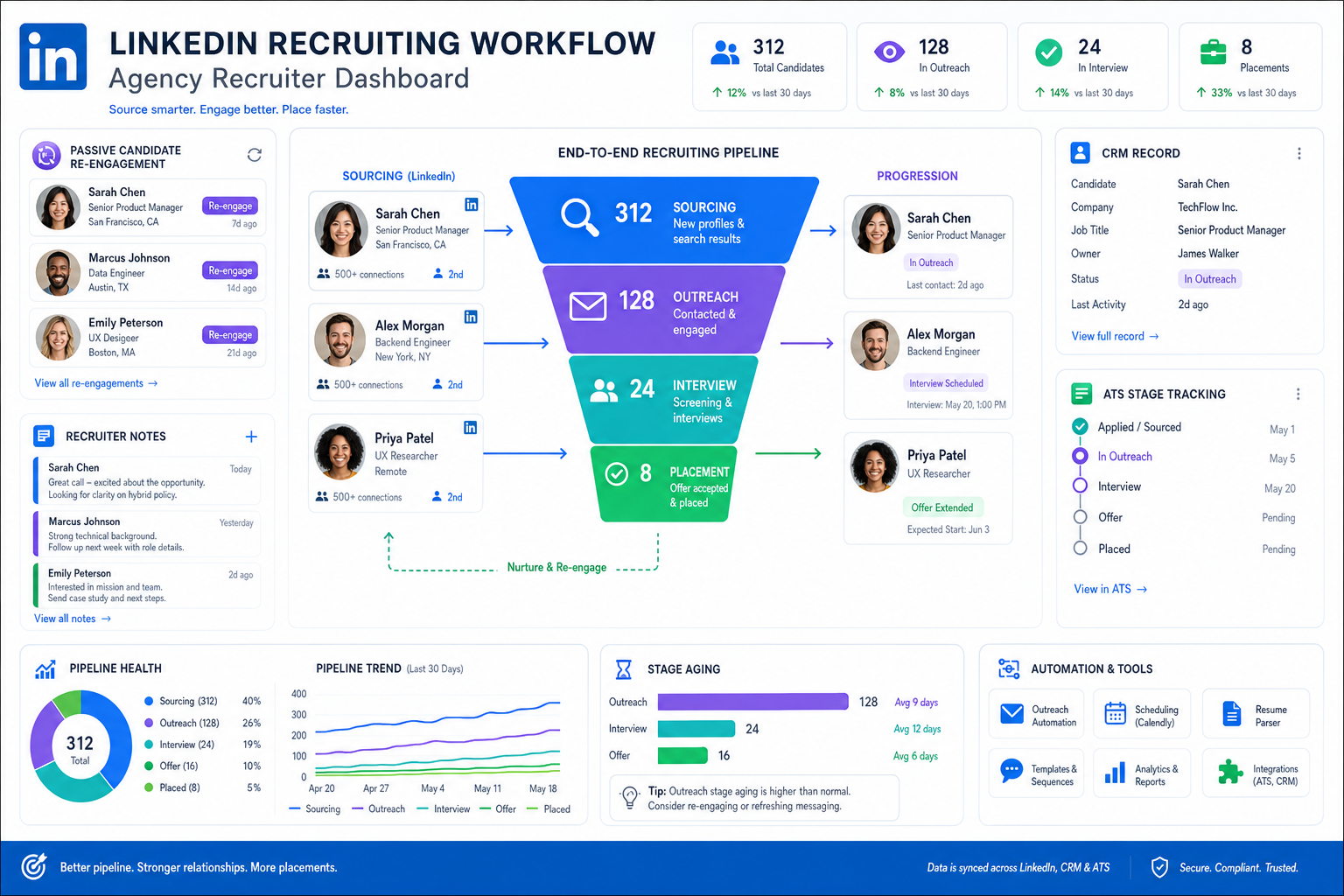
This guide helps recruiting leaders evaluate recruitment online for recruiters, prevent pipeline drift, and improve placements.
That distinction matters because most recruiting teams do not lose searches on feature gaps alone. They lose them when strong candidates never get re-engaged, when recruiter notes sit in inboxes instead of shared records, when passive talent drifts away, and when hiring managers only see the pipeline after momentum is gone. For a solo recruiter headhunter, that means missed fees and weaker client trust. For a growing agency or in-house team, it means slower hiring, more admin, and a process that depends too heavily on memory.
In my own workflow, tools that reduce repetitive outreach and keep candidate conversations moving have made the biggest difference, which is why I pay attention to platforms like StrategyBrain AI Recruiter. Used well, it can help with initial LinkedIn outreach, after-hours follow-up, and collecting resumes or contact details from interested candidates, while the recruiter still makes the final call on fit, resume quality, and next-step decisions. That balance matters when the problem is not just finding people, but staying engaged with them at the speed the market demands.
You see this clearly in specialist search. In finance hiring, for example, agencies that consistently place strong accountants do not rely on job ads alone. They stay active in the market every day, publish useful material, shape candidate positioning, and keep long-running relationships with professionals who are not actively applying but may move for the right role. The real advantage is not a single sourcing trick. It is daily marketplace engagement combined with a practiced sense of who is actually high quality for a given brief.
That is exactly where software selection becomes practical rather than theoretical. If your team depends on outbound relationship-building, passive-candidate tracking, and disciplined follow-up, an online recruitment website is not enough. You need recruiting software that supports the same strengths good agencies use in real markets: active engagement, quality judgment, and an established workflow for turning interest into interviews.
- What Best Recruiting Software Really Means
- Why Marketplace Engagement Matters in Software Choice
- ATS vs CRM vs All-in-One Recruiting Platforms
- Best Recruiting Software by Team Type
- Features That Matter Most to Recruiters
- Advantages of Applicant Tracking System Adoption
- How to Evaluate Recruiting Software Without Guesswork
- Common Buying Mistakes
- FAQ
What Best Recruiting Software Really Means
Choosing the best recruiting software is rarely about finding one perfect platform with the longest feature list. In practice, it is about whether your system supports the real work recruiters do every day: staying visible in the market, identifying quality, managing active jobs, and keeping relationships warm long enough to convert them.
That is why many searches for recruitment online for recruiters are really searches for something more specific: an applicant tracking system for recruiters, a recruitment CRM, or a platform that combines outbound sourcing with pipeline execution. Recruiters do not need vague online presence. They need operational control.
A useful working definition is this: the best recruiting software helps a team do three things consistently well.
- Stay engaged with the market through sourcing, outreach, and re-engagement
- Judge and organize quality with searchable records, notes, and talent history
- Run a repeatable hiring process with stages, scheduling, collaboration, and reporting
Key insight: The best system is the one that supports the same habits top recruiters already use offline: market engagement, quality judgment, and a repeatable methodology.
Why Marketplace Engagement Matters in Software Choice
One of the most useful lessons from specialist recruitment is that strong hiring outcomes come from consistent market participation, not occasional bursts of activity. Finance recruiters who regularly place top accountants tend to know the market because they are in it all the time. They speak with candidates daily, help shape positioning, and build credibility before a live role even appears.
That matters for software because a weak system breaks this rhythm. If recruiters cannot easily revisit past candidates, review old conversations, or track who was open six months ago, their real network becomes much smaller than it should be.
The second lesson is about quality judgment. Tenured recruiters build a feel for what "good" looks like in a role because they review talent in context, repeatedly, over time. Software should help preserve that judgment. Notes, tags, candidate history, and communication records are not administrative extras. They are how recruiter intuition becomes team memory.
The third lesson is methodology. Good agencies do not improvise every search from scratch. They follow repeatable steps for outreach, qualification, follow-up, shortlist management, and client communication. The right recruiting software should reinforce that discipline rather than scatter it across spreadsheets, inboxes, and disconnected tools.
In other words, software should not just process applicants. It should support the operational habits that already separate average recruiters from strong ones.
ATS vs CRM vs All-in-One Recruiting Platforms
A large share of software confusion comes from treating all recruiting tools as if they solve the same problem. They do not. Most teams are really choosing between workflow control, relationship management, or a combination of both.
What is an applicant tracking system for recruiters?
An applicant tracking system for recruiters manages candidates who are already in an active hiring process. It organizes applications, resumes, stages, interviews, feedback, approvals, and hiring decisions.
This is where the advantages of applicant tracking system tools become obvious. They create structure and visibility, especially when multiple recruiters, coordinators, and hiring managers are involved.
What is a recruitment CRM?
A recruitment CRM supports proactive recruiting before a candidate applies. It is built for sourcing, nurture campaigns, segmented talent pools, re-engagement, and long-cycle relationship tracking.
That is especially important for agency desks, executive search firms, and any recruiter headhunter model where passive talent is a core part of delivery. If your business depends on identifying accountants, engineers, or revenue leaders before they raise a hand, CRM capability is not optional.
What is an all-in-one ATS plus CRM?
An all-in-one platform combines inbound process management with outbound relationship management. For many teams, this is the best fit because the handoff between sourcing and process execution is where data often gets lost.
| Category | Best For | Primary Strength | Potential Limitation |
|---|---|---|---|
| ATS | Structured hiring workflows | Application-stage control | Often weaker for long-term sourcing |
| Recruitment CRM | Agency recruiting and executive search | Relationship-building and re-engagement | May require separate process tools |
| ATS + CRM | Teams managing both inbound and outbound | Unified recruiter workflow | Needs thoughtful setup and adoption |
If candidates mainly enter through applications, ATS depth matters more. If your team succeeds by building trust with passive talent over time, CRM depth becomes central. Most mature recruiting functions need both.
Best Recruiting Software by Team Type
The phrase best recruiting software only becomes useful when tied to the team doing the work. Different recruiting models create different software priorities.
Agency recruiter
Agency recruiters need speed, candidate rediscovery, client-by-client visibility, and outreach support. In many agency workflows, the platform must help the recruiter return to the market repeatedly, not just sort fresh applicants.
Practical priorities for agencies include:
- Fast search across candidate history and prior conversations
- Talent pooling and segmented outreach
- Multi-role pipeline visibility across clients
- Reporting that reflects recruiter activity and delivery health
Recruiter headhunter or executive search firm
A recruiter headhunter usually cares more about relationship depth than about high-volume applicant intake. Search work often depends on discreet outreach, candidate history, nuanced stage movement, and detailed notes that stay useful across long cycles.
Practical priorities for headhunters include:
- CRM-style candidate records with strong filters
- Easy review of past conversations before fresh outreach
- Flexible pipelines for retained or consultative searches
- Collaboration support when several consultants touch one mandate
In-house recruiting team
Internal teams usually need stronger hiring-manager collaboration, approvals, interview coordination, scorecards, and analytics. For them, the applicant tracking layer is often the operational backbone.
Practical priorities for in-house teams include:
- Scheduling and feedback collection
- Clear requisition and stage management
- Career site and job distribution support
- Reporting on conversion, aging, and bottlenecks
Lean or growing recruiting teams
Smaller teams benefit from software that reduces tool-switching. If one recruiter is handling outreach, screening, coordination, and reporting, an all-in-one setup often beats a fragmented stack.
In these environments, usability matters more than theoretical depth. A disciplined, simpler system that the whole team actually uses is usually better than a powerful platform that only one power user understands.
Features That Matter Most to Recruiters
Feature lists are easy to compare. What matters more is whether those features support the kind of market engagement and judgment strong recruiters rely on.
1. Candidate sourcing and talent pool management
If your recruiters spend serious time in outbound search, the software must make it easy to group, tag, revisit, and re-contact prospects. This is one of the clearest differences between a simple online recruitment website and software built for recruiters.
In my own sourcing work, this is also where AI Recruiter has been most useful as a supporting layer. It helps keep initial contact moving on LinkedIn, replies after hours, and gathers resume or contact details from interested people, so the recruiter can focus on actual fit assessment rather than repeated first-touch admin.
2. Searchable candidate history
Good recruiters build advantage through memory, but team-scale recruiting cannot rely on memory alone. Searchable records, tags, notes, and prior outreach history help recruiters act like they are deeply embedded in the market, even when team members change.
This is part of how agencies develop a stronger sense of quality over time. The system preserves context instead of forcing every search to start from zero.
3. Resume parsing and record standardization
Resume intake should be quick and consistent. Structured records reduce manual cleanup and make later rediscovery far easier.
One of the more practical applicant tracking system benefits is that every candidate record becomes easier to compare, search, and revisit.
4. Job posting distribution
For teams that do depend on inbound volume, posting tools still matter. But posting should be evaluated as an entry point, not the whole system. Ask what happens after candidates apply: duplicate handling, source tracking, routing, and stage visibility are the real workflow questions.
5. Interview scheduling and scorecards
Once candidate interest turns into active process, delays become expensive. Scheduling tools and structured scorecards reduce drift and make hiring-manager feedback easier to compare.
This is where ATS discipline often protects recruiter momentum built earlier through sourcing.
6. Pipeline management
Recruiters should be able to answer simple operational questions quickly: where is a role stuck, who is waiting on feedback, which candidates need re-engagement, and which searches are aging without movement?
If the software cannot answer these questions clearly, it is not helping the recruiter run a methodology.
7. Reporting and analytics
The most useful recruiting analytics do not just show activity. They show where the process breaks. Stage conversion, time in stage, source quality, outreach response patterns, and recruiter workload all help teams improve execution.
For leadership, this is one of the most durable advantages of applicant tracking system adoption: visibility without manual spreadsheet chasing.
8. Integrations with HR systems and communication tools
Software should fit the broader recruiting environment. For internal teams, this often means HRIS handoff. For agencies, it may mean email, calendar, and sourcing workflow continuity. Not every integration is urgent, but disconnected systems create hidden costs fast.
Advantages of Applicant Tracking System Adoption
Many teams understand what an ATS does in theory, but the real value becomes clear when recruiter activity scales beyond one person and one inbox.
- Process consistency: everyone uses the same stages and expectations
- Faster coordination: notes, interviews, and status updates live in one place
- Cleaner data: candidate rediscovery becomes easier over time
- Better visibility: blocked roles and slow stakeholders become visible earlier
- Improved candidate experience: fewer missed handoffs and delayed replies
These applicant tracking system benefits matter even more when the team is doing the kind of specialized search described earlier. If you are trying to place hard-to-find accountants, technical specialists, or senior leaders, every dropped note or missed follow-up weakens the search.
For many sourcing-heavy teams, the strongest setup is still ATS plus CRM, sometimes supported by targeted workflow automation on channels like LinkedIn. The lesson is consistent: structure matters most when the market itself is relationship-driven.
How to Evaluate Recruiting Software Without Guesswork
If you are comparing options, start with your recruiting motion rather than with a vendor demo.
- Define how your team wins searches. Is success driven by inbound applicants, outbound sourcing, or both?
- Map your market engagement. How often do recruiters revisit passive talent, send follow-ups, or reactivate old conversations?
- List the judgment points. Where do recruiters need context to assess quality, not just status?
- Test the daily workflow. Can a recruiter move from sourcing to screening to scheduling without tool friction?
- Check reporting against operating questions. Can leadership see bottlenecks, source quality, and aging roles?
- Evaluate implementation realism. The best fit is the one your team can adopt consistently.
A practical comparison framework looks like this:
| Evaluation Area | Questions to Ask | Why It Matters |
|---|---|---|
| Market engagement | Can recruiters easily source, re-engage, and track passive candidates? | Supports real recruiter behavior |
| Quality judgment | Does the system preserve notes, history, and candidate context? | Improves decision consistency |
| ATS workflow | Can we manage stages, interviews, and feedback cleanly? | Controls active hiring execution |
| CRM capability | Can recruiters build and nurture talent pools over time? | Essential for proactive recruiting |
| Automation support | Does the platform reduce repetitive outreach and admin? | Frees recruiter time for evaluation |
| Integration fit | Will this connect with our wider recruiting stack? | Prevents fragmented operations |
If your initial search was simply recruitment online for recruiters, this framework will usually get you to a much clearer shortlist than generic feature comparisons.
Common Buying Mistakes
Confusing visibility with workflow
An online recruitment website can support employer visibility or job discovery, but that is not the same as running a disciplined recruiting process. If your team needs outreach history, pipeline visibility, and candidate re-engagement, a website is only one piece.
Buying ATS-only software for a sourcing-led team
If your recruiters live in outbound search, ATS-only tools often force them to manage relationships elsewhere. That splits the process and weakens team memory.
Ignoring recruiter judgment in the system design
Software should not just show stages. It should help recruiters capture what they know about candidate quality, motivation, and timing. If that context is hard to store or retrieve, the team loses a major part of its advantage.
Overvaluing feature count
The longest checklist rarely wins in practice. Operational fit, recruiter adoption, and workflow clarity matter more than broad claims.
Skipping process design before rollout
Even the best platform will struggle if the team has not aligned on pipeline stages, ownership, outreach expectations, and reporting needs.
FAQ
What is recruiting software?
Recruiting software is a broad category that helps teams source candidates, manage applications, coordinate interviews, track pipelines, communicate with talent, and report on hiring activity. Depending on the workflow, it may function as an ATS, a recruitment CRM, or both.
What is the difference between an ATS and a CRM in recruiting?
An ATS manages candidates once they are in an active hiring process. A recruitment CRM helps recruiters build and maintain relationships before application, especially with passive talent. Many teams need both because sourcing and process execution are different jobs.
What software does a recruiter headhunter usually need?
A recruiter headhunter usually needs strong CRM capability, searchable candidate history, flexible pipelines, and reliable outreach support. Relationship depth is often more important than high-volume applicant processing.
How is an online recruitment website different from recruiter software?
An online recruitment website usually helps publish jobs or attract applicants. Recruiter software supports the work that happens after and around that, including outreach, tracking, communication, scheduling, feedback, and analytics.
What are the main advantages of applicant tracking system adoption?
The main advantages of applicant tracking system adoption are process consistency, cleaner data, easier collaboration, stronger reporting, and better visibility across the hiring funnel. These applicant tracking system benefits become more valuable as the team grows.
What features matter most for agency recruiters?
Agency recruiters should prioritize sourcing support, candidate rediscovery, communication workflows, talent pool searchability, and client-by-client pipeline visibility. If the model is heavily outbound, CRM capability matters as much as ATS workflow.
Where can LinkedIn automation support recruiters without replacing recruiter judgment?
It is most useful in repetitive first-touch work such as initial outreach, after-hours replies, and collecting resumes or contact details from interested candidates. The recruiter should still review the resume, assess fit, and decide whether to move the candidate forward. That is why I view tools like StrategyBrain AI Recruiter as workflow support rather than a substitute for recruiter evaluation.
Conclusion
The best recruiting software is the one that reinforces how strong recruiters already work. The agencies that consistently place hard-to-find talent do three things well: they stay engaged with the market, they develop a reliable sense of quality, and they follow a repeatable method. Your software should strengthen those habits, not interrupt them.
So if your search begins with recruitment online for recruiters, translate it into operational terms. Do you need better applicant control, better passive-candidate engagement, or both? Does your team depend on an online recruitment website, a sourcing-heavy CRM workflow, or a combined ATS plus CRM model? Once those answers are clear, the right platform category is usually much easier to spot.
Make the decision based on recruiter behavior, not marketing labels. That is how agencies, headhunters, and hiring teams choose software they can actually use well.