When ATS for recruiters evaluations miss after-hours workflow leaks, this article helps hiring leaders choose calmer systems and avoid burnout-driven mistakes.
That matters more than most software demos admit. When recruiters, agency owners, and in-house talent teams are buried in sourcing follow-ups, late hiring-manager feedback, interview rescheduling, and handoff gaps, the damage spreads well beyond admin time. Candidate response quality drops, promising leads cool off overnight, hiring managers lose trust in the process, and recruiters start doing the exact kind of always-on work that leads to burnout, poor concentration, and avoidable mistakes.
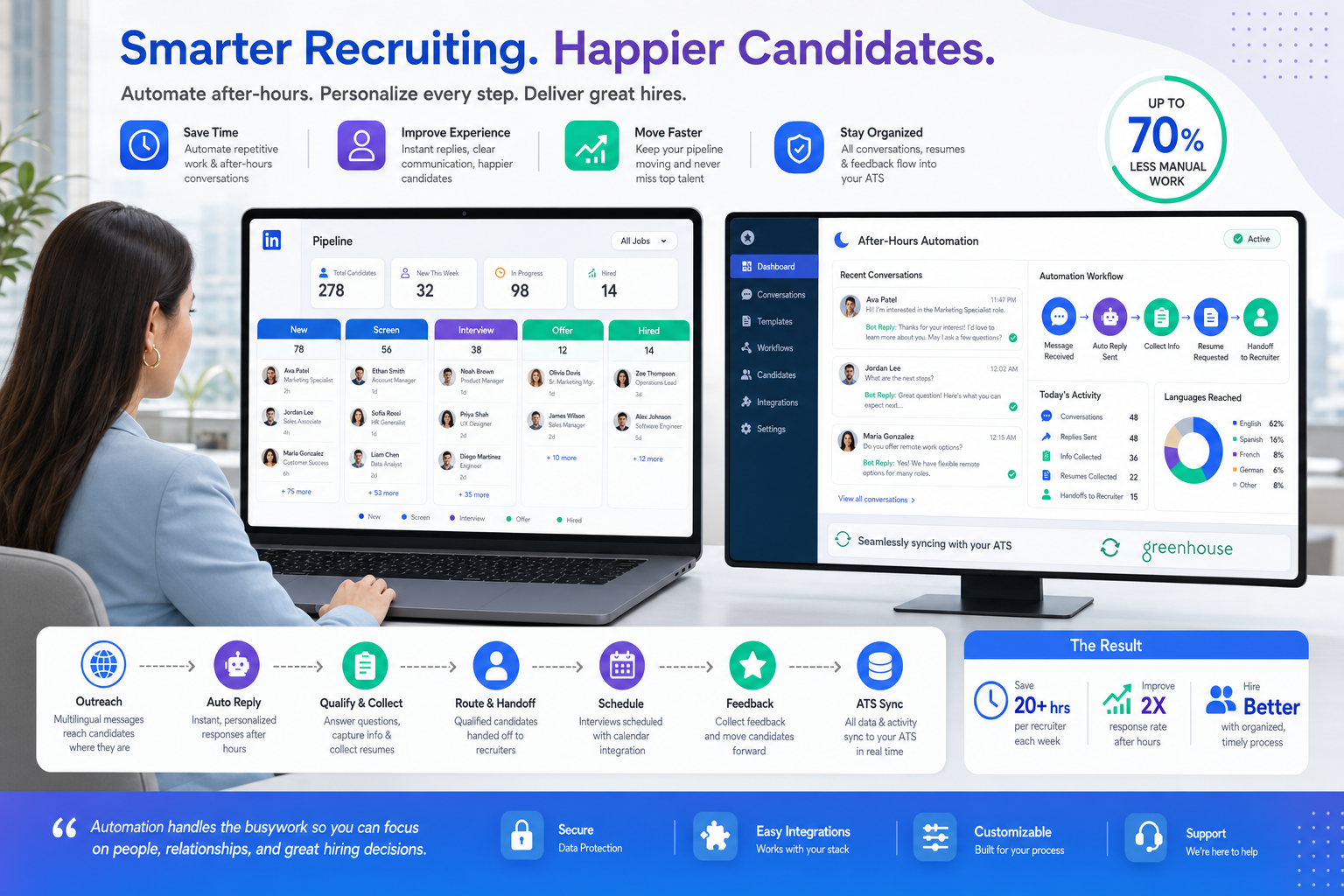
One practical way I have seen teams ease that pressure is by pairing a core ATS with targeted automation where the workload is most repetitive. In my own LinkedIn-heavy recruiting work, StrategyBrain AI Recruiter helped most with three specific bottlenecks: replying to candidate messages outside normal hours, keeping multilingual outreach moving across time zones, and collecting resumes or contact details once interest was confirmed. It did not replace recruiter judgment. I still reviewed resumes, decided who advanced, and handled the real qualification step, but it removed a lot of the back-and-forth that usually spills into personal time.
The pressure behind that kind of workflow problem is easy to recognize. In one widely cited finance leadership survey from Duke University and Grenoble École de Management, many CFOs reported that roughly 70-hour weeks had become normal. That is not a recruiting study, but the pattern carries over cleanly to hiring teams: once work stretches into nights, family events get missed, phones never stop buzzing, and the job starts consuming the hours that should protect clear thinking.
That is why choosing the best recruiting software cannot be treated as a feature-shopping exercise. The real question is whether your system reduces the same chain reaction the survey points to: constant interruptions, weak boundaries, and work that follows recruiters everywhere. If you are evaluating an ATS for recruiters, comparing the best applicant tracking systems for small companies, or even filtering out side-intent searches such as descargar paycor, the useful lens is simple: will this stack create a calmer, more consistent hiring process or just give your team one more tool to babysit?
Table of Contents
- Why Workload Relief Should Come First
- What an ATS for Recruiters Actually Needs to Do
- How to Compare Recruiting Software Categories
- Best Applicant Tracking Systems for Small Companies
- Recruiting Software Evaluation Matrix
- Where LinkedIn Automation Fits the Workflow
- Common Buying Mistakes
- What to Know About “Descargar Paycor”
- FAQ
Why Workload Relief Should Come First
Most articles about the best recruiting software start with features. Experienced recruiters usually start somewhere else: friction. If your team is already running hot, every weak handoff gets amplified. A recruiter who has to re-open LinkedIn at night to answer candidate questions, re-check a spreadsheet because stage data is stale, and then remind a hiring manager to submit feedback is not just losing time. That recruiter is losing consistency.
The finance reference point above matters because it frames the problem in human terms. Long weeks are not only a scheduling issue. They affect memory, focus, mood, sleep, and decision quality. In recruiting, those consequences show up in subtle ways: slower reply times, weaker note-taking, less disciplined screening, vague candidate updates, and hiring teams that start operating by inbox instead of by process.
That is why the ATS for recruiters should be evaluated as an operating-control system, not just a repository. The strongest setup helps teams protect focus during the workday so fewer tasks spill into the evening.
- For agency recruiters: it reduces the need to manually monitor every candidate conversation
- For corporate recruiters: it creates a cleaner source of truth across hiring managers and HR partners
- For small business operators: it lowers dependence on one overloaded person holding the entire process together
- For coordinators: it cuts the hidden work of chasing schedules, notes, and approvals
Key insight: The best recruiting software should make recruiters more available for judgment and less available for constant interruption.
What an ATS for Recruiters Actually Needs to Do
An ATS for recruiters is still the system of record for hiring activity. It should centralize candidate profiles, resumes, requisitions, stage movement, interview notes, feedback, approvals, and final decisions. But in practice, that definition is not enough. The better test is whether the system helps your team work in a way that is sustainable.
When buyers search for the best recruiting software, they are usually trying to solve one of four daily problems:
- Disorganized candidate history: notes and messages spread across inboxes, spreadsheets, and chat
- Pipeline confusion: no one is fully sure what stage a candidate is in
- Delayed collaboration: feedback arrives late or outside the system
- Messy handoff: recruiting and HR duplicate work after acceptance
The advantages of applicant tracking system use become real when those issues start disappearing. Recruiters spend less time rebuilding context. Hiring managers see where they need to act. HR gets a cleaner audit trail. Candidates get more consistent communication.
In other words, the platform should support both process control and human energy. That was the useful lesson I took from the work-life-balance reference material: a workflow that appears manageable on paper can still become unhealthy if every unresolved task follows people home through their phone.
What good ATS discipline looks like in practice
- Every job has clear stage definitions
- Candidate communication history is easy to find
- Interview feedback happens inside the system, not in side channels
- Ownership is visible at each stage
- Offer and onboarding handoff do not require duplicate entry
How to Compare Recruiting Software Categories
One reason software selection gets noisy is that several categories overlap in buyer language. ATS, recruiting software, hiring software, sourcing automation, and CRM tools often appear on the same shortlist. They are connected, but they are not identical.
| Category | Main Role | Best For | Watch-Out |
|---|---|---|---|
| ATS | System of record for applicants, stages, feedback, and decisions | Recruiters, HR teams, hiring managers | Poor configuration can make process feel rigid |
| Recruiting CRM | Talent relationship management for prospects and nurture workflows | Sourcing-led teams and pipeline builders | Often does not replace formal hiring controls |
| LinkedIn automation layer | Handles repetitive outreach, replies, and interest capture | Headhunters, agency recruiters, global sourcing teams | Still needs recruiter review for fit and advancement |
| Broader hiring suite | Combines recruiting with HR, onboarding, and administrative workflows | Companies reducing tool sprawl | May trade recruiter depth for breadth |
This is where I think many teams make a better decision once they separate core record-keeping from communication workload. A strong ATS anchors the process. Then, if your team does heavy outbound recruiting, a tool like AI Recruiter can support the front end by keeping candidate messaging active around the clock, especially when replies arrive after hours or across regions.
What I appreciated in use was not a promise that software would magically hire for me. It was the narrower gain: repetitive LinkedIn conversations kept moving, candidates could respond in their own language, resumes were collected when interest was real, and I could step in at the point where actual recruiter judgment mattered.
Best Applicant Tracking Systems for Small Companies
The search intent behind best applicant tracking systems for small companies is usually practical, not theoretical. Smaller teams are not asking for the broadest enterprise architecture. They are asking whether the system can be set up quickly, understood by occasional hiring managers, and maintained without a full operations layer.
For smaller organizations, the wrong tool creates the same work-life problem in a different form. Instead of a large team sharing the load, one recruiter, founder, office manager, or HR generalist ends up carrying everything. That is when nights and weekends disappear.
If you are choosing among the best applicant tracking systems for small companies, prioritize fit over ambition:
- Fast implementation: can you start using it without a long rollout?
- Simple permissions: can hiring managers participate without confusion?
- Clear pipelines: are the stages obvious to everyone involved?
- Useful reporting: can you see bottlenecks without complex setup?
- Reasonable integrations: does it connect to HR or onboarding steps you already use?
My practical advice is always the same: test one real job, not a polished demo. Post the role, move applicants through review, collect feedback, and complete the handoff. If one role already feels heavy, the system will not get lighter when you have several open searches running at once.
Recruiting Software Evaluation Matrix
Below is a working matrix for comparing the best recruiting software options without losing sight of recruiter workload.
| Evaluation Area | What Good Looks Like | Why It Matters |
|---|---|---|
| Candidate database | Searchable records, notes, and communication history | Prevents context loss and duplicate work |
| Pipeline management | Flexible stages with visible ownership | Reduces confusion and delays |
| Interview feedback | Structured scorecards collected on time | Improves decision quality |
| Scheduling support | Less manual back-and-forth | Protects recruiter time |
| Hiring manager experience | Low learning curve and simple review flow | Drives adoption outside TA |
| Reporting | Useful visibility into progress and bottlenecks | Supports process discipline |
| Compliance support | Documented records and permissions | Helps control and accountability |
| Implementation effort | Quick ramp-up with limited admin burden | Critical for small teams |
| Automation support | Repetitive outreach and updates handled cleanly | Reduces after-hours work |
If you want a one-line rule for selection, use this one: software should remove repeated effort from the hiring process before it adds sophistication.
Where LinkedIn Automation Fits the Workflow
Because this topic touches software use, especially recruiter workflows that start in outreach, it is worth separating ATS value from LinkedIn-heavy execution. They are related but not interchangeable. The ATS holds the hiring record. Outreach automation helps generate and maintain candidate flow.
In teams that rely heavily on LinkedIn sourcing, I have found the most useful support comes from automation that handles the repetitive first layer well and then hands control back to the recruiter. That is the scenario where StrategyBrain AI Recruiter fits best.
What it can help with
- Automating initial candidate connection and job introduction on LinkedIn
- Keeping conversations moving 24/7 when candidates reply outside business hours
- Supporting multilingual communication for cross-border searches
- Collecting resumes and contact details from interested candidates
From my perspective, the real benefit is not abstract AI hype. It is preserving recruiter attention for higher-value work. I can let messaging continue, then review the incoming resumes and decide who deserves deeper screening. That matters for agency recruiters handling multiple requisitions, for in-house teams covering several regions, and for independent headhunters trying to avoid being online every time a candidate replies late at night.
If you want to explore the workflow in more detail, the free trial and the product walkthrough at the AI Recruiter page show the practical use case better than generic automation claims do.
Used this way, automation supports the ATS rather than competing with it. Candidate interest gets captured, resumes are collected, and the recruiter still owns qualification, shortlist decisions, and stakeholder alignment.
Common Buying Mistakes
Even experienced teams make predictable mistakes when evaluating the best recruiting software. Most of them happen when buyers focus on features without tracing the real source of recruiter overload.
- Buying for future complexity instead of current pain. A bloated system will not save a lean team.
- Ignoring the cost of interruption. Tools that create extra notifications and duplicate updates can worsen workload.
- Assuming automation replaces judgment. It should reduce repetitive work, not remove recruiter review.
- Skipping hiring manager testing. If managers avoid the system, your process breaks anyway.
- Confusing access intent with evaluation intent. Not every software-related search means the buyer is comparing ATS options.
A useful checkpoint is to ask each stakeholder what work currently spills beyond the workday. Recruiters may say messaging and scheduling. Hiring managers may say resume review and scorecards. HR may say approvals and handoff. Your software stack should target those exact leaks.
What to Know About “Descargar Paycor”
The query descargar paycor usually signals navigational or download intent, not broad research into the best recruiting software. In plain terms, the searcher is often trying to find an app, login path, or official access point.
That distinction matters for recruiting teams doing software research. Some searches indicate buying intent. Others indicate usage intent. If your goal is to compare an ATS for recruiters, you should return to the workflow questions that matter most: how candidates are tracked, how feedback is captured, whether handoffs stay clean, and whether repetitive communication is controlled rather than constantly interrupting the team.
Browser-based platforms can work extremely well for recruiting because the core tasks still happen best on desktop: reviewing resumes, tracking stage movement, collecting hiring-manager input, and documenting decisions. So a download-related query like descargar paycor should not distract from the more important evaluation standard, which is operational fit.
FAQ
What is the difference between an ATS and recruiting software?
An ATS is usually the system of record for applications, stages, and hiring decisions. Recruiting software is a broader term that may also include sourcing, CRM, messaging automation, interview tools, and onboarding support.
What are the main applicant tracking system benefits for recruiters?
The main applicant tracking system benefits are centralized candidate data, clearer pipelines, structured feedback, better visibility, and less duplicated work. For recruiters, that usually means fewer interruptions and more consistent execution.
How should small businesses choose the best applicant tracking systems for small companies?
Start with ease of use, implementation speed, and hiring-manager adoption. The best applicant tracking systems for small companies are usually the ones a lean team can set up quickly and use consistently without adding process overhead.
Do LinkedIn automation tools replace recruiters?
No. They can keep repetitive outreach and candidate replies moving, but recruiters still need to review resumes, assess fit, decide who advances, and manage the relationship with hiring stakeholders.
When does StrategyBrain AI Recruiter make the most sense?
It is most useful when your team depends heavily on LinkedIn outreach, handles replies across time zones, or loses too much time to repetitive messaging and resume collection. In that setup, it works best alongside an ATS rather than instead of one.
Is browser-based recruiting software a problem if there is no separate app download?
Not usually. Most recruiter tasks still work best in a browser-based environment, especially resume review, stage management, structured feedback, and approvals.
Conclusion
The best recruiting software is not just the tool with the biggest feature list. It is the setup that keeps recruiters effective without forcing them into constant, after-hours maintenance work. If you evaluate an ATS for recruiters through that lens, you will make better choices around pipeline visibility, candidate organization, hiring-manager participation, and HR handoff.
For smaller teams, the lesson is even clearer. The best applicant tracking systems for small companies are the ones that reduce dependence on heroic manual effort. And when a search like descargar paycor appears during research, treat it as a different kind of intent altogether. In the end, the right recruiting stack should help your team stay organized, responsive, and sane enough to make better hiring decisions.