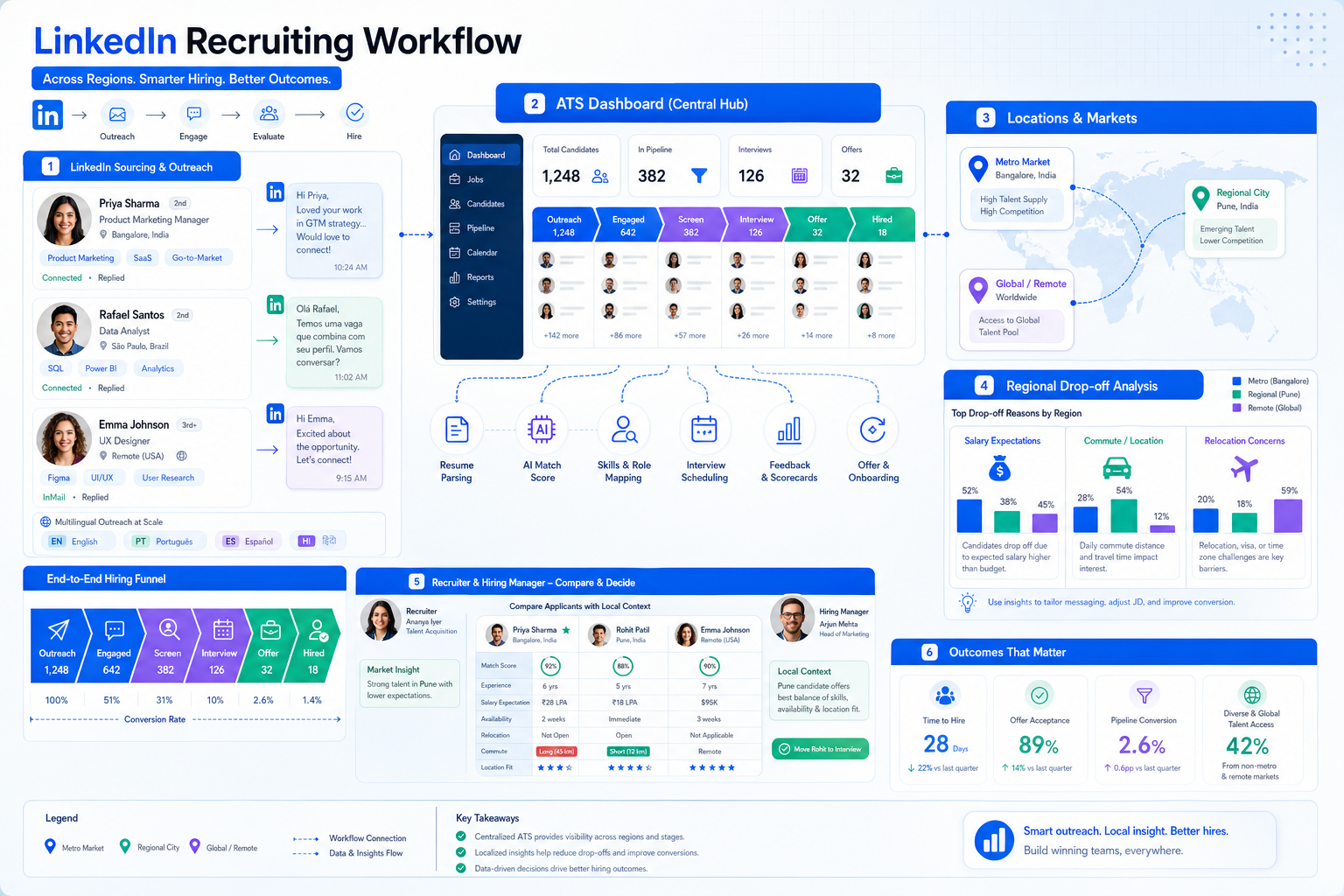
Assess an applicant tracking system for recruiters here before regional workflow gaps and local-fit misses cost your team placements.
That matters because many recruiting teams still run multi-location hiring with one generic workflow, even when candidate expectations shift sharply by region. The result is familiar: recruiters chase feedback in inboxes, hiring managers compare applicants without local context, compensation conversations stall, and good candidates disappear while the team debates whether the issue is salary, commute, flexibility, or simple market mismatch. For agency owners, solo headhunters, and in-house talent leads, those misses cost time, credibility, and placements.
One way I have reduced that friction is by pairing a core ATS with StrategyBrain AI Recruiter for the front end of outreach and early candidate communication. In practice, it helps most when a team is dealing with repeated LinkedIn follow-up, after-hours replies, and multilingual candidate conversations across locations. It can introduce roles, keep conversations moving, and collect resumes or contact details, while the recruiter still handles final judgment, resume review, and next-step decisions. Used that way, it supports the workflow instead of pretending to replace recruiting judgment.
That workflow issue becomes obvious when hiring expands across distinct local markets. A recruiter handling roles in a major metro, a smaller regional city, and a remote industrial area is not working with one talent pool but several micro-markets at once. In one location, candidates may expect hybrid work and move quickly if the process drags. In another, stability and family schedule matter more than title growth. In a rural or northern market, housing, relocation, and long-term location fit can decide whether a shortlist is real or only theoretical.
Once those differences hit the live pipeline, the software question gets sharper. The best recruiting software is not just the tool with the longest feature sheet. It is the platform that gives recruiters a reliable operating system for local context: better pipeline control, cleaner records, stronger collaboration, and reporting that shows where regional assumptions are breaking down. That is where an applicant tracking system for recruiters, the advantages of applicant tracking system adoption, and the most practical applicant tracking system benefits become part of the same buying decision.
Key insight: When hiring spans different labor markets, ATS quality matters more because recruiters need one system that can hold local nuance without losing process discipline.
Table of Contents
- Why regional hiring changes what the best recruiting software looks like
- What an applicant tracking system for recruiters actually does
- Advantages of applicant tracking system adoption in mixed markets
- Features that matter most when recruiting conditions vary by location
- How I use AI Recruiter alongside an ATS
- How to choose by team size and hiring complexity
- A practical evaluation process for recruiting teams
- Common mistakes when buying recruiting software
- FAQ
Why regional hiring changes what the best recruiting software looks like
Recruiters usually start software evaluations by listing standard needs: posting jobs, tracking applicants, scheduling interviews, collecting feedback, and reporting on funnel performance. All of that matters. But once hiring stretches across multiple regions, a more important question appears: can the system help the team respond to local differences without turning the process into chaos?
That is the practical lesson from localized recruiting. Labor markets are not uniform. Candidate mobility, pay expectations, work-style preferences, and competitive pressure can differ significantly between locations. The same title may attract a very different response in a dense urban market than it does in a smaller city or remote area. If your recruiting software cannot preserve those distinctions in the workflow, recruiters end up solving the problem manually.
In my experience, that manual fix usually looks the same everywhere: more notes outside the system, more recruiter memory carrying the process, more side messages to hiring managers, and weaker reporting because the real decision factors never make it into the ATS. A team can survive like that for a while. It cannot scale well that way.
So when people ask what the best recruiting software is, I usually answer with a qualifying question: best for what type of hiring reality? For many teams, the answer starts with whether the platform can support region-specific compensation conversations, location-fit screening, local sourcing channels, and stakeholder alignment across very different markets.
What an applicant tracking system for recruiters actually does
An applicant tracking system for recruiters is the operational center of recruiting software. It stores candidate records, manages hiring stages, documents communication and feedback, and gives the team a shared view of what is happening across open roles.
At a functional level, a good ATS usually supports:
- Candidate management: resumes, contact details, notes, communication history, and stage movement in one record
- Pipeline control: clear hiring stages from application through shortlist, interview, offer, and close
- Team collaboration: recruiter and hiring-manager access to status, scorecards, comments, and ownership
- Workflow automation: reminders, task triggers, and standardized actions that cut admin load
- Reporting: visibility into source quality, conversion rates, bottlenecks, and time in stage
- Integrations: links to calendars, email, HR systems, job boards, assessments, and messaging tools
The reason this matters more in regional recruiting is simple. A normal hiring process already has enough handoffs. Add location-specific realities such as relocation concerns, commute tradeoffs, or different compensation ranges, and those handoffs multiply. Without a strong ATS, the team starts improvising with spreadsheets and private notes. That creates fragmented records and slower decisions.
Where ATS structure helps most
Imagine a recruiting team hiring for one hybrid role in a major city, one office-based role in a smaller market, and one role in a remote area where relocation questions come up early. Recruiters need to track not just candidate interest, but why interest rises or falls by region. They need to know whether a candidate dropped because of pay, location, schedule, housing concerns, or competitive offers. An ATS makes that pattern visible when the workflow is designed well.
That is one of the most overlooked applicant tracking system benefits: not just storing applicants, but preserving the real operating context behind recruiting decisions.
Advantages of applicant tracking system adoption in mixed markets
The advantages of applicant tracking system adoption become much more tangible when recruiting teams are dealing with several labor markets at once. In that environment, the ATS is not just a convenience layer. It is how the team avoids losing local nuance while maintaining process consistency.
1. Faster response when candidate expectations differ by region
One of the most immediate applicant tracking system benefits is speed. When recruiters can see candidate stage, communication history, and blockers in one place, they spend less time reconstructing context. That matters when one market expects fast follow-up and another requires longer decision cycles because relocation or family logistics are involved.
What to test: Ask vendors to show stage automation, reminders, and how candidate reasons for progression or withdrawal are captured.
2. Better compensation and location-fit conversations
Regional hiring often fails because teams treat compensation as a national constant when it is not. A good ATS helps recruiters log market feedback consistently, tag patterns by location, and build a record of what candidates are actually saying. That creates better alignment with hiring managers and finance teams.
What to test: Check whether custom fields, filters, and reporting can reflect region-specific pay and work arrangement feedback without becoming messy.
3. Stronger collaboration with hiring managers
Hiring managers often understand the business need but not always the regional labor reality. Recruiters need a system that makes those differences easy to show. Centralized records, structured feedback, and visible ownership reduce the back-and-forth that slows regional hiring.
What to test: Have hiring managers review real candidate profiles during the demo. If they cannot understand status and context quickly, adoption will be weak.
4. Cleaner process across urban, regional, and remote openings
Another of the major advantages of applicant tracking system use is process consistency. Different locations may need different messaging or sourcing channels, but the team still needs a common framework for approvals, stage movement, feedback, and auditability.
What to test: Look for configurable workflows that allow local variation without creating separate systems for every market.
5. Reduced risk from poor location fit
Recruiters know that some hiring failures are not job-fit failures at all. They are location-fit failures. A candidate who underestimates commute time, housing pressure, or rural lifestyle change may exit early. Good ATS workflows support earlier documentation of those concerns and make them visible before the process goes too far.
What to test: Ask how the platform supports screening notes, disqualification reasons, and candidate history in a searchable way.
6. Better recruiting analytics
If software cannot separate regional patterns, reporting becomes too generic to be useful. Teams need to see where candidates are dropping, which locations are hardest to hire for, and whether the problem is sourcing, compensation, manager delay, or location reality.
What to test: Ask for reports by role, location, source, and stage. Dashboards should answer operating questions, not just look polished.
Features that matter most when recruiting conditions vary by location
Not every recruiting software feature deserves equal weight. In mixed-market hiring, the best systems are the ones that do the ATS basics extremely well and then add useful support around communication, reporting, and scale.
| Feature area | Why it matters | What recruiters should test |
|---|---|---|
| Pipeline management | Keeps multi-location hiring visible | Ease of moving candidates, filtering by region, and spotting stalled stages |
| Candidate record quality | Preserves local context | Whether notes, reasons, resumes, and communication are easy to review |
| Structured feedback | Improves manager alignment | How quickly hiring managers can leave clear, comparable input |
| Automation | Reduces repetitive follow-up | Reminders, stage triggers, and task creation tied to real recruiter workflows |
| Reporting and analytics | Shows regional bottlenecks | Location-based conversion, source performance, and custom reporting |
| Search and rediscovery | Supports repeat hiring in local markets | Speed and precision of filtering by skills, geography, and history |
| Integrations | Prevents duplicate work | Calendar, email, HRIS, and sourcing-channel connectivity |
| Scalability | Supports growth without rework | Whether the system can add users, roles, and process depth cleanly |
How to judge AI without getting distracted by labels
Most recruiting platforms now mention AI somewhere in the pitch. That alone is not enough. The better question is whether the AI reduces real recruiter work in the parts of the process that tend to break first: outreach, follow-up, note capture, candidate summaries, and workflow visibility.
If the feature saves repetitive effort and still leaves the recruiter in charge of judgment, it is usually worth attention. If it creates another review queue or adds unclear recommendations, it is probably noise.
How I use AI Recruiter alongside an ATS
I would not use AI to outsource hiring judgment, but I have found it useful for the repetitive communication layer that often slows regional hiring. My preferred setup is simple: let the ATS remain the source of truth for candidate status and team collaboration, then use AI Recruiter to keep top-of-funnel conversations active when recruiters are spread across time zones or handling too many LinkedIn threads at once.
In one recurring workflow, I use it to support outreach for roles where candidates respond after hours, ask early questions about compensation or work setup, or prefer communication in another language before sharing a resume. The tool can keep those conversations moving, gather resumes and contact details, and make the handoff cleaner for the recruiter. I still review the resume myself, decide whether the profile fits the brief, and determine whether the person moves forward.
What I like most is not the automation claim by itself. It is the reduction in dropped conversations. When a role spans several regions, follow-up tends to fragment first. Recruiters miss messages, candidates lose momentum, and local-market insight gets trapped in chat windows instead of informing the search. Using AI Recruiter conversation workflows as a support layer helps keep those early interactions alive without pretending that candidate qualification is fully automated.
For teams that rely heavily on LinkedIn sourcing, that combination can be practical: the ATS holds the process, while AI support handles repetitive outreach and response management. That is especially useful for agencies, lean in-house teams, and recruiters covering more than one geographic market.
How to choose by team size and hiring complexity
The best recruiting software depends on how your team works, how often you hire, and how much regional variation you deal with.
Small teams and independent recruiters
Smaller teams usually need simplicity first. A clean applicant tracking system for recruiters with strong candidate records, basic automation, and an easy hiring-manager experience will do more than a bloated platform.
- Prioritize fast setup and usability
- Look for straightforward pipeline visibility
- Use AI support carefully for outreach or follow-up if LinkedIn volume is high
Mid-sized internal recruiting teams
Growing teams typically feel the pressure of inconsistent workflows first. This is where the advantages of applicant tracking system adoption become strategic. Standardization, analytics, and stakeholder coordination matter more as roles spread across departments and locations.
- Prioritize reporting and workflow flexibility
- Check whether region-specific fields and filters are practical
- Validate integration needs before rollout
High-volume and enterprise teams
Larger teams need stronger governance. In these environments, the most meaningful applicant tracking system benefits often come from permissions, audit trails, process consistency, and dependable integration performance.
- Prioritize controls, role-based access, and scalability
- Test reporting by location and business unit
- Examine implementation quality, not just feature breadth
Agency recruiters and search teams
Agency teams often need ATS discipline plus stronger sourcing speed. Candidate rediscovery, searchability, communication tracking, and fast recruiter handoff all matter. If you recruit across several local markets, test how well the system handles nuanced notes and repeat searches, not just active applicants.
- Prioritize search quality and recruiter speed
- Check whether outreach support can reduce admin on LinkedIn-heavy desks
- Make sure the software supports both delivery and relationship history
A practical evaluation process for recruiting teams
If you are comparing the best recruiting software, a structured evaluation process beats generic demos every time.
- Map the real hiring workflow. Include where regional differences show up: compensation pushback, hybrid expectations, relocation concerns, manager delays, or location-fit drop-off.
- Define ATS non-negotiables. Start with the basics an applicant tracking system for recruiters must handle well: candidate records, stages, collaboration, reporting, and integrations.
- Separate workflow-critical needs from feature curiosity. AI can help, but not if the underlying process is weak.
- Use scenario-based demos. Ask vendors to show a realistic flow: sourcing a candidate, collecting a resume, screening for location fit, moving through interviews, and reporting by region.
- Include hiring managers. If the manager experience is clumsy, recruiters will end up carrying too much process manually.
- Test analytics early. You should know whether the platform can show regional bottlenecks before you shortlist vendors.
- Plan for adoption. The software should fit your process, but your team still needs ownership, training, and discipline.
That process makes the advantages of applicant tracking system adoption visible in daily work, not just in a sales deck.
Common mistakes when buying recruiting software
Buying for generic best-in-class claims
There is no single best platform outside your hiring reality. If your recruiting environment spans very different labor markets, software built only for a uniform process may disappoint quickly.
Ignoring local context in workflow design
Even good software fails when every region is forced into the same assumptions. The system should support consistency, but it must also let recruiters capture why local markets behave differently.
Overvaluing AI while under-testing core ATS quality
If candidate records, reporting, and hiring-manager collaboration are weak, AI features will not save the process.
Skipping recruiter-side communication testing
In many teams, communication is where the process actually breaks. If sourcing or LinkedIn follow-up is central to your work, test whether your stack can support that load sensibly.
Underestimating reporting needs
Many teams discover too late that they cannot answer simple questions such as which location loses the most candidates or whether compensation objections are concentrated in one market.
FAQ
What is an applicant tracking system for recruiters?
An applicant tracking system for recruiters is software that helps manage candidates, hiring stages, feedback, communication history, and recruiting reports in one system. It is usually the core of broader recruiting software.
Why does regional hiring affect ATS selection?
Because candidate expectations, compensation pressure, and location-fit issues can vary significantly by market. A stronger ATS helps recruiters preserve that context and manage it consistently across roles.
What are the main advantages of applicant tracking system adoption?
The main advantages of applicant tracking system adoption include centralized candidate data, better collaboration, faster process execution, workflow consistency, stronger reporting, and more reliable records.
Which applicant tracking system benefits matter most to recruiters?
The most practical applicant tracking system benefits for recruiters are visibility, speed, cleaner collaboration with hiring managers, and better reporting on where the funnel is slowing down or breaking.
Can AI help without replacing recruiter judgment?
Yes. AI is often most useful in repetitive communication, outreach, and follow-up support. Recruiters should still make the final decisions on resume quality, fit, and next steps.
How does StrategyBrain AI Recruiter fit into this workflow?
It works best as a support layer for LinkedIn outreach, candidate messaging, multilingual communication, and collecting resumes or contact details. The ATS remains the process backbone, while the recruiter keeps control of qualification and progression.
What should teams test in a recruiting software demo?
Test real workflows: creating a role, reviewing applicants, tracking location-specific issues, collecting hiring-manager feedback, handling outreach volume, and reporting on source and stage performance.
Final thoughts
The search for the best recruiting software gets clearer when you stop asking which platform has the most features and start asking which one helps your team hire accurately across different markets. For most organizations, that means beginning with the applicant tracking system for recruiters and evaluating whether it can hold local recruiting context without sacrificing speed or consistency.
That is where the real advantages of applicant tracking system adoption show up. The strongest systems do not just organize applicants. They help recruiters interpret what the market is saying, keep hiring managers aligned, and reduce risk when location fit matters as much as job fit. Those are the applicant tracking system benefits that matter most in real recruiting work.