When placement risk rises, this article helps recruiters judge hiring systems by reopen-readiness, so searches stay defensible and client trust holds.
That matters more than most software demos admit. When a recruiter is managing outreach, résumé follow-up, interview coordination, and client updates at the same time, the real failure point is rarely a missing feature. It is the gap between candidate momentum and process control. For a small search firm owner, that gap means lost billings and weaker client trust. For an individual recruiter, it means more after-hours admin and more missed follow-ups. For an in-house talent lead, it means slower hiring, confused hiring managers, and a process that looks less reliable than it should.
In my own workflow, tools that reduce repetitive sourcing and reply handling help most when they support, rather than replace, recruiter judgment. That is where StrategyBrain AI Recruiter can be useful in a broader hiring stack: it can automate initial LinkedIn outreach, keep candidate conversations moving across time zones, and collect résumés and contact details from interested prospects. The recruiter still owns final qualification, résumé review, and the decision about who should move forward.
A useful way to frame this comes from a familiar recruiting promise: reducing risk after a hire is made. In one recruiting announcement from Vancouver in December 2018, a long-established contingency firm did not just talk about filling roles. It introduced an added pledge on top of its existing six-month guarantee, meant to protect clients if a new hire left, was let go, or could not be successfully replaced. That is a client-side problem every experienced recruiter recognizes. Once the placement is live, the recruiter still has to track what happened, document handoffs, and show that the process was disciplined enough to stand behind.
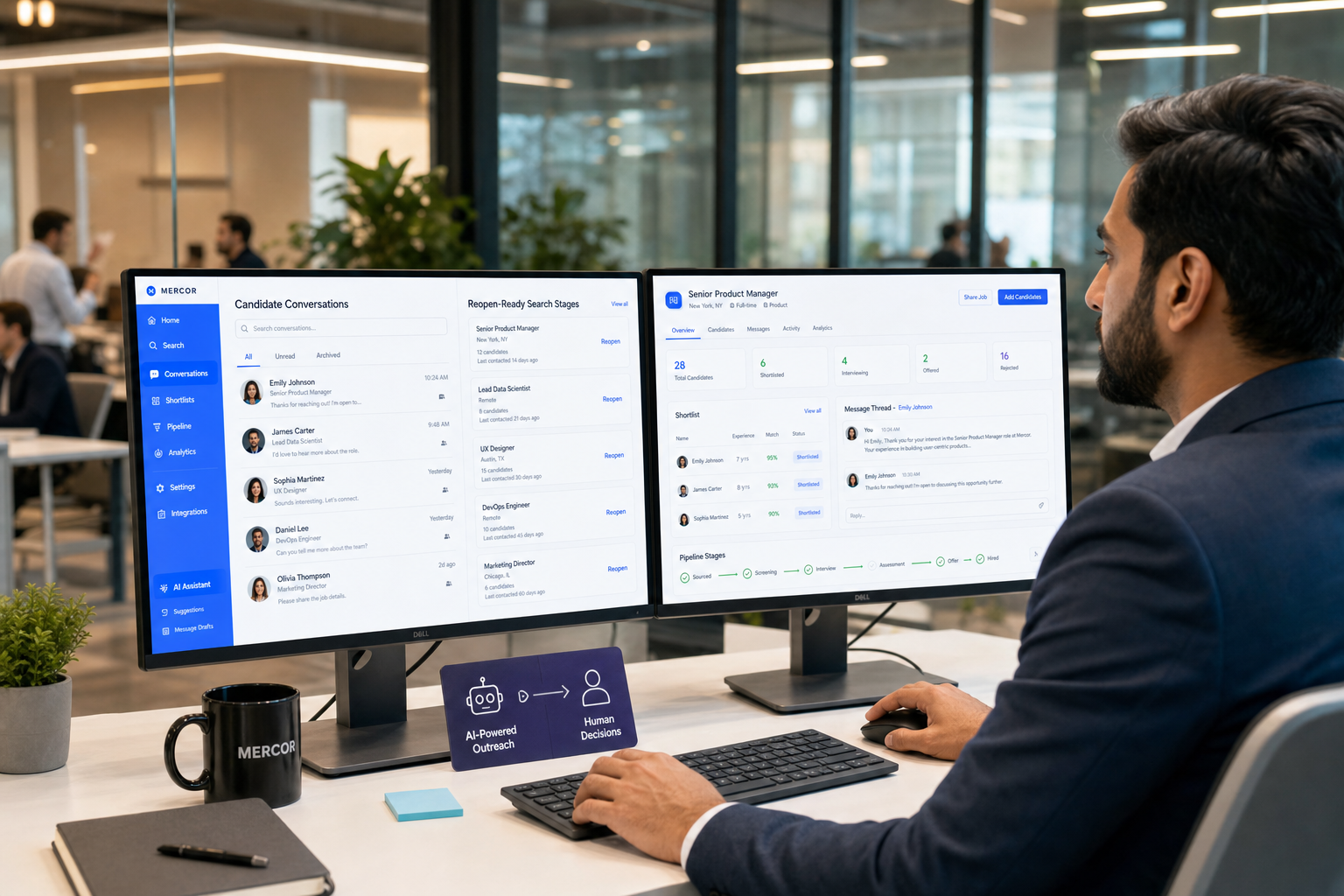
If you picture the actual work behind that promise, the software question becomes obvious. A recruiter has to reopen the search, review the original shortlist, check prior candidate replies, confirm what was shared with the client, and restart outreach without losing context. A client-facing guarantee sounds simple in sales language, but operationally it depends on whether the hiring system preserved stage history, communication records, and ownership well enough to act quickly when a placement risk turns real.
That is why evaluating the best recruiting software should start with reliability, not novelty. Strong hiring systems help recruiters protect client relationships, maintain process continuity, and manage applicant hiring with enough structure that a hiring system still works when a search must be reopened, defended, or accelerated.
- Hiring systems are broader than an ATS and should be evaluated by workflow reliability as much as feature breadth.
- The best recruiting software helps recruiters manage risk before and after a hire, especially when a search must be reopened or documented.
- A hiring system should preserve candidate history, stage movement, communication records, and recruiter accountability.
- Applicant hiring workflows break down fastest when outreach, follow-up, and client updates live in separate tools.
- AI support is most useful when it reduces repetitive messaging and admin while leaving final recruiter judgment intact.
Table of Contents
- Why reliability matters in recruiting software
- Hiring systems vs ATS vs applicant hiring tools
- What the best recruiting software must handle
- Which hiring system fits which recruiting team
- How to evaluate a hiring system before you buy
- Where AI fits into modern recruiting workflow
- Common buying mistakes
- FAQ
Why reliability matters in recruiting software
Most lists about the best recruiting software focus on features. In practice, experienced recruiters usually care first about whether the system holds up when the process gets messy.
The reason is simple. Recruiting is not linear. A role is approved, then reprioritized. A finalist accepts, then backs out. A placement starts, then exits early. A hiring manager changes the brief after the market has already been contacted. In each of those moments, the value of hiring systems is not just speed. It is their ability to preserve continuity.
That is the deeper lesson behind guarantee-style recruiting commitments like the one announced by that Vancouver agency in 2018. Any firm can market confidence. The operational question is whether the team has a hiring system strong enough to support that confidence when a replacement search, re-engagement campaign, or client review is needed.
For recruiters, that means software should help you do four things well:
- See what happened in the search without reconstructing it from inboxes
- Resume candidate contact without losing prior context
- Show clients and hiring managers a defensible process history
- Restart applicant hiring activity faster when the original hire does not hold
If a platform cannot support those realities, it may still be polished software, but it is not likely to be the best recruiting software for serious search work.
Hiring systems vs ATS vs applicant hiring tools
These terms overlap, but they are not always interchangeable. Buyers often say they need better hiring systems when the real issue is that the current workflow is fragmented.
| Term | What it usually means | Why it matters |
|---|---|---|
| Hiring systems | The broader category of technology supporting recruiting workflow | May include ATS, CRM, sourcing, scheduling, analytics, and automation |
| Hiring system | A platform or connected stack used to run recruiting operations | Should reflect how your team actually recruits and hands off work |
| Applicant hiring tools | Tools focused on candidate intake, movement, and communication | Useful when screening and process speed are the main bottlenecks |
| ATS | The system of record for applications, stages, and feedback | Usually the backbone for compliance, visibility, and reporting |
| Recruiter workflow tools | Tools that support sourcing, outreach, and candidate engagement | Important when the search starts before candidates formally apply |
For most teams, the ATS is the core record system, but it is not the whole answer. A search firm, internal talent team, or headhunter often needs a broader hiring system that captures early conversations, sourcing activity, stakeholder updates, and scheduling work before formal application stages even begin.
That is why applicant hiring problems often show up as software selection mistakes. Teams buy for posting and tracking, then discover they also need better outreach workflow, candidate re-engagement, and stronger visibility when a role changes course.
What the best recruiting software must handle
The best recruiting software should help a recruiter maintain control from first outreach through offer, start date, and, when necessary, replacement activity. I would assess it in seven operational areas.
1. Requisition clarity and job posting control
A good hiring system should make it easy to create, approve, and update roles without version confusion. If a recruiter cannot tell which brief is current, the rest of the process is already compromised.
2. Candidate record continuity
This is where many hiring systems fail quietly. Recruiters need one place to see outreach history, applications, feedback, notes, and status changes. When a search has to be restarted, this continuity becomes one of the most important applicant hiring advantages a platform can offer.
3. Outreach and response handling
Not all recruiting starts with inbound applicants. For many headhunters and agency recruiters, the process begins with direct outreach. In my own experience, using AI Recruiter alongside a core ATS helped most with the repetitive first layer of LinkedIn communication. It kept initial candidate conversations moving, gathered résumé and contact information from interested prospects, and reduced the need to chase every evening reply manually. What it did not do, and should not do, is replace my evaluation of whether a résumé actually fit the brief.
4. Interview coordination and stakeholder handoff
Once interest is confirmed, the hiring system has to support scheduling, panel coordination, and feedback collection without adding friction for hiring managers. If handoffs are clumsy, speed drops and candidate confidence falls with it.
5. Search restart and replacement readiness
This is the capability too many buyers ignore. If a placed candidate exits early, can the team reopen the role with prior candidate history intact? Can the recruiter quickly identify silver medalists, prior outreach responses, and previous client feedback? Software that supports this well is far more valuable than another decorative dashboard.
6. Reporting and accountability
Reporting should answer practical questions: Where did qualified candidates come from? Where did they stall? Which searches are vulnerable? Which managers delay feedback? Strong reporting is one of the most useful hiring system benefits because it turns recruiting from reactive work into manageable operations.
7. Compliance, privacy, and explainability
When AI or automation is involved, recruiters should understand what the tool does, what data it uses, and where human review sits. That matters for trust, governance, and candidate fairness.
Which hiring system fits which recruiting team
The right system depends heavily on who is recruiting, how often they hire, and how much process variation they deal with.
Small and midsize employers
SMB teams usually need a hiring system that is easy to adopt, fast to configure, and strong enough to prevent hiring manager chaos. Simplicity matters more than feature count.
Enterprise talent acquisition teams
Enterprise teams need approvals, permissions, integration depth, reporting discipline, and process consistency across business units. Their hiring systems must support governance as much as day-to-day recruiting.
Agency recruiters and search firms
Agencies need speed, candidate relationship visibility, and the ability to move between open searches without losing context. They also have stronger commercial pressure around placement quality and replacement risk, which makes record continuity especially important.
High-volume hiring teams
High-volume recruiting depends on repeatable applicant hiring workflow, messaging consistency, and efficient scheduling. Automation helps here, but only if the process remains reviewable.
Source-heavy and LinkedIn-driven recruiters
When recruiting depends heavily on outbound prospecting, many ATS platforms are not enough on their own. This is where a sourcing workflow layer can help. For recruiters who spend significant time on LinkedIn, StrategyBrain AI Recruiter is most relevant when the pain point is repetitive outreach, after-hours message handling, and collecting candidate details before formal screening. It is best treated as support for recruiter capacity, not as a replacement for recruiter judgment.
How to evaluate a hiring system before you buy
If you want to compare the best recruiting software seriously, use an evaluation process that mirrors real recruiting risk rather than a generic feature scorecard.
Step 1: Map the search from brief to backup plan
Do not stop at requisition approval and interview stages. Include what happens if a finalist withdraws, a hire exits early, or a replacement search is needed. The 2018 guarantee example is useful here because it reminds buyers that recruiting credibility does not end at acceptance.
Step 2: Test the system with a reopened role scenario
Ask the vendor to show how a recruiter would revisit a filled role, pull prior candidates, review communication history, and restart outreach. This is one of the clearest ways to separate robust hiring systems from basic applicant databases.
Step 3: Check user experience by role
Recruiters, coordinators, hiring managers, and interviewers all use the hiring system differently. A tool can work well for power users and still fail because occasional users avoid it.
Step 4: Review candidate-side friction
Look at application flow, response timing, interview scheduling, and duplicate requests for information. Applicant hiring should feel organized externally, not just internally.
Step 5: Validate integration depth
Surface-level integrations often sound better than they work. Ask what data syncs automatically, what remains manual, and where recruiters still copy information between tools.
Step 6: Evaluate AI features with a human-review lens
If the system includes automation, ask where it helps, what it cannot judge, and how recruiters can review or override outputs. Useful AI reduces admin. Risky AI hides reasoning.
Practical demo test: Use one real search scenario with three moments: initial outbound sourcing, shortlist presentation, and a replacement search triggered within six months. If the system struggles in that sequence, it will struggle in production.
Where AI fits into modern recruiting workflow
AI is now part of almost every recruiting software conversation, but the useful question is narrower: where does it remove repetitive work without weakening decision quality?
In recruiting operations, the strongest use cases are usually administrative and communication-heavy:
- Drafting or sending initial candidate outreach
- Handling candidate replies outside recruiter working hours
- Collecting résumés and contact details from interested prospects
- Summarizing candidate information for recruiter review
- Supporting scheduling or follow-up reminders
That is why I see value in AI-supported outreach tools only when they are transparent about the boundary between automation and judgment. In my own use, the benefit of StrategyBrain AI Recruiter was not that it magically qualified candidates for me. It was that it kept top-of-funnel conversations active, including multilingual and after-hours replies, while I focused on the actual assessment work. That distinction matters. A recruiter still needs to read the résumé, test the brief against the market, and decide who deserves a client conversation.
Buyers should also be careful with broad claims around bias reduction or fully automated qualification. A tool may support consistency, but it does not replace structured criteria, recruiter oversight, or fair process design.
Common buying mistakes
Most disappointment with recruiting software starts before implementation. These are the issues I see most often.
Choosing based on polished demos
Many products look capable in a guided tour. Far fewer perform well when a recruiter needs to reopen a search, recover prior outreach history, or defend process quality to a client.
Buying an ATS when you really need broader hiring systems
If your work depends on outbound search, passive candidates, or agency-style relationship management, ATS basics alone may not cover the workflow.
Ignoring post-offer risk
Software decisions often focus on time-to-fill and application handling. But the stronger long-term value comes from what happens when a placement does not hold and the team must act quickly.
Overestimating AI
Automation can help with sourcing and communication, but applicant hiring still requires recruiter judgment. If the vendor cannot explain where human review belongs, keep asking.
Underestimating implementation discipline
Even the best recruiting software performs poorly if stage definitions, ownership rules, note standards, and hiring manager responsibilities are vague.
FAQ
What is the difference between hiring systems and recruiting software?
Recruiting software is the broad market label. Hiring systems usually refers to the operational tools or connected stack used to run recruiting workflow, including ATS, sourcing, scheduling, analytics, and collaboration.
What makes a hiring system good for recruiters?
A strong hiring system supports real recruiter workflow: candidate history, stage tracking, outreach continuity, hiring manager collaboration, reporting, and the ability to restart or defend a search when needed.
How is applicant hiring different from applicant tracking?
Applicant hiring is the broader process of moving candidates toward selection. Applicant tracking is the system function that records applications, statuses, notes, and workflow movement inside that process.
Why does replacement risk matter when choosing recruiting software?
Because recruiting does not end when an offer is accepted. If a hire exits early or a replacement search becomes necessary, your system should preserve enough context to restart efficiently and maintain client confidence.
Can AI replace recruiter screening?
No responsible team should assume that. AI can help with outreach, scheduling, or summarization, but final qualification and résumé assessment should remain with the recruiter or hiring team.
When is StrategyBrain AI Recruiter most useful?
It is most useful when recruiters rely heavily on LinkedIn outreach and need help with repetitive first-contact messaging, multilingual communication, after-hours replies, and collecting candidate details before deeper screening.
What should I ask in a software demo?
Ask the vendor to show a full workflow: role creation, candidate movement, manager feedback, reporting, and what happens when the search has to be reopened after a failed placement or early exit.
Final thoughts
The best recruiting software is not the one with the longest feature list. It is the hiring system that protects continuity when recruiting gets complicated. The guarantee-style logic in the reference case makes that clear: confidence in a placement only works when the process behind it is visible, disciplined, and recoverable.
For most recruiters, that means choosing hiring systems that combine strong applicant tracking, clean communication records, practical collaboration, and enough workflow support to restart a search without starting from zero. If your process depends on outbound sourcing, AI-supported tools such as StrategyBrain AI Recruiter can add useful capacity at the top of the funnel, but the best results still come from pairing automation with experienced recruiter judgment.