See how HR leaders can evaluate ai talent management software to prevent missed context, inconsistent hiring, and avoidable risk.
That matters more than it used to. When recruiters, small search firms, and in-house talent teams cannot document outreach, surface past interactions, or spot sensitive patterns early, the damage is not only slower hiring. It can mean missed candidates, inconsistent manager behavior, poor follow-up on complaints, a weaker employer brand, and avoidable legal or reputational exposure for the business.
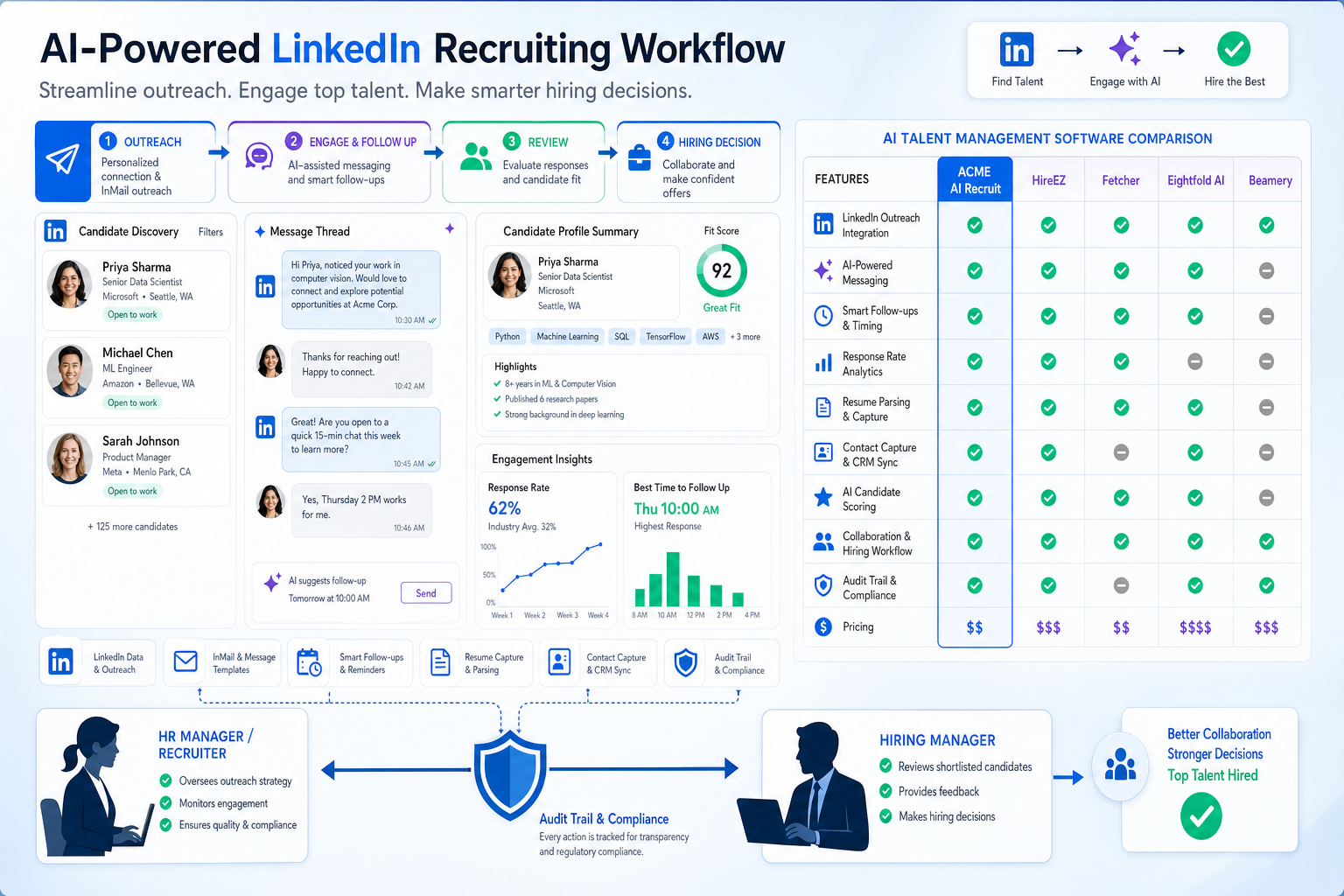
In my own workflow, one useful support layer has been AI Recruiter when a search depends on fast candidate outreach, after-hours replies, and careful capture of resumes and contact details without losing recruiter control. Its always-on messaging, multilingual communication, and automated collection of candidate responses can reduce the manual back-and-forth that often leaves important context scattered. The recruiter still makes the final call on resume review, qualification, and next steps, which is exactly how AI-supported recruiting should work.
A useful way to frame software selection starts with a workplace reality HR leaders have been forced to confront more openly since the #metoo era: misconduct does not stay contained inside policy documents. It shows up in hiring conversations, manager reputations, candidate questions, and the quiet signals people pass along before a role is even filled. An HR team may hear repeated concerns about a senior leader, review whether harassment definitions are clearly understood, and realize that managers have never been trained to recognize issues unless a formal complaint is filed.
At that point, the recruiting work becomes concrete. Someone has to open the requisition, brief the recruiter, log sensitive context correctly, answer candidate questions about culture, track what was disclosed to whom, and make sure hiring managers follow a consistent process instead of relying on whisper networks and memory. That is where the discussion shifts from policy to systems. The best recruiting software, especially modern talent management solutions and any serious talent management platform, has to support not only speed but accountability, visibility, and better decision-making.
Table of Contents
- Why Recruiting Software Now Has to Handle More Context
- Best Recruiting Software Categories in 2026
- Quick Comparison Table
- How to Choose the Right System
- Detailed Review of the Main Software Types
- Features That Matter Most
- Where AI Recruiter Helps in Real Recruiting Work
- How Pricing Usually Works
- ATS vs Recruiting Software vs Talent Management Platform
- Implementation Advice for Recruiting and HR Ops
- FAQ
Why Recruiting Software Now Has to Handle More Context
For years, buyers could treat recruiting technology as mainly a throughput question: post jobs, capture applicants, move people through stages, and report on time to fill. That still matters. But experienced recruiters know the harder part is preserving context around people, patterns, and decisions.
The reference point here is not abstract. As workplace norms changed and public discussion around harassment became more explicit, HR teams had to revisit how behavior is defined, how concerns are recognized, and what happens when leadership reputation affects hiring. One figure often cited in Canada during that period was that more than 1 in 10 workers said sexual harassment of women in their workplace was common, and 53% of women reported unwanted sexual pressure. Whether you operate in Canada, the US, or elsewhere, the lesson for recruiting is the same: candidates increasingly judge employers on safety, inclusion, and leadership credibility before they accept a conversation, let alone an offer.
That changes the software brief. AI talent management software is no longer just about automation. It should help teams maintain clean records, re-use candidate context appropriately, support timely communication, and connect recruiter actions with larger HR governance. In some companies that means an ATS with stronger controls. In others it means broader talent management solutions that tie hiring to internal mobility, policy visibility, and workforce planning.
Key insight: The best recruiting software does not only move candidates faster. It helps recruiters and HR teams manage sensitive context without turning the process into chaos or a black box.
Best Recruiting Software Categories in 2026
There is no single winner for every team. In practice, the best recruiting software usually falls into one of five models.
- AI-enhanced ATS for small and mid-sized teams
Best when you need tighter requisition control, applicant tracking, scheduling, and auditability without adopting a full suite.
- Talent acquisition suites for scaling in-house recruiting
Best when sourcing, CRM, rediscovery, analytics, and hiring manager collaboration all need to improve together.
- Talent intelligence and rediscovery tools
Best when you already have a large database and want stronger search, matching, and re-engagement capabilities.
- Enterprise talent management platform suites
Best when recruiting must connect with internal mobility, skills data, succession planning, and broader people operations.
- Agency-oriented recruiting systems
Best when recruiter desk productivity, relationship management, and fast candidate marketing matter more than broad HR-suite functionality.
Notice what is missing from that list: brand worship. Buyers often waste time comparing logos instead of asking which category fits their workflow, compliance pressure, and hiring volume.
Quick Comparison Table
| Software Type | Best For | Core Strength | Likely Tradeoff | Typical Pricing Model |
|---|---|---|---|---|
| AI-enhanced ATS | SMBs, lean TA teams | Pipeline control, records, scheduling | Less depth outside hiring | Per recruiter or tiered seats |
| Talent acquisition suite | Growing internal teams | Sourcing, CRM, analytics, rediscovery | More setup and process design | Seat-based or annual platform fee |
| Talent intelligence tool | Teams with large databases | Search, matching, rediscovery | Often depends on ATS integration | Platform fee plus user access |
| Enterprise talent management platform | Large HR organizations | Broader workforce visibility | Longer implementation and governance | Custom enterprise contract |
| Agency recruiting software | Staffing and search firms | Outreach speed and desk productivity | Less lifecycle HR coverage | Per user or desk-based pricing |
Teams evaluating workplace risk, candidate communication quality, and process consistency should pay special attention to the tradeoff column. A broader suite may provide stronger governance. A lighter ATS may keep recruiters moving faster. The wrong choice usually shows up first in handoffs, missing notes, and manager-side workarounds.
How to Choose the Right System
The best evaluation process starts with operational truth, not demo theater.
1. Start with the real hiring environment
If your recruiters mainly fill specialist roles, search flexibility and candidate relationship history may matter more than bulk automation. If your team handles high-volume openings, stage discipline, scheduling, and communication throughput often matter most. If candidates routinely ask about culture, conduct policies, or leadership trust, software that preserves context and supports coordinated responses becomes more valuable.
2. Define what must be documented
One lesson HR teams learned from workplace conduct failures is that undocumented process is fragile process. For recruiting, that means clarifying where notes live, how feedback is recorded, who can see sensitive information, and how recruiter conversations connect to requisitions and manager decisions.
3. Test human oversight
Good ai talent management software speeds up messaging, matching, search, and rediscovery. It should not hide why someone was surfaced or how a communication was triggered. Recruiters need to review, override, and step in when nuance matters.
4. Match system scope to organizational scope
Small firms often need recruiting-first tools. Mid-market companies may need stronger workflow flexibility and reporting. Enterprise buyers may need a full talent management platform because hiring decisions connect directly to internal movement, skills visibility, and governance requirements.
5. Evaluate manager behavior, not only recruiter behavior
A recruiting system can look polished in a recruiter demo and still fail if managers ignore feedback requests, ask candidates inconsistent questions, or operate outside the platform. This point matters even more when the company is trying to demonstrate policy maturity and cultural credibility.
Detailed Review of the Main Software Types
AI-enhanced ATS: best when structure is the main problem
An ATS remains the operational backbone for many teams. If jobs are being opened inconsistently, candidate records are incomplete, or communication history is scattered, a solid ATS often delivers the fastest improvement. The classic advantages are still the same: clearer pipelines, better audit trails, less manual admin, and more dependable handoffs.
The AI layer becomes valuable when it helps with parsing, matching, draft communication, reporting summaries, and rediscovery without removing recruiter judgment.
Talent acquisition suites: best for scaling teams
These tools sit between a basic ATS and broader enterprise HR systems. They usually combine applicant tracking, candidate relationship management, sourcing workflows, talent pools, rediscovery, and stronger analytics.
For internal recruiting leaders, this category often feels like the most practical middle path. You get more strategic capability without fully committing to a large-scale talent management platform.
Talent intelligence tools: best for search-heavy teams
If your biggest asset is an existing database of former applicants, referrals, silver medalists, and previous finalists, talent intelligence tools can be extremely useful. They help recruiters stop restarting every search from zero.
That said, they work best when your underlying data is clean. If recruiter notes, stage history, and communication records are inconsistent, even strong search technology will produce mixed value.
Enterprise talent management suites: best for broad people strategy
These broader talent management solutions are attractive when recruiting cannot be separated from internal mobility, skills architecture, leadership pipelines, and workforce planning. They can absolutely be the right answer, especially in larger organizations.
But from a recruiter’s perspective, they need to be tested for speed and usability. HR may appreciate governance while recruiters care about whether the system actually helps them run a desk.
Agency-focused recruiting systems: best for desk productivity
Agency recruiters and headhunters work in a different tempo. Search speed, outreach efficiency, candidate marketing, and submittal clarity usually matter more than deep HR lifecycle coverage. For those teams, the best recruiting software often behaves less like an HR suite and more like a production system for live searches.
Features That Matter Most
Whatever category you choose, these are the features worth testing in real workflows.
1. Search and matching transparency
Ask whether the system explains why candidates are surfaced and whether recruiters can refine the results without fighting the tool.
2. Candidate communication capture
If candidate questions about culture, manager reputation, or workplace standards arise, those exchanges need to be trackable. This is one of the most overlooked parts of software evaluation.
3. Talent rediscovery
Rediscovery is one of the most practical uses of ai talent management software. Previous applicants and past finalists are often the fastest path to a quality shortlist.
4. Resume and contact collection
Recruiters should test how easily the system collects resumes, logs contact details, and keeps records attached to the right requisition or talent pool.
5. Scheduling and follow-up
Any breakdown between recruiter, coordinator, and hiring manager creates avoidable friction. Scheduling matters because it exposes whether the platform fits your real team behavior.
6. Permissions and audit trail
When process consistency and reputational risk matter, user permissions and action history are not secondary features. They are core operational safeguards.
7. Reporting that supports decisions
Reports should help you answer where delays occur, which channels produce quality candidates, and whether manager-side steps are slowing down progress.
Where AI Recruiter Helps in Real Recruiting Work
I would not treat any AI outreach tool as a replacement for recruiter judgment, especially in searches where candidate trust and employer reputation are in play. But I have found that AI Recruiter can be genuinely useful in a narrower, practical lane: repetitive LinkedIn outreach, candidate interest checks, multilingual follow-up, and resume capture that would otherwise consume hours of recruiter time.
In one stretch of search work, the problem was not sourcing names. It was keeping up with replies arriving after hours, making sure interested candidates actually sent resumes, and avoiding the familiar mess where email, LinkedIn messages, and recruiter notes drift apart. Using AI Recruiter for that front-end communication layer helped keep the flow active overnight and across time zones, while I still reviewed the resumes myself and decided who moved to screening.
That is where it fits best alongside broader talent management solutions or an ATS: not as the final evaluator, but as a support system for outreach continuity. Its multilingual messaging is especially relevant for firms doing cross-border search, and the automated capture of contact details can reduce the manual copy-paste work that recruiters usually tolerate for too long.
If your desk relies heavily on LinkedIn, the more detailed explanation of LinkedIn recruiting workflow support is worth reviewing. The key point is still the same: AI handles repetitive outreach patterns; the recruiter owns qualification, context, and the hiring decision.
How Pricing Usually Works
Pricing depends mostly on software type.
- Per-user pricing: common for recruiter and sourcer seats.
- Tiered plans: often based on features, support, or company size.
- Platform fees: more common in broader talent management solutions.
- Custom contracts: typical for enterprise deployment and complex integration needs.
Do not judge cost only by subscription price. Include implementation effort, admin burden, integration work, recruiter adoption, and manager compliance. A cheaper system can become expensive very quickly if it forces work outside the platform.
ATS vs Recruiting Software vs Talent Management Platform
What is an ATS?
An ATS manages jobs, applicants, interview stages, feedback, and hiring records. For many teams, it is still the essential core.
What is recruiting software?
Recruiting software is the broader category. It can include ATS tools, sourcing tools, analytics, interview coordination, and outreach systems.
What is talent acquisition software?
Talent acquisition software usually means a more complete hiring stack with ATS, CRM, sourcing, rediscovery, and analytics capabilities.
What is a talent management platform?
A talent management platform usually extends beyond hiring into internal mobility, skills tracking, employee growth, and broader workforce planning.
Practical rule: If your main issue is recruiter workflow, start with recruiting-first software. If your issue is linking hiring to broader people strategy and governance, evaluate wider talent management solutions.
Implementation Advice for Recruiting and HR Ops
The opening case from workplace conduct policy is a reminder that process discipline matters most when pressure rises. Implementation should reflect that reality.
Map the process before launch
Document requisition intake, outreach ownership, hiring manager steps, escalation points, and where sensitive context should be stored.
Train managers to recognize and record issues
Do not assume formal complaints are the only source of risk. The old problem of "open secrets" applies to recruiting too. Managers need to know what to record, where to raise concerns, and how to stay inside process.
Build a small testing group
Include a recruiter, coordinator, hiring manager, and HR operations stakeholder. They will expose different workflow weaknesses.
Protect recruiter judgment
Automation should remove repetitive work, not independent thinking. Keep clear review points for search results, candidate movement, and communication handoffs.
Review fairness and compliance controls
Any AI-supported workflow should be checked for transparency, data handling, and human accountability, especially if candidate communication and recommendations are partially automated.
FAQ
What is AI talent management software?
It is software that uses automation, matching, search assistance, and analytics to support talent-related work such as sourcing, screening, rediscovery, scheduling, and reporting. In recruiting, it should speed execution while preserving human oversight.
What makes the best recruiting software different from a basic ATS?
A basic ATS tracks applicants and hiring stages. The best recruiting software may add sourcing, CRM, rediscovery, analytics, communication support, and stronger workflow flexibility.
When should a company choose broader talent management solutions?
Choose broader talent management solutions when recruiting needs to connect closely with internal mobility, skills visibility, or wider people operations. If the immediate pain is recruiter throughput and hiring workflow, recruiting-first software is usually the better starting point.
Why does context matter so much in software selection?
Because hiring decisions are shaped by more than resumes and interviews. Candidate questions, manager behavior, policy maturity, and recruiter notes all affect outcomes. Software that loses that context creates risk and inconsistency.
Can AI outreach tools replace recruiters?
No. They can help with repetitive tasks such as initial outreach, follow-up, and resume collection, but recruiters still need to assess fit, interpret nuance, and make final decisions.
How does AI Recruiter fit into a broader recruiting stack?
It works best as a support layer for LinkedIn outreach, candidate messaging, multilingual communication, and resume capture. It can complement an ATS or a broader talent management platform rather than replace them.
Conclusion
The best recruiting software in 2026 is not the one with the loudest AI claim. It is the system that helps recruiters move efficiently while preserving context, accountability, and human judgment.
That is why ai talent management software should be evaluated through real recruiting pressure: candidate trust, manager behavior, documentation quality, search speed, rediscovery value, and communication flow. For some teams, an AI-enhanced ATS is enough. For others, broader talent management solutions or a full talent management platform will be the better fit. The right choice is the one that keeps hiring effective when the process becomes complex, sensitive, or high-stakes.