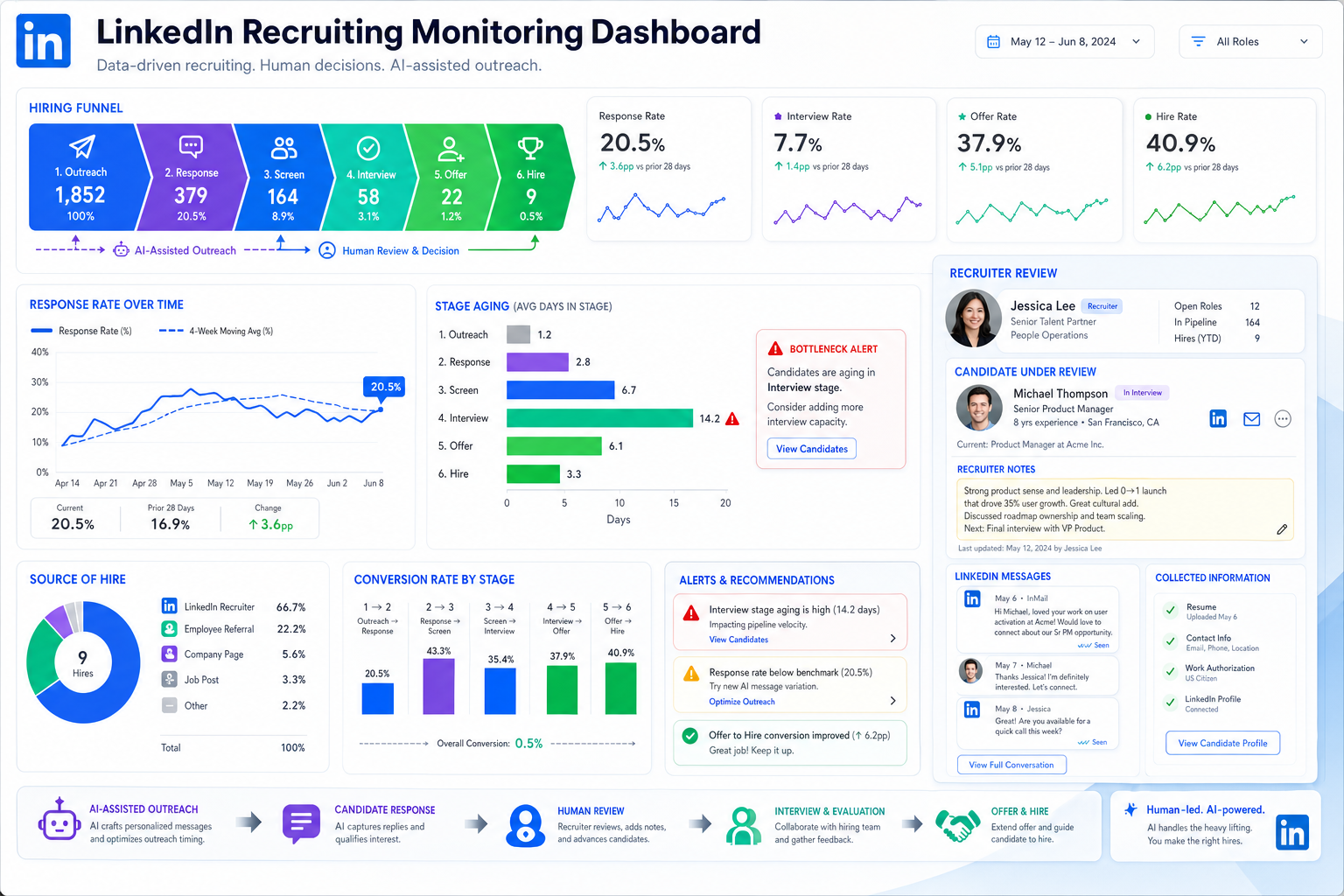
When recruitment monitoring reveals where replies, handoffs, and candidate signals break down, recruiters can judge software better and prevent stalled searches.
That matters because most hiring teams do not actually lose control at the requisition stage. They lose it in the middle of the work: one recruiter is chasing replies after hours, another is trying to remember which sourced candidate asked about compensation, a hiring manager is late with feedback, and leadership still expects a clean update on funnel health. For boutique search firms, internal talent teams, and solo recruiters alike, the cost is not only time. It shows up in missed replies, weak source visibility, inconsistent follow-up, slower closes, and avoidable damage to candidate trust.
In my own workflow, tools that reduce repetitive outreach without taking final judgment away from the recruiter have been the most useful. A product such as StrategyBrain AI Recruiter can help by automating first-touch LinkedIn outreach, handling after-hours candidate replies, and collecting resumes or contact details from interested prospects. What it does not do is replace recruiter judgment. The recruiter still reviews the resume, decides fit, and owns the next step, which is exactly how support software should work in serious hiring operations.
That balance becomes clearer if you look at a familiar career decision from another professional services world. After a brutal busy season, an auditor at a large global firm starts weighing whether to stay or move to a smaller or mid-sized practice. The real question is not simply big versus small. It is whether the next environment offers clearer growth, better use of experience, more exposure to the full project, and a culture that fits how the person wants to work.
For the recruiter trying to place or attract that kind of candidate, the process quickly becomes more than inbox management. You have to track who wants structure, who wants entrepreneurial room, who is worried about work-life balance, who values brand recognition, and who sees long-term upside in staying put. That is exactly why the best recruiting software starts with recruitment monitoring. If your system cannot capture those signals, show recruiter activity, and connect conversations to outcomes, it will struggle to support the recruiting metrics to track and hr recruitment metrics that matter before a software purchase.
Table of Contents
- Why the best recruiting software depends on context
- What an opportunity-evaluation case teaches recruiters
- Recruiting metrics to track before you buy
- Software features that make recruitment monitoring usable
- How to compare recruiting software options
- Three software categories recruiters usually compare
- Best-fit software by team size and hiring model
- Common buying mistakes
- FAQ
Why the best recruiting software depends on context
When recruiters search for the best recruiting software, they often mean different things. A solo headhunter may want faster outreach and cleaner follow-up. A talent acquisition lead may want dependable hr recruitment metrics. A recruiting manager may care most about stage aging, recruiter capacity, and hiring manager response discipline. Leadership usually wants evidence that hiring effort is turning into hires without excess lag or spend.
That is why software selection should be tied to recruitment monitoring rather than generic feature shopping. A good platform should help your team answer practical questions such as: Which sourced candidates are engaging? Where are candidates dropping off? Which recruiter workflows depend too much on memory? Which sources create interviews instead of just applications? Where is decision speed breaking down?
In practice, strong recruiting software behaves as both workflow system and measurement layer. It should support candidate records, communication history, pipeline visibility, and reporting consistency. If it only stores resumes, it may help with administration, but it will not reliably improve hiring judgment.
What an opportunity-evaluation case teaches recruiters
The auditor example above is useful because it mirrors a common recruiting reality: many strong candidates are not evaluating only the role. They are evaluating the operating model around the role. In the original professional-services context, the decision involved structured support versus a more entrepreneurial environment, broader project exposure versus repetition, and recognition versus fit. Those are not abstract career themes. They are placement variables.
For recruiters, this creates a monitoring problem. If you are recruiting experienced professionals from large firms into smaller teams, your notes need to capture more than compensation expectations. You need to track why they are open, what they want more of, what they want less of, and how those motives correlate with interview progression and offer acceptance.
I have found that this is where workflow support matters most. In outbound searches, StrategyBrain AI Recruiter was most helpful when I used it to keep initial LinkedIn conversations moving while I focused on fit assessment. It handled repetitive first-touch messaging, kept candidate replies from sitting overnight, and made it easier to gather resumes from people who were genuinely interested. That did not remove the need for recruiter judgment; it simply preserved momentum at the top of funnel, where many searches quietly stall.
Practical rule: If your software cannot show why a candidate entered the process, where the process slowed, and who needs to act next, your reporting is too shallow for serious recruiting.
Recruiting metrics to track before you buy
If you want the best recruiting software, ask how the platform handles the metrics below. These are the most useful recruiting metrics to track because they connect directly to sourcing, communication, screening, interviewing, and closing. They are also among the most practical hr recruitment metrics for team reviews.
1. Time to hire
Definition: The number of days between a candidate entering the process and accepting an offer.
Why it matters: This measures speed inside the active funnel. If experienced candidates are weighing whether to leave a structured employer for a smaller team, delays can easily reset their interest or strengthen their reasons to stay.
What good software should show:
- Average days by role, recruiter, and department
- Stage-by-stage aging
- Interview scheduling lag
- Time from final interview to offer
2. Time to fill
Definition: The number of days between requisition opening and role fill.
Why it matters: Time to fill captures the full vacancy lifecycle, including approvals, intake quality, sourcing difficulty, and stakeholder responsiveness.
Why recruiters should separate it from time to hire: One tracks a candidate journey. The other tracks the vacancy itself. Strong recruitment monitoring keeps those definitions distinct so teams diagnose the right problem.
3. Source of hire
Definition: The channel that produced the eventual hire.
Why it matters: Source data should guide budget and effort allocation. In many recruiter-led searches, especially for experienced professionals, the question is not just where candidates came from but which outreach path led to real conversations and sustained movement.
Useful source views:
- Application or outreach response volume by source
- Interview rate by source
- Offer rate by source
- Hire rate by source
- Drop-off rate by source
4. Stage conversion rates
Definition: The percentage of candidates moving from one hiring stage to the next.
Why it matters: This is one of the clearest recruiting metrics to track because it reveals whether your process is selective in a useful way or simply leaking momentum.
| Stage | Question to Ask | What a Drop May Indicate |
|---|---|---|
| Outreach to reply | Are we reaching the right candidates with the right message? | Weak targeting or low-value messaging |
| Reply to screening | Are recruiters qualifying interest correctly? | Poor handoff or inconsistent follow-up |
| Screen to interview | Are expectations aligned? | Role mismatch or unclear positioning |
| Interview to final | Is the panel calibrated? | Confused requirements or poor interview design |
| Offer to hire | Are we closing with enough speed and clarity? | Delays, compensation gaps, or candidate hesitation |
5. Offer acceptance rate
Definition: Accepted offers divided by total offers extended.
Why it matters: This metric often reveals whether recruiters have captured candidate motivation accurately. In the auditor-style decision case, a candidate may admire a smaller environment but still hesitate if the role does not clearly deliver broader exposure, growth, or cultural fit.
6. Candidate drop-off
Definition: The percentage of candidates who disengage before process completion.
Why it matters: Candidate drop-off exposes friction your team may not see. It can point to slow replies, too many interview steps, repetitive screening, weak follow-up, or poor expectation setting.
7. Cost per hire
Definition: Total recruiting cost divided by total hires in a given period.
Why it matters: This helps HR compare sourcing channels, agency usage, internal effort, and process overhead.
Formula view: Cost per hire = internal recruiting costs + external recruiting costs / total hires
The best recruiting software may not calculate every cost automatically, but it should make it easier to connect requisitions, source activity, recruiter time, and hiring outcomes.
8. Quality of hire
Definition: A structured view of whether new hires meet performance and retention expectations.
Why it matters: Fast hiring that ignores fit creates churn. In opportunity-evaluation searches, this matters even more because candidates are making deliberate trade-offs about culture, scope, and growth.
Practical ways to measure it:
- Hiring manager satisfaction after onboarding
- New hire performance at a defined checkpoint
- Early retention patterns
- Ramp success against role expectations
Software features that make recruitment monitoring usable
The best recruiting software supports measurement without creating extra admin work. Recruiters should not need a spreadsheet rescue project every time leadership asks for an update.
Core features to evaluate
- Pipeline dashboards
Your team should be able to see open roles, stage volume, stage aging, and recruiter workload quickly. This is essential when candidate decisions are nuanced and delays have meaning.
- Communication tracking
If software does not preserve outreach history, reply timing, and conversation notes, top-of-funnel monitoring becomes unreliable.
- Automation and reminders
Scheduling prompts, follow-up reminders, and status updates reduce the chance that recruiters lose momentum on good candidates.
- Source analytics
Good reporting should connect sources to progression, not just to raw volume.
- Role-based visibility
Recruiters, coordinators, hiring managers, and HR leaders need different views, but they should still work from the same definitions.
- Governance controls
Metric definitions, permissions, and audit trails matter if you want trustworthy hr recruitment metrics.
- AI support with human control
AI can help with repetitive tasks, message handling, and workflow prompts, but final fit judgment, resume review, and candidate advancement should remain with the recruiter.
What I would test in real use
If LinkedIn sourcing is part of your workflow, I would test how well the software supports the hours when recruiters are usually not online. In practice, that is where AI Recruiter stood out for me as a support layer rather than a replacement tool. Candidate replies that normally would have sat overnight kept moving, multilingual conversations were less likely to stall, and interested prospects could share contact details or resumes before intent cooled. I still had to assess whether the background matched the role, but the system prevented basic communication lag from becoming a reporting blind spot.
How to compare recruiting software options
A useful buying process compares tools against operating needs, not marketing claims. The best recruiting software for a solo recruiter will not be the same as the best fit for a large HR function with strict governance.
Step 1: Define the weekly decisions your team must make
Before demos, list the recurring questions your team cannot answer quickly. Examples include: Which roles are aging? Which sourced candidates are responsive? Which recruiters are overloaded? Which sources create qualified interviews? Where are candidates disappearing?
Step 2: Map your required recruiting metrics to track
For most teams, the starting set is time to hire, time to fill, source of hire, stage conversion, offer acceptance rate, and candidate drop-off. If a tool cannot report these cleanly, it is difficult to justify calling it the best recruiting software for data-driven teams.
Step 3: Test the recruiter workflow, not just the dashboard
Many systems look good in demos because the dashboard is polished. The better question is whether recruiters can move from outreach to screening to stakeholder updates without losing context.
Step 4: Check hiring manager participation
Software fails when hiring managers avoid it. Review how they submit feedback, track interview progress, and see stalled requisitions.
Step 5: Review governance before custom reporting
Custom dashboards are helpful only if stage definitions, user behavior, and data entry are consistent enough to trust.
Three software categories recruiters usually compare
Buyers looking for the best recruiting software usually compare three broad categories. The right choice depends on workflow maturity, team size, and how heavily your process depends on outbound sourcing.
1. Full ATS platforms
Strengths: Centralized candidate records, requisition management, interview workflows, compliance controls, and standard reporting.
Trade-offs: Some are strong on record keeping but weaker on proactive sourcing or top-of-funnel communication speed.
Best for: Mid-size to enterprise teams that need process consistency.
How they work with StrategyBrain AI Recruiter: They can serve as the system of record while AI Recruiter supports LinkedIn-first outreach and candidate engagement before handoff into the main workflow.
2. CRM-style recruiting systems
Strengths: Better relationship tracking, talent pools, and proactive outreach support.
Trade-offs: May require more operational discipline to produce clean HR-level reporting.
Best for: Search firms, agency recruiters, and in-house sourcing teams.
How they work with StrategyBrain AI Recruiter: Useful when recruiters want to scale first contact and capture resumes or contact details while still keeping relationship context inside their recruiting CRM.
3. Outreach automation and sourcing support tools
Strengths: Speed at the top of funnel, improved follow-up cadence, and better handling of repetitive sourcing tasks.
Trade-offs: They are rarely enough on their own for full hiring governance, quality reporting, or downstream process management.
Best for: Recruiters doing heavy outbound work, international sourcing, or after-hours candidate engagement.
How they work with StrategyBrain AI Recruiter: In this category, the key differentiator is whether automation simply sends messages or actually supports recruiter workflow with ongoing conversations, multilingual communication, and resume collection while leaving final qualification to the human recruiter.
Best-fit software by team size and hiring model
Lean internal recruiting team
A small team usually needs speed, simplicity, and visible pipeline health. Prioritize usable dashboards, clean stage tracking, and lightweight automation.
Best advice: Avoid oversized systems that require heavy setup before they deliver practical recruitment monitoring.
Mid-size HR and talent acquisition team
This group often needs stronger reporting, source analytics, stakeholder workflow, and governance. Cross-team consistency becomes more important as headcount grows.
Best advice: Choose software that can support both recruiter execution and leadership reporting without duplicate admin work.
High-volume recruiting environment
High-volume teams need queue visibility, stage monitoring, and automation. Candidate drop-off, response timing, and conversion rates become central.
Best advice: Focus on software that surfaces bottlenecks quickly and standardizes high-frequency tasks.
Agency or headhunter workflow
External recruiters usually need faster candidate movement, source transparency, client segmentation, and communication history that does not live in personal inboxes.
Best advice: If LinkedIn outreach is central, add a support layer that protects response speed and candidate continuity while keeping final selection with the recruiter.
Common buying mistakes
- Buying for features instead of decisions
If a platform looks advanced but does not improve recruitment monitoring, it will not change outcomes much.
- Ignoring candidate motivation data
In experienced-hire recruiting, motivation often shapes conversion as much as compensation does.
- Mixing time to hire with time to fill
These are different signals. Blending them leads to poor diagnosis.
- Overlooking top-of-funnel communication lag
Some teams monitor applicants well but lose sourced candidates because outreach and replies are not tracked tightly enough.
- Assuming automation fixes weak process design
Automation can reduce repetitive work, but it will also scale confusion if stage logic is weak.
- Underestimating governance
Without shared definitions, your dashboards become presentation material instead of management tools.
FAQ
Which recruiting metrics matter most?
For most teams, the most useful metrics are time to hire, time to fill, source of hire, stage conversion rates, candidate drop-off, offer acceptance rate, cost per hire, and quality of hire.
What is recruitment monitoring in recruiting software?
Recruitment monitoring is the ongoing visibility into pipeline movement, recruiter activity, source performance, candidate response behavior, and hiring delays. It matters because software should help teams act on issues, not just store data.
How do hr recruitment metrics differ from recruiter activity metrics?
HR recruitment metrics usually focus on organizational outcomes such as time to fill, cost per hire, and quality of hire. Recruiter activity metrics often focus more on outreach volume, response timing, scheduling speed, and candidate progression.
Can AI help without replacing recruiter judgment?
Yes. AI is most useful when it handles repetitive communication, first-touch outreach, reminders, or data capture while leaving fit assessment, resume review, and final advancement decisions to the recruiter.
What should an ATS dashboard include?
A strong ATS dashboard should include open requisitions, stage aging, source performance, recruiter workload, offer activity, conversion rates, and candidate drop-off. If outbound sourcing is important, communication response data should also be visible.
Conclusion
The best recruiting software is the software that helps your team see what is happening, understand why it is happening, and respond before good candidates disappear or searches lose momentum. That is the real purpose of recruitment monitoring.
If you are evaluating tools now, start with the decisions your team needs to make, then map the recruiting metrics to track and the hr recruitment metrics leadership expects. From there, test whether the system supports real recruiter workflow, preserves candidate context, and keeps top-of-funnel activity visible. That is how software becomes operationally useful rather than just technically impressive.