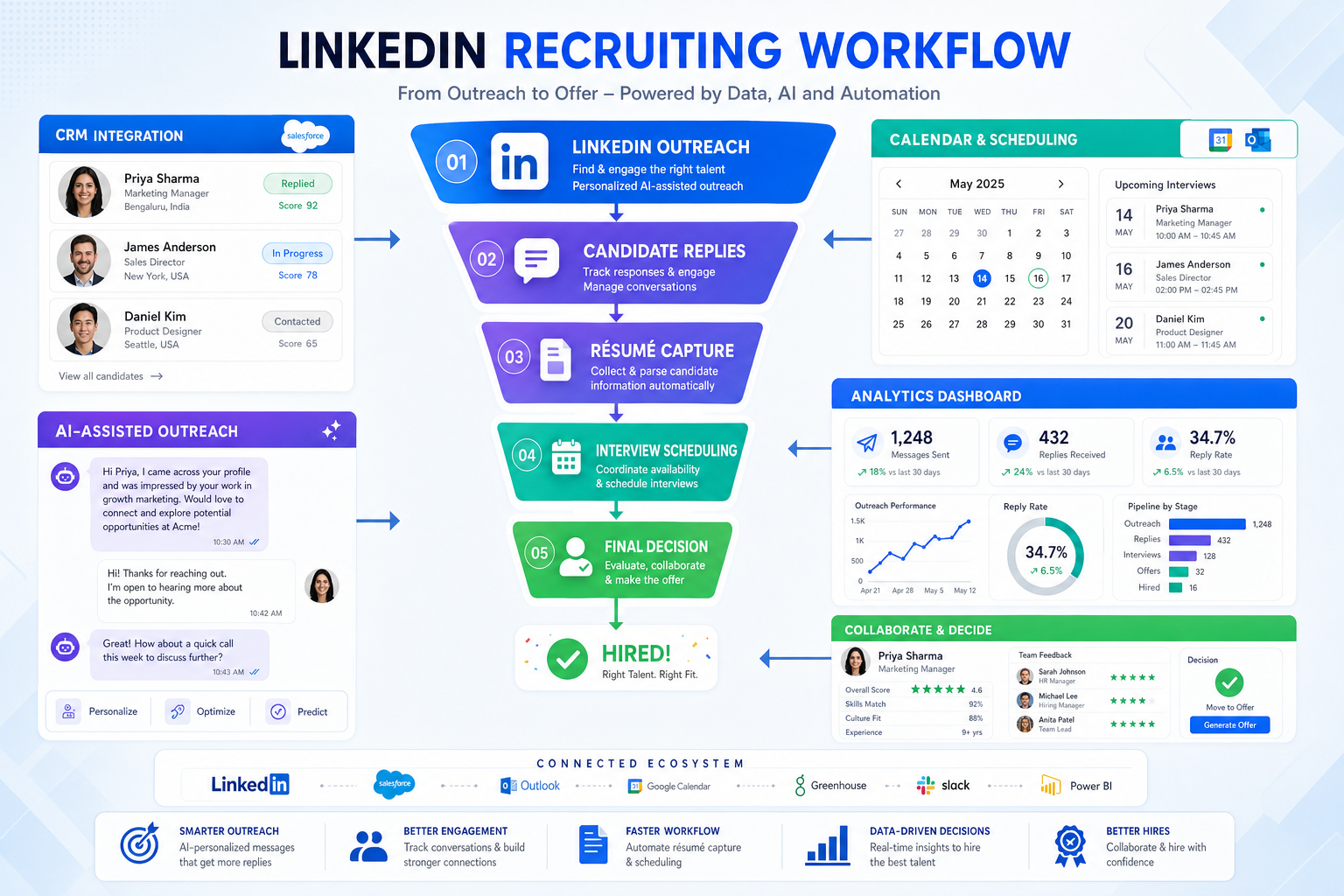
When recruiting systems scatter candidate data and slow hiring, this article helps hiring leaders judge what to fix, compare, and avoid.
That standard matters because most breakdowns in recruiting do not start with sourcing volume alone. They start when candidate information moves through too many inboxes, spreadsheets, calendars, and disconnected notes. For a solo recruiter, that means missed follow-up and weaker relationship continuity. For a small agency owner, it means consultants spending billable hours on admin instead of placements. For an in-house hiring lead, it means slower feedback, inconsistent process control, and reporting no one fully trusts.
In that gap, I have found tools like StrategyBrain AI Recruiter useful as a workflow support layer rather than a replacement for recruiter decision-making. In practice, the value is clearest when repetitive outreach, after-hours candidate replies, and résumé collection start overwhelming the desk. Its automated LinkedIn messaging, multilingual communication, and résumé/contact capture can keep conversations moving, while the recruiter still handles shortlist review, final qualification, and next-step judgment.
A useful way to frame this comes from a finance and accounting technology discussion in the GTA that argued strong decisions depend on understanding how data moves from the first operational touchpoint all the way to the final business output. That logic translates directly to recruiting. A recruiter opens a role, messages a candidate, logs interest, collects a résumé, books a conversation, and pushes the profile toward a hiring decision. When no one really understands how that information is captured, where it sits, or who updates it, the hiring process slows down long before anyone blames the software.
The same discussion also made a second point that recruiters should take seriously: technology matters most when it helps people see across the whole process rather than only one tool. That is why comparing the best recruiting software cannot stop at feature checklists. It has to answer whether your recruiting systems support clean data flow, better stakeholder alignment, and faster action across sourcing, tracking, interviews, and hiring manager follow-through. That is also where human resources recruiting software and the best talent acquisition software begin to separate from a basic ATS.
- The best recruiting software is the system that supports how information actually moves through your hiring process, not the one with the longest feature list.
- Strong recruiting systems should help recruiters understand data flow from first outreach to final decision, not just store applicants.
- An ATS gives workflow control, but many teams also need CRM, scheduling, automation, and analytics to reduce process drag.
- Human resources recruiting software is most useful when HR needs consistency across departments, handoffs, and reporting.
- The best talent acquisition software adds proactive pipeline building, talent pooling, and decision support for ongoing hiring environments.
- AI works best as recruiter leverage for outreach, candidate communication, and workflow continuity while humans keep final screening and hiring judgment.
This guide does not rank brands. It uses an operator-style evaluation framework shaped by real recruiting work: how requisitions open, how candidate data is captured, where communication stalls, which handoffs create friction, and what software actually helps recruiters, hiring managers, and HR teams move faster with more consistency.
Table of Contents
- What buyers are really buying when they compare recruiting systems
- Why data flow is the hidden selection criterion
- ATS vs recruiting software vs talent acquisition platform
- Why teams invest in recruiting systems
- How to evaluate the best recruiting software
- Where AI workflow support fits in practice
- Best recruiting systems by hiring model
- Standalone recruiting systems vs HR suites
- A practical software selection process
- Common buying mistakes
- FAQ
What buyers are really buying when they compare recruiting systems
When teams search for the best recruiting software, they are rarely shopping for software in the abstract. They are usually trying to fix a broken operating rhythm. Candidates reply after hours and no one follows up quickly. Recruiters keep outreach notes in one place and résumés in another. Hiring managers want updates but do not move feedback on time. Reporting depends on someone rebuilding the funnel manually every week.
That is why the term recruiting systems has become broader than it used to be. In practical use, buyers may be evaluating an ATS, a sourcing workflow, a candidate CRM, interview coordination, analytics, or an all-in-one hiring platform. The category label matters less than whether the system supports the actual sequence of work from first touch to accepted offer.
For many organizations, the software decision is really a process decision. If your recruiting motion is mostly reactive, an ATS-centered model may be enough. If your team hires continuously, revisits talent pools, or depends on recruiter-led outreach, the software has to support more than applicant storage. That is where human resources recruiting software and the best talent acquisition software start to become different buying conversations.
Why data flow is the hidden selection criterion
One of the most useful ideas from technology-heavy functions like finance is that strong operators learn how data flows, not just which tool holds it. In recruiting, that means understanding what happens from job creation to candidate outreach, response capture, résumé collection, stage movement, interview feedback, offer approvals, and final handoff into HR.
If a recruiting team does not understand that flow, software selection becomes superficial. The demo looks polished, but recruiters still duplicate records, candidate history gets lost between tools, and hiring managers end up making decisions from incomplete information. Good recruiting software should make the path of information more visible and more reliable.
That principle also explains why some systems feel stronger in day-to-day use than others. The issue is not only features. It is whether the software helps recruiters see the entire motion of work and anticipate what stakeholders need before they ask. In other words, the best recruiting software is not just a repository. It is a structure for faster judgment.
Practical takeaway: Before comparing software, map how candidate information currently moves through your team. If you cannot describe that clearly, your main problem may be workflow design rather than missing features.
ATS vs recruiting software vs talent acquisition platform
These terms overlap, but they solve different depths of problem. Buyers often compare them as if they were interchangeable, which leads to poor shortlists and confused evaluations.
| Category | Primary role | Best for | Typical limits |
|---|---|---|---|
| Applicant Tracking System | Track applicants, workflow stages, approvals, and compliance steps | Teams that need process control and central records | May be limited in CRM, sourcing, and proactive engagement |
| Recruiting Software | Support sourcing, tracking, communication, scheduling, and coordination | Recruiters who need broader workflow support | Depth varies widely across vendors |
| Talent Acquisition Platform | Handle end-to-end hiring with CRM, automation, analytics, and pipeline building | Complex or ongoing hiring environments | Can require more implementation discipline |
An applicant tracking system for recruiters usually forms the operational base. It tells the team where candidates are in the funnel and what should happen next. That alone creates major value when the current process depends on inboxes and spreadsheets.
The best talent acquisition software, however, usually goes beyond process control. It helps teams maintain candidate relationships over time, revisit previous prospects, coordinate interviewer input, and learn from conversion data. That is especially useful in specialist hiring and agency search work, where timing and persistence matter as much as application volume.
Why teams invest in recruiting systems
Most teams invest in recruiting systems because manual coordination eventually becomes too expensive. The cost is not just time. It appears in missed follow-up, duplicated work, weaker stakeholder trust, slower offers, and candidates who disengage because the process feels messy.
The main advantages of applicant tracking system adoption are operational clarity and consistency. Everyone sees the same stage definitions. Ownership is easier to assign. Interview steps become more repeatable. Status questions decrease because the answer is visible in the workflow.
These are the most common applicant tracking system benefits in practice:
- Shared visibility: recruiters, coordinators, HR, and hiring managers work from the same candidate record.
- Faster movement: interview scheduling, reminders, and approvals require less manual chasing.
- Better candidate experience: organized communication reduces dropped threads and duplicate requests.
- Stronger reporting: teams can review stage conversion, delays, source quality, and recruiter load with more confidence.
- Scalability: the hiring process holds together even as open roles and stakeholder counts increase.
For HR teams, human resources recruiting software also matters because recruiting is often the first point where employee lifecycle data starts to accumulate. If the intake is weak, every downstream handoff becomes harder. For agencies and search firms, the business case is even more direct: time lost to admin is time not spent placing candidates.
How to evaluate the best recruiting software
The strongest evaluations start with the workflow, not the category label. In practice, I assess recruiting systems against the points where work usually slows down.
1. Can the system handle your real recruiting flow?
Start with requisitions, stage design, permissions, offer movement, and hiring manager participation. A tool that looks sophisticated but makes basic candidate movement clumsy will create frustration quickly.
For buyers specifically assessing an applicant tracking system for recruiters, the question is simple: can recruiters act quickly without losing structure?
2. Does it show how candidate data moves?
This is the hidden quality marker. You should be able to tell where candidate information comes from, where it is stored, who can update it, and how that data appears in reporting. If that flow is opaque, the system will create blind spots.
This idea comes directly from the broader technology principle that business users should understand how data moves from transaction start to final decision output. In recruiting, that discipline is just as valuable.
3. How strong is sourcing and candidate CRM?
Teams that do proactive hiring need more than applicant tracking. They need searchable talent pools, outreach history, and a way to revisit people who were not ready last quarter but may be relevant now. This is one of the clearest dividing lines between a basic ATS and the best talent acquisition software.
4. Will scheduling and feedback collection actually improve?
Interview coordination is one of the largest hidden drains on recruiter productivity. Good recruiting systems reduce calendar friction, centralize scorecards, and keep feedback collection moving. If this part is weak, pipeline speed suffers regardless of sourcing quality.
5. Does automation support the recruiter or fight the process?
Automation is most useful when it handles repetitive steps such as reminders, candidate updates, status nudges, and follow-up prompts. The goal is not less human judgment. The goal is fewer mechanical tasks.
6. Are analytics usable for operational decisions?
Reporting should help leaders see delays, drop-off points, source performance, and recruiter capacity. If analytics require constant manual cleanup, the team will stop trusting them.
7. Will it fit the rest of your stack?
Calendar sync, communication tools, assessments, HR systems, and exports all affect daily usability. Integration quality often determines whether a system becomes a true workflow hub or just another tab recruiters ignore.
| Evaluation area | What to inspect | Why it matters |
|---|---|---|
| Workflow control | Stage movement, approvals, permissions | Drives recruiter speed and process consistency |
| Data flow visibility | Source capture, record updates, reporting logic | Improves trust in the system and the metrics |
| CRM and sourcing | Talent pools, searchability, outreach history | Supports proactive and repeat hiring |
| Interview management | Scheduling, scorecards, reminders | Reduces coordination delays |
| Automation | Task triggers, candidate messaging, nudges | Preserves recruiter capacity |
| Analytics | Pipeline conversion, time in stage, source quality | Supports better hiring decisions |
| Integrations | HR systems, calendars, assessments | Prevents fragmented workflows |
Where AI workflow support fits in practice
AI is useful in recruiting when it helps with the parts of the process that are repetitive, time-sensitive, and easy to delay. I would not treat it as a substitute for recruiter judgment, especially not in final screening or hiring recommendations. But I have seen real value when AI supports early-stage communication and keeps momentum alive outside normal desk hours.
In my own workflow, a tool like AI Recruiter makes the most sense when LinkedIn outreach starts generating more replies than one recruiter can reasonably manage in real time. Candidates respond late in the evening, ask basic role questions, confirm whether they are open to a move, and sometimes send contact details or résumés while the recruiter is working another requisition. Using StrategyBrain AI Recruiter as a support layer helps keep those conversations alive, capture the documents, and move interested people forward without pretending the tool should decide who is truly qualified.
What I like about that setup is its discipline. The system can handle repetitive LinkedIn connection and message flow, respond across time zones and languages, and collect candidate information when interest is confirmed. I still review the résumé, judge the fit, and decide whether the person belongs in the shortlist or a nurture pool. That balance is important, especially for agencies and in-house teams that want more coverage without lowering screening standards.
Experience note: The best use of AI in recruiting is to compress admin time around outreach and response handling, then hand control back to the recruiter for evaluation and next steps.
Best recruiting systems by hiring model
The best recruiting software depends heavily on the operating model behind the hiring team. The same tool that works for a lean HR team may frustrate a search consultant, while a system built for agency speed may feel excessive inside a lower-volume HR environment.
For small businesses and lean HR teams
These teams usually need simplicity first: clean job posting, visible applicant stages, basic reporting, and enough automation to avoid email chaos. They often benefit most from straightforward recruiting systems that are easy to maintain.
For enterprise recruiting teams
Enterprise buyers need structure at scale: permissions, analytics, cross-team consistency, and better coordination among recruiters, HR, and hiring managers. In these environments, human resources recruiting software often needs to support not just hiring velocity but governance and reliable reporting.
For staffing agencies and search firms
Agencies need speed, searchability, CRM, and relationship continuity across many openings. The right applicant tracking system for recruiters should feel like a production tool, not just a compliance archive. Outreach history, candidate notes, and talent reuse matter a great deal here.
For high-volume hiring teams
High-volume environments need automation, fast communication, interview scheduling support, and clean stage throughput. This is where applicant tracking system benefits often become most visible because small delays multiply quickly across large pipelines.
For proactive sourcing teams
Teams that build pipelines before candidates apply should prioritize CRM, nurture workflows, and outreach support. This is often the clearest fit for the best talent acquisition software, especially when the hiring market is competitive and candidates need multiple touchpoints over time.
Standalone recruiting systems vs HR suites
One of the most important decisions in the market is whether to choose standalone recruiting systems or recruiting functionality inside a broader HR suite.
| Option | Strengths | Tradeoffs | Best fit |
|---|---|---|---|
| Standalone recruiting software | Deeper recruiter workflows, stronger CRM, more sourcing flexibility | May require more integrations and admin ownership | Recruiting-led teams with complex hiring needs |
| Unified HR platform | Smoother handoff into onboarding and employee records | Recruiting depth may be lighter | Organizations prioritizing operational simplicity |
If your biggest pain is recruiter execution, candidate follow-up, pipeline visibility, or stakeholder responsiveness, standalone recruiting systems often win on daily usability. If your biggest pain is lifecycle continuity from recruiting into HR administration, a suite may be sufficient.
The right answer usually comes from the same principle discussed earlier: where does your information flow break down, and who needs better visibility into it?
A practical software selection process
The cleanest buying process is the one that mirrors real operations.
- Map the hiring motion. Clarify whether you are optimizing for agency search, proactive sourcing, low-volume professional hiring, or high-volume recruiting.
- Trace the data path. Identify where candidate information starts, where it gets lost, and where teams rebuild context manually.
- Identify the true bottleneck. Separate sourcing problems from scheduling problems, feedback problems, and reporting problems.
- Score real workflows. Compare tools using actual scenarios, not only demos. Open a role, move a candidate, collect feedback, and pull a report.
- Test adoption risk. Check how recruiters, hiring managers, and HR will use the system every week.
- Decide what AI should and should not do. Use automation for repetitive communication and task support, but keep screening and hiring judgment with trained humans.
- Plan ownership after launch. Someone must maintain workflows, templates, permissions, and reporting standards.
This process keeps buyers focused on operational fit, whether they are comparing a focused ATS, broader human resources recruiting software, or the best talent acquisition software for a more mature team.
Common buying mistakes
Even experienced teams make predictable mistakes when evaluating recruiting systems.
- Buying the category label instead of the workflow: software names can be misleading.
- Ignoring data flow: if you cannot tell how information moves, reporting and coordination will remain weak.
- Underestimating scheduling friction: many hiring delays are logistical, not strategic.
- Skipping CRM evaluation: this hurts teams that depend on repeat engagement and talent pooling.
- Choosing too much system: overbuilt platforms can reduce adoption as easily as underpowered tools.
- Confusing AI activity with recruiter productivity: test whether the tool saves time on specific tasks.
- Forgetting the stakeholder view: hiring manager usability often decides whether the process stays on pace.
The strongest buyers think like operators. They ask where work slows down, what information gets lost, and which system makes better decisions easier.
FAQ
What is recruiting software?
Recruiting software is technology used to manage hiring work such as job posting, applicant tracking, sourcing, candidate communication, interview scheduling, and reporting. Depending on the system, it may function as a basic ATS or a broader talent acquisition platform.
How is recruiting software different from an ATS?
An ATS usually focuses on tracking applicants through structured stages and maintaining process control. Recruiting software may include ATS functionality but also add sourcing, CRM, automation, interview management, and analytics.
Which features matter most in the best recruiting software?
The most important features usually include workflow control, data visibility, sourcing support, candidate CRM, interview scheduling, analytics, automation, and integrations. The right mix depends on your hiring model.
What are the advantages of applicant tracking system adoption?
The main advantages of applicant tracking system adoption are better visibility, stronger process consistency, cleaner coordination with hiring managers, and more reliable reporting. These benefits become more important as hiring volume grows.
When does a team need human resources recruiting software?
Teams typically need human resources recruiting software when recruiting must connect cleanly with broader HR operations, reporting, onboarding, and governance across departments.
What makes the best talent acquisition software different?
The best talent acquisition software usually adds proactive capabilities beyond applicant tracking, such as candidate CRM, talent pooling, automation, outreach support, and stronger funnel analytics.
How should AI be used in recruiting systems?
AI should support repetitive work such as outreach handling, candidate messaging, reminders, summarization, and workflow prompts. Recruiters should still make final decisions on qualification, shortlist selection, and hiring recommendations.
Conclusion
The best recruiting software is not simply the most advanced-looking platform. It is the system that helps your team understand and manage the full flow of hiring information, from first outreach to final decision. For some organizations, that means focused recruiting systems with strong applicant tracking. For others, it means broader human resources recruiting software or the best talent acquisition software with CRM, automation, analytics, and interview coordination built in.
If you are choosing now, start where experienced operators in other data-heavy functions start: understand the flow first. Once you know where candidate information enters, where it stalls, and where decision-making weakens, the software choice becomes much clearer.