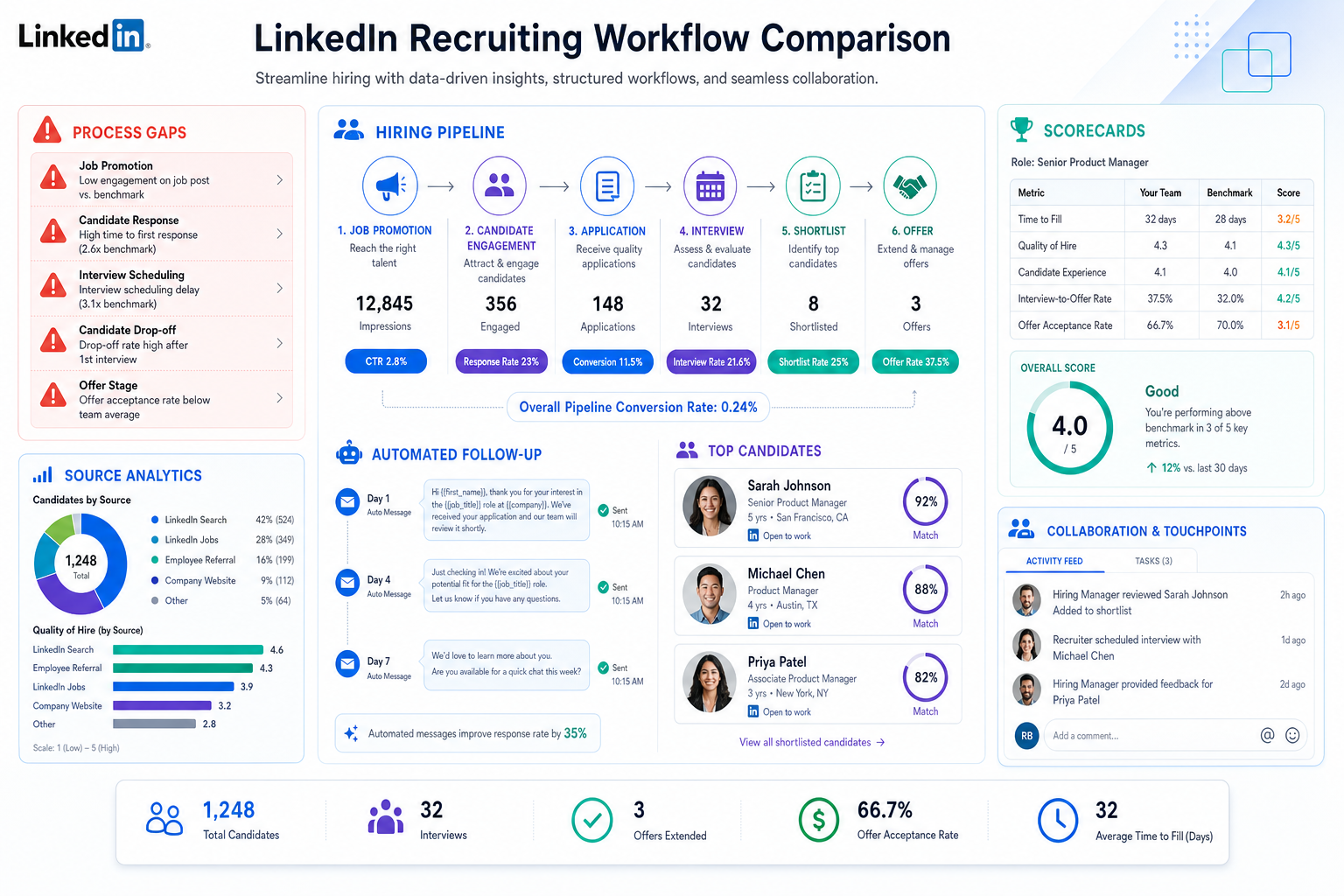
When hiring teams compare hiring systems, this article shows how to spot costly process gaps and choose software that improves decisions.
When those three things are missing, the damage shows up fast. Agency recruiters lose time chasing updates across inboxes and spreadsheets. In-house teams struggle to keep hiring managers aligned. Small search firms feel the cost in slower delivery, weaker candidate experience, and avoidable friction with clients who expected a clear process and realistic timelines. The software problem is rarely just about posting jobs or moving cards in a pipeline. It is about whether the system helps people make disciplined decisions under pressure.
In my own workflow, tools that reduce repetitive outreach and follow-up have been most useful when they support process rather than replace judgment. I have used AI Recruiter to keep candidate conversations moving after hours, answer routine role questions, and collect resumes or contact details from interested prospects without letting early-stage outreach stall. That matters when a recruiter needs to advertise for employees or run outbound search at the same time. The recruiter still reviews resumes, decides who actually fits, and controls the next step, but the front end becomes much easier to manage.
The underlying issue is familiar to anyone evaluating an external recruiter or building an internal talent function. Before you trust a partner or a platform, you want proof that the approach is not just another version of what already failed. In practice, that means checking whether the work is grounded in evidence, whether the recruiter can collaborate like a real partner, whether the process is clearly mapped with line-manager access and defined deliverables, and whether accountability is strong enough that risk is shared rather than passed downstream.
Those same decision criteria explain why some recruiting platforms work and others create expensive noise. The best recruiting software is not the one with the loudest feature list. It is the hiring system that helps your team evaluate candidates with less bias, coordinate with hiring managers more effectively, and run a repeatable process from job promotion through shortlist, interview, and offer.
- Why good recruiting tools still fail teams
- What a hiring system really includes
- A practical framework for evaluating recruiting software
- Quick comparison of recruiting software categories
- Best recruiting software by use case
- Features that matter most in hiring systems
- How hiring systems help you advertise for employees
- Implementation and buying guidance
- Common buying mistakes
- FAQ
Why Good Recruiting Tools Still Fail Teams
One reason software selection goes wrong is that buyers focus on features before they test operating discipline. In recruiting, a weak process can hide behind a polished demo for months. A platform may look efficient on the surface, but if it does not support structured feedback, clear ownership, realistic timelines, and objective candidate review, it will not improve hiring outcomes.
I see the same pattern in agency and in-house environments. Teams buy software for speed, then realize their real need is consistency. They want a better way to track applicants, but the deeper requirement is often broader: reduce bias, improve client or hiring-manager alignment, and create a workflow people will actually follow. That is why the strongest hiring systems behave less like isolated tools and more like operating systems for the recruiting function.
Key insight: If a recruiting platform cannot support objective decision-making, genuine stakeholder partnership, and a tested delivery process, it will not feel like the best recruiting software for long.
What a Hiring System Really Includes
A hiring system is not just an applicant tracking system. It is the full set of workflows, rules, collaborators, and software used to attract, assess, and hire talent. In practical terms, that usually includes job posting, sourcing, applicant tracking, interview coordination, feedback collection, reporting, and handoff into onboarding or HR systems.
That broader definition matters because buyers often search different terms for the same need. Hiring systems, hiring system, recruiting software, and applicant tracking system usually point to one question: how do we run hiring in a repeatable, visible, lower-friction way?
The main advantages of applicant tracking system software are not just administrative neatness. They include cleaner decision records, better collaboration, more consistent candidate movement, and fewer avoidable delays between recruiter action and hiring-manager response. Those are some of the most durable applicant tracking system benefits for teams that need hiring structure, not just a login.
A Practical Framework for Evaluating Recruiting Software
The most useful lesson from real recruiter selection also applies directly to software selection: start with standards that reveal how the work will actually get done.
1. Look for data before promises
Good recruiting software should help your team work from evidence rather than intuition alone. That means source tracking, stage conversion reporting, consistent scorecards, and visibility into bottlenecks. Data does not remove human judgment, but it does reduce the risk that likability, urgency, or internal politics drive the entire process.
When I test systems, I always look at whether the reporting can answer ordinary recruiting questions without workarounds: Which sources produce qualified applicants? Where do candidates stall? Which hiring managers delay feedback? If those answers are difficult to surface, the system is not helping enough.
2. Prioritize true partnership in the workflow
The best software supports two-way collaboration. Recruiters need to educate hiring managers on process, but the system should also make it easy for recruiters to learn the business context behind a role. A strong platform preserves that exchange through notes, scorecards, intake fields, approval steps, and role-specific feedback paths.
In other words, partnership is not a soft concept. It is a workflow requirement. If the software cannot capture what the business actually needs, your recruiters will still be working from half-formed briefs and inconsistent stakeholder input.
3. Demand a tested process, not just attractive features
One of the fastest ways to evaluate a platform is to ask whether it supports a proven hiring sequence. Can the team define steps clearly? Can recruiters access the right hiring stakeholders at the right stage? Can the system support expected timelines and visible deliverables? If not, the technology may add administration without creating control.
This is also where I found AI Recruiter useful in outbound search. It helped automate the repetitive top-of-funnel work on LinkedIn, such as initial connection attempts, role introductions, and ongoing candidate replies across time zones, while keeping the recruiter in charge of qualification after the resume arrives. That distinction matters. Automation should support a tested recruiting process, not pretend to replace it.
4. Check where accountability lives
In agency recruiting, buyers often look for a guarantee because it signals confidence in the process. Software does not work the same way, but the principle still holds. You want to know where accountability sits. Can the system produce an audit trail? Can it show who moved a candidate, who submitted feedback, who approved an offer, and where a handoff broke down? If not, process failure becomes hard to diagnose and easy to repeat.
Quick Comparison of Recruiting Software Categories
Rather than ranking specific vendors, it is more useful to compare categories of recruiting software based on operational fit.
| Use Case | Best Fit | What to Look For | Main Trade-Off |
|---|---|---|---|
| Small business | Simple ATS with guided setup | Basic job posting, candidate tracking, interview scheduling, easy reporting | Limited customization and lighter analytics |
| Startup | Flexible recruiting platform | Fast setup, collaboration, automation, adaptable workflows | Can be outgrown quickly |
| Mid-market | Scalable hiring system | Approvals, integrations, dashboards, stronger process control | More setup and higher cost |
| Enterprise | Advanced ATS | Permissions, compliance, high-volume workflows, deep integrations | Heavier daily use and slower adoption |
| Search or outbound recruiting | ATS plus outreach support | Pipeline control, communication tracking, sourcing workflow support | Requires careful process design |
| Employer branding focus | Recruiting suite with marketing tools | Career pages, job distribution, apply-flow quality, source tracking | May be stronger on attraction than analytics depth |
This comparison matters because the best recruiting software for a lean office team is very different from the best system for a retained search desk or a multi-location employer. The right choice depends on complexity, hiring volume, and how much process discipline the team can realistically maintain.
Best Recruiting Software by Use Case
Best for small businesses
Small teams usually benefit most from a straightforward hiring system that replaces inbox chaos and spreadsheet tracking. If hiring is occasional, ease of use matters more than deep configuration. Look for a system that makes job posting, candidate review, and scheduling clean enough that the process does not depend on one organized person holding everything together.
Best for startups
Startups need flexibility because headcount plans, role scope, and hiring ownership often change quickly. A startup-friendly platform should support fast edits to workflows and simple collaboration with founders or department leads. If the team needs to advertise for employees while also doing outbound sourcing, the recruiting software should connect those streams rather than forcing manual reconciliation.
Best for mid-market companies
Mid-market employers tend to outgrow ad hoc hiring systems first in reporting and stakeholder alignment. This is where applicant tracking system benefits become more operational: clearer approvals, better dashboards, and cleaner integration with broader HR processes.
Practical tip: test reporting during evaluation, not after purchase. Two platforms can look similar in a demo while performing very differently once the team needs source quality reports, manager response times, or stage aging analysis.
Best for enterprise hiring
Enterprise teams need governance as much as speed. Permissions, audit records, compliance support, and multi-team workflows become critical. The trade-off is usability. The strongest enterprise choice is not necessarily the one with the most features, but the one the organization can actually adopt without driving recruiters and managers back into side-channel communication.
Best for collaborative hiring
If the real issue is slow stakeholder response, prioritize platforms with strong scorecards, easy interview scheduling, and visible accountability. Collaborative hiring fails when people can participate only if they remember to check another system. Software should make contribution easy and expected.
Best for agency or outbound recruiting teams
Agency recruiters and outbound teams often need more than a standard ATS. They need speed at the top of funnel, strong search organization, and communication continuity. In my own usage, AI Recruiter was most helpful when response windows stretched across evenings or international time zones. It kept candidate conversations active, answered routine questions, and gathered resumes while I focused on shortlist quality and client calibration. That kind of support works best alongside a disciplined ATS process, not instead of one.
Features That Matter Most in Hiring Systems
When experienced recruiters evaluate software, the same feature groups matter again and again because they directly affect decision quality and delivery speed.
1. Job posting and distribution
If your team needs to advertise for employees regularly, this is foundational. Good software should make role publishing consistent, trackable, and easy to update without creating version confusion across channels.
2. Candidate pipeline management
A strong hiring system makes every stage visible and accountable. Applied, screened, interviewed, offer, hired, rejected: each transition should be easy to understand and hard to lose.
3. Structured feedback and scorecards
This is one of the most underrated applicant tracking system benefits. Structured feedback reduces vague reactions and improves comparability across candidates. It also gives recruiters a better basis for pushback when stakeholder input is inconsistent.
4. Scheduling and communication flow
Interview scheduling becomes a major bottleneck once several stakeholders are involved. Systems that reduce back-and-forth and keep candidates informed create a measurable difference in team responsiveness and candidate experience.
5. Reporting and source analytics
Data-driven hiring depends on being able to trust the dashboards. Look for source performance, conversion rates, pipeline aging, and manager response visibility. If the reporting is weak, process improvement becomes guesswork.
6. Automation for repetitive tasks
Automation is most useful when it removes admin rather than judgment. Reminder emails, stage changes, follow-up nudges, and communication handoffs are sensible uses. Candidate fit decisions are not.
7. Sourcing and outreach support
Not every ATS is strong in outbound work. If your team depends on proactive recruiting, evaluate how the platform works with sourcing and communication tools. For LinkedIn-heavy workflows, I found AI Recruiter especially relevant for handling repetitive first-touch messaging, follow-up, and multilingual communication while leaving final qualification to the recruiter.
8. Integrations with HR systems
Integrations matter most when recruiting data has to move downstream cleanly. One of the practical advantages of applicant tracking system adoption is reducing duplicate work after offer acceptance.
- For recruiters: prioritize stage visibility, communication flow, and workflow automation.
- For HR teams: prioritize audit trails, reporting, and integration quality.
- For hiring managers: prioritize usability, scorecards, and fast feedback submission.
- For agency teams: prioritize search organization, outreach continuity, and deliverable control.
How Hiring Systems Help You Advertise for Employees
Many teams think of job advertising and applicant tracking as separate tasks, but they are tightly connected. If you want to advertise for employees effectively, the system should connect the top of funnel with what happens after the application or response arrives.
A modern hiring system should help teams:
- Create clear job ads with accurate information and candidate-friendly apply routes.
- Distribute roles across relevant channels without introducing version errors.
- Capture responses and resumes in one place rather than scattering them across email and messaging platforms.
- Track source quality so teams can see which channels produce serious candidates.
- Move applicants into a defined process with screening, feedback, and scheduling already in place.
This is also where outbound and inbound work need to meet. If your team runs LinkedIn sourcing while also posting roles publicly, disconnected systems create duplicate outreach, missed follow-up, and unreliable reporting. A better hiring system closes that gap.
Implementation and Buying Guidance
Choosing the best recruiting software is partly a feature decision and partly an implementation decision. A cheaper platform can become expensive if it creates manual work, poor adoption, or reporting blind spots. A more advanced platform can also be wasteful if hiring volume is low or internal discipline is weak.
Use these questions before you buy:
- How many active roles do we usually manage at once?
- Who needs access beyond recruiters: hiring managers, leadership, finance, interviewers, HR operations?
- Do we need stronger reporting, cleaner approvals, or better top-of-funnel communication?
- Are we running mostly inbound applications, outbound search, or both?
- Do we need the system to help us advertise for employees across multiple channels?
- Will recruiting data need to move into HRIS or payroll systems?
- Can our current process support a heavier platform, or do we need simplicity first?
My implementation advice is simple: do not launch with every feature turned on. Start with stages, scorecards, scheduling, core permissions, and a clear job-posting path. If outbound sourcing is part of your workflow, define how recruiters will use support tools like AI Recruiter to keep early communication moving while final review stays human. Once adoption is stable, add deeper automation and advanced reporting.
Common Buying Mistakes
Buying a feature list instead of a working process
Software only helps if it fits the real hiring sequence. Fancy features cannot compensate for weak intake, vague ownership, or poor manager participation.
Confusing activity with evidence
A platform can generate lots of motion without improving decisions. Data should make the hiring process more objective, not just more visible.
Ignoring partnership requirements
If your hiring managers rarely submit useful feedback or recruiters lack business context, the technology should help solve that. Otherwise, the same communication failures simply move into a new interface.
Overestimating automation
Automation is valuable for repetitive messaging, reminders, and coordination. It should not replace recruiter judgment, resume review, or final qualification decisions.
Choosing enterprise weight for low-volume hiring
Some employers do not need a highly complex platform. If the process is simple, a lightweight hiring system may create more value than a large suite with low adoption.
FAQ
What is the difference between hiring systems and an ATS?
Hiring systems is a broader term that includes process, collaboration, sourcing, job advertising, and reporting. An ATS is usually the core software used to track candidates and hiring stages.
What are the main advantages of applicant tracking system software?
The biggest advantages of applicant tracking system software are centralized candidate records, cleaner workflow control, more structured collaboration, better reporting, and less manual admin. In practical recruiting terms, that means fewer dropped candidates and more reliable decision-making.
What are the most important applicant tracking system benefits for smaller teams?
For smaller teams, the most important applicant tracking system benefits are visibility, consistency, easier scheduling, and reduced reliance on email or spreadsheets. Those gains often matter more than advanced customization.
Can recruiting software help us advertise for employees?
Yes. Good recruiting software can connect job posting, career pages, screening questions, source tracking, and applicant movement into one process. That makes it easier to advertise for employees without losing control once responses begin.
Is automation useful in outbound recruiting?
Yes, especially for repetitive first-touch communication and follow-up. The best use of automation is to support recruiter productivity while leaving qualification, resume review, and next-step decisions with the recruiter.
Is an ATS too much for low-volume hiring?
Sometimes. If hiring is rare and simple, a full ATS may be more than you need. But if roles are slipping through the cracks, managers are slow to respond, or applicants are hard to track, even a lightweight hiring system can make a meaningful difference.
Conclusion
The search for the best recruiting software should start with the same discipline used to evaluate a strong recruiter: look for data, real partnership, a tested process, and visible accountability. Those standards reveal whether a platform will support better hiring or simply reorganize old problems.
If you are comparing hiring systems, map your real workflow first. Define how you will attract candidates, how you will advertise for employees, how feedback will be collected, and where automation can safely support the process. Once those answers are clear, choosing the right hiring system becomes much easier and much more durable.