Urgent leadership hiring exposes whether human resource recruitment software helps HR leaders choose internal vs external paths, avoid handoff delays, and keep searches moving.
That matters most when a replacement is not optional but overdue. A founder hesitates to let go, an HR lead has no clean view of internal talent, and an external search starts before role ownership, feedback rules, and onboarding handoff are clear. In small search firms, that means lost billable time and strained client trust. For in-house recruiters, it usually means slower decisions, duplicated outreach, and senior candidates cooling off while the company debates who owns the next step.
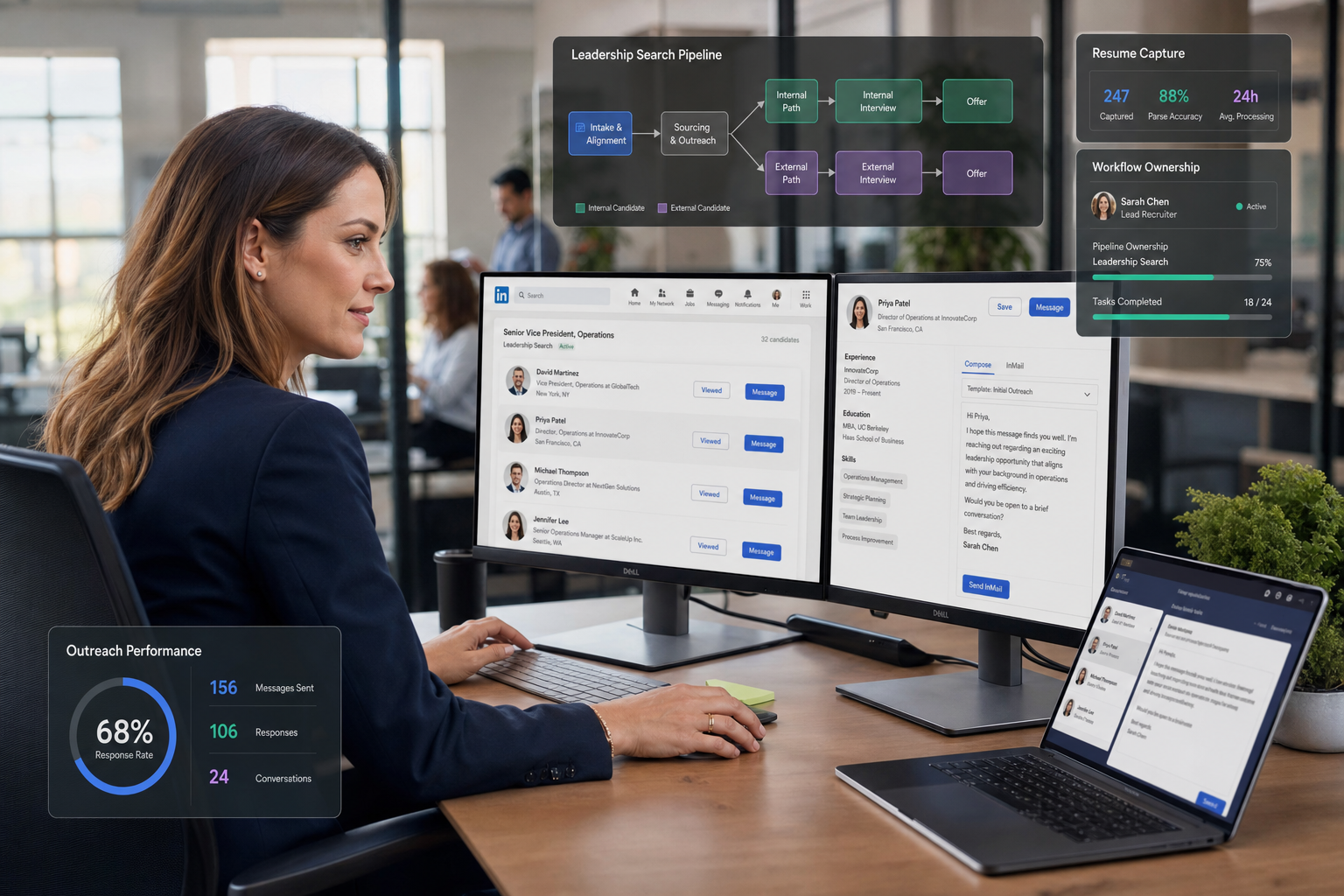
In my own workflow, tools like StrategyBrain AI Recruiter help most when that confusion starts at the top of funnel. I have used it to keep LinkedIn outreach moving, respond after hours, and collect resumes and contact details without waiting for me to be online. The practical value is not replacing recruiter judgment. I still review resumes, decide who advances, and handle the real qualification call. But when succession-related hiring suddenly turns urgent, that kind of always-on support keeps a search from stalling before the serious evaluation begins.
The succession planning problem is a familiar one. A business owner spends years focused on day-to-day operations and long-term growth, then realizes too late that key leaders will eventually leave through retirement, departure, disability, or some other disruption. Once that timeline becomes real, the organization has to decide whether to prepare someone internally or hire from outside. Both routes can work, but neither works well if no system exists for tracking capability, documenting decisions, and managing a clean transfer of knowledge.
That is exactly where recruiting operations and software selection meet. If a company wants to promote from within, it needs a structured way to evaluate skills, readiness, and development over time. If it needs an outside hire who can step in quickly, the recruiting team needs stronger sourcing, faster communication, and a better handoff into onboarding. When buyers compare the best recruiting software, they are often trying to solve this broader succession problem, even if they search for human resource recruitment software, hr management software, or popular hr software instead.
Practical takeaway: The best recruiting software is usually the system that keeps urgent hiring decisions organized across three moments: identifying whether the need is internal or external, running the search with clear ownership, and transferring the new hire into the business without losing knowledge.
Table of Contents
- Why succession hiring exposes recruiting software gaps
- What human resource recruitment software should actually cover
- Internal promotion vs external hire: the software implications
- How to evaluate the best recruiting software
- Quick comparison by team type
- ATS vs hr management software vs popular hr software
- Where AI-supported recruiting helps in real workflows
- Implementation advice for recruiters and HR teams
- Common buying mistakes
- FAQ
Why succession hiring exposes recruiting software gaps
Most recruiting processes can hide weak systems for a while. A few open roles, some hiring manager patience, and recruiters can work around fragmented tools. Succession hiring is different. When a senior operator, principal, or department lead is expected to move on, the business cannot afford vague ownership or scattered candidate information.
This is why succession situations are such a useful lens for evaluating the best recruiting software. They force a company to answer practical questions fast:
- Do we know whether we are promoting from within or hiring from outside?
- Can we assess internal talent in a structured way?
- Can we run an external search without losing momentum?
- Can we transfer role knowledge and onboarding steps cleanly after the hire?
If the answer to those questions depends on inbox threads, spreadsheets, and memory, the issue is no longer just hiring discipline. It is software fit.
What human resource recruitment software should actually cover
Human resource recruitment software is the operating layer that manages hiring before the employee record fully lives in broader HR systems. In practice, that usually means job intake, applicant tracking, candidate communication, scheduling, approvals, offer management, onboarding handoff, and reporting.
For most teams, the foundation is still the applicant tracking system for recruiters. The ATS gives structure to stages, ownership, status changes, and recordkeeping. Around that core, stronger platforms add sourcing support, CRM-style talent pooling, workflow automation, analytics, and integrations with onboarding or payroll systems.
In succession-related hiring, those functions matter because the work rarely begins with posting a job. It begins with a transition question. Is there internal bench strength? Is there time to develop someone? Does the business need an outside hire who can contribute quickly? The software should support that decision, not just collect applicants after the fact.
Core functions serious teams should expect
- Applicant tracking: a clear pipeline for each role and each decision stage
- Candidate sourcing support: intake from job boards, career pages, referrals, and direct outreach
- Internal talent visibility: structured notes, evaluation history, and mobility signals where relevant
- Interview and approval workflow: scheduling, scorecards, and decision accountability
- Automation: reminders, stage movement, communication sequences, and task triggers
- Onboarding handoff: smooth transfer from accepted offer into HR and team transition steps
- Analytics: funnel health, source quality, stage delay, and role-specific bottlenecks
That last point is easy to underestimate. In leadership and succession hiring, a delayed decision is not just a reporting issue. It can leave a business exposed operationally.
Internal promotion vs external hire: the software implications
One of the most useful ideas from succession planning is that companies usually face two paths: elevate someone from within or recruit from outside. The right software should make either path easier, because the risks are different.
When promoting from within makes sense
Internal promotion is often the better route when a capable person already exists in the team, the role transition can be planned, and there is enough time to develop the candidate properly. But this only works if the company has a formal and ongoing way to evaluate skill, aptitude, and readiness.
From a recruiting systems perspective, that means your software should support:
- consistent evaluation criteria
- documented feedback over time
- visibility into prior hiring and performance context
- clean collaboration between TA, HR, and leadership
Without that structure, internal succession often becomes subjective. The person closest to leadership gets attention, while stronger but less visible talent is overlooked.
When an external hire is the better answer
An outside hire becomes more attractive when the timeline is tight, no internal successor has been developed, or the business needs a fresh perspective. In those cases, human resource recruitment software needs to support speed without sacrificing process discipline.
The system should help recruiters:
- launch sourcing quickly across multiple channels
- capture and centralize candidate communication
- coordinate stakeholder feedback without delay
- prepare onboarding and knowledge-transfer tasks early
This is also where I have found AI Recruiter useful as a workflow assistant rather than a decision-maker. For leadership searches that begin with LinkedIn outreach, it can keep conversations moving in different time zones, answer routine candidate questions, and gather resumes while I stay focused on calibration with the client or hiring leader. The recruiter still owns fit assessment and shortlist quality, but the administrative drag gets lighter.
How to evaluate the best recruiting software
Most comparison content overemphasizes feature count. Experienced recruiters usually care more about workflow reliability. In succession-related hiring especially, software has to support judgment, coordination, and transition planning.
1. Start with the business transition, not the demo
Before reviewing platforms, ask what transition the business is preparing for. Is the problem replacing a founder-led operator, strengthening a leadership bench, or improving external search speed for hard-to-fill roles? The best recruiting software depends on that context.
This is one place where recruiting software overlaps with strategic planning. A system that works for routine hiring may fail when the business needs cleaner governance, more visibility, and stronger role handoff.
2. Test ATS workflow quality under real pressure
The applicant tracking system for recruiters should be simple enough that recruiters, coordinators, and hiring managers all use it consistently. In high-stakes hiring, poor adoption creates hidden delays. Test whether users can:
- move candidates quickly between stages
- submit feedback without training overhead
- see ownership for each step
- track approvals and exceptions clearly
The real advantages of applicant tracking system design appear when the workflow keeps everyone aligned without extra chasing.
3. Check how the system handles internal and external talent differently
Succession hiring often includes both pathways at once. A company may quietly review internal options while also mapping the external market. Your human resource recruitment software should make those tracks manageable, with secure permissions and clean reporting.
If it only works well for posted jobs and inbound applications, it may be too narrow for leadership recruiting.
4. Evaluate sourcing and communication depth
For external hiring, sourcing support is often the difference between a basic system and the best recruiting software for serious talent teams. Look for job board distribution, talent pools, direct outreach support, communication history, and candidate rediscovery.
Where LinkedIn outreach is part of the process, I prefer a stack where the ATS stays the system of record and StrategyBrain AI Recruiter supports the repetitive front-end communication. Used that way, it helps maintain outreach continuity without asking recruiters to hand over final evaluation.
5. Make onboarding handoff a buying criterion
The original succession planning logic is clear: replacing someone is not enough; the transfer of responsibility has to work too. Recruiting software should support offer approvals, data handoff, and onboarding coordination so the hire can absorb positional knowledge without confusion.
That is why the applicant tracking system benefits do not end at offer acceptance. In mature teams, the best systems reduce risk during the transition itself.
6. Review reporting through an operational lens
Ask whether the software can show where decisions slow down, which roles sit too long in manager review, and how internal versus external searches perform. Leadership teams need those views to improve planning rather than react late.
If reporting cannot support those questions, the platform may look modern but still be weak where it counts.
Quick comparison: what to prioritize by team type
| Team type | What matters most | Where ATS benefits are highest | Buying advice |
|---|---|---|---|
| Small business | Ease of use, fast setup, basic workflow control | Replacing email and spreadsheet hiring | Choose software that supports clear ownership during urgent replacement hiring |
| Mid-sized internal TA team | Structured pipelines, sourcing support, onboarding handoff | Standardizing leadership and specialist hiring | Prioritize flexibility for both internal and external candidate paths |
| Enterprise HR organization | Governance, permissions, analytics, integration depth | Managing complex succession and multi-business hiring | Stress-test reporting, admin controls, and HRIS connection early |
| Agency or search firm | Speed, CRM-style visibility, outreach continuity | Tracking passive talent across multiple mandates | Look for software that pairs well with sourcing and messaging workflows |
| High-volume hiring team | Automation, scheduling, bulk communication | Reducing admin at top-of-funnel | Make sure automation supports exceptions, not just standard volume hiring |
ATS vs hr management software vs popular hr software
Recruiters and HR leaders often use these terms loosely, but the distinctions matter when you are buying software for real hiring problems.
Recruiting software is the broader category focused on attracting, evaluating, and moving candidates.
ATS is the structured workflow engine at the center of most recruiting stacks.
Hr management software usually covers the wider employee lifecycle after hire, including records, payroll, time, benefits, and performance administration.
Many organizations begin with popular hr software that includes a recruiting module. That can be enough when hiring is light and straightforward. But when succession planning, leadership replacement, or specialized external recruiting becomes more common, built-in modules often feel shallow.
The biggest gap is usually not basic posting. It is everything around structured evaluation, sourcing depth, and post-offer transition.
Where they overlap
- candidate-to-employee data handoff
- offer approval workflows
- onboarding setup
- organizational structure and permissions
- shared reporting at a high level
Where they differ
- Recruiting software: optimized for pipeline movement, candidate communication, and search execution
- ATS: optimized for visibility, stages, feedback, and compliance-related records
- Popular hr software: optimized for broader HR administration across the employee lifecycle
If your issue is that accepted candidates disappear into a messy handoff, start with integration. If your issue is that recruiters and hiring leaders cannot run a disciplined search, you likely need stronger recruiting software first.
Where AI-supported recruiting helps in real workflows
AI in recruiting is most useful when it supports discipline rather than pretending to replace it. In my experience, the practical wins come from communication continuity, faster information capture, and reduced repetitive admin.
For example, in LinkedIn-heavy sourcing, I have used AI Recruiter to maintain candidate conversations after hours, answer basic role questions in the candidate's language, and collect resumes or contact details from interested people before momentum fades. That helps especially in external succession searches where timing matters and strong candidates often respond outside normal recruiter hours.
What it does not do, and should not be expected to do, is make the hiring decision for you. Resume review, context judgment, shortlist quality, stakeholder calibration, and final qualification remain recruiter work. That boundary matters.
Questions worth asking about AI features
- Does the feature save time in a specific step you already perform often?
- Can recruiters review and override outputs easily?
- Does it improve outreach continuity or candidate responsiveness?
- Will it work inside your actual workflow, not just in a demo path?
- Does it support recruiters, or create another layer for managers to ignore?
The best recruiting software uses AI to strengthen a sound process. It does not hide weak process design behind flashy claims.
Implementation advice for recruiters and HR teams
Even strong software underperforms if implementation starts with configuration instead of process design. Succession planning offers the right lesson here: think through the transition before the event forces it.
Map the decision path first
Document how a replacement decision begins. Who identifies the need? When do internal candidates get reviewed? When does an external search launch? What triggers onboarding preparation? Those answers should shape the software setup.
Define ownership across the handoff
In succession hiring, recruiters, HR, business leaders, and hiring managers often assume someone else owns feedback, approval, or onboarding preparation. Put ownership into the workflow from day one.
Set integration requirements early
If payroll, HRIS, or onboarding sit elsewhere, list your must-have integrations before evaluating vendors. This is especially important when comparing recruiting systems to popular hr software suites.
Train for behavior, not just navigation
Users need to understand why delayed feedback, missing notes, and informal approvals create risk. The software only works if the team respects the process it is meant to support.
Common buying mistakes
Buying for general HR coverage when the real problem is recruiting execution
Broad HR capability does not automatically mean strong candidate pipeline management. Test recruiting workflows on their own merits.
Ignoring internal mobility and succession needs
Some teams buy software as if every role starts with an external posting. That misses the reality that many critical hires begin as internal-vs-external decisions.
Overestimating AI and underestimating process ownership
AI can help with outreach and responsiveness, but it cannot fix unclear accountability, weak role definition, or inconsistent evaluation.
Skipping onboarding handoff in the evaluation stage
When the whole hiring effort is about replacing someone important, the transfer of knowledge matters as much as the acceptance of the offer.
Choosing complexity that the team will not use
The best recruiting software is not the most elaborate platform. It is the one your recruiters and hiring managers will actually use when pressure rises.
FAQ
What does human resource recruitment software do?
It helps teams manage hiring from job opening through offer and handoff into onboarding. Typical functions include applicant tracking, sourcing support, interview coordination, automation, reporting, and integration with HR systems.
Is recruiting software the same as an ATS?
No. An ATS is usually the core pipeline system inside a broader recruiting software category. Recruiting software may also include CRM functions, sourcing tools, analytics, and onboarding links.
What are the main advantages of applicant tracking system tools?
The main advantages of applicant tracking system tools are structured workflows, better visibility, more consistent decision-making, and less manual chasing across recruiters and hiring managers.
How does recruiting software help with succession hiring?
It helps teams organize internal-versus-external decisions, run structured searches, centralize feedback, and manage the transition from offer acceptance into onboarding and knowledge transfer.
Do companies still need recruiting software if they already use hr management software?
Often yes. Hr management software may handle employee administration well, but recruiting software usually provides stronger applicant tracking, sourcing workflow, and hiring team collaboration.
Can popular hr software be enough for small businesses?
Sometimes. If hiring volume is low and process complexity is limited, built-in recruiting modules can be enough. If roles are harder to fill or transitions carry more risk, dedicated recruiting software usually becomes more valuable.
Where does AI help most in recruiting?
AI helps most in repetitive workflow steps such as outreach continuity, resume collection, candidate communication, search support, and routine writing assistance. Final qualification and hiring judgment should stay with recruiters and hiring teams.
What should headhunters prioritize when choosing the best recruiting software?
Headhunters should prioritize search workflow speed, candidate communication history, sourcing support, CRM-style visibility, and software that works well with their actual outreach process.
Conclusion
The best recruiting software is easier to judge when you look at a real business transition instead of a generic feature checklist. Succession planning makes that clear. Every company eventually faces the need to replace a key leader, decide between internal development and external hiring, and transfer responsibility without confusion.
If your team is comparing human resource recruitment software, use that same logic. Test whether the platform supports disciplined evaluation, fast external search, clear ownership, and reliable onboarding handoff. That is how you separate software that looks complete from software that actually fits your hiring process.