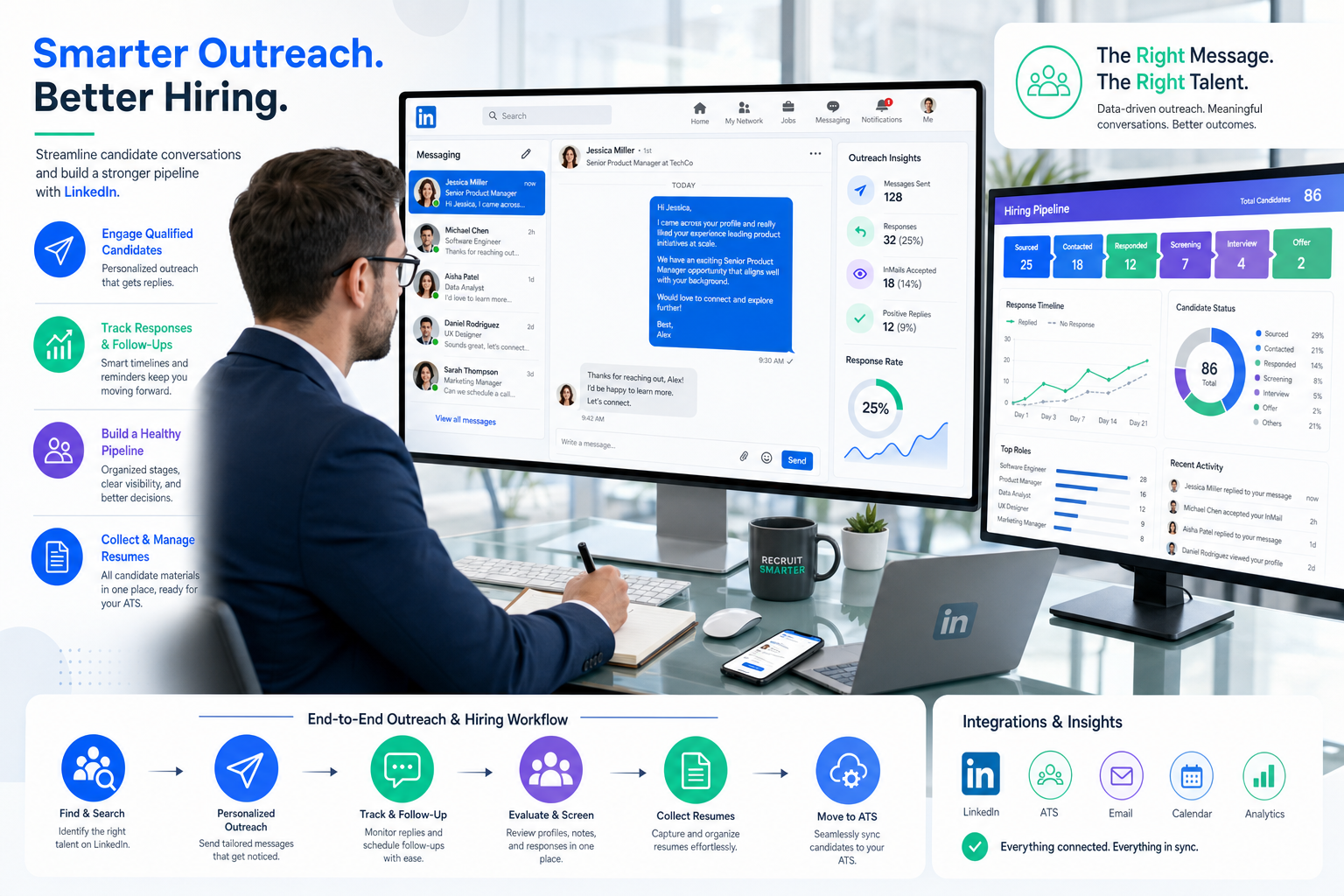
The best recruitment platforms are the ones hiring leaders can judge to prevent candidate drop-off, manager delays, and lost offers.
When that operating discipline is missing, the damage shows up fast. Recruiters lose hours chasing feedback, hiring managers treat strong applicants like interchangeable pipeline volume, and employers wonder why talent shortages persist even when inbound applications look healthy. For smaller search firms and lean in-house teams, the real cost is not just slower hiring. It is candidate drop-off, weaker relationships, avoidable rework, and a reputation for being organized on the job post but disorganized once real conversations begin.
In that gap between candidate interest and recruiter follow-through, I have found tools like StrategyBrain AI Recruiter genuinely useful when the challenge starts upstream on LinkedIn outreach and response handling. It can automate first-contact messaging, keep candidate conversations moving after hours, and collect resumes plus contact details from interested people, while the recruiter still owns the final judgment on fit, resume review, and whether the candidate should move into the formal process.
The underlying problem is easy to miss because it rarely starts with software. A high-performing finance candidate may accept that quarter-close or year-end work will be intense, but they still judge an employer by whether the opportunity looks like growth, whether the culture feels fair, and whether the role connects to something larger than short-term output. If a recruiter reaches out, gets a reply, promises next steps, and then leaves the candidate waiting while internal stakeholders drift, the employer has already failed the test that matters.
That is why the best recruiting software is not just about tracking applicants after they apply. It has to support the full chain that top candidates use to evaluate opportunities: engagement, responsiveness, transparency, flexibility, recognition, and a believable path forward. Once you view hiring through that lens, the search for the best hiring platforms for employers and the role of social recruiting software become much clearer.
Table of Contents
- Why the Best Recruitment Platforms Start With Candidate Reality
- What Makes the Best Recruitment Platforms Stand Out
- Quick Comparison of Recruiting Software Categories
- Best Recruiting Software by Hiring Use Case
- How to Evaluate the Best Hiring Platforms for Employers
- Where Social Recruiting Software Fits
- ATS Benefits That Matter in Daily Hiring
- A Practical LinkedIn Workflow With AI Recruiter Support
- Implementation and Rollout Questions
- Common Buying Mistakes
- FAQ
Why the Best Recruitment Platforms Start With Candidate Reality
Many hiring software comparisons begin with employer pain: too many resumes, not enough automation, poor reporting, weak integrations. Those issues are real, but experienced recruiters know the better starting point is candidate behavior. Strong candidates do not evaluate opportunities only on compensation or title. They pay attention to whether the employer follows through, whether growth looks real, whether the team seems supportive, and whether the role fits a sustainable working life.
That perspective matters because it changes how you assess the best recruitment platforms. A platform should not merely move names through stages. It should help recruiters keep engagement high, preserve momentum, and connect the role to the bigger picture quickly enough that top candidates do not self-select out.
In finance recruiting, for example, many candidates understand that demanding periods come with the territory. What they resist is a process that signals all sacrifice and no support. When hiring teams cannot communicate clearly, recognize strong talent promptly, or show flexibility where it matters, software gaps become talent losses.
So before comparing dashboards and feature lists, ask a more practical question: does this platform help recruiters create a hiring experience that matches what top talent wants at work? That is the real frame for choosing the best recruiting software.
What Makes the Best Recruitment Platforms Stand Out
When employers compare the best recruitment platforms, they often begin with an ATS checklist. In practice, the better decision comes from testing how the system performs across the full hiring journey, from first outreach through offer stage and handoff.
From an operator's perspective, the best recruiting software should handle six jobs especially well:
- Applicant tracking that keeps stages, notes, and ownership clear
- Candidate sourcing across job boards, referrals, talent pools, and outbound channels
- CRM and nurturing for relationship-based recruiting and re-engagement
- Interview coordination with low friction for hiring managers
- Analytics that show source quality, delays, and conversion points
- Integrations with HRIS, email, calendars, assessments, and onboarding tools
What separates average systems from the strongest ones is their ability to preserve context. If a candidate was attracted by advancement potential, flexibility, recognition, or culture, the platform should make that information visible to recruiters and hiring managers rather than burying it in inboxes and side notes.
That is also where the most meaningful applicant tracking value appears. Recruiters need fast review workflows and complete communication history. Hiring managers need structured feedback and fewer missed steps. TA leaders need reporting that reveals where candidate interest is stalling. A platform that cannot support those behaviors may still look polished in a demo, but it will underperform in live hiring.
Quick Comparison of Recruiting Software Categories
One reason buyers struggle to identify the best hiring platforms for employers is that rankings often mix very different categories. Separating them first makes evaluation much easier.
| Category | Primary Role | Best For | Watch-Out |
|---|---|---|---|
| ATS-first platform | Applications, workflow control, approvals, compliance | Teams needing structure and clear recruiter-manager handoffs | May need added sourcing or CRM depth |
| Sourcing-first platform | Outbound search and engagement | Hard-to-fill roles and proactive talent mapping | Often requires a separate system of record |
| CRM-driven recruiting platform | Talent nurturing and pipeline segmentation | Relationship-heavy and recurring hiring | Can be too complex for very small teams |
| Social recruiting software | Promotion and sourcing through social channels | Employer brand-led hiring and passive talent outreach | Not a replacement for full ATS workflow |
| Enterprise talent suite | Integrated governance, analytics, permissions, and workflow | Large organizations with layered approvals | Heavier implementation and admin overhead |
This distinction matters because a candidate who is evaluating culture, flexibility, and growth will often first encounter your brand through social or outbound channels, but their trust is won or lost in the process that follows. That is why many teams need a stack rather than a single point solution.
Best Recruiting Software by Hiring Use Case
A more realistic way to assess the best recruitment platforms is by hiring environment rather than by a universal winner.
Lean in-house teams and small employers
Smaller teams usually need intuitive setup, clean job distribution, basic reporting, and enough automation to reduce manual chasing. In this segment, the best hiring platforms for employers are usually the ones that recruiters can configure quickly and hiring managers can use without training fatigue.
These teams benefit most when the platform removes low-value coordination work. If recruiter time is still being spent on manual reposting, interview chasing, and fragmented candidate records, the software is not solving the real bottleneck.
Mid-market teams with growing process demands
As hiring volume rises, the challenge shifts from simple organization to repeatable quality. Mid-market employers often need custom stages, segmented pipelines, stronger source reporting, and better visibility into why promising candidates disengage.
This is where the best recruiting software should help teams preserve the motivations that matter to strong talent. If a candidate values growth, recognition, or manager quality, that context should stay visible through the workflow instead of getting lost after sourcing.
Enterprise talent acquisition teams
Enterprise buyers need governance, permissions, structured interviews, reporting depth, and localization. But they also need to avoid creating a system so heavy that recruiters build side processes outside it. The best enterprise platforms balance auditability with daily usability.
For these organizations, software quality shows up in consistency. Can the platform support transparent process expectations across locations and business units? Can leaders see where strong candidates are delayed? Can managers complete their part without slowing the entire chain?
Recruiting agencies and search firms
Agency teams and headhunters usually need search speed, rediscovery, note quality, client coordination, and a strong outreach layer. For them, the best recruitment platforms should support both relationship management and execution discipline.
Agency recruiters also have to protect candidate trust carefully. When a candidate is open to a move because they want more support, better balance, or stronger leadership visibility, the recruiter has to capture those motivations clearly and carry them into client conversations.
How to Evaluate the Best Hiring Platforms for Employers
If you are building a shortlist of the best hiring platforms for employers, use a workflow scorecard rather than a feature spreadsheet alone.
1. Does the platform help you sustain candidate engagement?
This is the most under-tested criterion. Strong candidates rarely vanish for no reason. They disengage when momentum drops, communication turns vague, or the opportunity stops looking credible. Evaluate whether the system supports fast follow-up, communication history, reminders, and talent nurturing.
2. Can recruiters preserve the candidate's decision context?
The best recruiting teams capture more than resumes. They capture why someone may move: better development, more honest culture, stronger recognition, more flexibility, or a clearer path. Good platforms make that context searchable and shareable.
3. Does automation remove admin without weakening judgment?
Automation should reduce repetitive tasks such as outreach, reminders, status updates, and scheduling. It should not replace the recruiter's role in assessing fit, reading resumes, or advising the hiring team. This distinction matters especially when evaluating AI-supported workflows.
4. Is the manager experience good enough to protect momentum?
A platform may work for recruiters but fail with occasional users. If hiring managers cannot review applicants, leave feedback, or approve next steps easily, top candidates will feel the delay even if they never see the software.
5. Does the platform support employer brand and social reach?
This is where social recruiting software becomes relevant. For many teams, social channels shape first impressions before an application ever happens. The stronger platforms let you connect social attention to a tracked hiring journey instead of treating promotion and process as separate worlds.
6. Are integrations deep enough for your real stack?
Check connections with HRIS, calendars, email, assessments, screening tools, and onboarding. Re-entering the same candidate information across systems is still one of the clearest signs that a stack is underperforming.
Practical takeaway: If your process cannot show a candidate why the role is worth the move and then keep that promise moving forward, no feature list will make it one of the best recruitment platforms.
Where Social Recruiting Software Fits
Social recruiting software is often reduced to job posting tools, but in real hiring teams it serves a broader function. It helps employers reach talent through professional networks, distribute brand messages, support outbound engagement, and bring passive candidates into a measurable pipeline.
In practice, social recruiting tools may support:
- Job promotion through social channels
- Profile enrichment and talent discovery
- Employer branding content distribution
- Direct outreach to passive talent
- Campaign tracking tied to recruiting activity
Still, social recruiting should not be confused with end-to-end process control. A recruiter may generate interest through social channels, but the hiring team still needs a durable system for application stages, feedback, interview progression, and offer management.
That is why many employers do best with an ATS-centered stack supported by social recruiting software. The first system creates order. The second expands reach. Together, they help employers attract top talent and then avoid losing that talent through process drift.
ATS Benefits That Matter in Daily Hiring
Because the market uses overlapping language, many buyers blur the difference between recruiting software and an ATS. The easiest way to separate them is this: the ATS is the hiring workflow core, while broader recruiting platforms may add sourcing, CRM, analytics, branding, and onboarding connections around it.
The most meaningful ATS benefits are practical:
- Pipeline visibility: everyone can see where candidates stand
- Consistency: teams follow defined stages, scorecards, and approvals
- Collaboration: recruiter and manager notes stay centralized
- Reporting: leaders can review delays, conversions, and source quality
- Candidate experience support: communication becomes easier to maintain
- Auditability: records remain organized in one workflow
These benefits matter because top candidates are evaluating the employer at every step. An ATS does not create culture, flexibility, or career growth, but it can prevent a company from undermining those promises through poor execution.
A Practical LinkedIn Workflow With AI Recruiter Support
When the front end of hiring depends heavily on LinkedIn, I have seen the biggest failure point occur before a candidate ever enters the ATS. A recruiter identifies the right profile, sends outreach, gets a reply after hours, and then loses momentum because the conversation sits unattended until the next day or longer. By the time the recruiter circles back, interest has cooled or the candidate has moved on.
That is one reason I have tested AI Recruiter in outreach-heavy workflows. The useful part is not some fantasy of fully replacing recruiters. It is the ability to keep first-stage communication moving: connecting with candidates that match a search, introducing the role, answering common questions, and collecting resumes or contact details from people who want to continue. For international searches, its multilingual communication and always-on response coverage can also reduce the lag that often kills early candidate interest.
My view after using it is straightforward: it works best as a bridge between sourcing and formal assessment. I still want the recruiter to review the resume, judge whether the candidate really matches the brief, and decide what goes to the client or hiring manager. But for repetitive LinkedIn tasks, especially when multiple searches run at once, it can reduce the dead space that top candidates often interpret as lack of seriousness.
Teams that want to understand those workflows more deeply can review the product details at the AI Recruiter page or see broader company information at StrategyBrain. In practice, I would use it alongside an ATS or CRM, not instead of one.
Implementation and Rollout Questions
Even the best recruitment platforms can disappoint if implementation focuses only on setup and not on operating behavior.
Before rollout, employers should clarify:
- What candidate signals need to be captured? Growth goals, flexibility concerns, compensation expectations, and cultural priorities should not disappear after first contact.
- Who owns process momentum? Recruiting operations, hiring managers, and TA leadership need clear ownership for each stage.
- Which integrations matter at launch? Email, calendar, HRIS, and assessment connections usually come first.
- How will social and outbound activity enter the formal workflow? This matters especially if LinkedIn and other external channels drive a large share of quality talent.
- How will success be reviewed in the first 30, 60, and 90 days? Early reporting should show stage delays, response gaps, and source quality quickly.
Implementation is where many employers discover that a platform can be feature-rich but operationally weak. The better systems make it easy to preserve context, maintain responsiveness, and keep top talent engaged from first touch through decision.
Common Buying Mistakes
Several mistakes appear repeatedly when employers choose recruiting software.
Buying for posting volume instead of talent quality
More top-of-funnel traffic does not fix a weak hiring experience. If strong candidates care about growth, flexibility, and a fair culture, the process must support those expectations.
Confusing social reach with full hiring capability
Social recruiting software can improve awareness and outreach, but it is not the same as a complete hiring system. Teams still need structured candidate management and manager accountability.
Ignoring recruiter workflow depth
If a system looks excellent in executive demos but adds steps to daily sourcing, note capture, or follow-up, recruiters will route around it.
Forgetting the manager side of adoption
Top candidates often drop because managers are slow, unclear, or absent in the process. Software that fails occasional users is rarely one of the best hiring platforms for employers.
Overestimating automation
Automation can move outreach and coordination forward, but recruiters still need to assess fit, read resumes carefully, and guide hiring teams through real decisions.
FAQ
What does recruiting software do?
Recruiting software helps employers manage hiring from sourcing through offer stage. Depending on the system, it can include applicant tracking, CRM, job distribution, analytics, interview scheduling, employer branding, and integrations with HR tools.
How is recruiting software different from an ATS?
An ATS is usually the workflow core for tracking candidates, stages, approvals, and records. Recruiting software is the broader category that may also include sourcing, CRM, analytics, employer branding, and social recruiting support.
What makes the best recruitment platforms different?
The strongest platforms do more than organize applicants. They help recruiters maintain momentum, preserve candidate context, collaborate with hiring managers, and turn early interest into a well-run process.
What are the best hiring platforms for employers?
The answer depends on hiring volume, process complexity, sourcing needs, and whether your team relies heavily on outbound or social channels. Employers should evaluate workflow fit rather than chase a generic winner.
What is social recruiting software?
Social recruiting software helps employers promote roles, build employer brand visibility, source passive talent, and engage candidates through social and professional platforms. It usually complements an ATS rather than replacing it.
Can AI help with LinkedIn recruiting without replacing recruiters?
Yes. Tools such as StrategyBrain AI Recruiter can handle repetitive LinkedIn tasks like first outreach, follow-up, and resume collection, while recruiters keep responsibility for qualification, resume review, and final decisions.
Which integrations should employers prioritize?
Most teams should prioritize HRIS, email, calendar, assessment, screening, and onboarding integrations. If LinkedIn sourcing is central to your process, you should also define how outreach activity and candidate data enter the ATS or CRM cleanly.
Final Takeaway
The best recruiting software is not the one with the loudest claim or the longest feature list. It is the one that helps your team attract strong candidates, keep them engaged, and move them through a process that feels organized, fair, and credible.
When you evaluate the best recruitment platforms, start where top talent starts: growth, recognition, flexibility, responsiveness, and trust. Then test whether the platform can support those realities in daily recruiting work. That is the clearest path to finding the best hiring platforms for employers, and to deciding where social recruiting software and AI-assisted outreach belong in your stack.