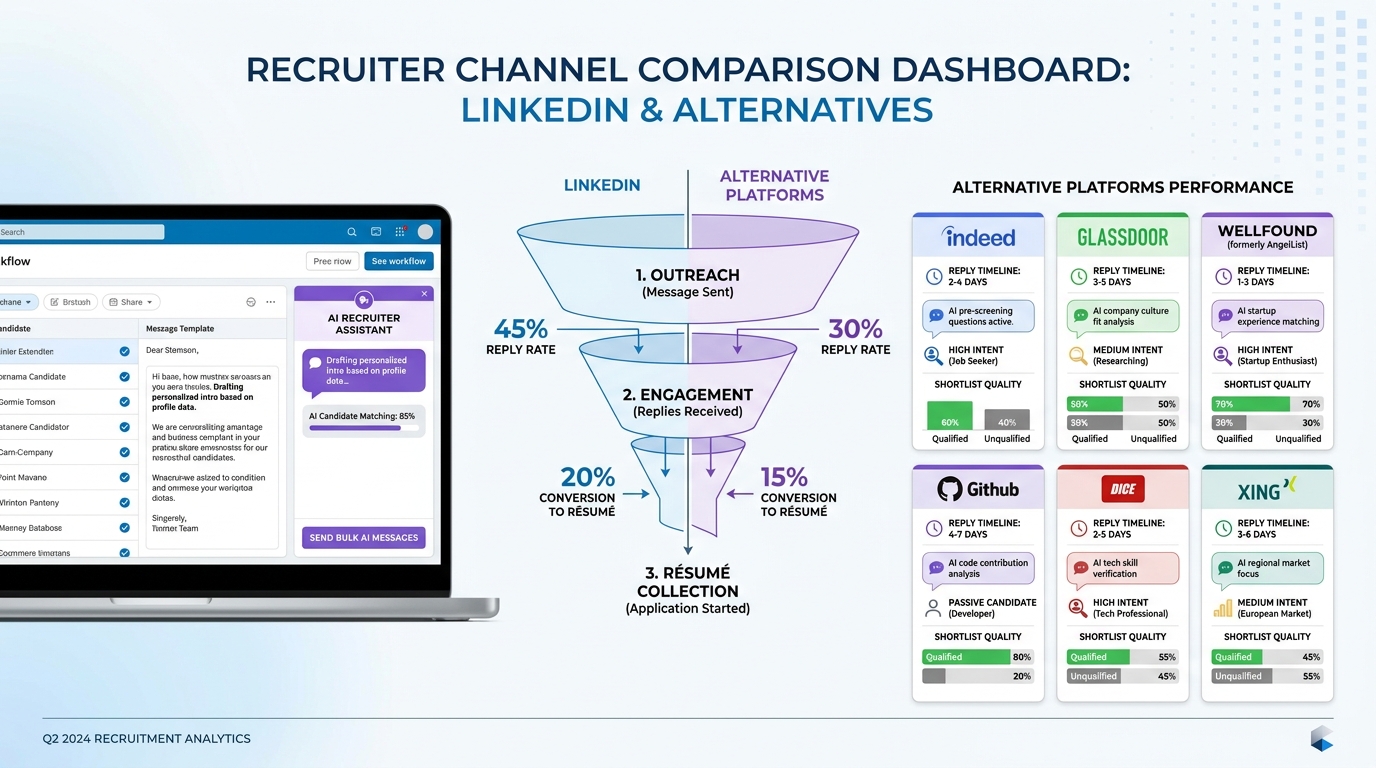
When sourcing stalls, recruiters can use this guide to judge which websites like LinkedIn fit candidate intent and avoid weak shortlist flow.
That distinction matters more than many teams admit. When a firm treats every channel as a copy-and-paste posting destination, recruiters end up with the same problems contractors face when they move from one project to the next: uneven response volume, rushed follow-up, weak specialization, and too much time spent selling the opportunity manually. For solo headhunters, boutique agencies, and in-house talent teams, the cost shows up in missed replies, slower shortlists, lower-quality conversations, and hiring managers who start to doubt the sourcing plan.
One workflow change that helped me on LinkedIn was using StrategyBrain AI Recruiter to handle repetitive first-touch outreach, after-hours candidate replies, and résumé collection while I kept control of fit judgment, résumé review, and interview decisions. In practice, the useful part was not replacing recruiter thinking. It was keeping candidate conversations moving when response timing was irregular, especially across time zones and outside working hours, and then letting me step in once intent and documents were already captured. If you want to see how that type of setup works in more detail, the product overview and workflow examples at this walkthrough and these conversation cases are the closest match to the day-to-day bottlenecks most LinkedIn-heavy recruiters run into.
The pattern is familiar if you recruit project-based specialists. A finance contractor starts weighing whether to go independent because the upside looks real, but the decision is not just about freedom. The person has to accept that work may come in bursts, that some weeks will be overloaded while others go quiet, and that finding the next contract becomes part of the job itself. The recruiter on the other side sees the same tension from a different angle: candidates are not only evaluating the role, they are evaluating whether the channel makes their next move easier, clearer, and worth the risk.
That is why the best LinkedIn alternatives are rarely simple substitutes. A contractor-minded candidate may want proof of employer credibility, direct access to niche opportunities, or a platform where specialist skills are easier to demonstrate than on a polished profile alone. Once you look at websites like LinkedIn through that lens of irregular demand, self-promotion, and deep specialization, the real comparison changes. You are no longer asking which site is biggest. You are asking which job boards other than LinkedIn and which job sites other than LinkedIn actually fit the way candidates evaluate opportunities and the way recruiters need to work.
Key takeaway: The strongest alternative to LinkedIn depends less on brand familiarity and more on whether you need active applicants, specialist proof, startup intent, employer-trust context, or regional networking depth.
Table of Contents
- Why Recruiters Look Beyond LinkedIn
- How Candidates Evaluate Platforms Before They Apply
- Quick Comparison of Websites Like LinkedIn
- Best General Job Boards Other Than LinkedIn
- Best Job Sites Other Than LinkedIn for Startup Hiring
- Best Websites Like LinkedIn for Technical Talent
- Networking and Regional LinkedIn Alternatives
- How I Use StrategyBrain AI Recruiter With LinkedIn
- How to Choose Between Job Sites Other Than LinkedIn
- Common Mistakes Recruiters Make
- FAQ
Why Recruiters Look Beyond LinkedIn
LinkedIn still matters, but experienced recruiters do not confuse importance with exclusivity. It remains useful for professional identity, messaging, and visibility, yet many hiring problems are not really networking problems. They are application-flow problems, trust problems, niche-skill proof problems, or geography problems.
That distinction becomes obvious when you recruit candidates whose careers already involve uncertainty and self-positioning. Contractors, consultants, startup operators, and technical specialists often think in terms of workload volatility, project quality, and whether their expertise is being treated as generic or truly specific. A broad social-professional feed does not always answer those questions well.
So when recruiters search for websites like LinkedIn, they are usually trying to solve one of five practical issues:
- They need more active job seekers than passive networking channels provide.
- They need candidates to trust the employer before applying.
- They need a startup or niche audience that behaves differently from the general market.
- They need evidence of specialist skill, not just profile polish.
- They need region-specific networking behavior that LinkedIn does not dominate.
That is why the better question is not “What replaces LinkedIn?” It is “Which platform fits the hiring motion for this role?”
How Candidates Evaluate Platforms Before They Apply
The contractor perspective from the opening is useful here. People considering a move do not just compare job titles. They compare risk, visibility, stability, and how much selling they will have to do themselves. That applies far beyond accounting and finance work.
In recruiting terms, candidates often judge a platform using three filters:
1. Will this channel help me manage uncertainty?
If someone expects feast-or-famine demand in their career, they gravitate toward platforms that make the next opportunity easier to discover. General boards do this through scale. Startup platforms do it through focused company discovery. Specialist communities do it through peer visibility.
2. Does this platform reward specialization?
Candidates with deep skills do not want to be flattened into generic keyword matches. A platform wins when it lets them show a portfolio, project history, technical depth, or industry focus.
3. How much self-promotion is required?
Some channels expect candidates to network constantly and market themselves. Others make the path more direct through search, alerts, or targeted role categories. That difference changes apply behavior, reply rates, and recruiter effort.
Once you understand those filters, the value of job boards other than LinkedIn becomes easier to judge. Different platforms support different kinds of candidate confidence.
Quick Comparison of Websites Like LinkedIn
| Platform | Type | Best For | Main Strength | Main Limitation |
|---|---|---|---|---|
| Indeed | General job board / aggregator | High-volume hiring | Large active job-seeker audience | Can produce heavy screening volume |
| Glassdoor | Review-driven job site | Brand-aware candidates | Company reviews and salary context | Not built for deep networking |
| ZipRecruiter | Distribution platform | Fast posting coverage | Broad multi-site exposure | Less useful for relationship-led sourcing |
| Wellfound | Startup hiring platform | Startup and growth-stage roles | Focused startup discovery | Narrower outside startup hiring |
| Monster | Traditional job board | General recruiting workflows | Familiar direct-apply behavior | Less differentiated for niche talent |
| Professional network | DACH-region recruiting | Regional professional relevance | Limited value outside core markets | |
| GitHub | Technical community | Developer sourcing | Real work visibility | Not a standard job board |
| Dice | Tech job board | Technology hiring | Specialist audience focus | Weak fit for non-tech roles |
| Jobcase | Workforce community | Frontline and community-driven outreach | Practical engagement model | Less suited to every white-collar niche |
For most recruiters, the table above is a reminder that platform choice should follow candidate behavior, not habit.
Best General Job Boards Other Than LinkedIn
General boards matter when the problem is reach, speed, and direct applications. They are especially useful when candidates are actively looking and do not want to spend time maintaining a networking presence.
Indeed
Best for: High-volume roles and steady applicant flow.
Indeed is one of the most practical websites like LinkedIn when you need active job seekers at scale. It tends to work well for operations, support, administration, and many mid-market roles where candidate behavior starts with search rather than networking.
Pros
- Large active candidate audience
- Strong job alert and search behavior
- Useful when speed matters more than relationship-building
Cons
- Application volume can outrun screening capacity
- Lower-fit applicants can pile up quickly
Recruiter advice: If your team already struggles with irregular response handling, do not add a broad board without tightening screening criteria first. Volume only helps when the review workflow can keep up.
Glassdoor
Best for: Employer reputation and apply-confidence.
Glassdoor stands out among job boards other than LinkedIn because candidates use it as a decision aid, not just a listing source. That matters for professionals who are already weighing uncertainty and want salary context, culture signals, and employer credibility before they apply.
Pros
- Combines jobs with employer research
- Supports candidates making risk-aware moves
- Can improve fit when trust influences conversion
Cons
- Not designed for recruiter-led networking depth
- Employer perception can affect conversion before outreach begins
Recruiter advice: If good candidates click but do not apply, treat reputation as part of sourcing performance, not a separate brand issue.
ZipRecruiter
Best for: Lean teams that need faster distribution.
ZipRecruiter is useful when your main goal is broad posting efficiency rather than social visibility. For small recruiting teams, the value is often operational: one workflow can extend job exposure quickly across multiple destinations.
Pros
- Efficient distribution model
- Helpful for understaffed talent teams
- Can accelerate top-of-funnel setup
Cons
- Distribution does not guarantee quality
- Limited advantage for relationship-heavy searches
Recruiter advice: Use it when you need market coverage, but judge success by qualified interviews, not by raw apply counts.
Monster
Best for: Traditional job board workflows.
Monster remains one of the recognizable job sites other than LinkedIn for employers who prefer a direct posting-and-review model. It fits teams that do not need heavy community interaction and simply want another general board in the sourcing mix.
Recruiter advice: It is usually most useful when paired with disciplined resume review and fast candidate follow-up.
Best Job Sites Other Than LinkedIn for Startup Hiring
Startup candidates often think like contractors in one important sense: they are not only evaluating compensation, but also autonomy, mission, pace, and risk. That is why startup hiring usually performs better when the platform itself supports company discovery and role ownership.
Wellfound
Best for: Startup and growth-stage recruiting.
Wellfound is one of the clearest job sites other than LinkedIn for startup roles because it frames opportunities around company stage, mission, and direct access. Candidates looking at earlier-stage work tend to care about scope and speed more than polished social proof.
Pros
- Strong audience alignment for startup jobs
- Focused company discovery
- Works well for candidates seeking ownership
Cons
- Less useful for enterprise-style recruiting
- Narrower candidate pool outside startup interest
Recruiter advice: Write the role like a business challenge, not a bureaucracy document. Startup candidates respond to clarity about impact, not corporate filler.
Jobcase
Best for: Community-oriented and practical workforce outreach.
Jobcase is a different answer to the question of websites like LinkedIn. It is less about professional polish and more about practical opportunity discovery and community engagement, which can be useful for frontline and local hiring campaigns.
Recruiter advice: Use simple language and clear next steps. In these channels, accessibility often outperforms brand-heavy messaging.
Best Websites Like LinkedIn for Technical Talent
Technical hiring works better when the channel reflects how skill is actually demonstrated. Specialists do not want to be treated as generalists, and recruiters should not source them that way.
GitHub
Best for: Developer sourcing and technical credibility.
GitHub is not a classic job board, but it is one of the most useful websites like LinkedIn for engineering recruitment because it exposes real contribution, code history, and technical relevance. For many developers, visible work carries more weight than a polished profile summary.
Pros
- Shows real technical signal
- Supports stronger outreach personalization
- Better fit for skill-first sourcing
Cons
- Not built for standard recruiting workflows
- Requires recruiters to interpret technical context carefully
Recruiter advice: Look beyond keywords. Review project relevance, maintenance history, collaboration patterns, and whether the work aligns with your actual stack.
Dice
Best for: Focused tech hiring.
Dice remains one of the more direct job boards other than LinkedIn for technical roles. Its strength is not reach for everything. Its strength is concentration around technology talent.
Pros
- Specialist audience
- Useful for targeted technology searches
- Less noise than broad boards for some roles
Cons
- Limited value for non-tech searches
- Smaller overall market reach than general boards
Recruiter advice: Use Dice when generic channels generate more screening work than signal.
Networking and Regional LinkedIn Alternatives
Some hiring goals are less about applications and more about presence, relevance, and where professionals already interact.
Best for: DACH-region professional networking.
Xing is often part of any serious discussion about LinkedIn alternatives because regional behavior matters. In German-speaking markets, platform familiarity and local networking patterns can outweigh global platform scale.
Recruiter advice: If your market is regional, your sourcing mix should be regional too. Global-first habits can hide local blind spots.
When communities outperform large platforms
In some niche markets, contribution-based communities outperform broad social-professional networks because reputation forms through visible work and discussion rather than self-presentation alone. That is often the case with technical, freelance, and specialist audiences.
Recruiter advice: Ask whether the role is application-led, relationship-led, or portfolio-led. That answer should drive channel choice.
How I Use StrategyBrain AI Recruiter With LinkedIn
Because this topic is really about LinkedIn usage experience as much as LinkedIn alternatives, it is worth separating two different decisions: when to leave LinkedIn for another platform, and when to improve the way you operate inside LinkedIn itself.
In my own workflow, LinkedIn usually breaks down at the same points the opening case hinted at: inconsistent candidate reply timing, too much manual follow-up, and lost momentum between first interest and résumé receipt. That is where I found StrategyBrain AI Recruiter useful. I used it for three narrow tasks that consume disproportionate recruiter time:
- sending and continuing first-touch LinkedIn outreach at scale
- replying to candidates after hours and across time zones
- collecting résumés and contact information from interested candidates
The important caveat is that it did not replace my judgment. I still reviewed each résumé, decided who was actually qualified, and took over when a real screening or interview decision was needed. That division of labor mattered. It kept the workflow compliant with how I want recruiting to run: automation handles repetitive communication, while the recruiter owns evaluation and next-step calls.
For teams that are heavily LinkedIn-dependent, that kind of support can be more practical than chasing a full platform switch too early. If you want a closer look at the operating model, the official comparison page and the broader headhunter workflow notes show the same pattern I experienced: keep conversations active, capture documents, and let recruiters step in for the real qualification work.
That is especially helpful when your candidate pool behaves like contractors or specialists. Their hours are irregular, their attention is split across projects, and their willingness to engage can disappear if follow-up stalls. In those cases, improving LinkedIn execution with AI support and expanding into the right job sites other than LinkedIn are not competing tactics. They are complementary ones.
How to Choose Between Job Sites Other Than LinkedIn
The best evaluation method is simple: score each platform against the kind of uncertainty, specialization, and candidate behavior your role involves.
1. Start with candidate intent
Are people actively searching, quietly networking, or waiting for highly relevant outreach? General boards suit active demand. Specialist platforms suit expertise-led moves. Networking platforms suit slower trust-building.
2. Ask whether the role rewards breadth or depth
If the role is generalist, scale matters. If it is specialist, proof matters. This is the same lesson contractors learn quickly: the market pays more attention when expertise is clearly defined.
3. Check how much context the platform gives candidates
Salary data, reviews, portfolios, project history, and regional credibility all reduce uncertainty. Platforms that provide this context often improve self-selection and save recruiter time.
4. Measure conversation quality, not vanity metrics
Clicks and applies can hide a weak channel. Track response quality, interview conversion, and hiring manager confidence in the shortlist.
5. Build a mix, not a dependency
Most strong recruiting systems combine channels. A common mix is one broad board, one credibility-driven site, one specialist or startup platform, and a LinkedIn workflow that does not rely entirely on manual follow-up.
Practical sourcing mix:
- Use Indeed or Monster for broad active-search demand.
- Use Glassdoor when trust and salary context influence apply rates.
- Use Wellfound for startup and growth-company hiring.
- Use GitHub or Dice for technical specialists.
- Use Xing for DACH-region networking.
- Use LinkedIn with a workflow layer such as AI Recruiter when the problem is communication continuity rather than platform reach.
Common Mistakes Recruiters Make
Posting the same message everywhere
A candidate considering contract-style uncertainty, startup risk, or specialist work does not respond to the same framing as a high-volume applicant. Message by audience, not by convenience.
Ignoring the platform's real job
Some tools create applications. Some create trust. Some create proof. Some create conversation. If you judge them all by the same metric, you will cut channels that were doing exactly what they were meant to do.
Treating specialists like generalists
This is one of the biggest mistakes in sourcing. Candidates with deep technical or functional expertise want to be found for that depth, not buried in broad matching logic.
Waiting too long to respond on LinkedIn
Irregular reply timing is normal, especially with passive talent and project-based professionals. If your process cannot keep pace, you lose people between first interest and next step.
Assuming a LinkedIn alternative must replace LinkedIn
Often the better answer is a mix: improve LinkedIn execution, then add one or two channels that solve a specific gap.
FAQ
What are the best websites like LinkedIn for general job search?
Indeed, Glassdoor, ZipRecruiter, and Monster are among the most practical choices for broad job search because they support active application behavior and direct role discovery.
Which job boards other than LinkedIn are best for recruiters?
It depends on the role. Indeed and Monster help with reach, Glassdoor helps when employer trust matters, Wellfound helps with startup hiring, and Dice or GitHub help with technical recruiting.
What are the best job sites other than LinkedIn for startup jobs?
Wellfound is one of the strongest options because it centers startup discovery, mission, and role ownership in a way that broad platforms often do not.
Which LinkedIn alternative is best for technical professionals?
GitHub and Dice are two of the strongest options. GitHub provides evidence of real work, while Dice functions more like a focused technology job board.
Do recruiters need to replace LinkedIn completely?
No. In many cases, the better move is to keep LinkedIn for visibility and outreach while adding the right niche or high-intent platforms for the role.
When does StrategyBrain AI Recruiter make sense?
It makes sense when LinkedIn itself is still strategically useful, but the team is losing time on repetitive outreach, slow reply handling, and manual collection of résumés or contact details. Recruiters still need to make the final qualification and interview decisions.
Conclusion
The best websites like LinkedIn are not the ones that mimic LinkedIn most closely. They are the ones that solve a clearer recruiting problem for a specific candidate mindset.
If the candidate is acting like a specialist contractor, they may care about irregular opportunity flow, niche proof, and whether the platform rewards expertise instead of generic visibility. If the recruiter is dealing with uneven reply timing and heavy manual follow-up, the problem may be workflow execution inside LinkedIn rather than channel mix alone.
That is why strong recruiting teams do both: they expand into smarter job boards other than LinkedIn and job sites other than LinkedIn, while also improving LinkedIn operations where it still belongs in the hiring stack.